May 22, 2026
Molecular Engineering: The Foundation of China's Strategic Advantage
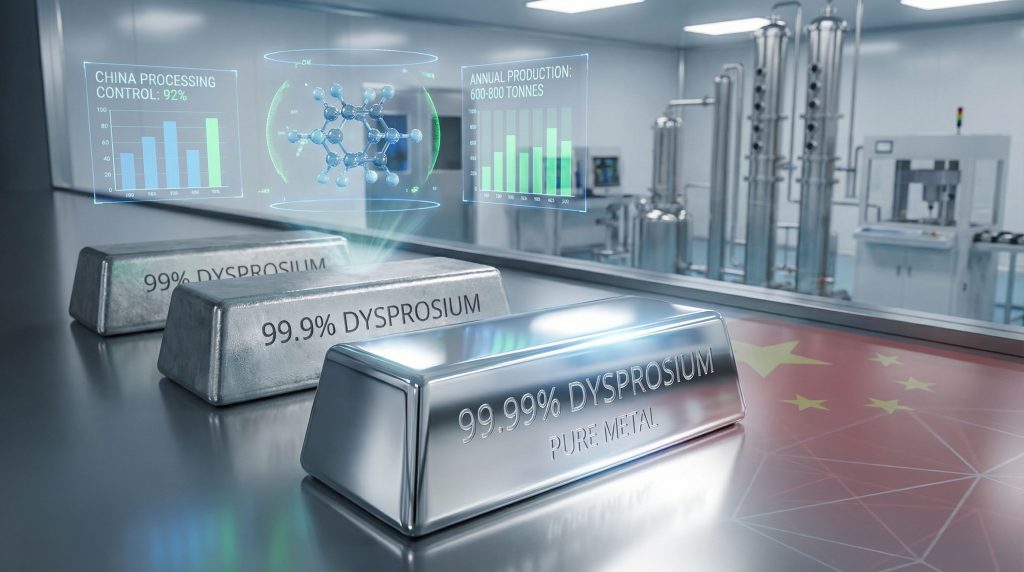
The precision required at the atomic level defines the competitive landscape in critical minerals and energy security. When examining China ultrapure dysprosium processing capabilities, the technical specifications reveal why fractional improvements in purity create exponential barriers to entry. Understanding these molecular-level requirements illuminates how processing dominance translates into geopolitical leverage.
The semiconductor industry operates within unforgiving tolerance margins where contamination levels below one part per million can compromise device performance. 99.99% purity standards represent more than industry preference; they constitute technical necessities for next-generation applications. AI processors and quantum computing systems demand dysprosium compounds with impurity levels measured in parts per billion, creating specification requirements that only advanced separation chemistry can achieve.
Each incremental purity improvement from 99% to 99.9% to 99.99% requires fundamentally different processing approaches. The transition from standard-grade to ultrapure materials involves sophisticated multi-stage purification systems where traditional mining extraction methods become inadequate. These technical thresholds explain why China ultrapure dysprosium processing facilities represent strategic infrastructure rather than commodity production centres.
When big ASX news breaks, our subscribers know first
Advanced Separation Methodologies: Where Chemistry Meets Geopolitics
The technical foundations of China's processing monopoly rest on decades of separation chemistry development that Western competitors struggle to replicate. Furthermore, the mining industry evolution towards increasingly sophisticated processing techniques has reinforced China's competitive advantages. Multi-stage solvent extraction systems utilising specialised phosphorus-based agents represent proprietary knowledge accumulated through iterative industrial refinement.
P507-kerosene extraction systems form the backbone of China's heavy rare earth separation capabilities. This di-2-ethylhexyl phosphoric acid methodology enables selective extraction of dysprosium from complex rare earth mixtures with separation factors exceeding traditional approaches. The technical expertise required to optimise these systems at industrial scale represents years of accumulated process knowledge that cannot be easily transferred or replicated.
Key separation technologies include:
- Carboxylic acid extraction circuits for preliminary separation stages
- Ion-exchange chromatography systems for final purification steps
- Crystallisation control mechanisms achieving 99.99% purity specifications
- Continuous solvent recycling maintaining process economics at scale
Beyond extraction chemistry, China's processing advantage extends to downstream metallisation techniques. Oxalic acid precipitation followed by controlled calcination enables transformation of separated compounds into high-purity oxide forms suitable for advanced manufacturing applications. These process sequences require precise temperature control, atmospheric management, and quality assurance systems developed through decades of industrial refinement.
Ultrasonic crystallisation represents a particularly sophisticated technique where acoustic energy controls crystal formation patterns, enabling achievement of specification-grade purity levels. Roller table kiln optimisation ensures consistent thermal processing conditions across large production batches, maintaining quality standards essential for semiconductor applications.
Geographic Concentration: The Wuxi Facility as Strategic Chokepoint
China's dominance in China ultrapure dysprosium processing manifests most clearly through geographic concentration of critical infrastructure. The Wuxi facility operated by Shenghe Resources represents the world's primary source of semiconductor-grade dysprosium compounds, creating single-point-of-failure vulnerabilities in global technology supply chains.
This facility's strategic importance extends beyond production volume to encompass technical capabilities that remain unmatched globally. Annual production capacity estimates suggest throughput sufficient to supply global semiconductor demand, but the true competitive advantage lies in quality consistency and specification compliance that alternative facilities cannot replicate.
The facility's competitive position reflects several integrated advantages:
- Proximity to ion-adsorption clay deposits in Ganzhou region providing optimal feedstock
- Integrated processing infrastructure spanning separation, purification, and metallisation
- Specialised workforce with decades of hands-on separation chemistry experience
- State-backed investment enabling continuous technology upgrading and capacity expansion
Southern China's rare earth processing ecosystem extends throughout the Ganzhou region, where ion-adsorption clay deposits provide naturally occurring heavy rare earth concentrations exceeding global alternatives. These geological advantages, combined with established processing infrastructure and transportation networks, create integrated value chains difficult to replicate elsewhere.
Consequently, the transportation and logistics optimisation within China's domestic supply chains enables cost efficiencies that international competitors struggle to match. Integrated mining-to-refining operations reduce material handling costs and quality degradation risks associated with international shipping of intermediate products.
Technical Barriers: Why Western Competition Remains Limited
The sophisticated nature of China ultrapure dysprosium processing creates multiple technical barriers that prevent rapid competitive responses from Western companies. These challenges encompass both explicit technological requirements and tacit knowledge accumulated through years of operational experience.
Process development for ultrapure rare earth separation requires extensive chemistry expertise that cannot be acquired through equipment purchases alone. Iterative optimisation of solvent extraction parameters, crystallisation conditions, and quality control procedures demands years of practical experimentation under commercial operating conditions.
Critical knowledge barriers include:
- Solvent mixture optimisation for specific rare earth compositions
- Temperature and pH control protocols maintaining separation efficiency
- Contamination prevention systems achieving 99.99% purity standards
- Process automation enabling consistent quality at commercial scale
Capital requirements for establishing competitive facilities create additional entry barriers that deter Western investment. Multi-billion dollar facility investments must be justified against uncertain demand projections and potential supply disruption risks from established Chinese competitors.
Environmental regulatory frameworks in Western jurisdictions impose compliance costs and permitting delays that Chinese facilities have historically avoided. Waste management systems for rare earth processing generate complex regulatory requirements in the United States and European Union, extending project development timelines and increasing capital requirements.
Specialised equipment manufacturing capabilities represent another competitive barrier where Chinese suppliers maintain technological advantages. Custom separation equipment designed for specific rare earth applications requires manufacturing expertise that Western equipment suppliers have largely abandoned.
Critical Applications: Where Purity Standards Drive Performance
The strategic importance of China ultrapure dysprosium processing becomes apparent when examining end-use applications where specification-grade materials enable technological breakthroughs impossible with lower-purity alternatives. Semiconductor manufacturing represents the most demanding application where contamination levels directly impact device performance and reliability.
Heat-resistant capacitor applications in advanced microprocessors require dysprosium oxide compounds with impurity levels below one part per million. These components enable stable electrical performance under extreme temperature conditions encountered in AI processing applications and high-performance computing systems.
Next-generation semiconductor applications include:
- AI processor thermal management systems requiring stable performance above 150°C
- Quantum computing components demanding minimal electromagnetic interference
- 5G communication circuits operating at extreme frequency ranges
- Autonomous vehicle processors requiring consistent performance across temperature extremes
Defence technology applications utilise ultrapure dysprosium in nuclear reactor control systems where neutron absorption properties enable precise reactivity management. These applications require material specifications exceeding commercial standards, creating additional demand for China's highest-purity production capabilities.
For instance, advanced laser technology depends on dysprosium-doped crystalline materials for precision optical applications including military targeting systems and scientific instrumentation. The optical properties of these materials require purity levels achievable only through sophisticated separation chemistry.
Permanent magnet alloys incorporating ultrapure dysprosium enable performance improvements in electric vehicle motors and wind turbine generators. These applications drive growing demand for specification-grade materials as renewable energy deployment accelerates globally.
Supply Chain Vulnerabilities: Quantifying Global Dependence
The concentration of China ultrapure dysprosium processing capabilities creates measurable vulnerabilities throughout global technology supply chains. Current dependence metrics reveal the extent to which critical industries rely on Chinese processing infrastructure for essential materials. This concentration directly relates to broader supply chain vulnerabilities affecting defence and civilian technologies.
China's control over rare earth processing extends across multiple value chain segments, with particularly acute concentration in separation and purification stages. Processing capacity concentration exceeds mining concentration, creating chokepoint vulnerabilities where Chinese facilities control access to specification-grade materials regardless of raw material sources.
Key vulnerability indicators include:
- Single-facility dependence for ultrapure dysprosium compounds used in AI chips
- Export licence requirements creating potential supply disruption mechanisms
- Alternative processing capacity gaps limiting supply diversification options
- Technical specification monopolies where only Chinese facilities achieve required purity standards
International efforts to establish alternative processing capabilities face significant technical and economic challenges. European separation facility initiatives remain in early development stages with commercial production timelines extending beyond immediate supply security requirements.
North American rare earth processing investments focus primarily on light rare earth applications, leaving heavy rare earth processing gaps that China's facilities continue to fill. These investment priorities reflect technical complexity differences between light and heavy rare earth separation chemistry.
However, implementing critical minerals strategy initiatives could help address these dependencies. End-use disclosure mandates implemented by Chinese authorities create additional supply chain transparency requirements that enable monitoring of critical technology applications. These regulatory mechanisms provide strategic intelligence regarding Western technology development priorities and defence applications.
The next major ASX story will hit our subscribers first
How Are Export Controls Reshaping Global Markets?
China's dominance enables sophisticated economic leverage mechanisms that extend beyond traditional trade relationships. Export restriction capabilities create strategic pressure points where political objectives can influence commercial relationships across multiple technology sectors.
Recent export control implementations demonstrate how processing monopolies translate into geopolitical influence. China's tightening grip on rare earth exports has created substantial uncertainty for global manufacturers. Government approval requirements for rare earth exports enable selective restriction of critical materials whilst maintaining plausible commercial justifications.
Strategic export control mechanisms include:
- End-use verification requirements monitoring defence technology applications
- Volume allocation systems managing global supply availability
- Quality specification restrictions limiting access to highest-purity materials
- Technology transfer conditions linking supply access to knowledge sharing agreements
The 2010 rare earth embargo targeting Japan demonstrated how supply disruptions create immediate economic impacts across technology manufacturing sectors. Price volatility during supply restrictions revealed the lack of adequate substitute materials and alternative processing capabilities.
Financial markets reflect supply security premiums in technology sector valuations where rare earth supply chain risks influence investor assessments of long-term profitability. Semiconductor companies particularly show sensitivity to rare earth price volatility and supply availability concerns.
Strategic stockpiling initiatives by Western governments attempt to mitigate short-term supply disruption risks, but stockpile effectiveness depends on maintaining material quality over extended storage periods and ensuring adequate volumes for critical applications.
Investment Strategies: Navigating Supply Chain Concentration Risks
Investment approaches to China's processing dependencies require sophisticated risk assessment frameworks that balance supply security considerations against economic efficiency objectives. Technology sector investments particularly need evaluation of rare earth supply chain vulnerabilities and potential disruption impacts.
Supply chain resilience investments create premium costs that must be justified against probability-weighted disruption scenarios. Companies implementing geographic diversification strategies face trade-offs between cost optimisation and supply security enhancement.
Investment considerations include:
- Long-term supply contract negotiations balancing price stability against volume guarantees
- Alternative technology research funding reducing dependence on critical materials
- Strategic partnership development with non-Chinese processing facilities
- Vertical integration assessments evaluating internal processing capability development
Portfolio strategies addressing rare earth concentration risks require sector allocation adjustments that account for supply chain vulnerabilities. Technology sector exposure creates concentrated risk during supply disruption scenarios where multiple companies face simultaneous material availability challenges.
Substitute material research represents potential disruption to existing rare earth demand patterns where technological breakthroughs could reduce dependence on critical materials. Investment strategies must balance current supply chain risks against potential demand destruction from alternative technologies.
Private equity and venture capital investments in alternative processing technologies face technical risk assessments where unproven separation chemistry approaches compete against established Chinese capabilities. Technology readiness evaluation becomes critical for assessing commercial viability timelines.
Future Processing Competition: Technology Development and Market Evolution
Emerging technologies for rare earth separation represent potential challenges to China's processing dominance, though commercial implementation remains years away from challenging established capabilities. Research initiatives focus on novel separation chemistry approaches that could reduce capital requirements and environmental compliance costs.
Flow-driven precipitation methodologies under development at Western research institutions promise simplified processing approaches that could enable smaller-scale commercial operations. These techniques utilise controlled fluid dynamics to achieve separation efficiency comparable to traditional solvent extraction systems.
Experimental separation technologies include:
- Ionic liquid extraction systems enabling room-temperature separation processes
- Membrane-based separation utilising selective permeability for rare earth isolation
- Electrochemical separation reducing chemical reagent requirements
- Continuous flow processing enabling modular facility designs with lower capital costs
Ionic liquid extraction research shows particular promise for achieving high separation factors whilst reducing environmental impact compared to traditional solvent systems. Furthermore, extraction innovation insights suggest that breakthrough technologies could potentially accelerate commercial development timelines.
Timeline projections for market diversification must account for both technology development requirements and facility construction timelines. Realistic implementation schedules suggest new processing capabilities require 5-10 year development cycles even with accelerated funding and regulatory support.
Commercial viability assessments for alternative processing approaches must consider both technical performance and economic competitiveness against established Chinese operations. Cost structure analysis indicates new facilities face significant disadvantages unless supported by strategic government investment or supply security premiums.
Strategic Planning Framework: Supply Chain Risk Management
Comprehensive approaches to China's processing dependencies require integrated strategic planning frameworks that address both immediate supply security needs and long-term competitive positioning objectives. Industry leaders must balance cost optimisation against supply chain resilience enhancement across multiple planning horizons.
Supply chain risk assessment methodologies should incorporate scenario analysis evaluating potential disruption impacts across different probability ranges. These assessments guide investment allocation between current supply relationships and alternative capability development.
Strategic planning elements include:
- Multi-supplier relationship development reducing single-source dependencies
- Technology diversification research creating substitute material options
- Geographic supply distribution balancing costs against political risk exposure
- Emergency response protocols managing acute supply disruption scenarios
Corporate planning processes must integrate rare earth supply considerations into product development timelines where material availability could constrain technology roadmaps. Design specification flexibility enables adaptation to alternative materials when primary sources face disruption.
Policy coordination between industry and government agencies creates frameworks for addressing supply security challenges that exceed individual company capabilities. Public-private partnerships enable shared investment in alternative processing infrastructure development.
International cooperation initiatives require careful balance between competitive interests and shared supply security objectives. Allied nation coordination on critical material strategies could create sufficient scale for viable alternative processing development whilst maintaining market competition.
Moreover, addressing these challenges requires understanding China's rare earth supply chains and their historical development. In addition, recognising how these processing capabilities fit within broader geopolitical strategies helps companies develop more effective risk mitigation approaches.
Note: The analysis presented reflects current market conditions and technological capabilities as of 2025. Rare earth processing technologies, geopolitical relationships, and supply chain structures continue evolving. Readers should consult current sources for the most recent developments in this rapidly changing sector.
Looking to Navigate Critical Minerals Supply Chain Risks?
Discovery Alert's proprietary Discovery IQ model delivers real-time alerts on significant ASX mineral discoveries, including critical minerals essential for advanced technologies and supply chain security. Stay ahead of market-moving announcements and understand why major mineral discoveries can generate substantial returns whilst positioning your portfolio to capitalise on the evolving critical minerals landscape.