
July 11, 2026
Understanding the Molecular Revolution in Electronics Recycling
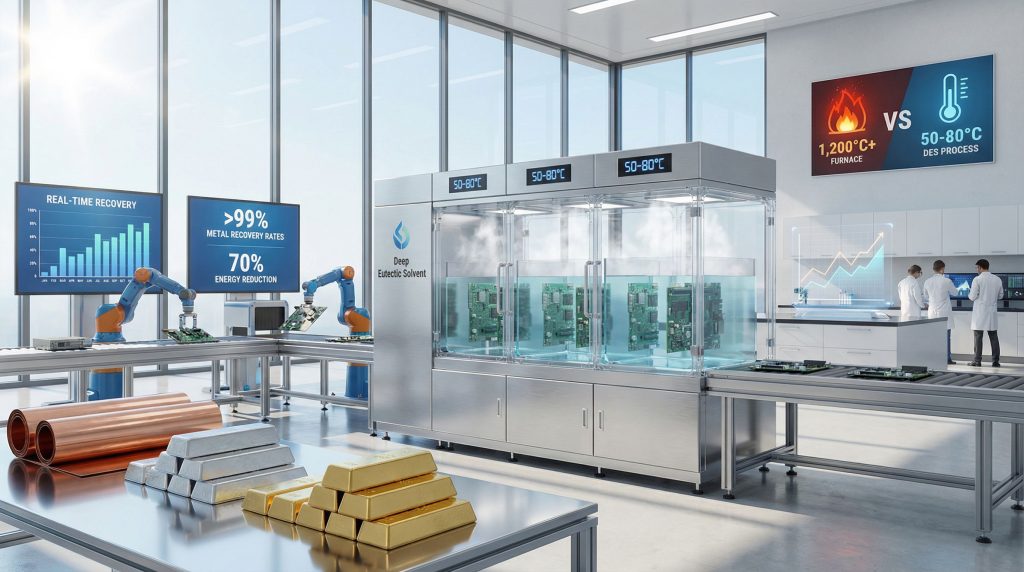
The electronics recycling industry stands at a technological inflection point, particularly as Cisco trials DEScycle metal recycling tech to validate innovative processing methods. Traditional pyrometallurgical processes, which have dominated metal recovery for decades, operate at temperatures exceeding 1,200°C and consume enormous amounts of energy. Deep eutectic solvent technology represents a fundamental departure from these energy-intensive methods, operating at temperatures between 50-80°C while achieving comparable or superior recovery rates.
Deep eutectic solvents function as non-toxic, non-aqueous salts that dissolve metal compounds through controlled chemical interactions rather than thermal fusion. This molecular-level approach eliminates the need for aggressive acids or high-temperature smelting, reducing both environmental impact and operational complexity.
The technology's revolutionary potential lies in its closed-loop processing capability. Unlike traditional methods that generate significant waste streams, DES systems can regenerate their solvent media, creating continuous cycles of metal extraction with minimal material loss. This regenerative characteristic fundamentally changes the economics of distributed recycling operations.
Precision Metal Targeting in Complex E-Waste Streams
Modern electronics contain an increasingly diverse array of valuable materials. AI data center hardware and advanced telecommunications equipment concentrate precious metals including gold, silver, and palladium alongside technology-critical elements like gallium, germanium, and rare earth compounds. This material complexity demands sophisticated extraction processes capable of selective recovery across multiple metal categories.
DES technology addresses this challenge through tunable solvent chemistry. Different solvent formulations can target specific metal groups, enabling sequential extraction processes that optimise recovery rates for individual elements. This precision approach contrasts sharply with traditional smelting, which processes all materials simultaneously and often requires extensive secondary refining.
The traceability advantages of DES processing create additional value beyond raw material recovery. Each processing batch generates comprehensive data on metal composition, recovery efficiency, and provenance tracking. This documentation capability addresses growing corporate and regulatory demands for supply chain transparency in recycled materials.
When big ASX news breaks, our subscribers know first
Strategic Corporate Investment in Distributed Processing Infrastructure
Technology manufacturers face mounting pressure to address end-of-life product management while securing reliable access to critical materials. The convergence of supply chain risk mitigation and sustainability mandates drives corporate investment in alternative processing technologies that offer both operational flexibility and environmental benefits.
Cisco Systems' partnership with DEScycle demonstrates this strategic alignment. The collaboration processes e-scrap boards derived from disassembled Cisco hardware at DEScycle's UK demonstration facility, generating recovery and process data to validate consistent performance at demonstration scale. This controlled evaluation approach allows corporate partners to assess technology viability before committing to commercial-scale deployment, particularly as the mining technology evolution continues to transform traditional processing approaches.
Economic Drivers Behind Modular Deployment
Distributed processing infrastructure offers compelling economic advantages over centralised recycling facilities. Transportation costs, which can represent 15-25% of total processing expenses for traditional recycling, are eliminated when modular systems process materials at or near generation sites. This cost reduction directly improves the economics of metal recovery, particularly for lower-grade electronic waste streams.
Modular systems also enable rapid capacity scaling in response to material availability and market conditions. Rather than constructing large, fixed facilities that require consistent feedstock volumes, distributed processing allows operators to deploy additional units incrementally as demand grows, supporting data-driven operations throughout the process.
The inventory management benefits of distributed processing extend beyond cost reduction. Converting end-of-life hardware into raw material inputs at controlled rates helps technology manufacturers manage supply chain volatility and reduce dependence on traditional mining operations. This operational flexibility becomes increasingly valuable as demand for technology metals continues to outpace conventional supply development.
Comparative Analysis of Metal Recovery Technologies
| Processing Method | Operating Temperature | Energy Requirements | Environmental Impact | Processing Speed | Recovery Precision |
|---|---|---|---|---|---|
| DES Technology | 50-80°C | Minimal heating requirements | Low toxicity, recyclable solvents | Rapid batch cycles | Selective metal targeting |
| Traditional Smelting | 1,200°C+ | High thermal energy demand | Significant emissions | Continuous operation | Bulk metal recovery |
| Acid Leaching | 60-90°C | Moderate heating needs | Toxic waste generation | Extended processing time | Variable selectivity |
The temperature differential between DES and traditional smelting represents the most significant operational advantage. Operating at near-ambient temperatures reduces both energy consumption and infrastructure requirements, enabling deployment in locations where traditional smelting would be economically or environmentally unfeasible.
Process Efficiency and Automation Potential
DES systems offer superior automation opportunities compared to traditional recycling methods. The controlled, low-temperature environment reduces safety risks and enables more sophisticated monitoring and control systems. Real-time process optimisation becomes possible when operating conditions remain within manageable parameters, particularly when enhanced by AI process optimization technologies.
Batch processing flexibility allows operators to adjust extraction parameters based on specific feedstock characteristics. This adaptability contrasts with continuous smelting operations, which must maintain consistent operating conditions regardless of input material variations.
The reduced maintenance burden of DES systems stems from their gentler operating conditions. High-temperature smelting requires frequent refractory replacement and equipment repair due to thermal stress, while DES processing minimises these maintenance-intensive requirements.
Investment Landscape and Commercial Viability Assessment
The transition from laboratory validation to demonstration-scale deployment represents a critical investment milestone for advanced recycling technologies. DEScycle's progression to demonstration plant operations, validated through corporate partnerships like the Cisco trials DEScycle metal recycling tech collaboration, indicates technology readiness approaching commercial viability.
Risk assessment for technology commercialisation must consider multiple factors beyond technical performance. Market acceptance depends on demonstrating economic competitiveness with existing recycling methods while meeting environmental and safety standards. Regulatory approval processes vary significantly across jurisdictions, potentially affecting deployment timelines and capital requirements.
Furthermore, the battery recycling breakthrough demonstrates how innovative processing technologies are gaining market acceptance across multiple sectors. This development validates the commercial potential for advanced recycling methods like DES technology.
Market Size Projections and Growth Drivers
Global electronic waste generation continues accelerating as device replacement cycles shorten and new technology categories emerge. The proliferation of AI infrastructure, electric vehicles, and renewable energy systems creates expanding streams of complex electronic materials requiring sophisticated recovery processes.
Policy frameworks increasingly favour circular economy approaches that emphasise material recovery over disposal. Extended producer responsibility regulations in Europe, North America, and Asia-Pacific markets create compliance drivers that support investment in advanced recycling technologies.
Corporate sustainability commitments provide additional market demand beyond regulatory requirements. Technology manufacturers face investor and customer pressure to demonstrate environmental responsibility throughout their supply chains, creating premium value for documented sustainable recycling processes that deliver decarbonisation benefits.
Critical Metal Recovery Priorities and Value Optimisation
Precious metals concentration in modern electronics drives immediate economic returns for advanced recycling operations. Circuit boards in data centre equipment contain gold concentrations that exceed those found in many mining operations, making recovery economics particularly attractive for high-value applications.
Technology metals present longer-term strategic value beyond immediate revenue generation. Gallium, germanium, and rare earth elements face supply constraints that make recovered materials increasingly valuable for supply chain security. Corporate buyers may accept premium pricing for materials with verified provenance and sustainability characteristics.
Rare Earth Element Recovery Challenges
Rare earth elements in electronic waste exist in complex chemical forms that resist conventional recovery methods. Permanent magnets from cooling systems contain neodymium and dysprosium in metallic states, while display technologies incorporate compounds that require different extraction approaches.
DES technology's selective chemistry advantages become particularly valuable for rare earth recovery. Traditional acid leaching often dissolves multiple elements simultaneously, requiring complex separation processes to isolate individual rare earth compounds. Tunable DES formulations can potentially target specific rare earth elements while leaving others undisturbed.
The geopolitical implications of rare earth recycling extend beyond immediate economic considerations. Domestic recycling capabilities reduce dependence on concentrated global supply chains, supporting national security objectives for technology-dependent economies.
Regulatory Framework Evolution and Compliance Requirements
Environmental permitting for advanced recycling technologies involves navigating multiple regulatory domains, including waste management, chemical processing, and workplace safety standards. DES technology's low-temperature, non-toxic characteristics simplify many permitting requirements compared to traditional smelting operations.
Carbon footprint reporting mandates increasingly require detailed lifecycle assessments of recycling processes. The significant energy reduction achieved through low-temperature DES processing creates competitive advantages in jurisdictions with carbon pricing or emission reduction requirements.
Circular Economy Policy Integration
Extended producer responsibility frameworks in major markets require technology manufacturers to demonstrate specific recycling performance targets. These regulations create structured demand for advanced recycling services that can provide detailed recovery documentation and performance metrics.
Tax incentive structures in various jurisdictions favour sustainable processing technologies through accelerated depreciation, research credits, and environmental performance bonuses. Understanding these financial benefits becomes crucial for investment decision-making and facility location selection.
Supply chain transparency requirements mandate detailed documentation of material flows from collection through final product delivery. DES technology's inherent traceability capabilities address these regulatory requirements while creating additional value for downstream customers.
The next major ASX story will hit our subscribers first
Technical Implementation Challenges and Solutions
Feedstock variability represents the primary technical challenge for any advanced recycling technology. Electronic waste streams contain diverse material compositions, contamination levels, and physical configurations that demand flexible processing approaches.
DES technology addresses this challenge through adaptable solvent formulations that can be modified for specific material types. Pre-processing steps, including dismantling and material sorting, become critical for optimising recovery efficiency and maintaining consistent process performance.
Contamination Management Strategies
Mixed material streams require sophisticated separation protocols before entering DES processing systems. Plastics, ceramics, and other non-metallic components must be removed to prevent solvent contamination and maintain recovery efficiency.
Process optimisation involves continuous adjustment of extraction parameters based on real-time composition analysis. Advanced monitoring systems can detect material variations and automatically adjust solvent concentrations, temperature profiles, and processing times to maintain optimal performance.
Equipment reliability in industrial environments demands robust engineering design that accommodates continuous operation while maintaining safety standards. Modular system architecture enables maintenance scheduling that minimises production disruptions.
Digital Integration and Supply Chain Transparency
Blockchain integration enables immutable documentation of material flows from collection through final delivery of recovered metals. This technological capability addresses growing demands for verifiable sustainability claims in corporate supply chains.
Quality certification protocols must establish standardised testing and documentation procedures for recycled materials. Industry acceptance of recovered metals depends on consistent quality assurance that meets or exceeds specifications for virgin materials.
Inventory Management Optimisation
Real-time material tracking systems enable sophisticated inventory management that optimises processing schedules based on material composition and market conditions. This operational flexibility maximises revenue generation while minimising storage and handling costs.
Customer reporting capabilities provide detailed recovery statistics that support corporate sustainability reporting and regulatory compliance requirements. Automated documentation systems reduce administrative overhead while ensuring comprehensive record-keeping.
Compliance documentation automation streamlines regulatory reporting through integrated data management systems that track all material flows and processing parameters. This capability reduces compliance costs while ensuring consistent adherence to environmental and safety standards.
Future Technology Development and Market Expansion
Process automation advancement through artificial intelligence integration offers opportunities for further efficiency improvements and cost reduction. Machine learning algorithms can optimise extraction parameters based on historical performance data and real-time material analysis.
Solvent development research continues exploring new DES formulations with enhanced selectivity and recovery performance. Academic and commercial research programs focus on expanding the range of materials addressable through DES technology.
International Deployment Strategies
Technology transfer opportunities exist in markets with growing electronic waste streams and developing recycling infrastructure. Modular system design facilitates international deployment while adapting to local regulatory requirements and material characteristics.
Partnership development with mining and manufacturing companies creates opportunities for integrated operations that combine primary production with recycling capabilities. These hybrid approaches can optimise overall resource utilisation while reducing environmental impact.
Investment attraction strategies must demonstrate clear paths to commercial profitability while highlighting environmental and strategic benefits. Successful technology commercialisation requires balancing technical innovation with practical market requirements and financial returns.
As Cisco trials DEScycle metal recycling tech demonstrate the viability of molecular-level processing, the broader implications for sustainable electronics manufacturing become increasingly apparent. Moreover, companies like Cisco are making significant climate investments that support businesses whilst benefiting the planet. Additionally, emerging technologies in electronic waste recycling are scaling chemical solutions that promise to transform the industry's approach to material recovery.
Disclaimer: This analysis includes forward-looking projections and market assessments that involve inherent uncertainties. Investment decisions should consider multiple risk factors including technology validation, regulatory approval, market acceptance, and competitive developments. Metal recovery rates, processing costs, and market pricing remain subject to operational validation and market conditions.
Looking to Capitalise on Next-Generation Technology Investments?
Discovery Alert's proprietary Discovery IQ model delivers real-time alerts on significant ASX mineral discoveries across technology metals and critical minerals sectors, enabling subscribers to identify actionable opportunities ahead of the broader market. Begin your 14-day free trial today to position yourself at the forefront of the evolving technology and resources landscape.