May 20, 2026
The Grade That Changes Everything: Why Monte Alto Could Reshape the Global Rare Earth Supply Chain
The rare earth industry operates on a counterintuitive truth: abundance in the ground does not guarantee security of supply. Decades of underinvestment in processing infrastructure outside China, combined with the geological reality that most known rare earth deposits carry grades far too low to justify standalone processing facilities, has left Western nations structurally exposed. The result is a supply chain where raw material potential consistently outpaces actual productive capacity. BRE terras raras Bahia has emerged as one of the most closely watched developments in this context.
Against this backdrop, the question for investors, policymakers, and industry observers is not simply where the next deposit lies, but whether it carries the grade, mineralogy, and development infrastructure to translate geological promise into real-world material flow. That distinction is what makes the Monte Alto project in Bahia, Brazil, worth examining closely. Furthermore, understanding rare earth supply chains helps contextualise why this project matters so profoundly.
When big ASX news breaks, our subscribers know first
What Makes Grade So Critical in Rare Earth Project Economics?
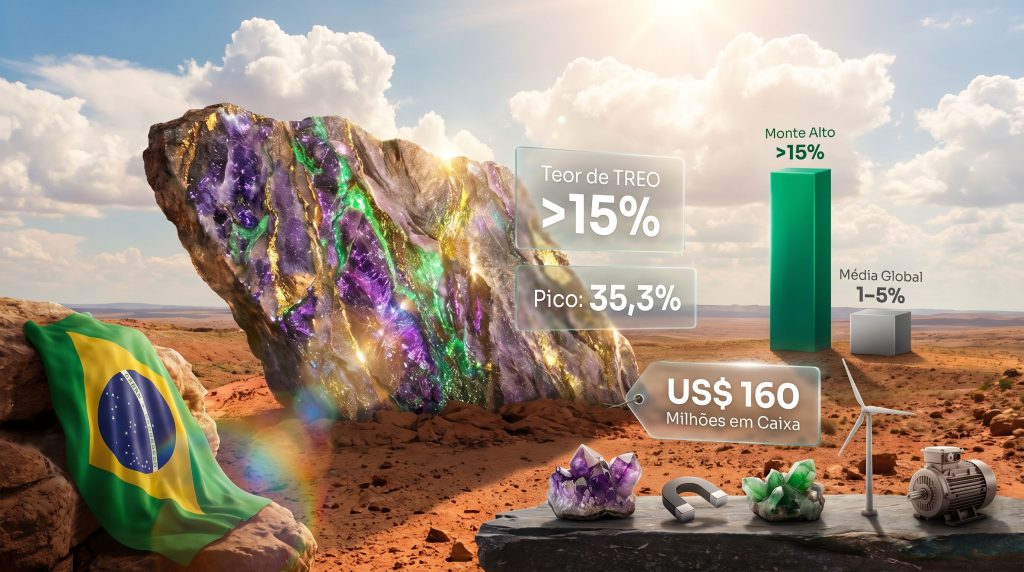
To understand why Monte Alto commands attention, it helps to understand the economics of rare earth concentration. Most ionic clay deposits, which dominate the development pipeline across Brazil and Southeast Asia, carry TREO grades in the range of 0.05% to 0.3%. Even the more advanced hard rock projects globally typically report grades between 1% and 5% TREO.
Monte Alto, operated by Borborema Recursos Estratégicos, a Brazilian subsidiary of ASX-listed Brazilian Rare Earths (BRE), has reported an average grade exceeding 15% TREO, with peak intersections from drilling reaching 35.3% TREO. The project is described in industry reporting as probably the highest-grade rare earth deposit reported in the world, a descriptor that, if validated through a formal resource estimate, would place it in a category occupied by virtually no other project in the global development pipeline.
The practical implications of this grade differential are substantial. Higher-grade ore means:
- Lower volumes of material must be mined and processed to yield the same quantity of rare earth oxides
- Concentration ratios are more favourable, reducing reagent consumption and processing costs
- Capital intensity per tonne of output is reduced relative to lower-grade alternatives
- The economic case for downstream processing integration becomes more compelling
Grade is the single most powerful lever in rare earth project economics. The difference between a 1% TREO deposit and a 15% TREO deposit is not a factor of 15 in value — it is potentially a factor of 50 or more once processing costs, recovery rates, and capital requirements are accounted for.
Mineralogy: The Four Elements Driving Demand
Grade alone does not determine a rare earth project's value. Mineralogy, specifically the distribution of individual rare earth elements within the total oxide content, is equally decisive. Not all rare earths are equal in demand or pricing. Consequently, understanding the critical minerals demand surge is essential to appreciating why Monte Alto's elemental profile is so commercially significant.
Monte Alto carries elevated concentrations of four elements that sit at the highest point of the rare earth value curve:
- Neodymium (Nd) and Praseodymium (Pr): The foundational inputs for NdFeB permanent magnets used in electric vehicle motors and wind turbine generators
- Dysprosium (Dy) and Terbium (Tb): Heavy rare earths used to improve the thermal stability of permanent magnets, enabling operation at the elevated temperatures found inside EV drivetrains
These four elements collectively underpin the permanent magnet supply chain that the global energy transition depends upon. Demand projections across multiple forecasting frameworks consistently point to significant supply deficits for neodymium and praseodymium in particular through the late 2020s and into the 2030s, driven by EV production scaling and offshore wind expansion.
The deposit also carries co-product potential in uranium, tantalum, and scandium, each of which adds incremental economic optionality that can improve project returns if processing flowsheets are designed to recover them.
| Element | Primary Application | Market Position |
|---|---|---|
| Neodymium (Nd) | NdFeB permanent magnets | High demand, constrained supply |
| Praseodymium (Pr) | NdFeB permanent magnets | Often sold as NdPr mixed oxide |
| Dysprosium (Dy) | Magnet thermal stabilisation | Critical, limited global sources |
| Terbium (Tb) | Magnet thermal stabilisation | Critical, very limited supply |
| Uranium (U) | Nuclear fuel | Co-product with specific regulatory pathway |
| Tantalum (Ta) | Electronics, capacitors | Niche but established market |
| Scandium (Sc) | Aluminium alloys, solid oxide fuel cells | Emerging, small but high-value market |
Hard Rock vs. Ionic Clay: A Technical Distinction With Strategic Consequences
The majority of Brazilian rare earth projects target ionic clay deposits, a mineralisation style where rare earth ions are adsorbed onto clay minerals and can be extracted through relatively simple heap leaching with ammonium sulphate or other lixiviants. This method carries low capital requirements but is characterised by modest grades and often a heavy rare earth profile that, while valuable, does not always align with the neodymium-praseodymium demand concentration.
Monte Alto is a primary hard rock deposit, meaning rare earth minerals are locked within the crystalline structure of the host rock. This requires conventional mining and comminution followed by physical and chemical concentration processes. The operational complexity is higher than ionic clay extraction, but the grade premium is substantial and the mineralogy is more precisely characterisable at the resource definition stage.
Primary hard rock deposits with grades above 10% TREO are considered world-class assets by international mineral valuation standards. Deposits exceeding 15% average grade have essentially no peer in the published development pipeline as of 2026.
This distinction matters for investors evaluating BRE terras raras Bahia against the broader Brazilian rare earth sector. The hard rock nature of Monte Alto means the project pathway resembles globally established rare earth mining operations more closely than the ionic clay extraction model, with defined processing flowsheets, established reagent supply chains, and clearer technical risk profiles. In addition, rare earth exploration trends suggest hard rock deposits of this calibre are exceptionally rare globally.
Why Does Deposit Type Matter for Investors?
Hard rock deposits offer more predictable metallurgical behaviour, greater resource confidence at earlier stages, and processing pathways that international financiers and off-take partners can more readily evaluate. These characteristics reduce perceived project risk, which in turn improves access to capital and strategic partnerships.
The Rocha da Rocha Province: District-Scale Optionality
The Monte Alto deposit sits within a substantially larger mineral province that BRE controls through more than 200 mining rights across approximately 300,000 hectares in the Recôncavo Sul region of Bahia. The exploration footprint extends along an approximately 160-kilometre strike corridor from Jiquiriçá and Ubaíra through to Jequié.
District-scale mineral provinces are rare globally. They are typically characterised by:
- Multiple confirmed mineralised centres across a single geological system
- Long mine life potential as individual deposits are sequentially developed
- Shared infrastructure economics that improve project returns over time
- Progressive resource growth as exploration density increases
While Monte Alto represents the current development focus, the broader Rocha da Rocha province represents a long-dated exploration pipeline that could sustain multiple decades of production if the geological model continues to be validated through ongoing drilling programs. Bahia state has consequently emerged as a potential new rare earth frontier in Brazil, attracting significant international attention.
BRE's Two-Phase Industrial Blueprint
BRE has outlined a staged development pathway that links the mine site to Brazil's existing industrial infrastructure.
Phase 1, estimated at R$ 600 million, centres on establishing a mine and concentration plant at Jiquiriçá/Ubaíra. At this stage, the output would be a rare earth concentrate, with the initial capital commitment representing a manageable entry point relative to the company's cash position.
Phase 2 escalates the total investment to approximately R$ 3.6 billion and involves constructing a rare earth oxide separation facility within the Camaçari petrochemical complex, located on the coast of Bahia.
The selection of Camaçari for separation reflects a deliberately pragmatic infrastructure logic:
- The existing petrochemical complex already supplies the industrial acids and reagents required for rare earth solvent extraction processes
- Port access at Salvador reduces logistics costs for both inbound reagent supply and outbound oxide export
- The site's existing industrial classification reduces environmental licensing complexity compared to greenfield locations in sensitive ecosystems
- An established skilled industrial workforce is already resident in the region
This two-phase structure also aligns with the Brazilian government's stated industrial policy objective of moving the country's role in critical mineral supply chains from raw material exporter toward processed material supplier, adding value domestically rather than exporting unprocessed concentrates.
The next major ASX story will hit our subscribers first
The Carester Partnership: European Technology Access and Market Certainty
One of the more strategically significant elements of BRE's development approach is its partnership with Carester, a French company headquartered in Lyon that has positioned itself as a rare earth processing specialist focused on reducing European dependence on Chinese separation capacity.
Carester's operational model combines permanent magnet recycling with the refining of mineral concentrates into separated rare earth oxides. The company represents a strand of European industrial policy that seeks to rebuild separation capability within the continent, addressing a structural vulnerability that became acute in the context of China's rare earth strategy and associated supply chain security concerns.
Under the terms of the rare earth offtake agreement between BRE and Carester, the French company commits to:
- Providing separation technology access for the Camaçari facility
- Supporting project development at the technical level
- Purchasing future production output, guaranteeing a defined market for BRE's concentrates
The off-take structure carries particular significance for project financing. Institutional lenders and project finance banks typically require demonstrated offtake commitments before approving debt facilities for capital-intensive mining and processing projects. By securing this agreement before the scoping study is even published, BRE has reduced one of the key risk categories that lenders assess.
The pilot plant being developed at SENAI-CIMATEC, Bahia's leading industrial research and training facility, is expected to commence operations in September 2026. This facility will validate the separation flowsheet at reduced scale before the Camaçari Phase 2 decision is made, a standard de-risking approach in complex hydrometallurgical project development.
Financial Positioning: A Rare Degree of Pre-Construction Independence
BRE closed 2025 with approximately US$ 160 million in cash, a figure that stands in stark contrast to the typical exploration-stage company profile. The vast majority of pre-feasibility stage mining companies operate with treasury positions below US$ 30 million, creating constant pressure to access equity and debt markets on terms that may not be favourable.
BRE's cash position provides a qualitatively different operational environment:
- The scoping study, pilot plant development, and resource drilling programs can proceed without capital market dependency
- Management retains negotiating leverage in partnership discussions
- The company can be selective about the timing and terms of any future capital raises
- Progress toward a construction decision can be made on technical merit rather than funding availability
This financial position is reinforced by the character of BRE's anchor shareholders:
| Shareholder | Profile |
|---|---|
| Hancock Prospecting | One of Australia's largest and most influential private companies, with a track record of long-duration capital commitment to large-scale resources projects |
| Whitehaven Coal | A major Australian resources company with the capital allocation capacity associated with large-scale resource project investment |
The combination of a substantial cash reserve and institutional-quality anchor shareholders positions BRE to self-fund through to construction decision and to attract additional strategic partners from a position of strength rather than necessity. Furthermore, BRE raised A$120 million to accelerate its Brazilian projects, reinforcing its financial resilience.
BRE was also among 56 companies pre-selected for the BNDES/Finep critical minerals financing support program, which provides an additional non-dilutive financing avenue that could complement the company's existing capital structure as the project advances toward the larger Phase 2 capital requirement.
Key Risks and Challenges the Project Must Navigate
No rare earth development project at this scale is without material execution and regulatory risk. Monte Alto faces several challenges that will define its ultimate trajectory:
| Development Phase | Primary Risk | Mitigation Activity |
|---|---|---|
| Exploration and Scoping Study | Resource confirmation and grade continuity | Drilling programs ongoing; Scoping Study due Q3 2026 |
| Phase 1 Concentration Plant | Environmental licensing in sensitive ecosystems | Engagement with Bahia state authorities |
| Phase 2 Separation at Camaçari | Separation technology scale-up | Carester partnership and SENAI-CIMATEC pilot plant |
| Full Project Financing | Raising R$ 3.6 billion total capital | US$ 160M cash + BNDES/Finep pathway + anchor shareholders |
Environmental and Regulatory Considerations
Environmental licensing represents a particularly nuanced challenge. The Monte Alto area intersects with landscapes that include Caatinga and Atlantic Forest biomes, both of which carry specific regulatory protections under Brazilian environmental law. While the Camaçari site offers a pre-anthropised alternative for the separation facility, the mine and concentration plant at Jiquiriçá/Ubaíra will require a carefully managed licensing process.
Technology and Market Structure Risks
Technology scale-up risk is inherent in rare earth separation. The transition from pilot-scale hydrometallurgical separation to industrial production is one of the most technically demanding steps in mineral processing engineering. Rare earth solvent extraction circuits involve multiple sequential stages, precise chemical control, and significant infrastructure complexity. The partnership with Carester reduces this risk by bringing established separation expertise, but the pilot-to-commercial scale transition remains a critical path item.
Chinese separation dominance represents a structural industry reality. China controls the majority of global rare earth separation and processing capacity, built over decades of deliberate industrial policy investment. Western projects seeking to replicate this capability face a learning curve, supply chain gaps for specialised equipment and reagents, and the challenge of training a skilled workforce where no established industry base exists.
What the Next 24 Months Will Determine
The period between mid-2025 and mid-2027 will be decisive for the Monte Alto project and, by extension, for BRE's position within the global rare earth development landscape.
The Q3 2026 Scoping Study represents the first formal market-facing quantification of the project's economics. It will provide initial estimates of capital and operating costs, production scale, mine life assumptions, and the project's overall economic return profile. For investors in BRE and observers of the BRE terras raras Bahia development story, this document will set the parameters for all subsequent valuation discussions.
The September 2026 pilot plant commissioning at SENAI-CIMATEC will provide the first real-world data on separation performance for Monte Alto concentrate, validating or revising the assumptions embedded in the Phase 2 separation facility design.
Together, these two milestones will determine whether the deposit's geological exceptionalism translates into a financially executable development pathway. If both deliver results consistent with current expectations, Monte Alto moves from a geologically compelling exploration asset into a credibly de-risked pre-construction project.
Frequently Asked Questions About the BRE Terras Raras Bahia Project
What is the Monte Alto Project?
Monte Alto is a primary hard rock rare earth deposit located near Jiquiriçá and Ubaíra in the state of Bahia, Brazil. It is operated by Borborema Recursos Estratégicos, a subsidiary of ASX-listed Brazilian Rare Earths (BRE).
What is the TREO Grade at Monte Alto?
The deposit has reported an average TREO grade exceeding 15%, with peak intersections reaching 35.3% TREO from drilling samples. It is described as potentially the highest-grade rare earth deposit reported in the world.
Which Rare Earth Elements Are Present at Monte Alto?
The deposit contains elevated concentrations of neodymium, praseodymium, dysprosium, and terbium, along with co-products including uranium, tantalum, and scandium.
When Will the Scoping Study Be Published?
The Scoping Study is expected to be published in the third quarter of 2026.
What Is the Total Planned Investment by BRE in Bahia?
Phase 1 involves approximately R$ 600 million for the mine and concentration plant. Total investment through Phase 2, including the Camaçari separation facility, is projected at up to R$ 3.6 billion.
What Is Carester's Role in the Project?
Carester is a French rare earth processing company that has signed an off-take agreement with BRE. Under this arrangement, Carester provides separation technology access and development support, and commits to purchasing future production output.
Has BRE Received Specific Government Funding for the Project?
BRE was pre-selected among 56 companies for the BNDES/Finep critical minerals financing support program. The company also signed a memorandum of understanding with the Bahia state government. No confirmed government funding or project-specific financial support has been announced as of the date of the Brasil Mineral reporting.
Disclaimer: This article is for informational purposes only and does not constitute financial advice. Information regarding exploration projects, resource estimates, cost projections, and timelines is subject to material change as technical studies progress. Readers should conduct independent due diligence before making investment decisions. Forward-looking statements involve risk and uncertainty, and actual outcomes may differ materially from projections.
Want to Catch the Next Major Mineral Discovery Before the Market Does?
Discovery Alert's proprietary Discovery IQ model scans ASX announcements in real time, instantly identifying high-potential opportunities across rare earths and more than 30 other commodities — turning complex geological data into clear, actionable insights for investors at every level. Explore how historic discoveries have delivered extraordinary returns on Discovery Alert's dedicated discoveries page, then begin your 14-day free trial to position yourself ahead of the market.