
June 5, 2026
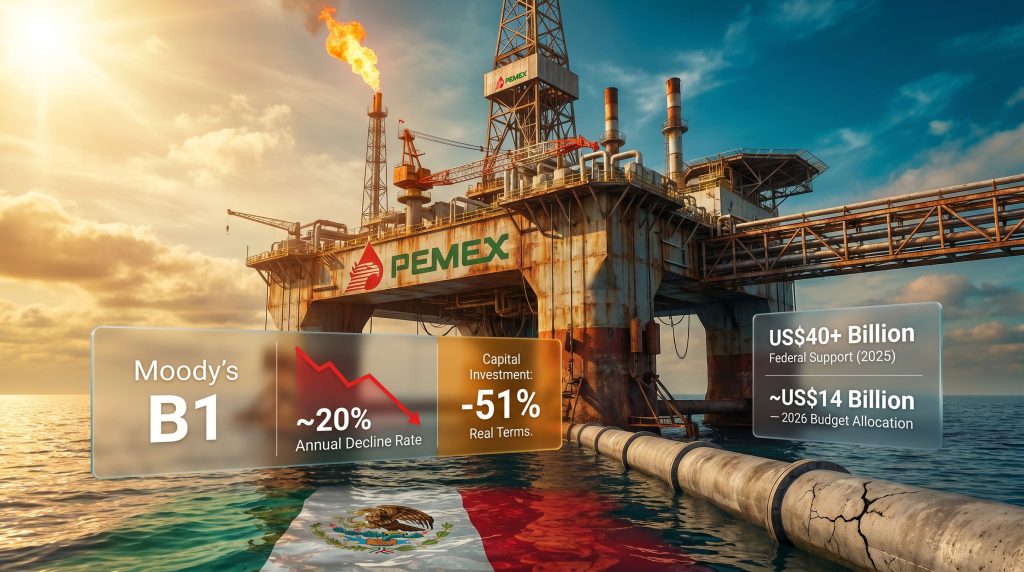
The Structural Trap Behind PEMEX's B1 Rating: Sovereign Support, Declining Fields, and the Limits of Policy
When a national oil company carries a speculative-grade credit rating despite receiving tens of billions of dollars in annual government support, something deeply structural is at work. For most corporate borrowers, a B1 designation from Moody's would reflect a company navigating a temporary rough patch. For Petróleos Mexicanos, better known as PEMEX, the Moody's PEMEX B1 rating and operational risks story is altogether different. The B1 is not a cyclical signal. It is a codified acknowledgment that PEMEX's intrinsic financial health is so impaired that only continuous sovereign intervention keeps the company solvent and creditworthy.
Understanding why this matters requires stepping back from the headline rating and examining the three compounding forces shaping PEMEX's credit trajectory: a reservoir depletion crisis that is outpacing capital investment, a downstream policy framework that structurally limits revenue capture, and a debt profile so large that market access alone cannot manage it.
When big ASX news breaks, our subscribers know first
What a B1 Rating Actually Signals for a State-Owned Enterprise
Moody's long-term rating scale places B1 four notches into speculative-grade territory, a category broadly associated with material credit risk and a heightened vulnerability to adverse business or economic conditions. For a private-sector company, this would typically reflect elevated leverage, weak cash flow coverage, or a deteriorating competitive position.
For state-owned enterprises, the methodology is more layered. Moody's evaluates two distinct credit signals simultaneously: the company's standalone financial strength and the degree to which sovereign support can be expected to offset that weakness. In PEMEX's case, the agency applies a very high sovereign support assumption, which means the B1 rating is anchored almost entirely by Mexico's willingness and capacity to intervene financially, not by PEMEX's own operational performance.
When a sovereign-backed company holds a speculative-grade rating with very high assumed state support already factored in, the underlying business risk is considerably more severe than the headline letter suggests. PEMEX's B1 functions as a policy signal, not a performance endorsement.
This distinction creates an important analytical nuance for credit watchers. PEMEX's rating moves in near-lockstep with Mexico's own sovereign creditworthiness. Any deterioration in the federal government's fiscal position cascades directly into PEMEX's rating trajectory, regardless of what happens at the field level. The company's credit profile is, in a meaningful sense, a derivative instrument on Mexico's sovereign balance sheet. Furthermore, US policy change and PDVSA dynamics elsewhere in Latin America serve as a useful comparative lens for understanding how geopolitical shifts can destabilise state oil company finances with little warning.
The Scale of Federal Financial Intervention Required to Maintain Solvency
The numbers involved in keeping PEMEX financially functional are striking. In 2025, the Mexican federal government delivered more than US$40 billion in financial interventions directed at reducing PEMEX's debt load and addressing overdue supplier obligations. The 2026 federal budget allocates approximately US$14 billion specifically to cover PEMEX's short-term debt maturities.
Beyond direct budget transfers, Banobras has been positioned as a liquidity backstop to support supplier payment programmes. Mexico's recently approved pension reform, which caps high-end benefits across public sector entities, will also gradually reduce PEMEX's pension obligation stack, though Moody's characterises this relief as incremental rather than transformative in terms of near-term cash flow impact.
| Intervention Type | Estimated Value | Primary Purpose |
|---|---|---|
| Total federal financial support (2025) | US$40+ billion | Debt reduction and supplier obligations |
| 2026 federal budget allocation | ~US$14 billion | Short-term debt maturity coverage |
| Banobras standby liquidity facility | Undisclosed ceiling | Supplier payment backstop |
| Pension reform contribution | Gradual and phased | Long-term liability reduction |
Moody's baseline projection assumes PEMEX will invest an average of US$11 billion annually in capital expenditure over the 2026 to 2028 period. Given that debt maturities remain elevated across that same window, government transfers will need to continue at levels sufficient to cover both refinancing obligations and operational shortfalls. The message embedded in that projection is unambiguous: PEMEX's financial continuity depends on Mexico's sustained willingness to allocate sovereign resources to the company, year after year, with no defined exit point.
Upstream Decline: When Capital Cuts Compound a Reservoir Crisis
The upstream section of Moody's assessment contains the most structurally alarming findings. PEMEX reported liquids production of approximately 1.65 million barrels per day in the first quarter of 2026, which Moody's characterises as a near-term stabilisation driven by execution improvements. The agency is careful to distinguish this from any reversal of underlying production trends or reserve dynamics.
The core problem is reservoir depletion at PEMEX's most productive assets. The company's major producing fields represent roughly 80% of total upstream output, and on a production-weighted basis, those fields collectively carry an underlying decline rate in the low 20% range annually. This means PEMEX must reinvest aggressively simply to hold production flat. When that reinvestment is simultaneously being cut, the compounding effect on output is severe.
Field-Level Decline Trajectories:
| Field | Decline Pattern |
|---|---|
| Maloob | Double-digit annual decline |
| Zaap | Double-digit annual decline |
| Quesqui | Steeper than average decline |
| Tupilco Profundo | Steeper than average decline |
Against this backdrop, capital investment contracted approximately 51% in real terms in early 2026 compared to the prior year, a consequence of Mexico's tightening fiscal conditions reducing the government's capacity to fund PEMEX's capex requirements. Moody's projects this investment shortfall will continue to suppress operational performance and production sustainability well beyond 2027.
The technical mechanics of this situation deserve emphasis. A production-weighted decline rate in the low 20% range is not an abstract statistic. It means that for every five barrels PEMEX produces today from its major fields, it can expect to lose the equivalent of approximately one barrel per year through natural reservoir pressure decline, without any consideration of surface equipment degradation or facility downtime. Arresting that decline requires sustained high-pressure injection programmes, infill drilling campaigns, and enhanced recovery techniques — all of which are capital-intensive and cannot be deferred without compounding consequences.
Mixed Development Contracts: Promising Architecture, Unproven Scale
The Sheinbaum administration's response to the upstream capital gap centres on mixed development contracts, a mechanism designed to bring private capital into PEMEX-operated fields while preserving state control over operations and ownership structures. Approximately 10 contracts have been awarded to date, with most signed and progressing toward execution.
Moody's projects these contracts could deliver incremental production of roughly 76,000 barrels per day in 2026, with moderate further growth anticipated in subsequent years. However, the agency flags a structural limitation that sits at the heart of the private capital challenge: the fields most urgently in need of investment are large, technically complex, and heavily depleted. These characteristics make contract economics difficult to structure attractively for private investors who must weigh capital recovery timelines against geological uncertainty and pricing terms.
The mixed contract framework represents a structurally sound mechanism for attracting upstream capital, but its impact on production decline at scale remains unproven. Moody's treats projected incremental volumes as aspirational within its credit modelling, not as committed production that can be relied upon for cashflow forecasting purposes.
Downstream Policy Design and the Revenue Capture Problem
PEMEX's downstream challenges operate through a different mechanism than its upstream crisis, but the financial consequence is the same: structurally impaired revenue generation. The energy sovereignty framework that guides the current administration directs an increasing share of domestic crude production toward domestic refineries rather than export markets. This policy design reduces PEMEX's exposure to higher-margin international crude sales at precisely the moment when current crude oil prices are elevated.
Geopolitical tensions reshaping trade flows pushed Brent crude above US$100 per barrel in March 2026 and sustained Mexico's export blend at elevated levels through May. Yet PEMEX's ability to translate those international price levels into proportional revenue improvement is constrained by the government's domestic fuel pricing policy, implemented through the IEPS excise tax mechanism. Consequently, the oil price geopolitical factors driving global benchmarks higher are not translating into equivalent financial gains for the company.
| Fuel Type | Estimated IEPS Subsidy | Effect on PEMEX Margins |
|---|---|---|
| Diesel | ~MXN 4.6 per litre | Suppresses downstream revenue capture |
| Gasoline | ~MXN 3.3 per litre | Limits pass-through of global price gains |
These IEPS reductions function as implicit consumer subsidies that prevent PEMEX from capturing the margin windfall that elevated international prices would otherwise deliver to an unencumbered oil producer. The commercial logic is coherent from a social policy perspective but materially damaging from a credit perspective. Indeed, the relationship between commodity prices and company performance is a well-documented dynamic across resource-dependent enterprises operating under government pricing constraints.
Safety Risk as a Latent Credit Variable
One dimension of PEMEX's downstream risk profile that receives less attention in standard financial analysis is the direct link between capital spending reductions and operational safety. As maintenance budgets are trimmed and equipment replacement cycles are extended, the probability of process safety incidents, unplanned outages, and environmental liability events increases.
A documented Gulf of Mexico environmental spill in 2026 and recurring safety incidents at the Dos Bocas Olmeca refinery are consistent with this pattern. Moody's frames infrastructure underinvestment not merely as an operational management challenge but as a credit-relevant risk vector, given the potential for material liability exposure, regulatory penalties, and forced production curtailments following major incidents.
Debt Market Activity in 2026: Maintenance, Not Investment
PEMEX successfully accessed Mexico's local capital market in 2026, completing an issuance of approximately US$1.7 billion directed primarily toward liquidity support. A broadly similar issuance is anticipated in the second half of the year, again for liquidity maintenance rather than capital investment funding.
Any potential return to international debt markets remains conditional and timing-uncertain. If executed, proceeds would be applied to refinancing existing obligations, with a liability management strategy likely targeting maturity extension to reduce near-term refinancing concentration risk.
The practical implication of this market access profile is significant. PEMEX's debt activity in 2026 and 2027 is a financial maintenance operation. The capital required to reverse production decline must come from government budget allocations or from private contract capital that mixed development agreements are designed to mobilise but have not yet delivered at the required scale.
Overdue supplier obligations, estimated at approximately US$20 billion, add another layer of operational risk. Unpaid contractor bills create a feedback loop: financially stressed suppliers reduce their operational engagement, slow project execution, and ultimately deter future participation in PEMEX tenders. This translates directly into reduced capacity to execute the very drilling and maintenance programmes needed to arrest production decline. In addition, Moody's published ratings methodology for state-owned enterprises makes clear that supplier payment risk is increasingly weighted as a standalone credit consideration rather than merely a working capital footnote.
The next major ASX story will hit our subscribers first
The Intrinsic vs. Supported Credit Profile: A Comparative Framework
| Credit Dimension | Standalone Assessment | Supported B1 Rating |
|---|---|---|
| Free cash flow | Persistently negative | Partially offset by sovereign transfers |
| Refining profitability | Chronic operating losses | Not materially improved by policy design |
| Production trajectory | Structural multi-field decline | Stabilised short-term through execution |
| Debt servicing capacity | Dependent on external funding | Covered by government budget allocation |
| Capital market access | Severely constrained independently | Enhanced by sovereign association |
The gap between PEMEX's intrinsic credit quality and its B1 rating is substantial and is entirely attributable to assumed government support. This creates a binary scenario for credit watchers: either Mexico's government continues to prioritise PEMEX financial support at current levels, or the rating faces significant downward pressure.
Conditions That Could Trigger Downward Rating Pressure
- Reduction in Mexico's sovereign willingness to allocate budget resources to PEMEX support
- Deterioration in Mexico's own fiscal position or sovereign credit rating
- Accelerated production decline that outpaces both government transfers and private capital injections from mixed contracts
- Escalating safety incidents leading to regulatory shutdowns, forced curtailments, or material environmental liability
- Failure of mixed development contracts to attract private capital at the scale required to offset field-level depletion
Conditions That Could Support Rating Stabilisation
- Successful scaling of mixed development contracts delivering sustained incremental production materially above current projections
- Restoration of capital investment toward levels sufficient to match or exceed production-weighted field decline rates
- Structural reform of the IEPS subsidy mechanism allowing partial market-price capture at the downstream level
- Reduction in overdue supplier obligations through Banobras-facilitated structured payment programmes that restore contractor confidence
Frequently Asked Questions on the Moody's PEMEX B1 Rating and Operational Risks
Why does PEMEX hold a B1 rating if its operational performance is deteriorating?
The B1 rating reflects Moody's assumption of very high Mexican government support, not PEMEX's standalone financial profile. Without sovereign backing factored into the assessment, the company's intrinsic creditworthiness would be rated considerably lower given persistently negative free cash flow, chronic refining losses, and a structural production decline that capital investment is insufficient to offset.
What does a 20% annual production decline rate mean in practical terms?
At a production-weighted decline rate in the low 20% range across its major fields, PEMEX loses the equivalent of roughly one-fifth of its production capacity from natural reservoir depletion each year. Maintaining flat production requires continuous, high-scale reinvestment in drilling, pressure maintenance, and enhanced recovery. When capital budgets are simultaneously being reduced by approximately 51% in real terms, the net trajectory is accelerating production erosion.
How do IEPS fuel subsidies structurally limit PEMEX's financial performance?
IEPS reductions function as government-mandated consumer subsidies that prevent PEMEX from capturing the full margin benefit of elevated international crude prices. During periods of high global oil prices, as observed when Brent surpassed US$100 per barrel in early 2026, this policy architecture means PEMEX's downstream revenue does not improve proportionally, weakening its capacity to self-fund operations and reduce dependence on sovereign transfers.
What is the overdue supplier debt risk and why does it matter operationally?
PEMEX's estimated US$20 billion in overdue supplier obligations creates a direct operational risk transmission channel. Contractors facing payment delays are more likely to reduce operational commitment, deprioritise PEMEX projects in favour of paying clients, and withdraw from future tenders. This reduces PEMEX's execution capacity precisely when the company needs maximum contractor engagement to arrest production decline and advance mixed development contract programmes.
Disclaimer: This article is intended for informational purposes only and does not constitute financial or investment advice. Credit ratings, production data, and financial projections referenced are based on publicly available information and Moody's published assessments. All forecasts and forward-looking statements are subject to material uncertainty and should not be relied upon as guarantees of future outcomes.
Want to Stay Ahead of Major Resource Discoveries Before the Market Catches On?
Discovery Alert's proprietary Discovery IQ model scans ASX announcements in real time, instantly identifying significant mineral discoveries and turning complex data into actionable investment insights — explore historic discoveries and their returns to understand the opportunity, then begin your 14-day free trial at Discovery Alert to position yourself ahead of the broader market.