June 25, 2026

Why Africa's State Energy Agencies Are Shedding Their Administrative Skins
Across the African continent, a quiet but consequential structural shift is reshaping how governments manage their most strategic resource assets. National hydrocarbons and mining agencies, long constrained by administrative legal frameworks inherited from post-independence development models, are increasingly converting into commercially agile corporate entities. This is not simply a governance trend. It reflects a fundamental reckoning with the scale of financing required to develop Africa's energy infrastructure in a competitive, capital-intensive global market. The Morocco ONHYM joint-stock company is among the most significant expressions of this shift, and understanding what it means requires looking well beneath the surface of the announcement itself.
When big ASX news breaks, our subscribers know first
From Bureaucratic Mandate to Commercial Entity: ONHYM's Institutional Origins
The National Office of Hydrocarbons and Mines has deep institutional roots. Formed in 2005 through the merger of two predecessor agencies, the Bureau de Recherches et de Participations Minières (BRPM) and the Office National de Recherches et d'Exploitations Pétrolières (ONAREP), ONHYM brought together more than 90 years of combined expertise in subsurface exploration, geological data management, and hydrocarbon licensing coordination across Morocco.
Headquartered at 5 Avenue Moulay Rachid in Rabat, ONHYM operated as the sole institutional interface between international exploration companies and the Moroccan state. It maintained geological datasets, administered licensing frameworks, and coordinated with the Ministry of Energy, Mines and Environment on all upstream activities. For decades, this model served Morocco adequately.
However, as the scale and complexity of international energy projects grew, the public establishment model revealed structural constraints that increasingly misaligned ONHYM's mandate with the ambitions Morocco was setting for itself.
The Hidden Costs of Public Establishment Status
The limitations of ONHYM's former legal status are rarely discussed in detail, but they were significant for any entity expected to co-develop continental infrastructure:
- The agency could not establish subsidiaries or acquire equity stakes in third-party vehicles
- Access to venture capital, structured debt, and equity capital markets was prohibited
- Cross-border commercial operations fell outside the permitted scope of activities
- Participation in dedicated project finance structures was legally constrained
- The agency had no formal mandate to commercialise its accumulated geological data assets
These were not minor inconveniences. For a project like the Africa-Atlantic Gas Pipeline, which requires a co-governed, co-financed dedicated project company, ONHYM's former status created a fundamental legal incompatibility. The reform was, consequently, a structural necessity rather than an administrative preference.
Law 56.24: The Legal Architecture of the Morocco ONHYM Joint-Stock Company
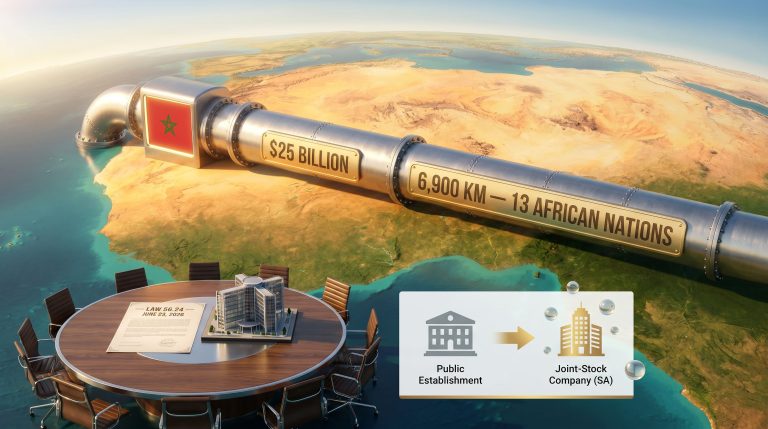
The transformation of ONHYM into ONHYM-SA was formalised through Law 56.24, approved by Morocco's parliament and enacted through a royal decree published in the Official Gazette, as reported by Médias24 on June 23, 2026. The result is a state-owned joint-stock company (société anonyme) in which the state retains 100% of initial share capital, with an initial capital amount that has not been publicly disclosed.
Critically, Energy Transition Minister Leïla Benali has explicitly stated that this conversion does not constitute privatisation. The Moroccan state preserves majority voting rights even as the structure progressively opens to private capital participation.
Governance Distinction: The conversion changes ONHYM's legal personality entirely, not merely its name or reporting structure. All pre-existing assets, geological data repositories, contractual obligations, and institutional expertise transfer in full to the new corporate entity.
Capability Transformation: Before and After the Reform
The practical difference between the two legal structures is best understood through direct comparison:
| Operational Capability | Public Establishment (Pre-2026) | ONHYM-SA (Joint-Stock, Post-2026) |
|---|---|---|
| Subsidiary creation | Not permitted | Permitted |
| Equity capital raising | Not permitted | Permitted |
| Venture capital access | Not permitted | Permitted |
| Structured borrowing | Restricted | Fully enabled |
| International commercial operations | Not permitted | Permitted |
| Private investor participation | Not permitted | Progressively enabled |
| Geo-scientific information system | Not formally mandated | Formally established under law |
| Dedicated project company participation | Legally constrained | Fully enabled |
The ANGSPE Framework: Morocco's Wider Corporate Governance Architecture
ONHYM-SA does not operate in isolation. Its conversion sits within the governance framework established by the Agence Nationale de Gestion Stratégique des Participations de l'État (ANGSPE), Morocco's National Agency for Strategic Management of State Participations. ANGSPE provides the overarching supervisory architecture within which ONHYM-SA and future converted state entities will function.
This signals that Morocco is not simply reforming one agency but building a systematic institutional scaffold designed to receive approximately 50 state-owned entities as they transition to joint-stock company status.
The $25 Billion Catalyst: Africa-Atlantic Gas Pipeline
No analysis of the Morocco ONHYM joint-stock company transformation is complete without examining the project that made the reform an urgent priority. Furthermore, the energy transition demand driving this infrastructure push reflects a global pattern of accelerating capital commitment to large-scale energy corridors.
The Africa-Atlantic Gas Pipeline, also referred to as the Nigeria-Morocco Gas Pipeline, is a proposed 6,900-kilometre infrastructure corridor connecting Nigeria's natural gas production fields to Morocco, with onward connectivity to European markets. The pipeline would traverse 13 African countries, making it one of the most geographically complex energy infrastructure projects ever proposed on the continent. The estimated capital cost stands at approximately $25 billion.
For ONHYM to fulfil its role in this project, it must co-establish a dedicated project company jointly with Nigeria's NNPC Limited. Under ONHYM's former public establishment status, participating in such a vehicle was legally impossible. The conversion to joint-stock company status removes this barrier entirely.
Pipeline Timeline and Financial Structure
The project is advancing along a defined, if still contingent, timeline:
- The intergovernmental agreement and Final Investment Decision (FID) are both anticipated during 2026, according to statements by ONHYM Chief Executive Amina Benkhadra cited by Reuters
- The pipeline route will be divided into three sections to optimise phased financing and logistics coordination
- In April 2026, Bloomberg reported that ONHYM was preparing its first capital raise since achieving joint-stock status; however, a source at ONHYM clarified to Médias24 that the fundraising vehicle will be the dedicated project company, not ONHYM-SA directly
- The specific size, structural form, and timing of the initial capital raise have not been publicly determined
Investor Note: The distinction between ONHYM-SA raising capital directly and the dedicated project company raising capital is operationally significant. It means ONHYM's own balance sheet may remain structurally separate from the pipeline's initial financing risk, though ONHYM's participation in the project vehicle creates indirect exposure.
Geopolitical Dimensions of the Pipeline
The strategic geography of this project extends well beyond energy economics. By positioning Morocco as the northern terminus of a 13-country gas transit corridor, the pipeline reinforces Morocco's ambition to function as a continental energy gateway between Africa and Europe. The broader geopolitical mining landscape across the region similarly reflects this trend of nations repositioning themselves as strategic infrastructure anchors.
For the transit countries along the route, the infrastructure offers potential access to gas supplies, revenue-sharing frameworks, and development-linked infrastructure benefits. This aligns with broader African Union energy connectivity objectives, though the specific terms of each country's participation remain subject to intergovernmental negotiation.
Morocco's Broader Public Sector Reform: ONHYM as the Policy Template
Minister Benali's framing of the ONHYM conversion before Morocco's Parliament is important context. Her characterisation of the reform as the official launch of a broader public sector transformation identifies ONHYM-SA not as an isolated case but as a replicable governance model for approximately 50 Moroccan state-owned entities.
The stated objectives driving this wider programme are structured around five priorities:
- Competitiveness enhancement enabling state entities to compete on equal terms with private-sector and international counterparts
- Governance modernisation introducing corporate board structures, fiduciary accountability, and shareholder reporting standards
- Performance orientation shifting from administrative compliance metrics to commercial and operational key performance indicators
- Asset valorisation unlocking the latent commercial value embedded in geological, mineral, and hydrocarbon data
- Financing diversification reducing dependency on state budget allocations by enabling market-based capital access
The selection of ONHYM as the first entity to undergo this conversion is deliberate. Its centrality to Morocco's energy transition agenda, its role in the Africa-Atlantic pipeline, and its existing international profile make it the most credible launch case for demonstrating the reform model's functionality.
The Geo-Scientific Information System: An Underappreciated Commercial Asset
One provision of Law 56.24 that has received limited attention is the formal mandate for ONHYM-SA to establish and maintain a national geo-scientific information system. This is more commercially significant than it might initially appear.
Morocco's subsurface data represents decades of accumulated exploration intelligence, including seismic surveys, well logs, geochemical analyses, and mineralogical assessments covering both hydrocarbon and mining domains. Under ONHYM's former public establishment status, this data was maintained as an administrative resource rather than a commercial asset.
The joint-stock structure changes this fundamentally. A formalised, commercially structured geo-scientific information system can position Morocco's subsurface data as a licensable asset class, generating potential data commercialisation revenues from international exploration companies seeking to evaluate prospectivity before committing capital to licensing rounds. This reduces exploration risk for incoming partners and accelerates deal timelines, creating a more attractive environment for upstream investment.
The next major ASX story will hit our subscribers first
Comparative Context: How Morocco's Approach Mirrors a Continental Pattern
Morocco's conversion of ONHYM is not without regional precedent, and understanding the comparative landscape reveals both the logic and the risks of the approach. In addition, the critical minerals demand surge across global markets is reinforcing the urgency with which African governments are pursuing these institutional upgrades.
| Country | National Entity | Corporate Structure | Private Participation Model |
|---|---|---|---|
| Morocco | ONHYM-SA | Joint-stock company (2026) | Progressive, majority state-retained |
| Nigeria | NNPC Limited | Limited company (converted 2021) | Partial private stake |
| Algeria | Sonatrach | State enterprise | Minimal private participation |
| Egypt | EGPC | Public authority | Limited |
| Senegal | Petrosen | State company | Joint venture model |
Nigeria's 2021 transformation of NNPC into NNPC Limited is the most instructive comparison. That conversion similarly unlocked project finance access for large-scale infrastructure and enabled NNPC to participate in commercial joint ventures that were previously legally problematic. The timing of both reforms relative to the Nigeria-Morocco pipeline project suggests the two conversions are structurally linked, each party needing compatible legal personalities to co-govern a shared project vehicle.
Financing Architecture: What ONHYM-SA Can Now Access
The financial instruments now available to ONHYM-SA represent a qualitative expansion of the agency's operational toolkit. Furthermore, the African mining finance trends emerging across the continent suggest that this shift towards corporate financing models will only accelerate in the coming years.
- Venture capital co-investment enabling partnerships with private exploration and technology companies at the project development stage
- Structured debt instruments including project finance facilities, bond issuances, and syndicated loan arrangements
- Equity capital raises enabling the state to progressively dilute its stake while retaining majority voting control through legislative safeguards
- Subsidiary financing vehicles allowing ONHYM-SA to establish purpose-built entities for specific projects, ring-fencing risk and optimising capital allocation across a portfolio
The legislative framework governing private capital introduction explicitly mandates that the state retains majority voting rights at all stages, mirroring governance structures employed by sovereign energy companies across the Gulf Cooperation Council. This architecture allows commercial flexibility without surrendering strategic control. For instance, the mining private equity space has demonstrated repeatedly that state-retained majority structures can still attract substantial institutional capital when the governance framework is sufficiently transparent.
Structural Risks and Open Questions
The transformation of the Morocco ONHYM joint-stock company carries genuine uncertainties that investors, partners, and policymakers should track carefully.
Key Risk Factors
- Capital raise ambiguity: The size, structure, and timing of the first fundraising exercise remain undetermined, creating planning uncertainty for potential investors
- Governance transition complexity: Shifting from administrative to corporate governance requires new board competencies, audit frameworks, and accountability mechanisms that take time to embed effectively
- Replication scalability risk: Applying the same legislative template to approximately 50 state entities will demand significant parliamentary throughput and institutional capacity across Morocco's public sector
- Pipeline execution dependency: ONHYM-SA's near-term financial and strategic positioning is closely tied to the Africa-Atlantic Gas Pipeline, a project that remains subject to intergovernmental negotiation timelines and FID execution risks
What Remains Undisclosed
Several material details have not been publicly confirmed as of the time of reporting:
- The initial share capital amount of ONHYM-SA
- The timeline and sequencing for progressive introduction of private capital
- The board composition requirements for ONHYM-SA, including any independent director mandates
- The commercial terms of the dedicated pipeline project company between ONHYM and NNPC Limited
Analytical Caution: The pipeline's intergovernmental agreement and Final Investment Decision are both projected for 2026, but large-scale infrastructure projects of this complexity frequently encounter timeline revisions. The FID represents a conditional milestone, not a confirmed outcome.
Frequently Asked Questions
What is the Morocco ONHYM joint-stock company?
ONHYM-SA is the restructured legal form of Morocco's National Office of Hydrocarbons and Mines, converted from a public establishment into a state-owned joint-stock company under Law 56.24. The Moroccan state holds 100% of initial share capital, while the new structure enables access to private capital markets, subsidiaries, and international commercial operations for the first time.
Is the conversion of ONHYM a privatisation?
No. Energy Transition Minister Leïla Benali has explicitly stated that the conversion does not constitute privatisation. The Moroccan state retains majority voting rights and remains the principal shareholder. Private participation will be introduced progressively within the bounds of existing Moroccan investment legislation.
Why does the Africa-Atlantic Gas Pipeline require ONHYM to be a joint-stock company?
The pipeline project requires ONHYM to co-establish a dedicated project company jointly with Nigeria's NNPC Limited. Under ONHYM's former public establishment legal status, participating in such a commercial vehicle was legally impossible. The joint-stock conversion removes this structural barrier entirely.
How many Moroccan state entities will undergo similar reform?
Approximately 50 Moroccan public entities are expected to adopt joint-stock company status as part of the broader public sector governance programme, with ONHYM-SA serving as the first and most visible case.
When is the Final Investment Decision for the Nigeria-Morocco pipeline expected?
According to statements by ONHYM Chief Executive Amina Benkhadra cited by Reuters, both the intergovernmental agreement and the Final Investment Decision are anticipated during 2026. These remain projected milestones subject to negotiation outcomes.
Key Takeaways for Energy Sector Observers
- The conversion of ONHYM into a joint-stock company under Law 56.24 represents Morocco's most consequential energy governance reform since the agency's founding in 2005
- The reform is a structural prerequisite for Morocco's participation in the $25 billion Africa-Atlantic Gas Pipeline alongside Nigeria's NNPC Limited
- ONHYM-SA functions as the policy template for a broader programme targeting approximately 50 Moroccan state-owned entities
- The new corporate structure unlocks venture capital, structured debt, equity raises, subsidiary creation, and international operations, capabilities previously unavailable under public establishment status
- The Moroccan state retains majority voting control, ensuring strategic sovereignty is preserved as commercial flexibility expands
- The formal establishment of a geo-scientific information system transforms Morocco's accumulated subsurface data from an administrative resource into a potentially licensable commercial asset
- Morocco's approach closely mirrors Nigeria's 2021 NNPC Limited conversion, pointing to a broader continental pattern of corporatising national resource agencies to unlock infrastructure-scale financing capacity
Readers seeking ongoing coverage of Morocco's energy policy landscape and African hydrocarbons governance can find sector-focused reporting at Ecofin Agency, which covers African energy, mining, and public management developments across the continent.
Want to Track the Next Major Mineral Discovery Before the Broader Market Does?
Discovery Alert's proprietary Discovery IQ model delivers real-time alerts on significant ASX mineral discoveries, transforming complex geological data into actionable investment insights — explore historic discoveries and their exceptional returns to understand the scale of opportunity, then begin your 14-day free trial at Discovery Alert to position yourself ahead of the market.