June 25, 2026
The Institutional Architecture of African Energy: Why Legal Structure Determines Capital Access
Across the African continent, the single most underappreciated barrier to large-scale infrastructure financing is not resource scarcity, political instability, or even regulatory uncertainty. It is the legal architecture of the institutions tasked with developing those resources. When a state agency operates under administrative public law rather than commercial corporate law, it is structurally excluded from entire categories of financing that project-scale infrastructure demands. This distinction, invisible to most observers, is precisely what the Morocco ONHYM joint-stock company conversion is designed to resolve.
Understanding this reform requires moving beyond the headline and into the mechanics of why institutional form shapes financial outcomes, and why this particular governance change carries implications that extend well beyond Morocco's borders.
When big ASX news breaks, our subscribers know first
Why Morocco Is Restructuring Its State Energy and Mining Sector Now
The Institutional Gap That Law 56.24 Was Designed to Close
Morocco's National Office of Hydrocarbons and Mines, known as ONHYM, spent the first two decades of its existence operating under the framework of a public establishment. This legal category, common across Francophone administrative systems, places entities under state administrative law rather than commercial company law. The practical consequences are profound. Public establishments cannot create subsidiaries in their own right, cannot access venture capital instruments, cannot raise structured debt at the project level, and face significant constraints when seeking to operate across international borders.
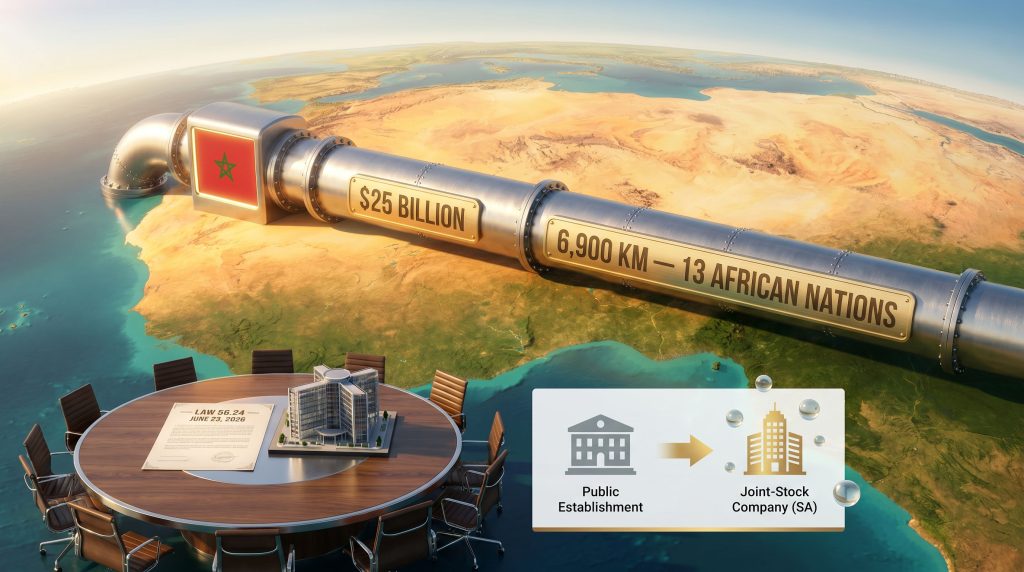
For a national hydrocarbons and mining authority with a mandate to attract foreign exploration partners and develop transnational infrastructure, these constraints created an institutional ceiling. Draft Law No. 56.24, approved on June 23, 2026, was designed specifically to remove that ceiling by converting ONHYM into a société anonyme, or joint-stock company, aligned with Morocco's national public shareholding legislation.
From Public Establishment to Corporate Entity: Understanding the Legal Distinction
The difference between a public establishment and a joint-stock company is not merely administrative. It represents a fundamental shift in the legal personality, accountability framework, and financing toolkit available to the institution.
Under the old structure, ONHYM's activities were governed by administrative decisions, ministerial approvals, and public budget cycles. Under the new corporate structure, ONHYM-SA operates with commercial legal personality, meaning it can:
- Enter into commercial contracts with the flexibility of a private entity
- Establish wholly owned or jointly owned subsidiaries for specific projects
- Access capital markets and structured finance instruments
- Raise equity from private investors, subject to state majority retention
- Operate internationally without requiring separate legislative authorisation for each jurisdiction
This transformation does not reduce state oversight. Rather, it replaces administrative control with shareholder governance, a model that in practice tends to demand greater financial transparency and performance discipline from management.
How ONHYM's 2005 Origins Shape the Significance of This 2026 Reform
ONHYM was established in 2005 through the merger of two legacy state bodies: BRPM, the Bureau de Recherches et de Participations Minières, which had overseen mining development, and ONAREP, the Office National de Recherches et d'Exploitations Pétrolières, responsible for hydrocarbons. Together these institutions brought more than 90 years of combined geological and resource expertise under a unified national mandate.
That institutional heritage is not incidental to the current reform. ONHYM enters its new corporate life with an established track record, an existing portfolio of exploration partnerships, and deep data assets accumulated across decades of geological survey work. The reform is therefore not a reinvention from scratch. It is a legal upgrade of an already operational institution, designed to equip it for a financing environment that has become increasingly sophisticated since 2005.
What Is the Morocco ONHYM Joint-Stock Company Reform?
The Legislative Foundation: Draft Law No. 56.24 Explained
The legislation underpinning this transformation was formalised through a royal decree published in Morocco's Official Gazette, with Médias24 reporting the publication on June 23, 2026. The decree completed a legislative process that had been in preparation for approximately one year prior to its publication.
The core legal mechanism converts ONHYM from a public establishment governed by state administrative law into a joint-stock company subject to Morocco's framework legislation on state shareholding enterprises. This places ONHYM-SA within a commercial legal environment while retaining the state as the sole shareholder at the point of conversion.
Key Provisions of the New Corporate Structure at a Glance
| Reform Dimension | Details Under Law 56.24 |
|---|---|
| Previous Legal Status | Public establishment under state administrative law |
| New Legal Status | Joint-stock company aligned with national public shareholding legislation |
| State Ownership at Launch | 100% of initial share capital held by the state |
| Private Capital Access | Gradual opening to private investors with state retaining majority voting rights |
| New Corporate Powers | Subsidiary creation, equity participation, structured borrowing, venture capital access, international operations |
| Asset Continuity | Full transfer of all existing assets, rights, and obligations to the new structure |
| Governance Oversight | Subject to monitoring by ANGSPE (National Agency for Strategic Management of State Participations) |
| First Reform of its Kind | ONHYM is the first of approximately 50 Moroccan public entities targeted for similar conversion |
What Gradual Capital Opening Actually Means for Private Investors
The phrase gradual capital opening is carefully chosen language. It signals that private equity participation is an intended endpoint but not an immediate one. Before private capital can enter, several conditions must first be satisfied: resource valuation processes must be completed, governance frameworks must be demonstrably operational, and the regulatory environment under ANGSPE oversight must be established.
Investors examining this trajectory should understand that the timeline for meaningful private ownership participation remains uncertain. What is confirmed is that when private capital does enter, the state will retain majority voting rights, ensuring strategic decision-making remains within sovereign control regardless of the ownership percentage eventually offered to external investors.
Why This Reform Is Explicitly Not a Privatisation
Energy Transition and Sustainable Development Minister Leïla Benali stated clearly before Parliament that ONHYM's conversion to joint-stock company status does not constitute privatisation. This distinction matters both politically and structurally. The state retains full initial capital, majority voting rights are constitutionally protected in the design of the reform, and the entity remains subject to ANGSPE governance monitoring. The reform is better understood as a modernisation of the state's ownership vehicle rather than a transfer of ownership away from the state.
How Does the Joint-Stock Structure Change ONHYM's Operational Capabilities?
Financing Instruments Previously Unavailable to ONHYM
Perhaps the most consequential practical effect of the conversion is the expansion of ONHYM's financing toolkit. Under the former public establishment structure, the entity relied primarily on state budget allocations and operator contributions under exploration and production sharing agreements. The new corporate structure opens access to an entirely different set of instruments, including those commonly examined through mining private equity frameworks:
- Access to venture capital structures suited to early-stage exploration risk
- Structured borrowing and project-level debt financing backed by specific asset cash flows
- Capital raising through equity participation mechanisms in subsidiaries
- International capital market instruments including bonds and syndicated loans
- Cross-border project vehicles with foreign partners and multilateral lenders
Each of these instruments carries specific eligibility requirements that a public establishment cannot meet but that a joint-stock company satisfies by default of its legal form.
The Subsidiary Creation Mandate and Its Strategic Implications
The ability to create subsidiaries is often described in passing but deserves deeper examination. Project-level subsidiaries serve a critical function in infrastructure finance: they isolate risk. When a specific pipeline section, mineral concession, or exploration block is held within a dedicated subsidiary, lenders and equity investors can assess and price the risk associated with that single asset without being exposed to the broader balance sheet of the parent entity.
This structure, standard practice in global infrastructure finance, was unavailable to ONHYM as a public establishment. Its availability under the new corporate form is not a minor administrative convenience. It is the foundational tool that makes bankable project finance possible for assets of the scale ONHYM is now being asked to develop. Furthermore, it enables the kinds of joint ventures and asset sales that large-scale resource projects increasingly depend upon.
Establishing a Geo-Scientific Information System: The Data Infrastructure Angle
One dimension of the reform that receives limited attention in mainstream coverage is the mandate to establish a formal geo-scientific information system. ONHYM has accumulated geological survey data over decades across both hydrocarbon and mineral domains. Formalising this data within a structured information system creates a monetisable asset class in its own right.
Exploration partners and international operators routinely pay significant premiums to access high-quality, well-organised geological data before committing to exploration expenditure. A formalised geo-scientific database positions ONHYM-SA to generate revenue from data licensing while simultaneously reducing exploration risk for potential partners, accelerating partnership formation and improving the commercial terms ONHYM can negotiate.
Accountability Mechanisms Under the New Governance Framework
ANGSPE, Morocco's National Agency for Strategic Management of State Participations, will oversee ONHYM-SA alongside other converted state enterprises. This oversight body operates differently from traditional ministerial supervision. Rather than approving operational decisions, ANGSPE monitors financial performance, governance compliance, and strategic alignment with state objectives. This shift from operational supervision to performance monitoring is characteristic of global best practice in state enterprise governance reform.
What Role Does the Nigeria-Morocco Gas Pipeline Play in This Reform?
The Africa-Atlantic Gas Pipeline: Scale, Scope, and Strategic Logic
The Nigeria-Morocco gas pipeline, formally referred to as the Africa-Atlantic Gas Pipeline, is one of the most ambitious infrastructure projects ever conceived on the African continent. Its physical and financial parameters are extraordinary by any measure.
| Pipeline Parameter | Specification |
|---|---|
| Total Route Length | Approximately 6,900 kilometres |
| Countries Traversed | 13 African nations |
| Estimated Capital Cost | USD $25 billion |
| Key Counterparty | Nigeria's NNPC Limited |
| Project Structure | Dedicated joint project company co-established with NNPC |
| Route Division | Three sections for logistics and financing segmentation |
| Key Milestones Pending | Intergovernmental agreement signing and Final Investment Decision (FID) |
The pipeline's strategic logic extends beyond simple gas transit. For the 13 West African nations it traverses, it represents potential access to natural gas for power generation, industrial use, and domestic energy consumption. For Morocco, it positions the country as a critical transit and terminus hub for sub-Saharan energy flows into Europe, reinforcing its geographic significance at the intersection of Africa and the Atlantic world.
Why ONHYM's Old Legal Structure Was Incompatible With Pipeline Financing Requirements
A $25 billion infrastructure project cannot be financed through state budget allocations or simple bilateral loans. Projects of this scale require layered capital structures involving multilateral development bank facilities, export credit agency guarantees, commercial bank syndications, and equity contributions from multiple sovereign and private sources.
Each of these financing layers requires the borrowing entity to have commercial legal personality, auditable financial statements prepared under international accounting standards, board governance structures that satisfy lender covenants, and the ability to pledge project assets as security. A public establishment under administrative law satisfies none of these requirements. A joint-stock company, by definition, satisfies all of them.
The Dedicated Project Company Model: How Capital Will Actually Be Raised
An important clarification emerged in April 2026 when Bloomberg reported that ONHYM was preparing its first capital raising. A source at ONHYM subsequently clarified to Médias24 that fundraising activity will be conducted through the dedicated pipeline project company, which will be established jointly with NNPC Limited, rather than through ONHYM-SA itself.
This distinction is significant for investors monitoring the situation. ONHYM-SA's corporate conversion is the enabling condition for the project company structure. But the actual capital raise, its size, structure, and timing, will be determined at the project company level, and none of those parameters have been formally confirmed as of the reform announcement.
This nested structure, where ONHYM-SA creates or co-creates a subsidiary project company that then raises capital independently, is the direct application of the subsidiary creation mandate described above. It represents exactly the kind of risk isolation architecture that made the corporate conversion necessary in the first place.
Timeline Expectations for the Final Investment Decision and First Capital Raise
ONHYM Chief Executive Amina Benkhadra indicated, in statements cited by Reuters, that the formal signing of the intergovernmental agreement between Morocco and Nigeria and the Final Investment Decision are both anticipated within 2026. These two milestones represent the threshold between project planning and project execution. Until both are achieved, capital raising activity remains at the preparatory stage.
Is ONHYM the Template for Broader Moroccan Public Sector Reform?
The 50-Entity Reform Pipeline: Scope of Morocco's State Enterprise Modernisation
ONHYM's conversion is the opening move in a significantly larger programme. Minister Benali confirmed before Parliament that approximately 50 Moroccan public entities are targeted for similar joint-stock company conversions. The scope of this programme means the Morocco ONHYM joint-stock company reform serves a dual purpose: it directly enables the pipeline project, and it simultaneously establishes the legal and operational template that will be replicated across state enterprises in other sectors.
The sequencing of ONHYM as the first among these 50 entities is not accidental. By applying the framework to a high-profile, internationally visible entity with a concrete major project attached, Morocco generates proof-of-concept evidence that can accelerate subsequent conversions and build investor confidence in the broader reform programme.
What Governance Problems the Joint-Stock Model Is Designed to Solve
The governance deficiencies the reform targets are structural rather than managerial. The joint-stock conversion addresses:
- Fragmented accountability structures within public establishments where ministerial and operational responsibilities overlap
- Limited access to performance-linked financing that creates incentives for commercial discipline
- Weak integration into international capital markets that restricts funding sources to state budgets and bilateral arrangements
- Absence of subsidiary structures for project-specific risk isolation that prevents bankable project finance
- Lack of international operational mandates that limits cross-border partnership formation
The Role of ANGSPE in Monitoring the New Generation of State Enterprises
ANGSPE's role in this ecosystem is worth examining carefully. As the body responsible for monitoring strategic state participations, it occupies a position analogous to a sovereign wealth fund management committee in other governance frameworks. Its effectiveness will determine whether the governance improvements promised by the joint-stock conversion actually materialise in practice, or whether they remain formal changes without operational substance.
Comparative Governance Models: How Morocco's Approach Aligns With Global SOE Reform Trends
Morocco's chosen reform path mirrors patterns observed in state enterprise modernisation programmes across Southeast Asia, the Gulf Cooperation Council, and parts of Latin America. The common thread across these programmes is the use of commercial corporate law as a governance discipline mechanism, combined with a retained state majority that preserves strategic sovereignty. Malaysia's Petronas, Saudi Arabia's partial Aramco listing, and Oman's recent restructuring of its hydrocarbons sector each reflect variations on this same fundamental approach.
What distinguishes Morocco's programme is its scale of application across 50 entities and its explicit linkage to a single transformative infrastructure project. This combination gives the reform a credibility anchor that purely administrative governance changes typically lack. Consequently, the broader geopolitical mining landscape across Africa is watching this programme with considerable interest.
The next major ASX story will hit our subscribers first
What Does This Mean for Hydrocarbon and Mining Exploration Partners?
ONHYM as Sole Interlocutor: What Changes and What Stays the Same
International exploration companies that currently hold or are negotiating exploration and production agreements with ONHYM should note that the conversion preserves all existing contractual rights and obligations. The full transfer of assets, rights, and liabilities to the new corporate structure is a stated provision of Law 56.24. Counterparties do not need to renegotiate existing agreements as a result of the conversion.
What changes is the efficiency and flexibility of future contract formation. ONHYM-SA can now create project-specific subsidiaries as joint venture vehicles, which simplifies the allocation of rights, revenues, and costs between ONHYM and its exploration partners.
New Contractual and Financing Flexibilities for International Exploration Partners
The new structure creates several practical advantages for international operators considering Morocco's upstream sector:
- Subsidiary joint ventures can be established for specific blocks, allowing cleaner risk separation and simpler financing arrangements
- Structured carry arrangements become possible, where ONHYM-SA participates in project financing rather than relying solely on state budget contributions
- International operational mandates allow ONHYM-SA to participate in cross-border projects as an active equity partner rather than purely as a regulatory and licence-granting authority
- Data licensing arrangements create a new commercial touchpoint between ONHYM-SA and exploration companies at the pre-licence stage
Implications for Morocco's Competitive Positioning in African Resource Exploration
Morocco competes for exploration investment against a roster of African nations with comparable geological endowments but varying governance environments. The conversion of ONHYM to a joint-stock company, combined with the visibility of the pipeline project and the broader 50-entity reform programme, signals institutional maturity to international capital allocators in a way that administrative improvements alone cannot replicate. In addition, shifting African mining finance trends mean that institutional credibility has never been more central to attracting competitive capital.
Strategic Scenario Analysis: Three Pathways for ONHYM-SA Post-Reform
Scenario 1: Accelerated Pipeline Execution With Multilateral Financing Support
In the most optimistic trajectory, the intergovernmental agreement between Morocco and Nigeria is signed before year-end 2026, the Final Investment Decision follows within months, and the dedicated project company begins its first capital raise with multilateral development bank participation providing an anchor of credibility. Under this scenario, ONHYM-SA's new financing powers are exercised rapidly and the broader 50-entity reform programme gains powerful momentum from demonstrated success.
Scenario 2: Phased Private Capital Entry Through Subsidiary Structures
A more measured pathway sees ONHYM-SA using the first two to three years post-conversion to build governance credibility under ANGSPE oversight, develop its geo-scientific information system into a revenue-generating asset, and attract private capital through subsidiary structures in less capital-intensive mining and exploration activities before the pipeline project company's full capital raise is executed. This phased approach aligns closely with how definitive feasibility studies are typically used to stage capital deployment in resource projects.
Scenario 3: Stalled Reform if Governance Benchmarks Are Not Met Under ANGSPE Oversight
The risk scenario involves governance changes that are formal rather than operational. If ONHYM-SA's financial statements, management accountability frameworks, and performance reporting do not meet the standards expected by international lenders and equity investors, the corporate conversion may prove to be a necessary but insufficient condition for attracting private capital at competitive rates.
The ultimate test of this reform will not be the legal conversion itself. It will be whether ONHYM-SA can demonstrate the financial discipline and transparency benchmarks that international capital markets require before committing to infrastructure of this scale and duration.
This scenario analysis is speculative and does not constitute financial or investment advice. All projections involve uncertainty, and actual outcomes may differ materially from those described.
Frequently Asked Questions: Morocco ONHYM Joint-Stock Company
What is ONHYM and what does it do?
ONHYM is Morocco's National Office of Hydrocarbons and Mines, established in 2005 through the merger of the Bureau de Recherches et de Participations Minières (BRPM) and the Office National de Recherches et d'Exploitations Pétrolières (ONAREP). It manages Morocco's hydrocarbon and mineral resource development, oversees exploration partnerships with international operators, and holds the national mandate for geological survey and resource data management.
What does it mean for ONHYM to become a joint-stock company?
It means ONHYM has transitioned from a public establishment governed by administrative law to a commercial corporation governed by company law. This change gives ONHYM the ability to create subsidiaries, access financial markets, raise private capital, and operate internationally, capabilities that were structurally unavailable under its previous legal form.
Will ONHYM be privatised under the new structure?
No. The state holds 100% of the initial share capital, and the reform framework explicitly preserves state majority voting rights even as private capital is gradually permitted to enter. Minister Benali has confirmed publicly that the conversion does not constitute privatisation.
How does the reform connect to the Nigeria-Morocco gas pipeline?
The pipeline project, estimated at $25 billion over approximately 6,900 kilometres across 13 African countries, requires a dedicated project company co-established with Nigeria's NNPC Limited. That project company structure was incompatible with ONHYM's former public establishment status. The corporate conversion creates the legal foundation for ONHYM to participate in establishing and co-owning the project company.
When will private investors be able to buy into ONHYM?
No specific timeline has been confirmed. The reform framework describes a gradual opening of capital to private investors following asset development and resource valuation processes. Investors should treat timing projections as speculative until formally announced.
How many Moroccan state entities are expected to follow ONHYM's reform model?
Approximately 50 Moroccan public entities are targeted for similar joint-stock company conversions, according to statements by Minister Benali before Parliament. ONHYM is the first.
What is Law 56.24 and when was it passed?
Law 56.24 is the draft legislation that formalised ONHYM's conversion to joint-stock company status. Its implementing royal decree was published in Morocco's Official Gazette on June 23, 2026.
Key Takeaways: Morocco's ONHYM Reform in Numbers
| Metric | Value |
|---|---|
| Year ONHYM Established | 2005 (merger of BRPM and ONAREP) |
| Combined Institutional Heritage | 90+ years of hydrocarbon and mining expertise |
| Legislation Formalised | June 23, 2026 (Law 56.24) |
| Pipeline Project Cost Estimate | USD $25 billion |
| Pipeline Route Length | 6,900 km across 13 African countries |
| Moroccan SOEs Targeted for Similar Reform | Approximately 50 public entities |
| State Ownership at Launch | 100% (full initial capital held by the state) |
| Pipeline Counterparty | NNPC Limited (Nigeria) |
A Governance Inflection Point With Continental Consequences
Why the Structural Change Matters Beyond Morocco's Borders
The Morocco ONHYM joint-stock company conversion is not an isolated national event. It is a demonstration of a governance model with continent-wide applicability. Across Africa, dozens of national resource agencies face the same structural constraints that ONHYM has now resolved: public establishment status that excludes them from the financing instruments required by 21st century infrastructure projects.
For regional peers watching from Abuja to Nairobi to Accra, ONHYM-SA's trajectory over the next three to five years will serve as a live case study. If the conversion delivers measurable improvements in capital access, governance transparency, and project execution speed, the pressure on comparable agencies to pursue similar reforms will intensify considerably.
The Credibility Test: Governance, Transparency, and Performance Expectations
Legal conversion is the beginning of a credibility-building process, not its conclusion. International capital markets are well acquainted with governance reforms that succeed on paper while failing in practice. The metrics that will determine ONHYM-SA's credibility include the quality and timeliness of its financial reporting, the independence of its board governance from day-to-day ministerial influence, the commercial terms it can negotiate with exploration partners post-conversion, and the speed at which the pipeline project company reaches financial close.
What Investors, Partners, and Policy Observers Should Watch Next
For those monitoring this space, the following milestones will be the most informative signals of reform trajectory:
- Signing of the intergovernmental agreement between Morocco and Nigeria for the Africa-Atlantic Gas Pipeline
- Announcement of the Final Investment Decision and associated capital structure for the dedicated project company
- First ANGSPE governance assessment of ONHYM-SA's performance under the new corporate framework
- Commencement of private capital admission to ONHYM-SA or its subsidiaries, and the valuation methodology applied
- Next entities announced in the broader 50-entity reform programme, which will indicate the pace of Morocco's wider state enterprise modernisation
This article is intended for informational purposes only and does not constitute investment advice. Forward-looking statements involve inherent uncertainty. Readers should conduct independent due diligence before making any investment or commercial decisions based on the information presented here.
Want to Track the Next Major Mineral Discovery Before the Broader Market Does?
While Morocco's ONHYM reform reshapes the institutional architecture of African resource development, Discovery Alert's proprietary Discovery IQ model is scanning ASX announcements in real time — instantly alerting subscribers to significant mineral discoveries across more than 30 commodities before the wider market catches on. Explore historic discoveries and the returns they generated, then begin your 14-day free trial to position yourself ahead of the next major find.