July 27, 2026
The Hidden Cost of Trade Walls: How U.S. Phosphate Policy Became a Farm Crisis
Global fertilizer markets operate under a set of structural constraints that most observers rarely consider. Unlike energy commodities, which benefit from diversified production across dozens of countries, phosphate fertilizer supply is geographically concentrated to a degree that has few parallels in agricultural commodity markets. When trade policy disrupts access to that concentrated supply, the consequences radiate through every level of the food production chain. The current U.S. debate over the bill to end Morocco phosphate duties is not simply a legislative footnote — it represents a fundamental reckoning with the unintended costs of using trade remedy tools in commodity markets where no viable alternative supply base exists at equivalent scale.
When big ASX news breaks, our subscribers know first
Understanding Countervailing Duties and How They Entered the Phosphate Trade
Countervailing duties are a specific category of trade remedy, distinct from standard tariffs in both purpose and legal architecture. Understanding how tariffs work helps clarify why CVDs are surgically targeted: they are calculated to neutralise the specific competitive advantage that a foreign government's subsidy programmes have granted to its exporters. Under U.S. trade law, specifically Section 701 of the Trade Act of 1974, the Department of Commerce and the International Trade Commission conduct separate but coordinated investigations.
Commerce determines whether actionable subsidies exist and quantifies their magnitude; the ITC then assesses whether domestic industry has suffered material injury as a result.
The 2021 phosphate CVD orders emerged from petitions filed by U.S. producers, primarily Mosaic Company, alleging that subsidised phosphate exports from Morocco and Russia were causing material harm to domestic operations. Following formal investigations, duty rates were established with significant variation by exporter. Moroccan producers faced rates ranging from approximately 16.6% to over 47%, with OCP S.A., Morocco's state-linked phosphate enterprise, assessed at 19.97%. These rates were layered on top of existing standard import tariffs, creating a combined duty burden that effectively repriced Moroccan phosphate out of competitiveness in the U.S. market.
What distinguishes this case from typical CVD applications is the structural asymmetry it created. Phosphate fertiliser is not a substitutable commodity in any meaningful agronomic sense. Crops require phosphorus as a primary nutrient, and there is no alternative source that can replace DAP or MAP in standard nutrient management programmes at the volumes American agriculture demands. Furthermore, the broader tariff impacts on supply chains highlight just how deeply these disruptions can affect downstream industries.
A Decade of Data: What the Trade Collapse Actually Looks Like
The scale of the supply disruption following the 2021 CVD orders is starkly visible in trade data. Prior to duty imposition, U.S. combined imports of DAP (diammonium phosphate) and MAP (monoammonium phosphate) reached a record 1.85 million tonnes in 2018, reflecting a healthy competitive import market with Morocco as the dominant supplier. In the five years following the April 2021 orders, average annual imports collapsed to just 182,300 tonnes per year — a reduction exceeding 90% by volume.
Moroccan shipments specifically tell an even sharper story:
| Supply Metric | Pre-2021 Period (2016–2020 avg.) | Post-2021 Period (2021–2025 avg.) |
|---|---|---|
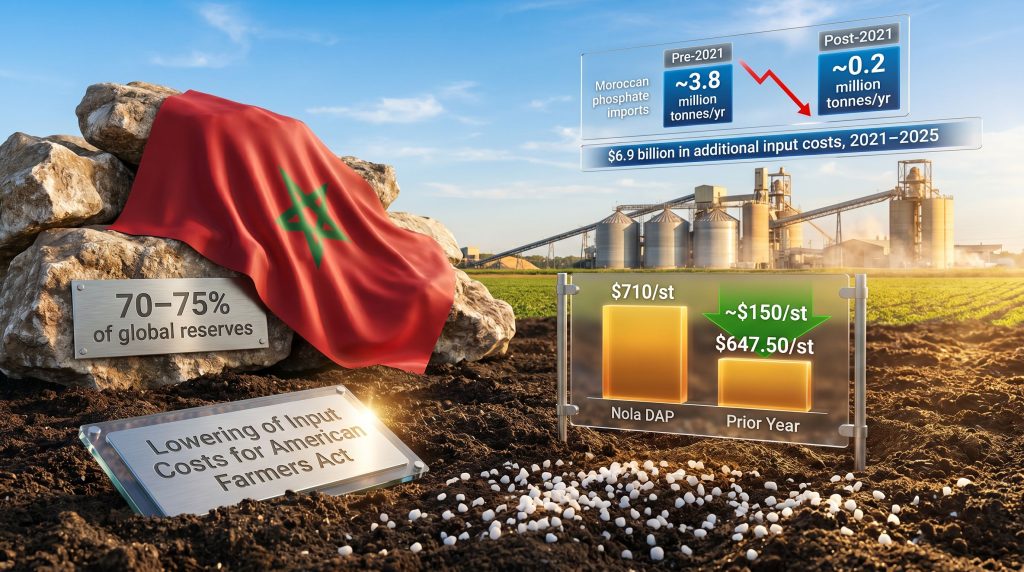
| Moroccan imports (P₂O₅ equivalent) | ~3.8 million tonnes/year | ~0.2 million tonnes/year |
| Combined U.S. DAP/MAP imports | Near record highs | ~182,300 tonnes/year |
| Moroccan phosphate imports (2025) | N/A | Zero |
| U.S. domestic price trend | Near historic norms | Structurally elevated |
By 2025, Moroccan phosphate imports into the United States had reached zero — a complete severance of what had been the single largest supply relationship in the U.S. phosphate import market. The residual import volumes that did enter the country came from higher-cost alternative suppliers, including producers in Jordan, Israel, and Tunisia, none of whom operate at the scale economies that allow OCP S.A. to compete at Moroccan cost levels.
The supply picture was further complicated by geopolitical disruption independent of U.S. trade policy. The ongoing Middle East Gulf conflict restricted Saudi Arabian seaborne phosphate volumes transiting the Strait of Hormuz, removing another source that had previously helped buffer U.S. supply. These two forces converged to produce a structurally tighter domestic market with reduced competitive pressure on U.S. producers.
The combination of import duties and geopolitical supply disruptions has effectively isolated U.S. farmers from the global phosphate market, creating a structurally elevated domestic price environment with few short-term remedies available through conventional market mechanisms.
The Lowering of Input Costs for American Farmers Act: What the Bill Would Actually Do
U.S. Senator Roger Marshall of Kansas announced plans to introduce the bill in late April 2026, targeting the direct repeal of countervailing duty orders on Moroccan phosphate fertiliser imports. The bill was unveiled alongside Department of Agriculture and White House cabinet officials as part of a broader coordinated effort to address farm input cost pressures, according to reporting by Argus Media on April 28, 2026.
The projected impact of full duty elimination is significant:
- Cost reduction magnitude: More than 20% reduction in phosphate fertiliser costs for U.S. farmers
- Dollar value: Approximately $150 per short ton in savings at current pricing
- Current price baseline: Nola DAP was assessed at approximately $710/st fob at the time of announcement
- Year-over-year comparison: Nola DAP stood at $647.50/st twelve months earlier, representing a roughly 9.6% increase over the prior year
- International benchmark context: India DAP was priced at approximately $865/t cfr, illustrating that while U.S. prices are elevated relative to historical norms, they remain below certain import market benchmarks
| Price Benchmark | Approximate Price | Pricing Basis |
|---|---|---|
| Nola DAP (April 2026) | ~$710/st | fob |
| Nola DAP (April 2025) | ~$647.50/st | fob |
| India DAP (April 2026) | ~$865/t | cfr |
| Estimated post-duty reduction | ~$560/st | Projected |
| Implied saving per short ton | ~$150/st | Projected |
The legislative mechanism matters as much as the price impact. By pursuing repeal through congressional action rather than waiting for the administrative sunset review process to conclude, the bill would bypass the standard evidentiary procedures that govern trade remedy reassessment. This distinction has significant implications for timing, certainty, and the ability of domestic producers to contest the outcome.
Two additional pieces of legislation were announced in parallel: the Fertiliser Price Transparency Act, designed to improve price visibility and accountability across the supply chain, and the Fertiliser Research Act, focused on long-term investment in domestic production efficiency and fertiliser innovation. Together, these bills represent a multi-pronged legislative approach to the fertiliser affordability issue rather than a single-point intervention.
The Sunset Review: A Parallel Process That Could Reshape the Outcome
Independent of the legislative proposal, a five-year sunset review of the 2021 phosphate CVD orders was already underway at the time of Senator Marshall's announcement. Under 19 U.S.C. § 1675, countervailing duty orders are subject to mandatory review approximately every five years to determine whether their continuation remains warranted. The U.S. Department of Commerce and the ITC conduct these reviews jointly, examining whether revocation of the duty orders would be likely to lead to a continuation or recurrence of subsidised imports and material injury to domestic producers.
The current sunset review was initiated approximately two months before the April 28, 2026 legislative announcement, placing its start date around late February 2026. Based on standard statutory timelines, the review would be expected to conclude somewhere between early 2027 and mid-2027, depending on the complexity of the evidentiary record.
A sunset review is a mandatory five-year evaluation conducted by the U.S. Department of Commerce and the International Trade Commission to assess whether existing countervailing duties should remain in place. If the review concludes that removing the duties would not cause renewed material injury to domestic producers, the orders can be revoked without congressional action.
This creates three distinct and competing pathways to potential duty removal, each with different characteristics:
- Legislative repeal via the Lowering of Input Costs for American Farmers Act: fastest pathway if enacted, bypasses administrative process, most durable against legal challenge
- Sunset review revocation: slower (12–18 months), follows established evidentiary procedures, allows domestic producers to formally contest removal
- Executive suspension: reported as a possibility under consideration in response to corn grower lobbying pressure, fastest of the three but potentially subject to legal challenge and reversal
The existence of three simultaneous pathways is itself unusual and reflects the degree of political pressure that has built around farm input costs. It also creates strategic uncertainty for market participants trying to price the likelihood and timeline of duty removal into forward purchasing decisions.
The $6.9 Billion Question: Who Bears the Cost?
Agricultural industry groups representing corn, soybean, and wheat producers have been the most vocal proponents of duty removal, and their cost quantification has become the central economic argument for reform. Ag groups calling for reform note that more than 50 state-level agricultural affiliates have formally urged revocation of the duty orders, citing a cumulative additional input cost burden of $6.9 billion imposed on U.S. programme crop farmers between 2021 and 2025.
That figure reflects the aggregate price premium U.S. farmers paid for phosphate fertiliser above what a competitive open-market price would have been, had Moroccan supply remained accessible. It translates to roughly $1.38 billion per year in additional costs spread across the corn belt, the plains wheat states, and major soybean-producing regions. For individual farm operations, this cost elevation affects both operating margins and the economics of fertiliser application decisions.
Policy tension: the debate pits domestic producer protection — a legitimate trade remedy objective — against agricultural input affordability, a food security and farm viability concern. Both represent valid policy goals, and the regulatory framework does not provide a straightforward mechanism for reconciling them when they conflict.
On the opposing side, U.S. phosphate producers including Mosaic and Simplot have consistently maintained that the CVD orders represent a legitimate and proportionate response to subsidised competition. Their core argument centres on OCP S.A.'s relationship with the Moroccan state, which they contend provides the company with financing, infrastructure, and resource access on terms unavailable to private commercial operators.
The next major ASX story will hit our subscribers first
Why Morocco Cannot Simply Be Replaced in the Global Phosphate Market
The Scale of Morocco's Reserve Dominance
A less commonly understood dimension of this debate is the degree to which Morocco's dominance in global phosphate reserves is not a temporary or contingent feature of the market but a geological reality with multi-generational permanence. Considering the distribution of global phosphate reserves, Morocco holds an estimated 70 to 75% of the world's known phosphate rock reserves — a resource endowment that no other country approaches.
OCP S.A. has built its operations around the Khouribga, Gantour, and Boucraâ phosphate basins, processing ore grades that allow for production cost structures fundamentally lower than most competing sources. This geological advantage has a practical implication that is frequently overlooked in trade policy discussions: any country that excludes Moroccan phosphate from its supply base is not simply choosing a different supplier. It is accepting a structurally higher cost floor for one of its most essential agricultural inputs.
The Grade Advantage That Cannot Be Replicated
The phosphate rock quality factor also matters considerably. OCP's Khouribga deposits, for example, yield high-grade ore with phosphate content in the range of 32 to 35% P₂O₅, which translates to lower processing costs per unit of finished fertiliser compared to lower-grade deposits in other producing regions. This grade advantage compounds over time into a durable cost per tonne advantage that alternative suppliers cannot easily replicate.
| Supplier Characteristic | Morocco (OCP S.A.) | Typical Alternative Sources |
|---|---|---|
| Share of global reserves | ~70–75% | Combined remainder |
| Phosphate rock grade (P₂O₅) | ~32–35% | Typically lower |
| Production cost structure | Among lowest globally | Generally higher |
| U.S. import volume (2025) | Zero | Limited residual volumes |
In addition, the question of US fertilizer import reliance underscores why finding meaningful alternative suppliers at equivalent scale remains so structurally challenging for American agriculture. Furthermore, domestic initiatives such as the Ammaroo phosphate project illustrate that efforts are underway globally to develop new supply sources, however these remain years away from materially altering the market balance.
Market Consequences of Duty Removal: Scenarios and Cautions
The following analysis involves forward-looking projections and market scenarios. These are speculative in nature and do not constitute financial or investment advice. Actual market outcomes will depend on numerous variables including legislative timelines, supply chain responsiveness, and global phosphate market dynamics.
If the bill to end Morocco phosphate duties is enacted, the immediate market consequences would likely unfold across several dimensions.
Short-term effects (0 to 12 months post-repeal):
- Moroccan supply would begin re-entering U.S. import channels, likely through existing terminal infrastructure along the Gulf Coast
- Competitive pressure on domestic U.S. producers would increase as Moroccan DAP and MAP entered the market at lower landed costs
- DAP and MAP prices at key benchmarks such as Nola could trend toward the projected $150/st reduction, though the pace would depend on how quickly supply chains reactivate
- Farmers applying fall nutrient programmes and early spring pre-plant applications would be the primary near-term beneficiaries
Medium and long-term structural considerations:
- Sustained duty removal would shift U.S. phosphate supply away from near-total domestic dependency toward a more diversified sourcing model
- Domestic producers facing renewed import competition might reduce capital expenditure on new capacity or, in a more adverse scenario, exit higher-cost production facilities
- A phased or conditional duty reduction structure, rather than immediate full repeal, could provide a transition period for domestic industry adjustment while still delivering meaningful cost relief to farmers
Residual geopolitical risks regardless of duty outcome:
- The loss of Saudi Arabian seaborne phosphate supply through the Strait of Hormuz is a structural constraint unrelated to U.S.-Morocco trade policy and persists under any duty scenario
- Morocco's own export priorities, including long-term supply agreements with Asian and African markets, could limit the volume of supply redirectable to the U.S. at short notice
- Any future deterioration in U.S.-Morocco diplomatic or trade relations could reintroduce supply vulnerability
Frequently Asked Questions: U.S. Phosphate Duties and the Proposed Bill
What are countervailing duties on Moroccan phosphate fertilisers?
Countervailing duties are trade remedy tariffs applied by the U.S. government to neutralise competitive advantages created by foreign government subsidies. The duties on Moroccan phosphate fertilisers were established in April 2021 following formal investigations by the Department of Commerce and the ITC, with rates ranging from approximately 16.6% to over 47% depending on the exporter, and OCP S.A. assessed at 19.97%.
How much have U.S. phosphate prices risen since 2021?
Nola DAP was assessed at approximately $710/st fob at the time of the April 2026 legislative announcement, up from $647.50/st twelve months earlier. Prior to the 2021 duties, U.S. phosphate prices benefited from greater import competition, contributing to lower price levels across the market.
What would the proposed legislation actually achieve?
The Lowering of Input Costs for American Farmers Act, introduced by Senator Roger Marshall of Kansas, would repeal the April 2021 CVD orders on Moroccan phosphate fertilisers. If enacted, it is projected to reduce phosphate fertiliser costs by more than 20%, or approximately $150 per short ton, restoring competitive supply access for U.S. farmers.
What has the cumulative cost to U.S. farmers been?
Agricultural industry coalitions representing over 50 state-level affiliates estimate that the CVD orders contributed to approximately $6.9 billion in additional input costs for U.S. programme crop farmers between 2021 and 2025, equivalent to roughly $1.38 billion per year.
What is a sunset review and how does it differ from the proposed bill?
A sunset review is the standard administrative mechanism under U.S. trade law for evaluating whether existing duty orders remain justified after five years. The current review of the 2021 phosphate duties was initiated approximately two months before the April 2026 legislative announcement. The proposed bill to end Morocco phosphate duties would bypass this administrative process by legislatively repealing the duties, potentially delivering a faster outcome through a different procedural pathway.
Why does Morocco's reserve position matter so much to this debate?
Morocco holds an estimated 70 to 75% of the world's known phosphate rock reserves, giving OCP S.A. a scale and cost advantage over virtually all competing suppliers. This means the U.S. decision to restrict Moroccan imports is not simply a trade policy choice between interchangeable suppliers — it is a decision to accept a structurally higher cost base for a non-substitutable agricultural input, with long-term implications for farm economics.
The Road Ahead for U.S. Phosphate Trade Policy
The convergence of legislative action, an active sunset review, and reported executive consideration of suspension options makes the current moment unusually consequential for U.S. phosphate policy. Each pathway carries different probabilities, timelines, and stakeholder implications, and the outcome of any one of them could effectively render the others moot.
What is not in dispute is the underlying economic pressure. The $6.9 billion cost burden accumulated between 2021 and 2025 represents a structural tax on American agricultural productivity with no corresponding domestic supply security benefit proportionate to its magnitude. Phosphate is not a strategic mineral in the same sense as critical technology metals — it is a crop nutrient without which yields fall and food production contracts.
The policy question is therefore not whether to protect domestic producers or to support farmers. Both matter. The more precise question is whether the original injury determination from 2021 still reflects current market conditions, and whether the costs imposed on the downstream agricultural economy are proportionate to the protection being provided. Those are precisely the questions the sunset review is designed to answer, and the questions the bill to end Morocco phosphate duties would sidestep in the interest of speed.
For U.S. farmers, the pricing mathematics are straightforward: a reduction from $710/st to approximately $560/st for Nola DAP would represent meaningful relief in the context of compressed margins across corn, soybean, and wheat production. Whether that relief arrives through the Senate floor, the ITC hearing room, or an executive order remains the open variable in one of American agriculture's most consequential regulatory debates.
Want To Stay Ahead of the Next Major Mineral Discovery Shaping Global Commodity Markets?
While phosphate policy debates highlight how supply disruptions and geopolitical pressures can reshape entire commodity sectors, Discovery Alert's proprietary Discovery IQ model delivers real-time alerts on significant ASX mineral discoveries — instantly translating complex geological data into actionable investment opportunities for investors at every level. Explore how historic discoveries have generated extraordinary returns and begin a 14-day free trial today to position yourself ahead of the broader market.