May 12, 2026
When Fertilizer Giants Stumble: Understanding the Forces Behind a $496 Million Earnings Reversal
The global fertilizer industry operates on a knife-edge of intersecting variables: commodity pricing cycles, agricultural demand patterns, raw material availability, currency fluctuations, and geopolitical dynamics affecting supply chains that span multiple continents. When conditions across several of these variables deteriorate simultaneously, the financial consequences can be dramatic, even for the world's largest producers. The first quarter of 2026 delivered precisely this kind of convergence for one of the sector's most prominent players, producing an earnings outcome that has reverberated across analyst desks and investment portfolios alike.
Understanding how a company moves from $238 million in net income to a $258 million net loss within a single year requires more than reading a headline. It demands a granular look at production economics, geographic risk exposure, cost structure management, and the structural forces reshaping how fertilizers are priced and produced on a global scale. Furthermore, the interplay between commodity prices and miners across the sector adds additional complexity to this picture.
When big ASX news breaks, our subscribers know first
From Profit to Loss: Anatomy of the Mosaic First Quarter Loss in 2026
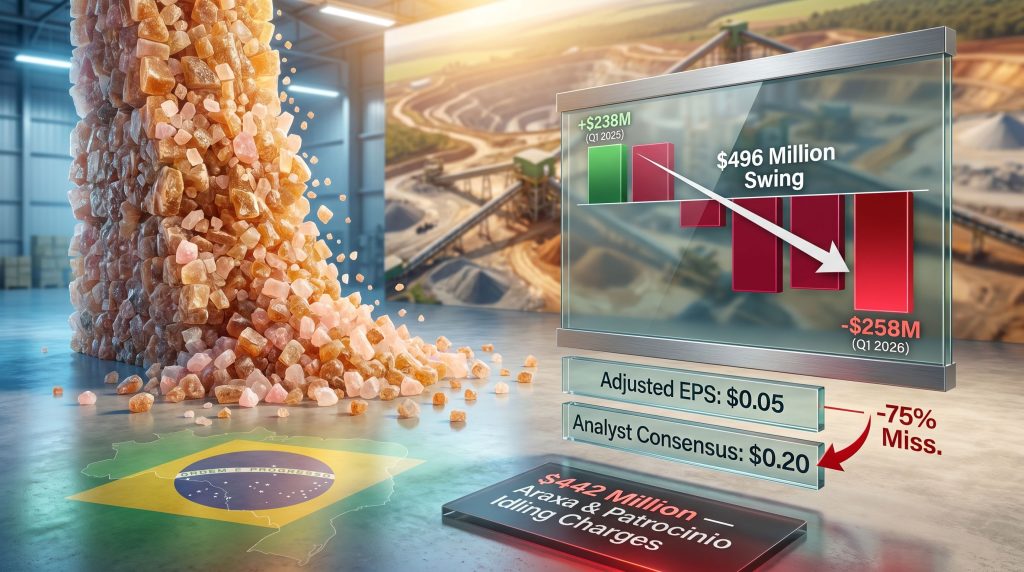
The scale of the Mosaic first quarter loss becomes most striking when viewed as a year-over-year comparison. The company reported a net loss of $258 million for Q1 2026, against net income of $238 million recorded in Q1 2025. That single-year swing of approximately $496 million places this among the more significant quarterly earnings reversals in the company's recent history.
Adjusted earnings per share came in at just $0.05, falling well short of the analyst consensus estimate of $0.20, representing a miss of roughly 75%. For a company of Mosaic's scale and operational footprint, a miss of this magnitude typically triggers downward revisions to forward estimates across the fertilizer sector more broadly.
Adjusted EBITDA for the quarter reached $416 million, which, while still positive, reflects the degree of cost-side pressure that eroded profitability despite relatively resilient top-line revenue figures. Net sales came in at approximately $2,998 million, underscoring that the Q1 loss was not primarily a demand destruction story but rather a cost structure and exceptional charges event.
| Financial Metric | Q1 2026 | Q1 2025 |
|---|---|---|
| Net Income / (Loss) | -$258 million | +$238 million |
| Year-over-Year Swing | -$496 million | N/A |
| Net Sales | ~$2,998 million | Comparable |
| Gross Margin | $236 million (8%) | Higher |
| Operating Earnings | -$372 million | Positive |
| Adjusted EBITDA | $416 million | Higher |
| Adjusted EPS | $0.05 | Positive |
| Analyst EPS Consensus | $0.20 | N/A |
| EPS Miss Margin | ~75% | N/A |
The $442 Million Brazilian Facility Charges: A Deeper Look at Araxa and Patrocinio
The most consequential single driver of the Q1 result was $442 million in charges tied to the idling of the Araxa and Patrocinio production facilities in Brazil, which formed the core of $323 million in total pre-tax notable items recorded during the quarter.
Araxa and Patrocinio are phosphate mining and processing operations located in the state of Minas Gerais, Brazil. Phosphate rock mined at these sites feeds into fertilizer production chains serving South American agricultural markets. The decision to idle these facilities reflects a deliberate capacity management response to raw material constraints rather than an uncontrolled operational failure.
However, the financial charges associated with idling at this scale, including asset impairments, workforce adjustments, and facility preservation costs, concentrated significant one-time expense into a single reporting period. In addition, these challenges echo broader mining consolidation trends playing out across the global resources sector.
The magnitude of asset charges tied to a deliberate operational decision illustrates a critical but often overlooked principle in mining economics: the cost of not producing can sometimes rival the cost of producing at a loss when long-term asset value and market positioning are factored in.
Restructuring costs and foreign currency translation losses added further drag beyond the facility-specific charges, reflecting the financial complexity of managing a multi-continent operation across currencies with divergent macroeconomic trajectories.
Segment-by-Segment Breakdown: Where the Pressure Landed
Phosphate Division: Raw Material Constraints and a May Curtailment Window
The phosphate segment recorded sales volumes of 1.9 million tonnes in Q1 2026. Sequential recovery into a range of 1.7 to 1.9 million tonnes is anticipated in subsequent quarters, though this projection carries meaningful uncertainty given the announced production adjustments.
Operationally, the quarter was not without positives. Phosphoric acid production at three key facilities, Riverview, Bartow, and Faustina, operated at target rates during the period. A major maintenance turnaround was successfully completed at the New Wales facility in Florida during March 2026, which, while temporarily affecting throughput, positions that asset for improved reliability going forward.
The more concerning development is the formal review of the US and Brazil phosphate production plan currently underway as a direct consequence of raw material supply constraints. Partial production curtailments are scheduled to commence in May 2026, creating a sequential pressure point that is likely to weigh on Q2 phosphate volumes. Projects such as the Ammaroo phosphate project in Australia demonstrate how global phosphate supply diversity remains a strategic priority for the industry.
It is worth noting that raw material constraints in phosphate production typically centre on sulfuric acid availability, ammonia supply, or, critically, access to phosphate rock feedstock of sufficient grade and quantity. When input supply chains tighten, the economic calculus of maintaining full production rates can quickly shift from value-accretive to value-destructive.
Potash Division: Volumes Holding Amid Pricing Volatility
Potash segment sales volumes reached 2.2 million tonnes in Q1 2026, with potash revenue coming in at approximately $667 million. Potash operations are anchored in Saskatchewan, Canada, one of the world's most significant potash-producing regions, with additional operations in Florida, USA.
Mosaic's North American footprint encompasses seven potash and phosphate mining facilities alongside five phosphate concentrate sites in Louisiana and Florida. The geographic concentration of potash production in Saskatchewan provides operational stability but also exposes the segment to pricing dynamics heavily influenced by global supply decisions from major producing nations.
Potash pricing in global markets is particularly sensitive to production and export volumes from Canada, Russia, and Belarus, where Canpotex, Uralkali, and Belaruskali collectively account for the majority of traded supply. Any shift in the volume or pricing strategies of these dominant producers filters through to competitive dynamics for all major potash sellers, including Mosaic.
Mosaic Fertilizantes: South American Scale and Currency Complexity
The South American segment recorded Q1 2026 sales volumes of 1.6 million tonnes, operating across an extensive Brazilian infrastructure network that includes 13 production facilities, 7 tolling operations, 1 port terminal, and approximately 6.6 million tonnes of blending capacity. Head office operations are based in São Paulo, Brazil, with regional commercial and production facilities extending into Paraguay and Peru.
This geographic breadth creates natural currency risk exposure. The Brazilian Real (BRL) has experienced considerable volatility against the US dollar in recent years, and Mosaic reports in USD. When the BRL weakens, the dollar value of Brazilian-sourced revenues compresses even when local operating conditions remain stable, adding a layer of earnings unpredictability that purely domestic producers do not face.
Brazil's agricultural sector is one of the largest fertilizer consumers on the planet, and Mosaic's South American footprint is strategically positioned to serve that demand. However, scale alone cannot insulate the segment from input cost inflation, currency movements, and the financial weight of facility restructuring decisions.
Capital Discipline and Strategic Response
In response to the challenging operating environment, management has implemented a clear capital preservation framework built around three core actions:
- Production curtailment of uneconomic output to protect per-unit margins and avoid compounding losses at the facility level.
- Working capital management as a primary cash flow lever, prioritising receivables, payables, and inventory optimisation over growth-oriented spending.
- Capital expenditure deferral, with full-year capex guidance revised down to $1.25 billion from an earlier higher baseline, reflecting the postponement of projects deemed less time-sensitive in the current environment.
The capex reduction preserves balance sheet flexibility but also signals that growth investment is being subordinated to near-term financial resilience. For investors monitoring long-term production capacity trajectories, this is an important distinction: deferred spending today may translate to constrained output growth capacity in future periods when market conditions potentially recover.
Despite the net loss, the company maintained its regular common dividend of $0.22 per share during Q1 2026. Dividend continuity in the face of a significant quarterly loss signals board-level confidence in the medium-term cash generation capacity of the underlying business and is likely intended to provide investors with a degree of earnings stability assurance.
Broader Fertilizer Market Context: Why 2026 Is a Difficult Year for the Sector
Mosaic's Q1 results do not exist in isolation. The global fertilizer market in 2026 is navigating a challenging structural environment shaped by several converging forces:
- Commodity price compression across both potash and phosphate markets has reduced per-tonne margins industry-wide, as excess supply from certain producing regions intersects with demand-side uncertainty tied to agricultural commodity prices.
- Input cost inflation for energy, sulfuric acid, and other raw materials used in fertilizer processing continues to pressure production economics globally, particularly for producers with energy-intensive operations.
- Chinese phosphate export policy remains a critical variable. China is the world's largest phosphate exporter, and its periodic imposition or relaxation of export restrictions directly influences global phosphate price benchmarks.
- Indian demand cycles for both potash and phosphate create seasonal and policy-driven demand pulses that can either support or compress international pricing depending on subsidy structures and monsoon-season agricultural performance.
- Currency headwinds in South America have amplified earnings volatility for companies with significant regional exposure, as BRL weakness erodes the reported dollar value of local operations.
Gross margin compression to just $236 million, representing approximately 8% of net sales, is perhaps the clearest single indicator of the margin environment facing the business. When gross margin as a percentage of revenue falls to single digits, it leaves minimal buffer to absorb exceptional charges, restructuring costs, or currency losses without translating into bottom-line losses. Consequently, US fertilizer import reliance becomes an increasingly relevant concern when domestic producers face sustained margin compression of this kind.
Furthermore, emerging supply alternatives such as the Toolse phosphate project in Estonia highlight how the global phosphate industry is actively seeking new sources of supply to reduce concentration risk and shore up supply chain resilience.
Key Risk Factors Investors Should Watch Through the Remainder of 2026
The following risk considerations are based on publicly disclosed operational and financial information. They do not constitute financial advice. Investors should conduct independent due diligence and consult qualified advisors before making investment decisions.
Production Curtailment Cascade Risk
The May 2026 partial curtailments in both the US and Brazil create a compound supply reduction scenario at a time when the phosphate segment is already managing the absence of Araxa and Patrocinio capacity. If raw material constraints persist beyond initial projections, the curtailment period may extend or deepen, creating Q2 volume headwinds beyond current guidance.
Commodity Price Recovery Sensitivity
Given the operational leverage inherent in large-scale mining and chemical processing, even a moderate recovery in potash or phosphate benchmark pricing could materially improve earnings. The flip side is equally true: sustained price weakness at current levels would continue to compress margins across a cost base that has limited short-term flexibility.
Currency and Geopolitical Exposure in South America
Mosaic's extensive Brazilian operations create significant BRL/USD translation risk that is difficult to fully hedge at scale. Macroeconomic instability in Brazil, including inflation dynamics and central bank policy decisions, adds a dimension of earnings unpredictability that North American-focused producers do not face to the same degree.
Analyst Estimate Revision Dynamics
A 75% miss against consensus EPS expectations typically initiates a cycle of downward analyst estimate revisions that can weigh on investor sentiment beyond the immediate reporting period. Monitoring forward estimates and how sell-side models adjust to incorporate the May curtailments and revised capex guidance will be important for tracking market expectations through the remainder of 2026.
The next major ASX story will hit our subscribers first
Frequently Asked Questions: Mosaic First Quarter Loss 2026
What caused Mosaic's first quarter loss in 2026?
The Q1 2026 net loss of $258 million was driven primarily by $323 million in pre-tax notable items, the largest component of which was $442 million in charges associated with idling the Araxa and Patrocinio facilities in Brazil. Restructuring costs and foreign currency losses contributed additional pressure.
How significant was the year-over-year earnings swing?
The move from $238 million in net income in Q1 2025 to a $258 million net loss in Q1 2026 represents a year-over-year deterioration of approximately $496 million, one of the most substantial single-quarter earnings reversals in Mosaic's recent operating history.
Did Mosaic miss analyst expectations in Q1 2026?
Yes. Adjusted EPS of $0.05 fell approximately 75% below the analyst consensus estimate of $0.20, a miss likely to prompt downward revisions to full-year earnings forecasts.
What are Mosaic's Q1 2026 sales volumes by segment?
- Phosphate: 1.9 million tonnes
- Potash: 2.2 million tonnes
- Mosaic Fertilizantes (South America): 1.6 million tonnes
Is Mosaic still paying dividends despite the Q1 loss?
Yes. Mosaic paid a regular common dividend of $0.22 per share during Q1 2026, maintaining shareholder returns despite the net loss.
What is Mosaic's revised capital expenditure guidance for 2026?
Full-year capex guidance has been revised to $1.25 billion, reflecting the deferral of less time-sensitive investment projects as part of a broader capital discipline response to current market conditions.
What Mosaic's Q1 2026 Results Signal for the Fertilizer Sector
The Mosaic first quarter loss of 2026 functions as more than a company-specific event. It serves as a barometer for the structural pressures compressing margins across the global fertilizer industry. Several broader conclusions can be drawn:
- Revenue stability without margin protection is insufficient to prevent significant net losses when cost structures deteriorate across multiple fronts simultaneously.
- Deliberate capacity management through facility idling and production curtailment, while generating significant short-term charges, may be preferable to sustaining uneconomic output that deepens per-unit losses.
- Companies with extensive South American exposure face an additional layer of earnings complexity tied to currency dynamics that can amplify or dampen underlying operational performance.
- The fertilizer sector's pricing recovery outlook depends heavily on variables outside any single company's control, including Chinese export policy decisions, Indian subsidy structures, and the production strategies of state-owned or state-linked producers in Russia and Belarus.
For market observers and sector investors, Mosaic's Q1 2026 results offer both a warning and a framework: the path back to profitability exists, but it runs through raw material supply normalisation, fertilizer price recovery, and disciplined cost management over the quarters ahead.
Want to Spot the Next Major Mineral Discovery Before the Market Reacts?
While fertiliser giants navigate margin compression and earnings reversals, Discovery Alert's proprietary Discovery IQ model delivers real-time alerts on significant ASX mineral discoveries, transforming complex resource data into actionable investment insights — explore historic discoveries and their returns to see what's possible, and begin your 14-day free trial today to position yourself ahead of the broader market.