June 18, 2026
When Precious Metals Momentum Meets Critical Minerals Strategy
Silver rarely commands the attention of institutional capital markets the way gold does. Yet in 2026, a confluence of industrial demand, geopolitical supply chain fragility, and multi-year commodity price momentum has repositioned silver at the intersection of monetary safe-haven demand and critical technology inputs. Against this backdrop, the Sunshine Silver Mining & Refining Company US IPO represents something genuinely uncommon in the modern resource equities landscape.
Understanding what makes this moment significant requires looking beyond a single company filing and examining the structural forces reshaping how investors, governments, and industrial buyers think about domestic silver and critical mineral supply.
When big ASX news breaks, our subscribers know first
Why Precious Metals Are Dominating Capital Markets Attention in 2026
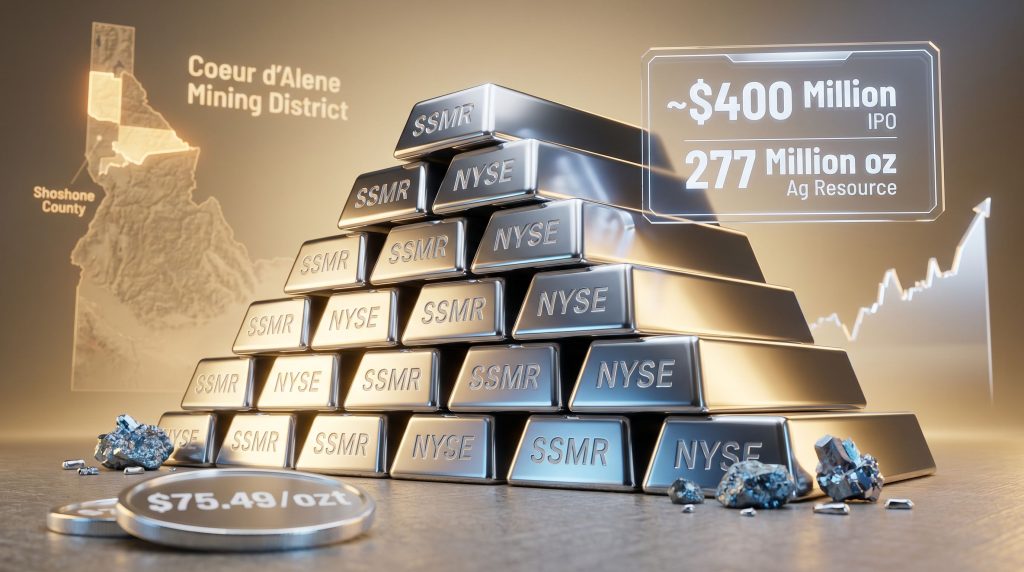
As of May 11, 2026, commodity markets are painting an extraordinary picture. Silver futures are trading at $75.495 per troy ounce, reflecting a 7.47% single-session gain, a move that underscores just how compressed market positioning had become heading into this price breakout. Gold futures are trading above $4,713 per troy ounce, up 3.84% on the day, while copper is approaching record territory near $5.64 per pound, advancing 2.72% in a single session despite ongoing geopolitical uncertainty.
These are not minor fluctuations. A 7.47% daily move in silver futures represents the kind of volatility that forces institutional portfolio managers to reassess allocation decisions. For investors evaluating pre-production mining equities, that kind of price action creates a very different risk-reward calculation than a flat or declining commodity environment.
The IPO Market's Fragile Recovery
The broader IPO market context matters here. Market participants have observed a gradual pickup in listing activity, but the recovery remains sensitive to macro shocks. Geopolitical uncertainty, stemming partly from the Iran conflict that has already impacted fertiliser production, has kept investor risk appetite selectively deployed rather than broadly open.
This creates an interesting dynamic for a resource IPO. On one hand, volatile macro conditions suppress risk appetite. On the other, elevated commodity prices generate compelling project economics and newsflow that can attract specialist investors even when generalist appetite is cautious. Consequently, deals with institutional-grade credentials, strong commodity exposure, and strategic positioning tend to get a hearing that smaller or less differentiated offerings might not.
Silver's Dual Identity as Monetary and Industrial Metal
What differentiates silver from most other commodities is its unusual split identity. Silver's dual role as a monetary store of value and a critical industrial input gives it an unusual demand profile — one that is correlated with gold during risk-off periods whilst simultaneously expanding through photovoltaic solar cells, electric vehicle components, advanced electronics, and defence technologies.
The industrial demand thesis is structural, not cyclical. Solar panel manufacturing alone has materially expanded silver consumption over the past decade, and electrification trends in transportation and grid infrastructure continue pushing that demand floor higher. Furthermore, silver supply deficits have become an increasingly important narrative for commodity analysts in 2025 and beyond. A primary silver producer entering the market at this point in the cycle is therefore leveraged to both monetary and long-duration industrial consumption.
The Strategic Case for a Domestic U.S. Silver Producer
Pure-play U.S.-domiciled primary silver producers are exceptionally rare on major exchanges. Most domestic silver production arrives as a by-product of copper, lead, zinc, and gold operations, meaning the silver output is incidental to the primary mine economics. This structural characteristic means that investors seeking direct silver exposure through U.S.-listed equities have historically had very limited options.
The reasons are partly geological, partly economic. Silver mineralisation that is economic to mine as a primary product typically requires exceptionally high grades, because silver's price per tonne of ore is lower than gold. This means only a small number of deposits globally justify primary silver mining economics, and even fewer of those are located in U.S. jurisdictions with the infrastructure, permitting clarity, and workforce depth to support development.
Against that backdrop, the Sunshine Silver Mining & Refining Company US IPO represents something genuinely distinctive: a high-grade, historically proven asset in an established U.S. mining district, controlled by well-capitalised sponsors, seeking a public listing at a moment when silver's price is near multi-year highs and critical minerals demand is under unprecedented policy scrutiny.
What Is Sunshine Silver Mining and Refining Company?
The company, which plans to list on the NYSE under the ticker symbol SSMR, is developing what it characterises as a permitted, restart-ready operation at the Sunshine complex in Idaho's Coeur d'Alene Mining District. The target is a 2028 production commencement, with primary output being silver alongside critical mineral co-products including antimony, and base metal by-products of copper and lead.
The asset has deep roots. The Coeur d'Alene Mining District in Shoshone County, Idaho, is one of North America's most historically productive silver-producing regions, with a track record that extends back over a century. Historical output from the Sunshine Mine alone is reported to have exceeded 360 million ounces of silver, making it one of the most prolific individual silver mines in American history.
Electrum Group's Role and Capital Deployment
The asset was acquired by Electrum Group in 2010, beginning a long-cycle private investment and development programme that has persisted through multiple silver price cycles. Total capital deployed since acquisition reportedly exceeds $250 million, with more than $180 million directed specifically toward exploration, land position expansion, and infrastructure upgrades. The land position itself has grown by nearly four times its 2010 size as part of a systematic district-consolidation strategy.
Importantly, the company is reported to be entering the IPO process with a debt-free balance sheet, following a $75 million equity financing round closed in September 2025 led by Electrum Silver US LLC. In a capital-intensive sector where overleveraged balance sheets frequently destroy shareholder value during commodity downturns, this structural characteristic deserves attention.
The Banking Syndicate and What It Signals
The selection of Morgan Stanley, Scotiabank (Bank of Nova Scotia), and BMO Capital Markets (Bank of Montreal) as joint lead book-running managers is not accidental. All three institutions maintain significant natural resources investment banking franchises. Their combined involvement signals that the deal has been structured with institutional distribution in mind, targeting sophisticated resource investors, family offices, and sector-specialist funds rather than purely retail participation.
The presence of both U.S. and Canadian banking institutions is also notable, reflecting the cross-border investor base that typically engages with large precious metals listings. Canadian institutional investors and mining-focused funds have historically provided anchor support for significant precious metals IPOs, and their involvement through Scotiabank and BMO creates a natural conduit to that capital pool.
Inside the Sunshine Mine: Grades, Resources, and Geology
Resource Estimate Breakdown
The mineral resource base underpinning the Sunshine Silver Mining & Refining Company US IPO is reported to be substantial both in scale and in grade quality:
| Resource Category | Tonnage | Silver Grade | Contained Silver |
|---|---|---|---|
| Indicated | 3.3 million tonnes | 1,067 g/t Ag | ~112 million oz |
| Inferred | 6.4 million tonnes | 797 g/t Ag | ~165 million oz |
| Combined Total | 9.7 million tonnes | Mixed | ~277 million oz |
To put these grades in context, the global average silver grade for operating mines sits materially below 200 g/t in most cases. A deposit grading above 1,000 g/t silver in its indicated category places the Sunshine resource in genuinely rare territory globally. High-grade silver deposits are important not just because they contain more silver per tonne, but because they typically generate lower unit processing costs, higher metallurgical recovery rates, and stronger project economics across a wider range of silver price scenarios.
What High-Grade Silver Mineralisation Means in Practice
The technical significance of grade is often underappreciated by non-specialist investors. In underground silver mining, grade directly determines the economics of ore extraction at depth. Higher grades allow operators to selectively mine thinner or more structurally complex veins while still maintaining positive mine margins.
They also reduce the volume of rock that must be moved, crushed, and processed to generate a given amount of payable silver, which translates directly to lower energy costs, a smaller processing footprint, and reduced tailings volumes per ounce recovered. The Coeur d'Alene district's geology is characterised by silver-bearing veins hosted in metasedimentary rocks, a structural setting that tends to produce concentrated, high-grade mineralisation in discrete zones rather than lower-grade bulk tonnage deposits.
By-Product and Critical Mineral Profile
Beyond silver, the Sunshine complex is reported to carry a critical mineral co-product suite of significant strategic value:
- Antimony — the primary critical mineral co-product and a U.S. nationally designated strategic material
- Copper — an industrial by-product with independent market value benefiting from the same electrification demand driving broader commodity strength
- Lead — a traditional base metal by-product
- Gallium and Germanium — high-technology critical minerals with applications in semiconductor manufacturing and defence optical systems
The combination of these co-products transforms the economic and strategic character of the project from a straightforward precious metals play into something considerably more complex and arguably more defensible.
The Antimony Dimension: Why This Is the Strategic Wild Card
Of all the co-products associated with the Sunshine complex, antimony commands the most immediate strategic attention. China currently controls the dominant share of global antimony supply, a concentration that has been formally identified as a national security vulnerability by the U.S. government. The scale of antimony supply risks to U.S. defence and industrial sectors has accelerated policy urgency considerably.
Antimony is used in flame retardants, ammunition primers, semiconductors, and military-grade equipment, making its supply chain a legitimate defence and industrial concern rather than merely a commodity market issue. U.S. domestic antimony production is currently negligible, and there is no operating U.S. primary antimony producer of scale, creating a supply gap that imported material, predominantly from China, currently fills almost entirely.
Projected U.S. Antimony Demand Coverage
| Timeline | Projected U.S. Antimony Demand Coverage |
|---|---|
| 2028 (Initial Production) | Approximately 40% of U.S. domestic demand |
| 2031 (Full Production Ramp) | Approximately 80% of U.S. domestic demand |
If accurate, these projections would represent a transformative shift in the domestic antimony supply picture. Moving from near-zero domestic production to covering 80% of U.S. demand within five years would not go unnoticed by industrial buyers, defence procurement agencies, or policy makers focused on supply chain resilience. In addition, strategic antimony funding initiatives already underway elsewhere in the sector illustrate just how seriously the U.S. government is treating this supply gap.
The Refinery Advantage: A Structural Competitive Moat
Perhaps the most strategically significant but least widely understood aspect of the Sunshine Silver Mining & Refining Company US IPO is the company's reported refinery position. The company operates a COMEX-approved refinery that is described as the only U.S. facility currently permitted for large-scale processing of antimony, gallium, and germanium, in addition to its silver refining function.
This vertical integration from underground mine through to refined, deliverable output creates a structural competitive position that is difficult to replicate. A new entrant seeking to compete in domestic critical mineral processing would need to not only find a comparable ore body, but also construct and certify a new refinery from scratch — a process that takes years and costs hundreds of millions of dollars under the best of circumstances.
The refinery's designed capacity to process third-party concentrates adds a further dimension. Revenue streams derived from processing concentrate produced by other mining operations are independent of the company's own mine output, creating a degree of economic diversification unusual for a development-stage company. This processing-as-a-service capability makes the business model closer to an integrated critical minerals infrastructure operator than a conventional single-asset miner.
"The combination of a high-grade silver mine, a domestic antimony supply position, and a certified refinery capable of processing gallium and germanium distinguishes this from typical mining IPOs in ways that matter to strategic investors as much as financial ones."
The next major ASX story will hit our subscribers first
How the $400 Million IPO Fits Into the Capital Strategy
IPO Sizing and Use of Proceeds
The target gross IPO raise is approximately $400 million, with proceeds earmarked for full development and production restart of the Sunshine complex. This follows the $75 million private equity round closed in September 2025, meaning the IPO is not a rescue financing but rather a staged capital programme advancing a development-ready asset toward production.
| Capital Event | Amount | Structure | Lead Party |
|---|---|---|---|
| September 2025 Private Round | $75 million | Private equity | Electrum Silver US LLC |
| 2026 IPO Target | ~$400 million | Public equity (NYSE) | Morgan Stanley / Scotiabank / BMO |
| Cumulative Capital Deployed (since 2010) | $250 million+ | Multi-round private | Electrum Group |
The $400 million target represents a significant scaling-up from prior private financing rounds, but the project's development stage, combined with current silver and antimony market conditions, provides the valuation context for that ambition.
Historical Precedent: The 2011 Filing Comparison
The current IPO attempt is not without historical precedent within this same asset's lifecycle. A predecessor entity filed for a $250 million NYSE IPO in 2011 under the proposed ticker symbol "AGS." That earlier attempt combined the Sunshine Mine with a Mexican silver asset, the Los Gatos project, which was subsequently developed separately by Gatos Silver Inc. (NYSE: GATO), completing its own IPO in 2020 at $7 per share, raising approximately $150 million.
| Transaction | Year | Exchange | Target Raise | Outcome |
|---|---|---|---|---|
| Sunshine Silver Mines (predecessor) | 2011 | NYSE (proposed) | $250 million | Did not proceed |
| Gatos Silver Inc. (related asset) | 2020 | NYSE | ~$150 million | Completed |
| Sunshine Silver Mining & Refining (SSMR) | 2026 | NYSE (SSMR) | ~$400 million | Filing stage |
The 2026 target of $400 million represents a 60% premium to the 2011 attempt. That gap reflects both the cumulative capital deployed in asset development over the intervening 15 years and the materially different silver price environment. Silver in 2011 briefly touched $50 per troy ounce before retreating sharply; silver in May 2026 is trading above $75 per troy ounce with strong industrial demand support underpinning the move.
The failure of the 2011 filing is worth examining because it illustrates execution risk that is independent of asset quality. Market conditions, deal structure, and investor appetite can all derail a technically sound transaction. The fact that the current attempt is backed by more development capital, a more substantial resource base, and a post-production refinery position may differentiate it meaningfully from its predecessor — however, the precedent should inform investor caution.
The Federal Critical Minerals Backdrop
In May 2026, the Trump administration's $18.6 billion federal critical minerals funding initiative provides important policy context, though it is important to distinguish between sector-level policy tailwinds and project-specific support. The funding package — which BMO analysis breaks down into approximately $15.9 billion in loans, $2.1 billion in equity investments, and $615 million in grants — is described as allocated unevenly, with rare earths receiving the largest share.
Antimony, gallium, and germanium, all co-products of the Sunshine complex, appear on the official U.S. Critical Minerals List published by the USGS. Critical minerals designation does not automatically confer government financial support, but it does shape procurement priorities, import controls, research funding, and the regulatory environment in ways that can benefit domestic producers operating in those material categories.
Key Investment Risks Investors Should Evaluate
Development and Execution Risk
The 2028 production target means investors are being asked to fund a development programme with a two-year runway before revenue generation begins. Underground mining operations carry inherent geological, geotechnical, ventilation, and cost escalation risks that can extend timelines and expand capital requirements. No current revenue is being generated by the mine, meaning the company is entirely dependent on the IPO proceeds and existing cash to execute its development plan.
Commodity Price Sensitivity
The project's economics at current silver prices near $75 per troy ounce are very different from the economics at $35 or $40 per troy ounce. If the silver price environment deteriorates materially between the IPO date and first production in 2028, the project's net present value could compress significantly, affecting the stock price well before any ounce is mined. Silver's historical volatility — including its 50% price collapse from 2011 peaks — is a relevant risk frame even in a structurally supportive demand environment.
Geopolitical and Regulatory Considerations
- Idaho mining operations require compliance with federal and state environmental permitting frameworks
- Water rights, air quality permits, and tailings management requirements are all subject to regulatory review
- Any changes to U.S. critical minerals policy priorities could alter the competitive landscape
- Middle East geopolitical instability is currently contributing to broad market volatility that affects IPO timing and pricing windows
- China's potential response to growing U.S. domestic critical mineral production could include export restrictions or pricing strategies affecting antimony market dynamics
IPO Market Timing Risk
The IPO market recovery described as fragile means that deal windows can close rapidly if macro conditions shift. As of May 2026, no confirmed pricing date or final IPO price range has been announced. The S-1 registration statement has been filed with the SEC, but the timeline from filing to pricing to trading is subject to regulatory review periods, book-building dynamics, and market conditions that remain fluid.
This article is informational in nature and does not constitute financial advice. Investing in pre-production mining companies involves substantial risk of capital loss. Readers should conduct their own due diligence and consult qualified financial advisors before making investment decisions.
What the Sunshine Silver IPO Signals for the Broader Sector
If the Sunshine Silver Mining & Refining Company US IPO proceeds as planned and achieves its $400 million fundraising target, it would represent one of the larger precious metals IPOs on a U.S. exchange in recent years. More significantly, the production restart of the Sunshine complex is reported to have the potential to increase total U.S. primary silver output by approximately 20%, a meaningful contribution to domestic supply that has historically relied heavily on by-product silver from base metals operations and on imports.
For the broader silver sector, a successful high-profile listing at current price levels would likely renew institutional interest in other development-stage silver assets, many of which have remained underfunded through the years of subdued silver prices between 2013 and 2023. The combination of a primary silver producer with a domestic critical minerals processing capability and no direct domestic competitor in antimony, gallium, and germanium refining creates a template that is genuinely new to U.S. equity markets.
Silver's Industrial Demand Trajectory
The structural shift in silver's demand profile toward industrial applications — particularly photovoltaic manufacturing, EV components, and advanced electronics — supports a higher long-term price floor than historical monetary-demand models would suggest. This demand trajectory, combined with constrained primary silver supply growth globally, provides a more durable economic foundation for high-grade development projects than the volatile monetary price cycles of earlier decades.
Investors following the Sunshine Silver Mining & Refining Company US IPO should monitor several key milestones in the months ahead: the confirmed IPO pricing range as it emerges from book-building, any SEC review correspondence that may affect the filing timeline, quarterly updates on silver and antimony price trajectories, and any company disclosures regarding the status of third-party concentrate processing agreements that would indicate early refinery revenue potential independent of mine development progress.
Ready to Capitalise on the Next Major Mineral Discovery Before the Broader Market?
Discovery Alert's proprietary Discovery IQ model delivers real-time alerts the moment significant ASX mineral discoveries are announced, translating complex resource data into actionable investment insights for both short-term traders and long-term investors — explore historic discoveries and their returns to understand just how transformative these moments can be, then begin your 14-day free trial at Discovery Alert to position yourself ahead of the market.