July 9, 2026
Why the Sulphur Supply Chain Is Now the Most Important Variable in Global Food Security
Few commodity markets expose the fragility of modern agricultural supply chains quite like phosphate fertilizer. Beneath the surface of every bushel of corn, every tonne of soybeans, and every kilogram of wheat lies an intricate industrial process that depends on a small number of upstream inputs produced in geopolitically sensitive regions. Among those inputs, sulphur occupies an almost invisible but utterly critical role. When its supply is disrupted, the consequences cascade rapidly through fertilizer production and ultimately onto farm gate economics worldwide.
That dynamic is now playing out in real time. Mosaic phosphate output cuts in the US and Brazil are not simply the operational decisions of a single producer managing margins — they are the visible symptom of a much deeper systemic fracture running through the global sulphur supply chain.
When big ASX news breaks, our subscribers know first
The Sulphuric Acid Dependency: A Technical Mechanism Most Analysts Overlook
To understand why Mosaic's curtailments matter, it helps to understand the chemistry involved. Phosphate rock, once mined, cannot be directly applied as fertilizer in its raw form at industrial scale. It must be chemically converted, most commonly into diammonium phosphate (DAP) or monoammonium phosphate (MAP), through a reaction with sulphuric acid. That acid is produced by burning elemental sulphur — a byproduct of oil and gas refining operations concentrated heavily in the Middle East.
This creates a dependency structure that is rarely discussed in mainstream agricultural commentary:
- Elemental sulphur is produced predominantly as a refinery byproduct across Kuwait, Saudi Arabia, the UAE, and Oman
- It is exported in granular or liquid form and converted into sulphuric acid at phosphate processing facilities
- There are no cost-effective substitutes for sulphuric acid in conventional phosphate fertilizer manufacturing at scale
- Western Hemisphere phosphate producers, including those in Florida and Louisiana, rely heavily on imported sulphur from Middle Eastern sources
When maritime passage through the Strait of Hormuz became severely constrained following the outbreak of the US-Iran conflict on 27 February 2026, this dependency transformed from a background risk into an acute operational crisis.
Record Sulphur Prices: Quantifying an Input Cost Catastrophe
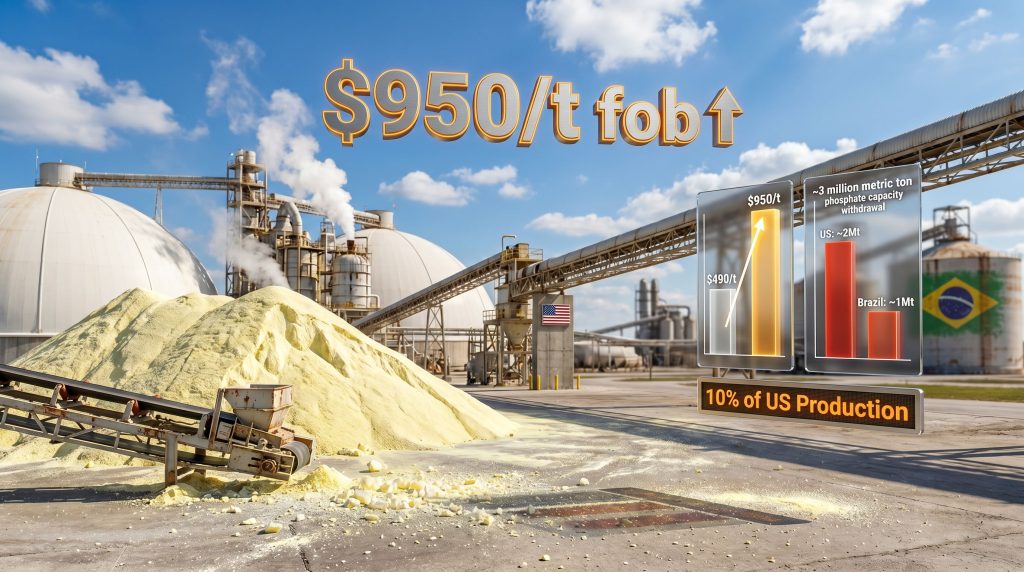
The pricing signal from the sulphur market is unambiguous. Kuwait's state sulphur price, known as the KSP and set monthly by Kuwait Petroleum Corporation (KPC), reached $950/t fob Kuwait in July 2026 — a single-month increase of $145/t from the June level of $805/t fob. To put that in perspective, the previous all-time record for the KSP stood at $490/t fob, set during the commodity price spike of June 2022. The July 2026 figure therefore exceeds that prior record by $460/t, representing a historically unprecedented dislocation in upstream phosphate input costs.
When freight rates are added — running at $108–$116/t for a standard 30,000–35,000 tonne shipment to Chinese ports as of early July 2026 — the delivered cost to Asian buyers reached an estimated $1,058–$1,066/t cfr, before insurance premiums are applied.
For Western Hemisphere phosphate producers relying on imported sulphur, the arithmetic of continued full-rate production became impossible well before these July figures were published.
Mosaic Phosphate Output Cuts in the US and Brazil: Scope and Sequencing
The production curtailments Mosaic has implemented across its US and Brazilian operations represent a sequenced escalation rather than a single sudden decision. Understanding the timeline reveals how the crisis has intensified over successive months. Projects such as the Ammaroo phosphate project and the Toolse phosphate project in Estonia serve as useful reminders that new supply development pipelines exist but cannot respond to short-term market dislocations at the speed required.
US Facility-Level Curtailments
| Facility | State | Status | Notes |
|---|---|---|---|
| Bartow | Florida | Reduced operating rate | Potential continuation if sulphur outlook improves |
| Faustina | Louisiana | Previously idled; full halt anticipated | Customers expect complete operational halt |
| Riverview | Florida | Newly added to curtailment program | Additional reduction announced July 2026 |
| Uncle Sam | Louisiana | Newly added to curtailment program | Additional reduction announced July 2026 |
Across these four facilities, combined US phosphate capacity reductions total approximately 2 million metric tons annually, representing close to 10% of total US phosphate production. Operating rates at the most affected facilities have been reduced to roughly 50% of nameplate capacity.
In May 2026, Mosaic formally withdrew its full-year phosphate production guidance of at least 7 million metric tons — an unusual step that signalled management's recognition that a credible production forecast was no longer possible given raw material uncertainty.
Brazilian Operations: An Escalating Withdrawal
The Brazilian curtailment narrative follows a similarly progressive pattern:
- April 2026 — SSP production and mine activity idled
- May 2026 — Phosphate rock production paused
- July 2026 — Additional temporary curtailments and facility idling announced across the Araxá and Patrocínio complexes
Brazilian capacity removed is estimated at approximately 1 million metric tons annually. Furthermore, Mosaic has flagged a pre-tax financial charge of $350–$400 million associated with the Brazilian restructuring, and is actively exploring a potential sale of the Araxá assets — a strategic pivot that follows its earlier divestiture of the Taquari-Vassouras potash mine.
The Global Sulphur Stress Map: Disruption Extends Far Beyond North America
One of the less widely reported dimensions of this crisis is how the Hormuz disruption has fractured sulphur supply across multiple continents simultaneously. South Africa's experience provides a particularly stark illustration.
| Region | Key Disruption | Severity |
|---|---|---|
| South Africa | 68% sulphur import collapse; Foskor and Sasol shutdowns | Critical |
| Bangladesh | BCIC tender for 15,000t crushed lump sulphur after failed April tender | High |
| Copperbelt (DRC) | Mining sector outbidding fertilizer buyers at premium prices | High |
| Global Seaborne | Kuwait KSP at record $950/t fob; freight to China at $108–116/t | Extreme |
South Africa imported only approximately 56,300 tonnes of sulphur in the January–May 2026 period, compared with 174,183 tonnes in the same five months of 2025 — a collapse of 68%. Prior to the conflict, South African imports drew heavily from Kuwait (62,600t), Oman (40,000t), Saudi Arabia (38,500t), and the UAE (31,500t). In 2026, only a single Middle Eastern cargo of approximately 55,000 tonnes arrived in February, before all Gulf supply flows ceased entirely.
Foskor, South Africa's major integrated fertilizer and sulphuric acid producer, shut down operations in March 2026 after sulphur inventories ran dry. Separately, Sasol suffered an unplanned shutdown at one of its sulphur-processing facilities in March, with maintenance work expected to run through August 2026. The combined loss of these two domestic acid producers has compressed South Africa's fertilizer output capacity at precisely the wrong moment in the agricultural calendar.
In Bangladesh, the state fertilizer procurement body BCIC issued a buy tender in July 2026 for 15,000 tonnes of crushed lump sulphur, having been unable to secure any award from an identical April tender — a clear sign that the global seaborne sulphur market is severely undersupplied relative to demand.
The Moroccan Wildcard: Trade Policy Collides with Supply Arithmetic
Approximately one week before Mosaic's latest curtailment announcement, the US government confirmed an eight-month pause on countervailing duties applied to Moroccan phosphate imports. This decision carries significant market and strategic implications, and it intersects with broader global commodity tariffs that have reshaped fertilizer trade flows in recent months.
Mosaic itself alleged in 2011 that Moroccan imports — primarily from OCP, the state-controlled phosphate giant — were materially injuring the US domestic industry. The duty structure that followed from that allegation had effectively restricted OCP's access to the American market for over a decade. The duty pause essentially reopens that access, allowing OCP volumes to re-enter the US at a moment when domestic supply is contracting sharply.
The trade policy calculus here is revealing: US agricultural supply security has taken precedence over legacy domestic industry protection, reflecting a significant reordering of policy priorities under acute supply stress conditions.
Whether OCP can fully compensate for the combined 3 million metric ton annual capacity withdrawal Mosaic is executing across the US and Brazil remains an open question. Morocco holds the world's largest known phosphate rock reserves and OCP has been expanding processing capacity aggressively, but logistics timelines and shipping constraints are real limiting factors.
The next major ASX story will hit our subscribers first
Downstream Agricultural Exposure: The Farmer Carries the Cost
The American Soybean Association has publicly characterised the timing of Mosaic's curtailments as particularly damaging for US agricultural producers, describing the reductions as occurring at a moment of maximum vulnerability for row crop farmers. That framing is grounded in genuine market arithmetic.
US soybean and corn producers face a compounding set of pressures in the 2026 season:
- Elevated DAP and MAP application costs driven by tightening domestic phosphate supply
- Pre-existing input cost inflation across fuel, herbicide, and seed categories
- Compressed commodity price margins reflecting trade war supply chains disruption and global demand volatility
- Reduced access to competitively priced domestic fertilizer at a time when forward purchasing decisions carry unusually high risk
If phosphate prices rise materially in response to the supply withdrawal and Moroccan volumes prove insufficient to fully offset losses, the affordability threshold for phosphate fertilizer application may be reached for some producers — leading to demand destruction and potentially reduced application rates, which carry multi-season consequences for soil productivity.
Three Scenarios for Production Recovery
Mosaic has explicitly characterised all curtailments as temporary and reversible, stating that operations can be unwound relatively quickly if sulphur supply and affordability improve. Three plausible forward scenarios are worth stress-testing against that assertion.
Scenario 1 — Rapid Hormuz Normalisation (Optimistic): A sustained reopening of the strait and resumption of Middle Eastern sulphur export flows would allow Mosaic to rebuild inventories and restart idled capacity within weeks to months. Under this outcome, any phosphate price premium built into forward markets would likely compress as supply returns.
Scenario 2 — Prolonged Disruption with Partial Trade Substitution (Base Case): OCP volumes re-enter the US market under the duty pause and partially offset domestic losses. Brazilian operations remain curtailed through H2 2026 pending asset sale resolution. A net phosphate supply deficit persists through the 2026 Northern Hemisphere application season, maintaining elevated DAP/MAP pricing.
Scenario 3 — Extended Geopolitical Stalemate (Bearish Agricultural Supply): The US-Iran interim deal — signed on 18 June 2026 but already showing signs of fracture, with Iran's forces resuming attacks against vessels attempting Hormuz passage on 7 July 2026 and US sanctions authorities revoking authorisation for Iranian oil purchases effective the same date — deteriorates further. Sulphur prices remain at or above record levels through Q3–Q4 2026. Mosaic proceeds with full idling of additional US facilities. Consequently, global DAP/MAP prices rise materially, creating food security pressure across fertilizer-import-dependent economies.
Strategic Procurement Responses for Agribusiness Operators
For agricultural supply chain participants, treating this as temporary market noise carries material financial risk. The following frameworks are worth considering:
- Forward purchasing and contract locking ahead of further potential supply tightening, particularly for autumn application programmes
- Alternative supplier diversification across OCP (Morocco), PhosAgro (Russia), and other global phosphate exporters to reduce single-source dependency
- Blended fertilizer reformulation strategies to reduce phosphate intensity where agronomically feasible and soil conditions permit
- Commodity price derivatives to hedge DAP/MAP exposure during periods of acute supply uncertainty
- Monitoring leading indicators including the monthly Kuwait KSP benchmark, Strait of Hormuz shipping traffic data, and Mosaic operational update releases
The Kuwait KSP, in particular, deserves recognition as a tier-one leading indicator for the phosphate sector. Given that it is set monthly and reflects the actual delivered cost environment for the world's most sulphur-dependent fertilizer producers, movements in this benchmark telegraph phosphate supply economics weeks before they appear in finished fertilizer price assessments. In addition, understanding the import tax structure applied to related energy commodities can help agribusiness operators contextualise how input costs are likely to evolve across interconnected supply chains.
Key Takeaways
Mosaic phosphate output cuts in the US and Brazil represent a convergence of geopolitical disruption, input cost crisis, trade policy realignment, and downstream agricultural exposure that is without recent precedent in its simultaneous multi-geography scope. As analysts have noted, the combined scale and pace of these curtailments signals a structural rather than cyclical challenge for the phosphate market.
- A combined ~3 million metric tons of annual phosphate capacity has been removed across two continents
- The Kuwait KSP at $950/t fob in July 2026 is $460/t above the previous all-time record
- South Africa's sulphur imports collapsed by 68% in the first five months of 2026, with Foskor and Sasol shutdowns compounding regional acid shortages
- The Moroccan duty pause introduces a partial supply offset but cannot fully substitute for the scale of Mosaic's withdrawal
- Recovery timelines are directly and exclusively tied to sulphur market normalisation, which in turn depends on geopolitical developments that remain fluid and unpredictable
Disclaimer: This article contains forward-looking analysis, scenario projections, and market commentary that are inherently speculative and subject to change. Nothing in this article constitutes financial, investment, or agricultural procurement advice. Readers should conduct independent due diligence and consult qualified professionals before making decisions based on the information presented.
Want to Stay Ahead of Mineral Discoveries Reshaping Global Commodity Markets?
Discovery Alert's proprietary Discovery IQ model delivers real-time alerts on significant ASX mineral discoveries — instantly translating complex resource data into actionable investment insights across phosphate, sulphur, and over 30 other commodities. Explore historic discoveries and their exceptional market returns, then begin your 14-day free trial at Discovery Alert to position yourself ahead of the next major market-moving announcement.