July 9, 2026
The Hidden Bottleneck Western Nations Are Racing to Fix
For decades, the global conversation around mineral security focused almost entirely on extraction: where ore sits in the ground, how much of it exists, and who controls the land above it. That framing missed the more consequential vulnerability entirely. The real chokepoint was never in the mine. It was always in the smelter.
Processing capacity — the ability to transform raw concentrates into refined, specification-grade metal — represents a far harder infrastructure challenge than opening a new pit. It requires decades of metallurgical knowledge, purpose-built equipment, skilled technical workforces, and in the case of polymetallic operations, the ability to separate and recover multiple elements simultaneously from complex feed streams. That kind of capability cannot be replicated quickly, regardless of how much capital is deployed.
This reality explains why the Teck Trail critical minerals expansion has attracted so much attention from both industry and policymakers. Trail Operations in southern British Columbia is not a proposed facility or a feasibility-stage concept. It is an operating, fully integrated polymetallic smelting and refining complex with existing germanium and gallium production capacity, established supply chains, and decades of technical knowledge embedded in its workforce.
When big ASX news breaks, our subscribers know first
Why Germanium, Gallium, and Antimony Became Geopolitical Flashpoints
China's Progressive Export Restrictions and Western Supply Chain Exposure
The supply security conversation around these three metals intensified sharply beginning in 2023, when Beijing introduced export licensing requirements for gallium and germanium, followed by antimony restrictions in 2024. The cumulative effect of these Chinese export controls was to concentrate supply risk in a way Western defence and technology sectors had not fully anticipated.
Prior to these controls, China accounted for a dominant share of global refined gallium output, with some estimates placing the figure above 80% of world supply. For germanium, Chinese producers were also major contributors to global refined production, though Western operations including Trail held a more meaningful share than in gallium. Antimony presented a similar concentration picture, with Chinese production integral to global flame retardant and energy storage supply chains.
Germanium, Gallium, and Antimony: Functional Comparison for High-Tech and Defense Applications
| Metal | Primary Applications | Strategic Significance | Key Supply Risk |
|---|---|---|---|
| Germanium | Fibre optics, infrared tech, semiconductors | Dual-use: civilian and defense | Chinese export controls since 2023 |
| Gallium | Telecommunications, radar, next-gen electronics | Essential for compound semiconductors | ~80%+ of global supply previously from China |
| Antimony | Flame retardants, batteries, alloys | Critical for energy storage and defense materials | Subject to Chinese export restrictions |
What makes these three metals particularly consequential is where they sit within the technology stack. Germanium, for instance, is not simply a materials input. It is foundational to infrared imaging systems used in military optics, to fibre optic transmission cables carrying global internet traffic, and to certain classes of semiconductor substrates. Gallium underpins the compound semiconductors used in radar arrays, telecommunications base stations, and the power electronics found in next-generation military platforms.
The antimony shortage risks extend across both civilian energy storage applications — including emerging antimony-based anode battery chemistry — and in defence-grade materials where its flame-retardant properties are considered non-substitutable in specific applications. Furthermore, understanding antimony in defense applications helps illustrate precisely why Western governments are treating this expansion with such urgency.
A critical but underappreciated detail about gallium is that it is primarily recovered as a byproduct of aluminium smelting and zinc refining rather than mined directly. This means gallium supply is fundamentally tied to the economics and operating status of base metal processing capacity. Building gallium production capacity requires an existing smelting infrastructure, which is precisely what Trail provides.
What Trail Operations Actually Is, and Why It Cannot Be Easily Replicated
A Polymetallic Complex With Compounding Recovery Economics
Trail Operations, situated in the Kootenay region of southern British Columbia, processes concentrates from multiple feed sources and recovers a remarkably broad portfolio of materials from a single integrated flow sheet. Current output includes zinc, lead, silver, indium, germanium, gallium, cadmium, sulfuric acid, fertilizer, gold, and additional byproducts from third-party feedstocks.
This multi-product recovery model creates a cost structure that single-metal facilities simply cannot match. When germanium, gallium, or indium are recovered as byproducts alongside primary zinc and lead output, their marginal production cost is substantially lower than it would be if the same metals were targeted as primary products. The primary metals effectively subsidise the recovery of the critical mineral byproducts, making the economics of critical minerals production at Trail structurally more resilient than at purpose-built primary producers.
The scale of the Teck Trail critical minerals expansion reflects both the opportunity and the confidence Teck has in Trail's existing infrastructure as a foundation:
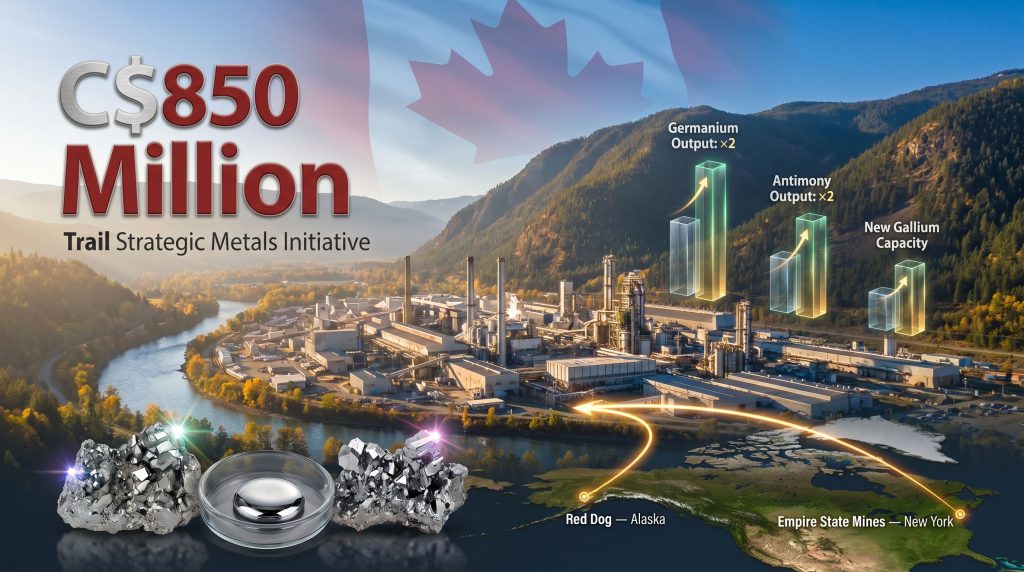
- Total potential capital commitment under the Strategic Metals Initiative: up to C$850 million (~USD $600 million)
- Targeted production outcomes: doubling existing germanium and antimony output
- New capacity addition: establishment of gallium production at meaningful commercial scale
- Existing competitive position: Teck is already among the world's largest germanium producers and holds an established role as a key supplier of germanium to the United States market
Why Greenfield Development Cannot Solve the Timeline Problem
A greenfield polymetallic processing facility comparable to Trail's integrated complexity would require not only capital in the billions but also environmental permitting processes measured in years, metallurgical commissioning periods that frequently extend well beyond initial projections, and the gradual development of the operational knowledge that Trail has accumulated over multiple generations of workforce.
Expanding an existing world-class operation, however, compresses this timeline dramatically. The environmental footprint is defined, the infrastructure is in place, the workforce expertise exists, and the metallurgical flow sheets for recovering these specific metals have already been optimised over decades. This is the core competitive advantage that underpins the investment thesis for the Trail expansion.
Canada's Critical Minerals Accelerator: How the Investment Structure Works
Architecture of a C$2 Billion Federal Program
The Canada Critical Minerals Accelerator, managed through Export Development Canada and deployed in partnership with the Canada Growth Fund, represents a C$2 billion (~USD $1.4 billion) program commitment established under Budget 2025 allocations. Trail Operations was selected as the inaugural transaction under this framework.
The program's design acknowledges a fundamental challenge in critical minerals investment: the capital intensity and long development cycles of processing infrastructure create a risk premium that private markets alone have historically been reluctant to absorb, particularly when commodity price volatility introduces uncertainty into long-term return modelling.
Breaking Down the C$400 Million Equity-Like Investment
The Canada Growth Fund's participation in the Trail investment is structured as an equity-like commitment of up to C$400 million (~USD $282 million). Several aspects of this structure deserve attention:
-
It is not a grant. Unlike grant-based support programs, an equity-like instrument means the government's returns are tied to the project's commercial performance, creating alignment between public and private interests.
-
Offtake rights are included. The agreement framework includes provisions for the Government of Canada to secure offtake rights over a portion of future germanium, antimony, and gallium production from Trail.
-
Strategic stockpiling is embedded in the design. Ottawa has indicated that the offtake mechanism is intended, in part, to support the development of a national critical minerals stockpile capable of supplying both Canadian and allied-nation needs during periods of supply disruption.
-
Conditions remain. As of mid-2026, the full investment and offtake arrangements remain subject to definitive legal documentation and applicable regulatory approvals.
Comparing Government Investment Structures in Critical Minerals Globally
| Country | Program | Investment Vehicle | Target Metals | Scale |
|---|---|---|---|---|
| Canada | Canada Critical Minerals Accelerator | Equity-like + offtake | Ge, Ga, Sb | C$2B program |
| United States | DOE Critical Materials Office / DPA Title III | Grants + loans | REEs, Li, Ga | Multi-billion USD |
| Australia | Critical Minerals Facility (EFA) | Debt financing | Li, Co, REEs | AUD $4B+ |
| European Union | Critical Raw Materials Act | Strategic partnerships | 34 CRMs | EU-wide framework |
Canada's equity-like structure with embedded offtake rights is a notably different approach from the grant-dominant models deployed in some peer nations. The European critical raw materials strategy, for instance, relies heavily on strategic partnerships rather than direct equity participation. By retaining upside exposure through equity-like returns, the federal government positions itself to recover value over time while simultaneously securing physical metal access for strategic purposes.
The Feedstock Question: Where the Germanium Actually Comes From
Red Dog and the Transition Challenge
Understanding the feedstock dynamics of Trail's expansion requires understanding Red Dog Mine, the zinc operation in the DeLong Mountains of northwest Alaska that has served as Trail's primary germanium-bearing concentrate source for decades. Red Dog has historically been one of the most significant zinc mines on Earth, at times supplying approximately 5% of global zinc production, along with globally significant quantities of lead, silver, and germanium from a single highly concentrated ore body.
Red Dog is now transitioning from its original ore zone, mined over 37 years, to a new mining area approximately 10 miles to the north. This transition is expected to create a temporary reduction in concentrate volumes available for Trail, creating both a timing challenge and a strategic imperative to diversify feedstock sources before the expanded Trail capacity comes online.
Empire State Mines: A Tailings Reprocessing Opportunity Worth Understanding
In May 2026, Teck announced an investment agreement with Titan Mining Corp. to evaluate germanium recovery from processing streams at the Empire State Mines operation in Upstate New York. The potential recovery target under evaluation is up to 13,000 kilograms of germanium per year. In July 2026, Titan reported sampling results confirming consistent germanium mineralisation across multiple historic tailings facilities and meaningful values in primary ore zones at the property.
The tailings reprocessing pathway offers several structural advantages that are not always apparent to observers unfamiliar with mine development economics:
- Liberation work is substantially complete. Tailings material has already been mined, blasted, crushed, and milled. The energy-intensive and time-consuming process of mechanically liberating minerals from host rock has already been done, potentially at the cost of prior operators.
- No new mining footprint is created. Reprocessing tailings does not require opening new pit areas, which simplifies the permitting and community engagement dimensions of the project.
- The development timeline compresses significantly. Projects without new mine development requirements can often move from evaluation to production in a fraction of the time required for greenfield or even brownfield mine expansions.
- Zinc recovery may stack economics. Titan's evaluation includes the potential to reprocess tailings enriched in both germanium and high-grade zinc, meaning germanium recovery could be stacked on top of zinc economics in a model analogous to Trail's own byproduct recovery logic.
Feedstock Diversification Risk Matrix
| Feedstock Source | Location | Germanium Potential | Development Stage | Key Risk |
|---|---|---|---|---|
| Red Dog Mine | Alaska, USA | High (established) | Transitioning to new zone | Temporary volume reduction |
| Empire State Mines tailings | New York, USA | Up to 13,000 kg/yr | Evaluation and sampling phase | Permitting and recovery confirmation |
| Third-party concentrates | Global | Variable | Ongoing commercial sourcing | Price and availability volatility |
Quantifying What Expanded Trail Output Means for Global Supply
Germanium: A Market Where Production Scale Is Measured in Tonnes, Not Millions of Tonnes
Germanium is not a bulk commodity. Global annual refined germanium production is typically measured in the low hundreds of tonnes, making it a market where even incremental capacity additions at a facility of Trail's scale are commercially meaningful. Doubling Trail's germanium output would represent a material increase in non-Chinese global refined germanium availability, particularly relevant given that Western fibre optic manufacturers and defence electronics integrators have been actively seeking to qualify non-Chinese supply sources since Beijing's 2023 export controls.
Gallium: Canada's First Meaningful Scale Entry
Gallium presents a different market dynamic. Because it is recovered primarily as a byproduct of aluminium and zinc processing, global supply is inherently tied to base metal smelting capacity. Trail's integrated zinc processing infrastructure positions it as a logical platform for gallium recovery. If the Teck Trail critical minerals expansion successfully adds gallium output at meaningful commercial scale, it would represent Canada's first significant contribution to the global refined gallium market at a time when Western demand for this metal in compound semiconductor manufacturing is growing rapidly.
Antimony and the Battery Storage Dimension
While antimony's traditional applications in flame retardants and lead-acid battery plates are well understood, the emerging interest in antimony-based anode materials for next-generation lithium-ion and sodium-ion battery chemistries adds a demand dimension that was not present even a few years ago. Research into antimony anodes suggests potential for higher energy density and faster charge rates compared to conventional graphite anodes. A doubling of Trail's antimony output consequently positions Teck to serve both established and emerging demand segments simultaneously.
The next major ASX story will hit our subscribers first
Canada's Industrial Policy Shift: From Ore Exporter to Value-Added Producer
The Processing Premium That Canada Has Historically Surrendered
For much of its resource history, Canada exported concentrates and primary metals while the higher-value refining and processing stages were captured by downstream buyers in other jurisdictions. The investment model underpinning the Trail expansion represents a deliberate departure from this pattern. By retaining processing capacity domestically and structuring federal investment to ensure a portion of refined output stays within Canadian and allied-nation supply chains, the Trail initiative reflects a broader industrial policy objective of capturing processing value onshore.
This aligns with frameworks including the Minerals Security Partnership, which brings together the United States, Canada, Australia, the United Kingdom, Japan, South Korea, and the European Union to coordinate investment in defence critical minerals supply chains. Trail's expanded output would feed directly into the supply chains these allied-nation frameworks are designed to reinforce.
Regional Economic and Employment Dimensions
Trail Operations is not simply an industrial facility. It is a cornerstone employer in the Kootenay region of southern British Columbia, with multiplier effects extending through the regional supply chain. A capital investment of up to C$850 million generates construction employment, sustained operational roles, and procurement activity across engineering, equipment, and services suppliers throughout the province. British Columbia's designation of the Trail expansion among its eight priority resource projects reflects this recognition of the broader economic dimensions of the initiative.
Frequently Asked Questions: Teck Trail Critical Minerals Expansion
What metals does the Trail expansion target for increased production?
The expansion targets doubled output of both germanium and antimony, alongside the potential addition of new gallium production capacity. All three are classified as critical minerals for defence, telecommunications, and clean energy applications.
How much is the Canadian government committing to Trail Operations?
The Canada Growth Fund is structured to make an equity-like investment of up to C$400 million into Trail Operations as the inaugural transaction under the C$2 billion Canada Critical Minerals Accelerator.
What is the total projected cost of Teck's Strategic Metals Initiative?
The potential total capital investment is up to C$850 million, approximately equivalent to USD $600 million.
Why is feedstock supply changing for Trail?
The Red Dog mine in Alaska, Trail's primary historical germanium-bearing concentrate source, is transitioning between ore zones, creating a temporary reduction in concentrate availability. Teck is actively diversifying sources, including through a partnership with Titan Mining Corp. to evaluate germanium recovery from tailings at Empire State Mines in Upstate New York.
Is the investment finalised?
As of mid-2026, the investment framework and offtake structure have been agreed in principle but remain subject to definitive legal documentation and applicable regulatory approvals. Investors and stakeholders should note this conditionality.
Why are these three metals classified as strategically critical?
All three have been subject to Chinese export controls introduced between 2023 and 2024. Their applications span fibre optics, defence electronics, radar, energy storage, and semiconductor manufacturing. Supply disruption in any of these metals carries significant economic and national security consequences for Western nations.
Key Data Summary: Teck Trail Critical Minerals Expansion
| Metric | Figure |
|---|---|
| Total Strategic Metals Initiative capital | Up to C$850 million (~USD $600 million) |
| Canada Growth Fund equity-like investment | Up to C$400 million (~USD $282 million) |
| CCMA total program envelope | C$2 billion (~USD $1.4 billion) |
| Germanium production target | Double existing capacity |
| Antimony production target | Double existing capacity |
| New capacity addition | Gallium production at commercial scale |
| Empire State Mines germanium evaluation | Up to 13,000 kg/yr |
| Red Dog mine's historic zinc contribution | ~5% of global supply |
| Trail's position in B.C. priority projects | Among eight designated provincial priorities |
| Investment status | Subject to definitive documentation and approvals |
Disclaimer: This article contains forward-looking statements regarding planned capital investments, production targets, and government investment frameworks. These are subject to change based on regulatory approvals, market conditions, definitive documentation, and other factors. Nothing in this article constitutes financial or investment advice. Readers should conduct their own due diligence before making any investment decisions.
Want to Catch the Next Major Critical Minerals Discovery Before the Market Does?
Discovery Alert's proprietary Discovery IQ model scans ASX announcements in real time, delivering instant alerts on significant mineral discoveries across germanium, gallium, antimony, and more than 30 other commodities — translating complex data into clear, actionable insights for both short-term traders and long-term investors. Explore how historic discoveries have generated extraordinary returns and begin your 14-day free trial at Discovery Alert to position yourself ahead of the market.