May 19, 2026
North West Queensland at a Crossroads: Inside the Mount Isa Transformation Study
Few industrial corridors in Australia carry the weight of economic history that stretches from the red dust of Mount Isa to the port cranes of Townsville. For decades, this inland arc of North West Queensland has anchored one of the country's most significant metals processing systems, feeding refined copper into global supply chains from a region most Australians have never visited. Yet the forces reshaping global industry — from the electrification of transport to the fragmentation of established supply chains — are now bearing down on this corridor with urgency. That is precisely the context in which the Mount Isa transformation study has emerged as one of the most consequential regional industrial planning exercises in Queensland's recent history.
When big ASX news breaks, our subscribers know first
Understanding the Industrial System at Stake
The Mount Isa to Townsville corridor is not a collection of isolated assets. It operates as a deeply integrated industrial system, where disruption at any single point creates ripple effects across communities spanning hundreds of kilometres of outback Queensland.
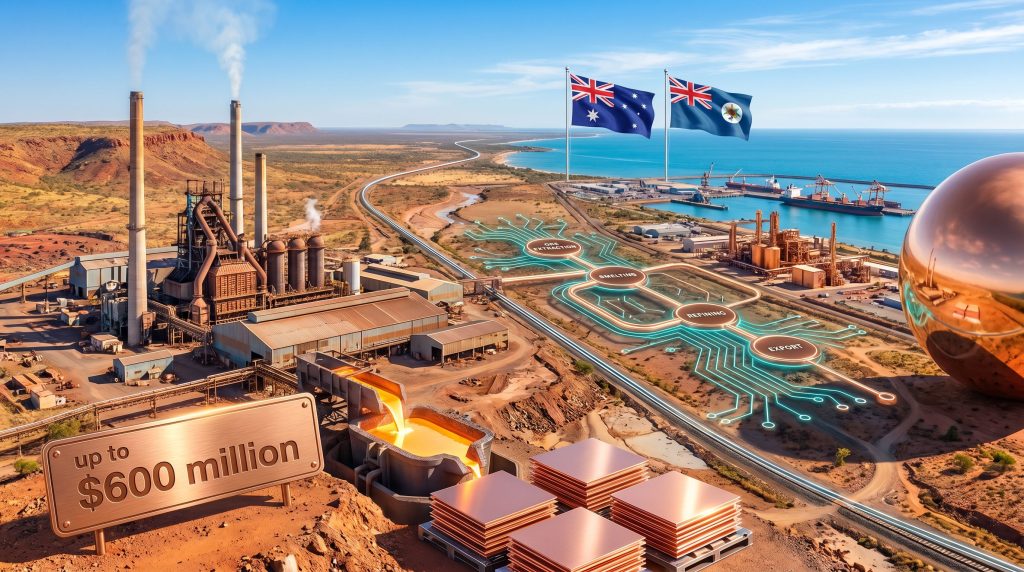
At its core sits the Mount Isa Copper Smelter, operated by Glencore, which processes ore drawn from multiple mines across the North West Minerals Province. From there, copper concentrate moves along the Mount Isa rail line — one of the longest freight rail corridors in Australia — before reaching the Townsville copper refinery for further processing and eventual export through the Port of Townsville into Asian markets.
What makes this system particularly vulnerable is its concentration. A single smelter serves as the processing anchor for an entire regional minerals economy. When that anchor faces operational or commercial pressure, the consequences are felt not just by Glencore's workforce but by contractors, service businesses, local councils, and community members across Mount Isa, Cloncurry, and Townsville.
The Glencore smelter pressures have been building for years, driven by a combination of ageing infrastructure, rising energy costs, global copper price volatility, and the increasing competitiveness of newer smelting facilities in Asia. These are not short-term fluctuations. They reflect a fundamental shift in the economics of primary metals processing in high-cost jurisdictions.
What the Mount Isa Transformation Study Is Designed to Do
The Mount Isa transformation study was commissioned as part of a broader joint Commonwealth and Queensland government support package valued at up to $600 million over three years, announced in October 2025. That package was designed to stabilise Glencore's operations during a period of acute uncertainty. The transformation study represents the forward-looking component of that framework, moving the conversation from crisis management toward strategic reinvention.
A consortium led by CRU International (Australia) Pty Ltd has been appointed to conduct the study. CRU International is a globally respected commodities research and consulting organisation with deep expertise across metals, mining, and fertilizers markets. Its appointment signals an intent to ground the study's findings in rigorous commercial analysis rather than political aspiration.
The scope of the study is deliberately broad:
| Study Component | Focus Area |
|---|---|
| Copper value chain mapping | Full analysis from ore extraction through smelting, refining, and export |
| Industrial capability assessment | Existing and latent processing infrastructure across the region |
| Emerging project pipeline | New mineral projects with potential to anchor future economic activity |
| Market and demand conditions | Global copper demand trajectory, particularly from clean energy sectors |
| Workforce and community pathways | Future employment opportunities and transition planning |
| Supply chain resilience | Rail corridor capacity, port infrastructure, and logistics optimisation |
The final report is due to be delivered to government by the end of 2026, creating a clear milestone against which stakeholder expectations can be measured.
Rebricking as a Signal of Operational Commitment
Coinciding with the study's commencement, Glencore has announced that rebricking works at the Mount Isa Copper Smelter are set to begin. Rebricking — which involves replacing the heat-resistant lining inside a smelter's furnace — is a technically demanding and costly maintenance process that extends the operational life of the facility. It is not the kind of investment a company makes if it intends to walk away in the near term.
This maintenance activity, funded under the government rescue package, is widely read as a signal of continued operational commitment. For regional communities and workers, it provides a degree of near-term certainty while the longer-term transformation study runs its course.
Why Copper, and Why Now?
Copper occupies a unique position in the clean energy transition. Unlike some critical minerals where substitution is possible, copper's combination of electrical conductivity, thermal performance, and durability makes it essentially irreplaceable in most energy applications. Furthermore, global demand forecasts consistently point to substantial growth through the 2030s, driven by:
- Electric vehicle manufacturing, where a battery electric vehicle contains roughly two to four times more copper than a conventional internal combustion engine vehicle
- Grid-scale electricity storage and transmission infrastructure upgrades
- Renewable energy generation, with wind turbines and solar installations requiring significant copper content per megawatt of capacity
- Data centre and artificial intelligence infrastructure buildout, which is emerging as a significant new demand driver not fully captured in earlier forecasts
Against this demand backdrop, Australia's copper reserve base, concentrated in Queensland and South Australia, represents a strategically significant asset. The challenge — and the opportunity — lies in capturing more of the value chain onshore rather than exporting raw or semi-processed materials for others to refine. Understanding copper market dynamics is therefore essential context for the study's conclusions.
The global shift toward supply chain security is creating conditions where countries with stable governance, established rule-of-law frameworks, and proven mineral endowments are increasingly attractive to long-term industrial investors. Australia's North West Queensland corridor sits squarely within that profile.
Australia's Competitive Position in Global Copper Markets
| Factor | Australia's Position |
|---|---|
| Copper reserve base | Among the world's largest, with major deposits in Queensland and South Australia |
| Processing infrastructure | Ageing but strategically significant; investment required to modernise |
| Proximity to Asian demand centres | Strong geographic advantage for export logistics |
| Geopolitical reliability | Increasingly valued by Western and Asian supply chain partners |
| Green copper premium potential | Early-stage but growing market for low-carbon copper production |
One dimension that deserves closer attention is the emerging concept of green copper — a product category defined by lower carbon intensity through the adoption of renewable energy in smelting and refining. As sustainability reporting requirements tighten across major importing nations, including those in the European Union, the carbon footprint embedded in copper production is becoming a commercial differentiator.
A Mount Isa corridor powered by North Queensland's substantial solar and wind resources could theoretically command a premium over copper produced in coal-heavy processing environments. This is speculative at this stage, and the economics of retrofitting or replacing fossil fuel energy in smelting operations are complex. However, it represents a strategic direction the transformation study is expected to assess. In addition, decarbonising mining operations could unlock meaningful economic benefits that strengthen the region's long-term investment case.
The Critical Minerals Diversification Opportunity
Copper is the anchor, but the North West Minerals Province's resource base extends well beyond it. The region hosts significant concentrations of cobalt, nickel, zinc, phosphate, and rare earth elements — metals that sit at the centre of global battery supply chain discussions.
Regional planning bodies, including MITEZ (Mount Isa to Townsville Economic Zone), have articulated an ambitious vision for the corridor as a critical minerals processing precinct capable of integrating into global clean energy supply chains. This concept — sometimes described as positioning Mount Isa as a critical minerals processing hub — represents a significant philosophical shift from the region's historical identity as primarily a copper town. The demand for critical minerals in the energy transition only strengthens the case for such repositioning.
The key elements of this diversification thesis include:
- Developing cobalt and nickel processing capabilities to serve battery precursor markets
- Leveraging existing metallurgical infrastructure for polymetallic ore processing
- Attracting downstream advanced manufacturing investment linked to battery materials
- Decarbonising smelting operations to access green premium markets
- Building workforce skills pipelines aligned to emerging processing technologies
MITEZ and allied regional industry groups have been explicit that the Mount Isa transformation study must produce structural reform outcomes, not simply extend operational subsidies. The distinction matters enormously. Subsidies preserve what exists. Structural reform creates the conditions for something new to grow.
The next major ASX story will hit our subscribers first
Stakeholder Landscape and Competing Priorities
The transformation study must navigate a complex stakeholder environment where different groups bring legitimate but sometimes competing interests to the table.
| Stakeholder Group | Primary Interest |
|---|---|
| Federal Government | National industrial capability, critical minerals strategy, supply chain security |
| Queensland State Government | Regional economic development, employment retention, community stability |
| Glencore | Operational continuity, investment certainty, infrastructure support |
| Local Councils (Mount Isa, Townsville) | Economic diversification, population retention, infrastructure investment |
| Workers and Trade Unions | Job security, transition pathways, skills development funding |
| MITEZ and Regional Industry Bodies | Structural reform, long-term investment attraction, not temporary rescue |
| Investors and Developers | Regulatory clarity, infrastructure access, transparent demand signals |
| Community Members | Livelihoods, access to services, confidence in the region's future |
Queensland Minister for Natural Resources and Mines Dale Last stated that the study is fundamentally about securing the long-term future of the region and the thousands of jobs and communities that depend on it, framing the investigation as spanning the full copper value chain from the Mount Isa Copper Smelter through to the Townsville port and refinery.
Federal Minister for Industry and Innovation Senator Tim Ayres described the study as a key milestone in the joint support package, emphasising that the work is intended to build Australia's resilience, regional growth, and international competitiveness in an increasingly volatile global environment.
Infrastructure Bottlenecks That Could Define the Outcome
Any serious assessment of the corridor's industrial future must confront its infrastructure constraints. Three are particularly significant:
1. The Mount Isa Rail Line
This freight corridor is the physical spine of the industrial system. Queensland has already introduced freight subsidies to support its commercial viability, recognising that without affordable bulk transport, the economics of expanding processing activity in the region become substantially harder to justify. Consequently, mine-to-port logistics planning is increasingly central to how stakeholders are thinking about the corridor's future.
2. Port of Townsville Capacity
Any expansion of processing activity — whether in copper or critical minerals — will eventually encounter port capacity constraints. Townsville's port infrastructure and expansion planning are central to any export-oriented industrial growth strategy for the region.
3. Energy Infrastructure
Perhaps the most underappreciated constraint, energy cost and reliability are critical determinants of smelting and refining economics. North Queensland has exceptional renewable energy resources, but translating that potential into cost-competitive industrial power requires significant transmission and storage investment.
The Risk of Inaction and Historical Precedent
Australia's industrial history offers cautionary lessons about what happens when ageing single-industry communities fail to transition. The decline of steel manufacturing in towns like Whyalla and Newcastle, and the social consequences that followed, illustrate the human cost of unmanaged industrial contraction.
The North West Queensland corridor is not yet in that position. The smelter is operational, the workforce is intact, and government attention is engaged. However, the window for proactive transformation is finite. Key risk factors if the study fails to translate into funded action include:
- Gradual withdrawal of industrial investment as uncertainty persists
- Workforce exodus driven by employment insecurity, eroding the skills base needed for any future expansion
- Infrastructure deterioration as utilisation falls and maintenance investment dries up
- Loss of institutional knowledge accumulated across decades of complex metallurgical operations
The period between now and the end of 2026 — when the transformation study's final report is due — represents a critical planning window. The Queensland government's support framework acknowledges this urgency, and the next 12 to 24 months will shape investment decisions and policy frameworks that will determine the region's industrial trajectory for a generation.
Frequently Asked Questions About the Mount Isa Transformation Study
What is the Mount Isa transformation study?
A government-commissioned research and planning exercise examining the full copper value chain across North West Queensland, from the Mount Isa Copper Smelter to the Townsville refinery and port, aimed at identifying long-term industrial opportunities and building regional economic resilience.
Who is conducting the study?
A consortium led by CRU International (Australia) Pty Ltd, a globally recognised commodities research and consulting firm with expertise across metals and mining markets.
When will the study be completed?
The final report is due to be delivered to government by the end of 2026.
How much government funding is associated with the study?
The study forms part of a broader joint Commonwealth and Queensland support package valued at up to $600 million over three years, announced in October 2025.
What critical minerals beyond copper could benefit from the study's findings?
The study is expected to assess opportunities in cobalt, nickel, zinc, and rare earth element processing, as well as battery materials supply chains, renewable energy integration, and advanced manufacturing.
What is MITEZ?
MITEZ, the Mount Isa to Townsville Economic Zone, is a regional industry and economic development body that has been actively advocating for structural reform and long-term investment in the corridor rather than short-term operational subsidies.
Disclaimer: This article contains forward-looking statements and projections based on publicly available information and current market assessments. Forecasts regarding copper demand, investment outcomes, and regional economic development are subject to material uncertainty and should not be relied upon as investment advice. Readers are encouraged to conduct independent research and seek professional financial guidance before making investment decisions.
Want to Capitalise on the Next Major Mineral Discovery Before the Market Does?
The North West Queensland copper corridor represents exactly the kind of high-stakes, commodity-rich environment where significant ASX mineral discoveries can emerge — and timing is everything. Discovery Alert's proprietary Discovery IQ model delivers real-time alerts on significant ASX mineral discoveries across copper, cobalt, nickel, and beyond, instantly translating complex geological data into actionable investment insights. Explore historic discoveries and their exceptional market returns to understand what's possible, then begin your 14-day free trial to position yourself ahead of the broader market.