May 19, 2026
The Permitting Bottleneck That Has Quietly Strangled U.S. Mining for Decades
Long before any drill turns or ore is processed, the fate of a major mining project in the United States is often decided in a far less visible arena: the federal permitting labyrinth. For decades, large-scale resource development projects have faced review timelines stretching seven to ten years or longer, not because of genuine environmental complexity alone, but because of structural dysfunction within multi-agency federal processes. Sequential reviews, unclear jurisdictional authority, and no binding accountability mechanism created a system where delay was the default outcome rather than the exception.
The consequences of this dysfunction have compounded quietly over time. As global demand for copper, zinc, and other industrial metals accelerated through the electrification era, the gap between what U.S. geology could theoretically supply and what U.S. permitting processes could realistically deliver grew wider. That gap has now attracted serious legislative and executive attention, and projects like the Trilogy Arctic project FAST-41 designation represent a direct product of that policy response.
When big ASX news breaks, our subscribers know first
What the FAST-41 Framework Actually Does
The Fixing America's Surface Transportation Act, enacted in 2015, contained a lesser-discussed but consequential provision known as Title 41, which established a federal permitting coordination framework for large infrastructure and resource projects. The Federal Permitting Improvement Steering Council (FPISC) was created to administer this framework, with a mandate to assign lead agencies, establish coordinated timelines, and publish permitting progress on a publicly accessible dashboard.
The core innovation of FAST-41 is deceptively simple: it forces parallel review rather than sequential review. Under a conventional federal environmental process governed by the National Environmental Policy Act (NEPA), agencies frequently wait for one another before initiating their own assessments, creating a chain of delays where each agency's inaction becomes another agency's justification for inaction. Furthermore, U.S. mining permit reforms have reinforced this shift, as FAST-41 breaks this chain by assigning binding milestones to each participating agency and making all progress visible to the public through the Federal Permitting Dashboard.
FAST-41 does not eliminate environmental review or guarantee project approval. Its function is structural: it removes procedural redundancy, imposes institutional accountability, and compresses timelines by requiring agencies to work concurrently rather than consecutively.
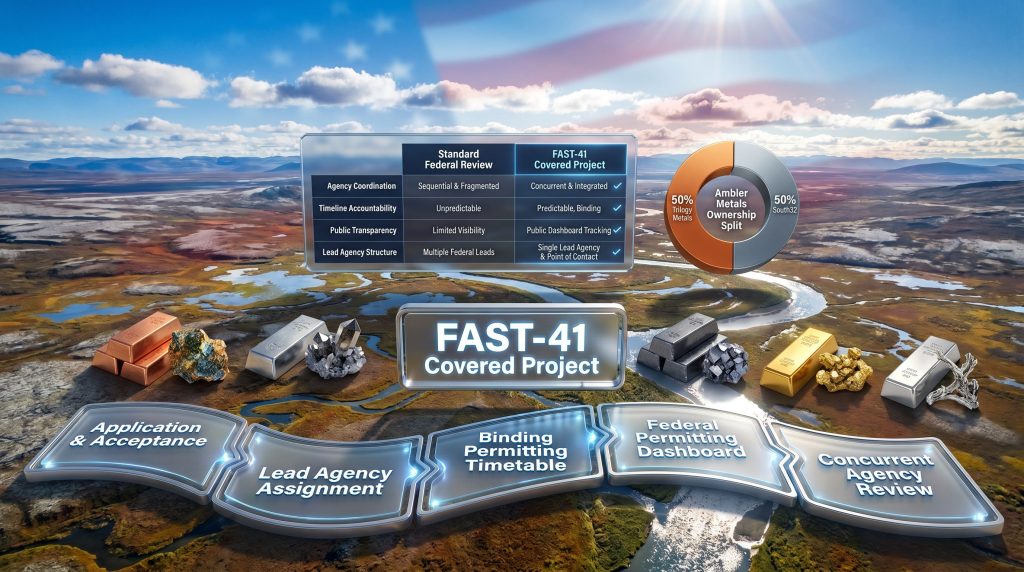
The Six-Stage Process for Covered Projects
Understanding how a project moves through FAST-41 coverage requires familiarity with the mechanics of the programme. The mining permitting basics involved are considerable, and the six stages are as follows:
- Application to FPISC – The project proponent submits a formal application demonstrating the project meets the criteria for a covered project, typically involving a capital investment threshold and multi-agency review requirements.
- Lead Agency Designation – A single federal agency is assigned as the coordinating authority, responsible for managing the overall review schedule across all participating bodies.
- Permitting Timetable Creation – A binding schedule is developed, with specific milestones assigned to each agency involved in the review process.
- Federal Permitting Dashboard Publication – The project is listed publicly, with all agency responsibilities, milestones, and progress updates accessible to investors, communities, and regulators alike.
- Concurrent Review Activation – All participating agencies begin their reviews simultaneously, rather than waiting for preceding steps to conclude.
- Milestone Accountability Enforcement – Agencies that fail to meet assigned milestones are required to publicly explain the delay, creating institutional pressure that did not exist under prior frameworks.
The distinction between FAST-41 and standard NEPA review is meaningful for project developers and investors alike. Under conventional processes, there is no legal mechanism compelling agencies to respect informal timelines. Under FAST-41, however, the public dashboard creates reputational and procedural consequences for agencies that fall behind.
The Arctic Deposit: Grade, Geology, and Strategic Value
The Arctic copper-zinc project, situated within Alaska's Ambler Mining District, occupies a genuinely rare position in the global mining development pipeline. It is widely cited among industry analysts as one of the highest-grade undeveloped polymetallic deposits remaining in the world, with a mineral assemblage spanning copper, zinc, lead, gold, and silver.
What distinguishes the Arctic deposit geologically is not simply its grade but the combination of grade and scale within a single mineralised system. VMS deposit geology reveals that volcanogenic massive sulphide deposits of this type form through hydrothermal activity on ancient seafloors and are characterised by tight mineralogical associations between base metals and precious metals. The Arctic deposit's VMS classification means that copper and zinc occur in concentrated, high-grade zones rather than the disseminated low-grade profiles typical of porphyry copper systems.
This geological distinction carries commercial weight. High-grade VMS deposits generally require smaller processing footprints to deliver equivalent metal output compared to bulk-tonnage porphyry systems, which can translate to lower operating costs per unit of metal produced once the infrastructure challenge is resolved. In the Arctic project's case, that infrastructure challenge is the defining variable: the project's remote location in northwest Alaska means that access road development is a parallel workstream to the permitting process itself.
Project Structure and Joint Venture Ownership
| Detail | Description |
|---|---|
| Project Name | Arctic Copper-Zinc Project |
| Location | Ambler Mining District, Northwest Alaska |
| Joint Venture Vehicle | Ambler Metals |
| Ownership Structure | 50% Trilogy Metals / 50% South32 |
| Primary Commodities | Copper, Zinc, Lead, Gold, Silver |
| Deposit Classification | Volcanogenic Massive Sulphide (VMS) |
| Current Stage | Pre-production / Federal Permitting Phase |
The 50/50 ownership structure between Trilogy Metals and South32 through the Ambler Metals joint venture is a commercially significant feature. South32 is a major diversified mining company with the financial capacity to sustain a multi-year permitting and development cycle without the capital constraints that typically afflict junior developers operating in remote jurisdictions. This financial resilience is particularly relevant given that the Arctic project's path to construction will require navigating not only federal permitting but also substantial infrastructure investment.
The Clean Water Act Section 404 Permit: The Critical Path Item
Among all outstanding federal approvals, the Clean Water Act Section 404 permit administered by the U.S. Army Corps of Engineers represents the most consequential near-term hurdle for the Arctic project. Section 404 governs the discharge of dredged or fill material into navigable waters and wetlands, a regulatory threshold with particular complexity in Alaska's Arctic terrain, where extensive wetland systems, permafrost dynamics, and hydrological sensitivity create a demanding assessment environment.
The Section 404 review process for a project of Arctic's scale involves several interlocking components:
- Wetland delineation and impact mapping across the full project footprint, including access corridors and processing infrastructure areas
- Alternatives analysis demonstrating that the proposed project configuration represents the least environmentally damaging practicable option
- Compensatory mitigation planning to address unavoidable impacts to aquatic resources, which may include wetland restoration or preservation offsets
- Coordination with co-regulators including the U.S. Environmental Protection Agency, the U.S. Fish and Wildlife Service, and relevant Alaska state agencies
Consequently, the Trilogy Arctic project FAST-41 designation is expected to improve the coordination quality among these agencies during the Section 404 review, reducing the risk of the sequential delays that have historically plagued multi-agency wetland permitting in remote Alaskan locations. For further context, Mining Journal's coverage of the FAST-41 designation provides useful regulatory background on what this milestone means in practice.
How FAST-41 Changes the Permitting Equation
| Factor | Standard Federal Review | FAST-41 Covered Project |
|---|---|---|
| Agency Coordination Model | Sequential, ad hoc | Parallel, formally coordinated |
| Timeline Accountability | No binding milestones | Binding milestones with public reporting |
| Public Transparency | Limited disclosure | Full Federal Permitting Dashboard visibility |
| Lead Agency Clarity | Often ambiguous | Single designated coordinating authority |
| Investor Visibility | Opaque | Real-time progress tracking available |
| Risk of Indefinite Delay | High | Structurally reduced |
Copper, Zinc, and the Critical Minerals Designation
Both copper and zinc are formally listed as critical minerals by the U.S. government, a classification that reflects their indispensability across defence manufacturing, grid infrastructure, electric vehicle production, and industrial applications. The critical minerals list is not merely symbolic; it informs federal procurement priorities, supply chain resilience planning, and increasingly, the prioritisation of domestic permitting resources.
The macro-level case for the Arctic project's strategic relevance rests on several converging pressures. As explored further through critical minerals and energy security analysis, global copper demand is projected to increase substantially through 2035, driven by the accelerating build-out of electrical grid infrastructure, EV manufacturing, and defence procurement. Meanwhile, the global pipeline of new copper projects capable of delivering meaningful production volumes within the next decade is considerably thinner than demand models require.
The International Energy Agency has noted that committed copper mining projects fall significantly short of the volumes needed to support energy transition scenarios, a structural gap that elevates the importance of advancing projects already in the permitting pipeline. In addition, understanding the copper supply crunch makes clear why projects of Arctic's calibre are attracting institutional attention.
Zinc's position as a critical mineral adds a second dimension to Arctic's strategic profile. While zinc receives less public attention than copper in energy transition narratives, it is essential for galvanising steel used in grid towers, wind turbine foundations, and industrial construction broadly. A deposit that delivers both copper and zinc at high grades from a single operation addresses two distinct critical mineral supply chain vulnerabilities simultaneously.
The polymetallic nature of the Arctic deposit is an underappreciated strategic asset. Unlike single-commodity projects that depend entirely on one metal's price cycle, Arctic's revenue diversification across copper, zinc, lead, gold, and silver provides a natural hedge against commodity price volatility.
The Ambler Mining District: A Broader Resource Corridor
The Arctic project does not exist in geological isolation. The broader Ambler Mining District in northwest Alaska is considered one of North America's most concentrated undeveloped polymetallic corridors, hosting multiple VMS deposits across a mineralised belt. The district's full resource potential extends well beyond the Arctic deposit itself, which means that the infrastructure and permitting frameworks being established for Arctic may ultimately serve as a template for developing adjacent resources within the same corridor. This optionality is rarely captured in standard project valuations but represents a meaningful dimension of the district's long-term strategic value.
What Investors and Project Financiers Are Watching
From a project financing perspective, FAST-41 designation alters the risk calculus in ways that matter to institutional capital providers. Permitting uncertainty is one of the primary reasons that large-scale mining projects in remote jurisdictions struggle to attract debt financing at competitive terms. Lenders and equity investors apply discount rates to projects where the regulatory pathway is unclear, timelines are undefined, and agency accountability is absent.
FAST-41 coverage addresses several of these concerns directly. Furthermore, as detailed on the Arctic project's official page, the joint venture structure reinforces these advantages:
- The Federal Permitting Dashboard provides investors with real-time visibility into agency progress, reducing information asymmetry between the project developer and capital markets
- Binding milestone schedules give project financiers a framework against which to assess development timelines, improving the quality of discounted cash flow modelling
- The lead agency structure reduces the coordination risk that has historically caused cost overruns and timeline blowouts in multi-agency review processes
- Public accountability for agency delays creates an institutional backstop against the indefinite deferrals that have historically made remote Alaskan projects difficult to finance
It is worth noting, however, that FAST-41 designation does not constitute a federal endorsement of the project or a commitment to approval. Investors should treat it as a process improvement mechanism rather than a guarantee of outcome. The Section 404 review will still involve substantive environmental assessment, and the Army Corps of Engineers retains full authority over its ultimate determination.
This article is intended for informational purposes only and does not constitute financial advice. Readers should conduct their own due diligence and consult qualified advisers before making investment decisions related to any mining project or company mentioned herein.
The next major ASX story will hit our subscribers first
Key Structural Takeaways
The Trilogy Arctic project FAST-41 designation represents a genuine inflection point in the project's development history, but understanding its significance requires situating it within the broader context of U.S. permitting reform, critical mineral strategy, and project-specific geology. Several structural points deserve emphasis:
- The permitting architecture has fundamentally changed for Arctic. The project now operates within a publicly accountable, agency-coordinated framework rather than an ad hoc multi-agency process with no binding timeline obligations.
- VMS deposit geology is a commercial differentiator. The Arctic deposit's high-grade, polymetallic VMS profile distinguishes it from the bulk-tonnage porphyry systems that dominate the North American copper development pipeline, with implications for processing economics and revenue diversification.
- The Section 404 permit is the immediate critical path item. All near-term development momentum will be measured against progress in the Army Corps of Engineers review, and FAST-41's coordination mandate is most directly relevant to this approval.
- South32's 50% stake provides financial depth. The joint venture structure insulates the project from the capital constraints that typically slow junior-led developments in remote jurisdictions through extended permitting cycles.
- Critical mineral designation for copper and zinc is not incidental. It places Arctic's output profile at the intersection of the two most institutionally prioritised supply chain vulnerabilities in current U.S. industrial policy.
- The Ambler Mining District's broader resource potential adds a long-term optionality dimension to the project that standard valuation approaches frequently underweight.
The convergence of structural permitting reform, verified geological quality, a financially capable joint venture partner, and a critical mineral output profile creates a development context for the Trilogy Arctic project FAST-41 designation that is genuinely uncommon within the North American mining pipeline. Whether that context translates into timely approvals and eventual production will depend substantially on what unfolds within the Section 404 review process in the months and years ahead.
Want to Stay Ahead of the Next Major Mineral Discovery?
Discovery Alert's proprietary Discovery IQ model delivers real-time alerts on significant ASX mineral discoveries, turning complex geological and commodity data into actionable investment insights for both short-term traders and long-term investors — explore the historic returns major discoveries have generated and begin your 14-day free trial to position yourself ahead of the broader market.