
May 21, 2026
When Processing Infrastructure Fails: What Copper Mining Economics Reveal About Operational Risk
Few forces reshape a mining operation's financial trajectory more decisively than the loss of a critical processing component. While ore bodies define the geological ceiling of a project, it is the processing plant that determines whether that ceiling is ever reached. At most open-pit copper mines, the comminution circuit sits at the centre of this dynamic: without functioning grinding capacity, even the most mineralised ore body produces nothing.
This reality played out in stark terms at Mount Polley, Imperial Metals' copper-gold operation near Williams Lake in central British Columbia, where a lightning strike in the second quarter of 2023 disabled one of the plant's key grinding mills. What followed was a case study in adaptive throughput management, production recovery, and the operational leverage that emerges when processing infrastructure is restored after extended disruption. The story of Mount Polley copper production despite a damaged mill in 2023 offers meaningful lessons for mining investors, operations analysts, and copper market observers alike.
When big ASX news breaks, our subscribers know first
The Role of Comminution in Copper Mine Economics
To understand the significance of a ball mill failure, it helps to understand where grinding sits within the broader mineral processing chain. At a copper-gold porphyry operation like Mount Polley, ore extracted from the open pit moves through a sequential processing flowsheet:
- Primary crushing reduces large blasted rock to manageable fragment sizes
- Secondary and tertiary crushing further reduces particle size ahead of grinding
- Ball mill grinding reduces crushed ore to fine particles (typically 75–150 microns) required for effective flotation
- Froth flotation separates copper and gold-bearing minerals from host rock
- Concentrate production produces the saleable copper-gold concentrate for transport and smelting
The ball mill stage is critical because it is both energy-intensive and sequential: all ore must pass through it. There is no workaround. Unlike mining operations, where equipment redundancy is achievable through additional trucks and excavators, mid-tier processing plants frequently operate without full grinding circuit redundancy. Consequently, losing one mill in a multi-mill configuration creates a disproportionate throughput reduction rather than a simple proportional decline.
This is the operational geometry that made Mount Polley's 2023 recovery so technically significant.
Mount Polley: Operation Profile and Production Baseline
What Does Mount Polley Produce?
Mount Polley is a copper-gold porphyry deposit situated in the Interior of British Columbia, operated by Imperial Metals Corporation (TSX: III) with a workforce of approximately 350 employees. Porphyry deposits are geologically distinctive: mineralisation is broadly disseminated across large volumes of rock rather than concentrated in discrete veins, which necessitates high-tonnage extraction and processing at modest ore grades to achieve economic metal output.
For the full year 2023, the operation delivered the following results:
| Parameter | 2023 Result |
|---|---|
| Total Ore Processed | 5.9 million tonnes |
| Copper Feed Grade | 0.287% Cu |
| Gold Feed Grade | 0.311 g/t Au |
| Annual Copper Output | 30.1 million lb. |
| Annual Gold Output | 41,834 oz. |
| Location | Near Williams Lake, B.C. |
| Workforce | ~350 employees |
These figures represent production achieved under material adversity. Copper output landed at the low end of annual guidance, while gold production exceeded the upper end of its target range. The divergence between the two outcomes reflects both the disruption's impact and the strategic value of gold as a by-product credit during periods of constrained copper throughput.
Within Imperial Metals' broader portfolio, Mount Polley operates alongside the Red Chris copper mine, also in British Columbia. The geographic concentration of assets within a single jurisdiction creates both operational efficiencies and regulatory consistency, though it also concentrates exposure to provincial environmental oversight — a factor with particular resonance given Mount Polley's environmental history.
The Lightning Strike Event: Technical Anatomy of the Disruption
During the second quarter of 2023, a lightning strike caused damage to the third ball mill within Mount Polley's grinding circuit. The specific failure mechanism associated with lightning damage to large rotating mill equipment is worth examining because it clarifies both the repair complexity and the timeline involved.
Ball mills are driven by large electric motors consuming multiple megawatts of power. A lightning strike or associated surge event can cause:
- Motor winding insulation breakdown, requiring either rewinding or full motor replacement
- Control system and instrumentation damage, affecting the programmable logic controllers that govern mill speed and safety interlocks
- Power distribution infrastructure failure, including switchgear, transformers, and cable systems feeding the mill
- Drive system damage, whether from gearbox-coupled arrangements or direct drive systems
The mill shell and grinding media (the steel balls) are generally not directly vulnerable to electrical damage. However, the electrical architecture required to rotate and control the shell must be fully functional before operation can resume. Replacement components for large industrial mill drives are not off-the-shelf items; procurement timelines of several months are common, particularly for custom-configured systems.
This explains the approximately five to six-month gap between the Q2 strike and the October 2023 return to service. The timeline is consistent with documented procurement and recommissioning patterns for comparable electrical equipment failures at remote mine sites.
Lightning protection at remote mine sites presents persistent challenges. Surge suppression and grounding systems reduce but cannot eliminate the risk of damage to high-voltage electrical equipment, particularly at elevations where ground strike frequency is higher. The Mount Polley event illustrates why some operations are now evaluating redundant electrical supply pathways for critical milling infrastructure.
Quantifying the Production Impact: Quarter-by-Quarter Analysis
The scale of the disruption and recovery becomes clearest when quarterly performance is compared directly. The table below illustrates the operational transformation between Q4 2022 and Q4 2023, after the damaged mill was restored to service:
| Metric | Q4 2022 (Estimated) | Q4 2023 | Change |
|---|---|---|---|
| Ore Processed | ~1.1 million tonnes | ~1.6 million tonnes | +44.6% |
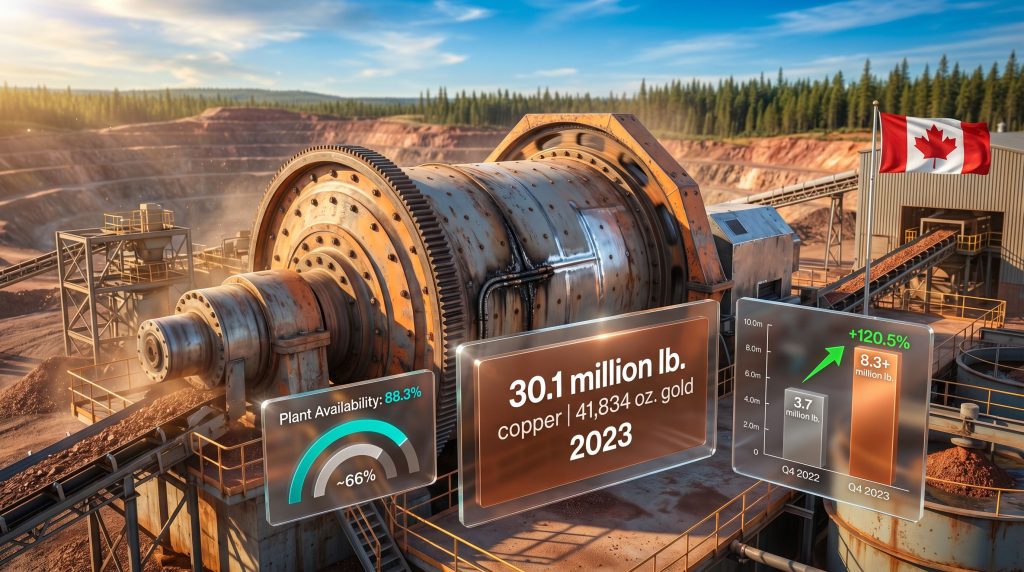
| Copper Produced | ~3.8 million lb. | 8.3+ million lb. | +120.5% |
| Gold Produced | ~6,993 oz. | 10,349 oz. | +48.0% |
| Plant Availability | ~66.3% | 88.3% | +22 percentage points |
The 120.5% increase in quarterly copper production cannot be attributed to throughput volume alone. The 44.6% increase in ore processed explains part of the uplift, but the magnitude of the copper production recovery suggests additional contributing factors: improvement in ore grade processed during Q4, enhanced metallurgical recovery rates following plant recommissioning, or the processing of higher-grade ore stockpiles that had accumulated during the constrained period.
Furthermore, a critical technical insight here is that plant availability is not the same as plant utilisation. Availability measures the percentage of scheduled time that equipment is mechanically capable of operating. Utilisation measures the percentage of time it actually runs. Moving plant availability from 66.3% to 88.3% in a single quarter reflects disciplined maintenance scheduling, efficient mill recommissioning, and successful ramp-up validation — not simply turning a switch back on.
Peak throughput during the third week of December 2023 reached 20,076 tonnes of ore processed, providing a benchmark for the circuit's restored capacity when all mills operate at design parameters. According to Imperial Metals' 2023 production update, this milestone demonstrated just how effectively the operation rebounded following an extended period of constrained grinding capacity.
The Gold Outperformance Story: Revenue Resilience Through By-Product Credits
One of the less-discussed dimensions of Mount Polley's 2023 performance is the role that gold played in partially offsetting the financial impact of the copper production shortfall. Full-year gold output of 41,834 ounces exceeded the upper boundary of the annual gold guidance range, even as copper production landed at the lower boundary of its equivalent target.
This divergence matters for several reasons:
- Revenue hedging: Gold production at above-guidance levels generates incremental revenue that partially compensates for copper volume shortfalls, smoothing the financial impact on the operation's cash generation
- Grade distribution signals: Gold exceeding guidance while copper meets only the low end of its range suggests that the ore zones processed during 2023 may have carried slightly higher gold-to-copper ratios than the planning model anticipated — a common characteristic of porphyry deposits where gold and copper grades are spatially correlated but not perfectly uniform
- Investor perception management: Demonstrating that a second revenue stream exceeded targets helps frame the overall production year as operationally credible rather than a guidance miss story, even if copper technically underperformed
For investors evaluating mid-tier copper-gold producers, this dynamic highlights why by-product credits are not merely accounting adjustments but genuine operational insurance against single-commodity disruptions.
The next major ASX story will hit our subscribers first
The 2014 Tailings Legacy: Environmental Obligations Shaping 2023 Capital Allocation
How Has the 2014 Incident Affected Ongoing Operations?
Any analysis of Mount Polley's operational context must acknowledge the event that remains the most significant chapter in the mine's history. In August 2014, the tailings storage facility at Mount Polley experienced a catastrophic breach, releasing approximately 25 million cubic metres of mine waste into surrounding waterways. The scale of the release made it one of the most significant tailings dam failures in Canadian mining history.
The operational response involved temporarily relocating tailings to the Springer pit, a closed mining excavation on the property, as an interim storage solution while permanent remediation was planned and executed. By early 2024, Imperial Metals was undertaking a programme to remove this material from the Springer pit, with completion targeted before the end of Q1 2024.
The intersection of active production planning with this remediation timeline creates a distinctive operational dynamic:
- Capital allocation decisions must accommodate remediation expenditure alongside normal sustaining capital requirements
- Environmental monitoring obligations generate ongoing regulatory reporting and stakeholder engagement requirements
- Community and Indigenous relationships, central to the mine's social licence to operate, continue to be shaped by the legacy of the 2014 event
- Mine planning decisions, particularly around tailings management infrastructure, carry heightened regulatory scrutiny compared to operations without incident histories
The lessons learned from the 2014 failure continue to influence tailings governance standards across British Columbia and more broadly across the Canadian mining sector. In addition, the near-decade timeline from the 2014 failure to the Q1 2024 Springer pit remediation completion illustrates the duration and complexity of major environmental remediation programmes in Canadian mining.
Investor Framework: Reading Operational Resilience as a Management Quality Signal
For investors in mid-tier mining companies, the Mount Polley copper production despite a damaged mill outcome in 2023 offers a specific lens through which management quality can be evaluated. The relevant questions are not simply whether production met guidance, but how the operation responded to an unplanned, externally caused disruption.
Maintaining annual copper production at the low end of guidance, rather than missing guidance entirely, after losing a primary processing component for roughly five to six months represents a meaningful management achievement. It implies that the operations team executed ore stockpile strategy during the downtime, prioritised higher-grade mill feed during constrained periods, and drove a rapid throughput ramp-up upon mill restoration.
Several operational quality indicators from the 2023 year are particularly instructive:
- The speed of the Q4 recovery (from October mill restart to peak December throughput of 20,076 tonnes per day) suggests commissioning competence and pre-planned restart protocols
- The 22 percentage point improvement in plant availability within a single quarter reflects maintenance discipline rather than luck
- Gold production exceeding its upper guidance boundary demonstrates that the metallurgical and grade control teams maintained focus on value extraction even during throughput constraints
When analysts assess production guidance conservatism at mining companies, the gap between guidance midpoints and actual outcomes under stress conditions is more informative than guidance accuracy under normal operations. Mount Polley's 2023 outcome suggests the guidance framework incorporated sufficient operational buffer to absorb a significant unplanned event.
British Columbia Copper: Jurisdiction Context and Supply Significance
Mount Polley sits within a British Columbia copper mining landscape that includes some of Canada's most significant porphyry deposits. The province's geological endowment in copper-gold porphyry systems, its established regulatory framework, and its workforce infrastructure make it one of North America's most important copper-producing jurisdictions.
Mid-tier operations like Mount Polley play a specific role in aggregate copper supply that is often underappreciated. Global copper supply projections through the late 2020s and into the 2030s anticipate growing supply deficits as demand from electrification and grid infrastructure investment accelerates. In this environment, sustaining production at existing mines — and returning disrupted capacity to service quickly — has a meaningful cumulative effect on the global supply picture.
No single mid-tier mine determines market balance. However, operational disruptions across multiple producers simultaneously create supply volatility that affects pricing and concentrate availability. The Mount Polley copper production despite a damaged mill recovery in Q4 2023 illustrates the industry's capacity to restore production at the asset level, which, when aggregated across multiple operations, supports copper market supply continuity.
Frequently Asked Questions: Mount Polley 2023 Production and Mill Recovery
What Caused the Production Disruption at Mount Polley in 2023?
A lightning strike during the second quarter of 2023 damaged the third ball mill within the mine's grinding circuit, constraining the plant's overall throughput capacity for several months.
How Much Copper Did Mount Polley Produce in 2023 Despite the Mill Damage?
The operation produced 30.1 million pounds of copper and 41,834 ounces of gold for the full year, with copper at the low end of guidance and gold exceeding the upper end of its target range.
When Was the Damaged Mill Returned to Operation?
The third ball mill was recommissioned in October 2023, enabling accelerated throughput through Q4 and into year-end.
What Was the Throughput Recovery Rate After the Mill Was Repaired?
Following the mill's return to service, approximately 1.6 million tonnes of ore were processed in Q4 2023 — a 44.6% increase over Q4 2022 — with plant availability rising to 88.3%.
What Is the Springer Pit Tailings Removal Programme?
Following the 2014 tailings storage facility failure, displaced tailings were temporarily stored in the Springer pit. A removal and remediation programme was underway in early 2024, with completion targeted before the end of Q1 2024.
What Ore Grades Did Mount Polley Process in 2023?
The mill treated ore grading 0.287% copper and 0.311 grams per tonne gold across 5.9 million tonnes of total feed for the year ended 31 December 2023.
Key Takeaways: What the Mount Polley 2023 Experience Demonstrates
- 30.1 million lb. of copper and 41,834 oz. of gold were delivered in a year defined by extended processing infrastructure disruption
- Q4 2023 copper output of 8.3+ million lb. represented a 120.5% year-on-year increase, illustrating the throughput leverage that returns when full milling capacity is restored
- Plant availability improving from approximately 66.3% to 88.3% within a single quarter reflects execution discipline and pre-planned restart protocols
- Gold production exceeding its upper guidance boundary provided a revenue offset that partially absorbed the financial impact of constrained copper throughput
- The ongoing Springer pit tailings removal programme signals continued progress on the environmental obligations arising from the 2014 tailings dam failure
- For investors and analysts, the year illustrates how mid-tier copper operations can preserve annual production integrity through adaptive throughput management, ore stockpile strategy, and rapid recommissioning execution — even when facing material unplanned equipment failures
This article is intended for informational purposes only and does not constitute financial advice. Production figures and operational timelines are sourced from reporting by the Canadian Mining Journal (January 18, 2024). Forecasts, projections, and analytical interpretations represent the author's assessment and are subject to change based on updated operational and market information. Investors should conduct their own due diligence before making investment decisions.
Want to Capitalise on the Next Major Copper Discovery Before the Market Does?
Discovery Alert's proprietary Discovery IQ model delivers real-time alerts on significant ASX mineral discoveries — transforming complex geological and commodity data into actionable investment insights the moment announcements hit the exchange. Start your 14-day free trial today and see why historic mineral discoveries have generated extraordinary returns for investors who moved early.