June 9, 2026
What Does the Mozal Shutdown Mean for European Aluminum Markets?
The global aluminum landscape faces unprecedented disruption as South32's decision to place the Mozambique Mozal smelter on care and maintenance creates ripple effects throughout European supply chains. This strategic shift represents more than a single facility closure; it fundamentally alters the competitive dynamics that have underpinned European aluminum procurement for decades. The search for alternative aluminum supply Europe Mozal shutdown solutions has become a critical priority for industrial buyers across the continent.
Quantifying the Supply Gap Impact
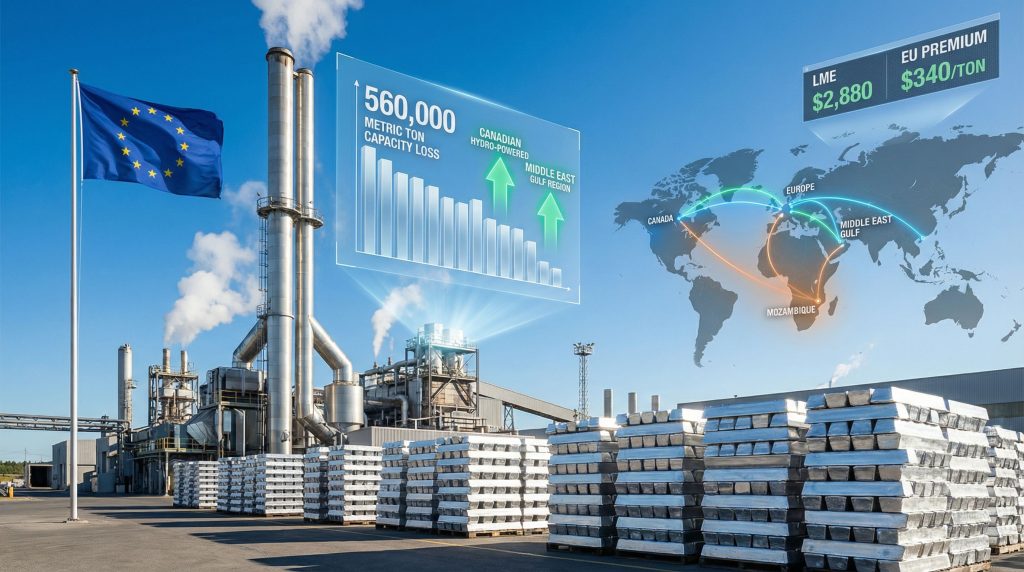
The magnitude of supply disruption extends far beyond initial assessments. Mozambique's 560,000 metric tons per year capacity loss removes a cornerstone supplier from European markets, with the facility having shipped 430,000 tons to EU buyers in the first ten months of 2025 alone. This volume represents approximately 19% of total EU aluminum imports, making Mozambique the bloc's primary supplier before the announced closure.
European aluminum demand operates on a scale of 9 million tons annually, according to Brussels-based industry group European Aluminium. Within this context, the Mozal shutdown creates a 600,000-ton deficit for 2026, as projected by ING analyst Ewa Manthey. This revised forecast represents a dramatic escalation from the previously anticipated 200,000-ton global deficit, effectively tripling the expected supply shortfall within a single announcement.
The supply mathematics reveal deeper structural challenges:
• Monthly displacement: 46,667 tons of lost production capacity per month
• Demand percentage: 6.2% of European annual consumption eliminated
• Timeline impact: Equivalent to 2.4 months of total European aluminum demand
• Market share concentration: Nearly one-fifth of EU imports from single source removed
Timeline and Market Response Mechanisms
The mid-March 2026 implementation date provides European buyers with approximately three months to secure alternative aluminum supply Europe Mozal shutdown arrangements. This compressed timeline coincides with the typical aluminum industry contracting cycle, where annual supply agreements are negotiated during the first quarter.
CRU analyst Ross Strachan emphasized that the Mozal closure fundamentally flips market dynamics from an anticipated 200,000-ton surplus to a substantial deficit. Furthermore, the timing creates compounding pressure as buyers simultaneously navigate the shutdown alongside other supply chain constraints.
European aluminum duty-paid premiums have already responded to tightening supply conditions, reaching a 10-month high of $340 per ton at the start of December before settling at $326 per ton. These premiums represent costs buyers pay above London Metal Exchange (LME) prices for physical metal delivery, covering taxes, freight, and handling expenses.
The premium escalation reflects underlying supply tension, with benchmark three-month aluminum trading at $2,880, approaching the three-year high of $2,920 recorded on November 3 and December 5. This price trajectory indicates market anticipation of supply constraints extending beyond the immediate Mozambique disruption.
When big ASX news breaks, our subscribers know first
Which Alternative Aluminum Supply Sources Can Fill the Mozambique Gap?
European aluminum buyers face a complex sourcing landscape as they seek alternative aluminum supply Europe Mozal shutdown solutions to replace Mozambique's substantial volumes. The strategic response requires balancing cost competitiveness, carbon compliance, and supply chain reliability across multiple potential suppliers.
Canadian Hydro-Powered Aluminum Advantages
Canadian primary aluminum production offers compelling advantages for European buyers navigating the post-Mozal supply environment. The country's 3.1-3.2 million metric tons of annual smelting capacity operates predominantly on renewable hydroelectric power, creating favourable carbon profiles under the EU's Carbon Border Adjustment Mechanism (CBAM).
However, Canada economic challenges in the current market environment may affect production costs and supply consistency. Canadian facilities typically achieve 4-6 tons CO₂ equivalent per ton of aluminum compared to the global average of 10-14 tons CO₂e per ton. This differential creates substantial cost advantages under CBAM carbon tax mechanisms, where European buyers face additional fees based on embedded carbon content in imported aluminum.
The logistics infrastructure connecting Canadian production to European markets has proven reliable through established trade relationships. Quebec and British Columbia smelters, operated by major producers including Alcan (Rio Tinto subsidiary), possess demonstrated capacity to serve export markets with competitive shipping routes through Atlantic and Pacific gateways.
Key Canadian advantages include:
• 95%+ hydroelectric power sources ensuring renewable energy profiles
• Established EU trade relationships with mature logistics networks
• CBAM compliance advantages reducing carbon tax exposure
• Production cost competitiveness through stable energy pricing
Middle East Gulf Region Opportunities
Gulf region aluminum producers present significant opportunities for alternative aluminum supply Europe Mozal shutdown strategies, driven by modern smelter technology and integrated power infrastructure. Facilities across the UAE, Saudi Arabia, Bahrain, and Oman operate among the world's most efficient primary aluminum operations.
In addition, Saudi Arabia exploration activities indicate potential for expanded mineral production capacity in the region. Middle East producers benefit from production costs estimated at $1,600-1,800 per ton on an ex-smelter basis, enabled by integrated power generation and advanced Hall-Héroult process technology.
Modern pot-line configurations achieve current efficiency exceeding 93%, while advanced anode technology reduces carbon consumption relative to older facility designs. CRU's Ross Strachan identified Gulf region exporters as particularly well-positioned to capture European market share, emphasising that elevated European duty-paid premiums create strong economic incentives for Middle Eastern producers to redirect shipments toward EU markets.
The premium differential compensates for shipping costs and logistics expenses associated with the 8,000-12,000 nautical mile transit from Gulf ports to Mediterranean European entry points.
Strategic advantages of Gulf suppliers:
• Modern smelter efficiency with state-of-the-art technology
• Competitive pricing structures enhanced by integrated power
• Shipping route optimisation through Suez Canal transit
• Economic incentives from elevated European premium environment
Nordic Supply Chain Reinforcement
Nordic aluminum production traditionally serves as a backbone for European supply security, leveraging abundant renewable energy resources across Iceland and Norway. However, concurrent operational challenges have constrained Nordic contribution to alternative aluminum supply Europe Mozal shutdown solutions.
Century Aluminum's Iceland facility experienced significant operational disruption in 2025, with output reduced by two-thirds due to electrical failure. This outage removed Iceland from its position as the EU's second-biggest aluminum supplier, creating additional supply pressure coinciding with the Mozambique shutdown announcement.
Norwegian aluminum capacity, including facilities operated by Norsk Hydro and Alcoa, maintains advantages through hydropower-dependent production. These operations benefit from electricity costs of $20-30 per MWh compared to European grid prices ranging from $60-120 per MWh, depending on market conditions.
Nordic production characteristics:
• Near-zero marginal energy costs for Icelandic geothermal/hydroelectric facilities
• Renewable power supply stability from Norwegian hydroelectric infrastructure
• Carbon intensity advantages supporting CBAM compliance requirements
• Recovery timeline uncertainty for Iceland facility restoration
How Will EU Carbon Border Adjustment Mechanism Reshape Sourcing Decisions?
The EU Carbon Border Adjustment Mechanism fundamentally transforms aluminum procurement economics by introducing carbon pricing as a primary cost variable. Implementation beginning January 2026 creates new competitive dynamics favouring low-carbon suppliers while penalising carbon-intensive production methods.
CBAM Implementation Impact Analysis
CBAM measures both direct CO₂ emissions from aluminum production and indirect emissions from electricity generation, establishing comprehensive carbon footprint assessments for imported materials. The mechanism applies EU Emissions Trading System (ETS) carbon price levels, typically ranging €60-90 per ton CO₂ equivalent, to the embedded carbon content of aluminum imports.
For instance, these energy transition imperatives are reshaping global supply chains across multiple sectors. For typical carbon-intensive aluminum producers, CBAM implementation creates €20-40 per ton of additional costs on imported aluminum.
This pricing structure fundamentally alters supplier competitiveness, as low-carbon producers gain cost advantages proportional to their carbon intensity differential versus high-emission facilities.
The carbon tax structure creates clear economic incentives for European buyers to prioritise suppliers from:
• Hydroelectric-powered facilities (Canada, Nordic region)
• Integrated renewable energy operations (select Gulf producers)
• Modern, efficient smelting technology with reduced carbon intensity
• Verified carbon reporting systems enabling accurate CBAM calculations
Russian Supply Restrictions and Market Dynamics
European aluminum sourcing faces additional constraints through Russian import limitations, with annual volumes capped at 50,000 metric tons from February 26 through December 31, 2025. While this represents approximately 0.55% of European annual demand, the restriction contributes to cumulative supply tightness alongside Mozambique and Iceland disruptions.
The Russian supply limitation forces European buyers to pursue diversified sourcing strategies prioritising suppliers from politically stable, trade-aligned regions. This geopolitical dimension adds complexity to alternative aluminum supply Europe Mozal shutdown decision-making, as buyers balance cost competitiveness against supply chain security considerations.
Combined supply restrictions create compounding pressure:
| Supply Disruption | Annual Volume Impact | EU Demand Percentage |
|---|---|---|
| Mozal Shutdown | 560,000 tons | 6.2% |
| Iceland Outage | 40,000-50,000 tons | 0.4-0.6% |
| Russian Restrictions | 50,000 tons | 0.55% |
| Total Impact | 650,000-660,000 tons | 7.2-7.4% |
What Strategic Options Are European Buyers Pursuing?
European aluminum buyers are implementing multifaceted strategies to address supply chain disruptions while maintaining cost competitiveness and regulatory compliance. These approaches span immediate sourcing adjustments and long-term structural investments in supply chain resilience.
Recycling Capacity Expansion Initiatives
Secondary aluminum production offers substantial benefits for European supply security, requiring 95% less energy than primary smelting while reducing dependence on imported metal. However, expanding recycling capacity requires significant capital investment, with new remelting facilities typically costing €450-550 million for commercial-scale operations.
European policymakers are considering scrap retention strategies to support domestic secondary aluminum production. Export restrictions on aluminum scrap could enhance feedstock availability for European recycling facilities, though implementation requires careful balance with international trade obligations and downstream industry needs.
Key recycling expansion elements:
• Energy efficiency advantages through reduced power requirements
• Capital investment needs for new remelting infrastructure
• Scrap feedstock security through export restriction policies
• Quality maintenance standards for secondary aluminum applications
Long-term Contracting and Strategic Reserves
European industrial buyers are pursuing extended contract terms to secure alternative aluminum supply Europe Mozal shutdown arrangements beyond traditional annual agreements. Multi-year contracting provides suppliers with revenue certainty while offering buyers price stability and volume guarantees during market volatility hedging scenarios.
Power Purchase Agreement (PPA) support mechanisms enable aluminum smelters to secure long-term energy contracts at competitive rates. These instruments reduce operating cost volatility while supporting renewable energy development, creating mutual benefits for utilities, smelters, and downstream industrial consumers.
Strategic stockpiling considerations include:
• Inventory buffer management for supply disruption protection
• Working capital requirements for increased aluminum holdings
• Storage infrastructure needs for strategic reserve maintenance
• Market timing optimisation for strategic reserve deployment
Domestic Smelter Viability Enhancement
European governments are exploring support frameworks for domestic aluminum smelting competitiveness, recognising strategic importance of maintaining regional production capacity. Energy cost mitigation represents the primary challenge, as European electricity prices significantly exceed those in major aluminum-producing regions.
Electrification and renewable energy integration offer pathways for improving European smelter economics while supporting decarbonisation objectives. However, implementation requires substantial infrastructure investment and supportive policy frameworks to compete with low-cost international producers.
Domestic smelter support strategies:
• Energy cost subsidisation for industrial competitiveness
• Renewable energy integration supporting decarbonisation goals
• Technology modernisation incentives for efficiency improvements
• Strategic importance recognition in industrial policy frameworks
How Are Aluminum Prices Responding to Supply Chain Disruptions?
Aluminum pricing dynamics reflect market anticipation of supply tightness extending through 2026, with both benchmark prices and regional premiums indicating structural shifts in global supply-demand balance.
London Metal Exchange Price Dynamics
LME three-month aluminum contracts have demonstrated resilience amid supply disruption concerns, trading at $2,880 with upward momentum of 0.5% following the Mozal shutdown announcement. This price level approaches the three-year high of $2,920 recorded on November 3 and December 5, indicating market recognition of tightening supply fundamentals.
The price trajectory reflects several converging factors:
• Supply disruption expectations from Mozambique shutdown
• Concurrent operational challenges at multiple facilities globally
• Energy cost pressures affecting global production economics
• Demand resilience from key consuming sectors
Technical analysis suggests $2,920 represents a critical resistance level, with potential for further advances if supply disruptions intensify or additional operational challenges emerge across the global aluminum system.
Regional Premium Adjustments and Market Signals
European aluminum duty-paid premiums have experienced substantial escalation, reaching a 10-month high of $340 per ton in early December before moderating to $326 per ton. These premiums reflect physical market tightness and transportation cost pressures affecting alternative aluminum supply Europe Mozal shutdown logistics.
The premium structure evolution indicates:
| Time Period | Premium Level | Market Signal |
|---|---|---|
| Early December | $340/ton (10-month high) | Acute supply tightness |
| Mid-December | $326/ton | Moderate price discovery |
| Trend Direction | Upward pressure | Supply constraint anticipation |
Regional premium differentials create economic incentives for suppliers to redirect volumes toward European markets, particularly benefiting Gulf region producers capable of optimising shipping routes and delivery schedules to capture premium pricing opportunities.
What Are the Long-term Implications for European Aluminum Strategy?
The convergence of supply disruptions, regulatory changes, and geopolitical constraints necessitates fundamental reassessment of European aluminum strategy. Long-term implications extend beyond immediate sourcing adjustments to encompass structural changes in supply chain architecture and industrial policy frameworks.
Supply Chain Resilience Building Measures
European aluminum supply chain resilience requires diversification away from single-source dependencies that characterised the Mozambique relationship. The concentration risk demonstrated by losing nearly 20% of EU imports from a single supplier highlights the importance of distributed sourcing strategies.
Investment in domestic production capabilities represents a strategic priority, though implementation faces challenges from high European energy costs and environmental regulations. Consequently, balancing supply security against cost competitiveness requires innovative approaches to energy procurement and facility optimisation.
These developments reflect broader industry evolution trends affecting global mineral markets and production strategies.
Strategic partnership development with reliable suppliers involves:
• Multi-region sourcing portfolios reducing concentration risk
• Long-term contract structures providing mutual security
• Infrastructure investment coordination supporting logistics efficiency
• Technology collaboration advancing production efficiency
Sustainability and Competitiveness Balance
CBAM implementation creates new dynamics where environmental performance directly impacts economic competitiveness. Low-carbon aluminum sourcing becomes not just an ESG requirement but a fundamental cost management strategy under carbon pricing mechanisms.
European buyers must balance multiple objectives:
Cost optimisation through efficient sourcing arrangements while minimising carbon tax exposure through low-emission suppliers and maintaining supply security through diversified supplier relationships.
This balance requires sophisticated procurement strategies incorporating carbon footprint analysis, long-term energy cost projections, and geopolitical risk assessment in supplier evaluation frameworks.
Policy Framework Evolution Requirements
European policymakers face pressure to enhance support mechanisms for domestic aluminum industry competitiveness while maintaining commitment to decarbonisation objectives. Scrap export restriction implementation could support secondary aluminum production, though careful calibration is required to avoid downstream industry disruption.
Industrial support mechanism enhancement may include:
• Energy cost compensation for internationally exposed industries
• Fast-track permitting for recycling facility investments
• Strategic material reserve programs for supply security
• Research and development incentives for production efficiency advances
The next major ASX story will hit our subscribers first
Key Monitoring Indicators for Market Participants
Market participants require systematic monitoring frameworks to navigate evolving aluminum supply dynamics and optimise strategic decision-making amid ongoing uncertainty.
Critical Decision Points and Timeline Markers
Several key developments will shape alternative aluminum supply Europe Mozal shutdown availability and pricing through 2026:
South32 Power Contract Negotiations: While the Mozal facility proceeds toward care and maintenance, potential resolution of power supply agreements could alter closure timeline or enable future restart scenarios. Monitoring utility negotiations and government involvement provides early warning indicators for supply restoration possibilities.
Canadian Shipment Flow Direction: Canadian aluminum producers typically allocate volumes between US and European markets based on relative pricing and demand conditions. Tracking Canadian export data reveals supply availability for European buyers and competitive dynamics with North American consumption.
Nordic Smelter Operational Status: Century Aluminum Iceland's electrical system repair progress directly impacts European supply availability. Recovery timeline updates affect medium-term sourcing strategies and premium pricing dynamics.
Critical monitoring indicators include:
• Monthly trade flow data from Canadian and Gulf producers
• LME inventory levels indicating physical supply tightness
• Regional premium spreads revealing supply-demand imbalances
• Energy market developments affecting smelter operating costs
Investment and Policy Signal Tracking
European policy developments significantly influence aluminum supply chain economics and investment decisions. Tracking regulatory announcements and implementation timelines enables proactive strategy adjustment.
EU Scrap Export Restrictions: Potential limitations on aluminum scrap exports would affect secondary production economics and domestic supply availability. Policy announcement timing impacts recycling facility investment decisions and scrap market pricing.
Fast-track Remelting Facility Approvals: Accelerated permitting for secondary aluminum production supports supply chain resilience while advancing circular economy objectives. Investment approval patterns indicate government commitment to domestic capacity enhancement.
PPA Support Program Implementation: Power purchase agreement support mechanisms enable aluminum smelters to secure competitive long-term energy contracts. Program details affect domestic smelter viability and international competitiveness.
Key policy tracking elements:
• Regulatory consultation timelines for scrap export policies
• Investment incentive announcements for recycling infrastructure
• Energy market reform proposals affecting industrial electricity pricing
• Trade policy adjustments influencing import/export dynamics
Europe's search for alternative aluminium supply has become increasingly urgent as the Mozal shutdown approaches. Market dynamics suggest that European aluminium deficit projections for 2026 will require comprehensive strategic responses from both industry and policymakers.
Disclaimer: This analysis contains forward-looking assessments based on current market conditions and announced industry developments. Actual outcomes may differ significantly due to operational, regulatory, or market changes beyond current forecasting capabilities. Investment and procurement decisions should incorporate comprehensive risk assessment and professional consultation appropriate to specific circumstances.
Looking to Capitalise on Critical Supply Chain Disruptions?
The Mozambique Mozal shutdown represents the type of supply chain disruption that creates significant opportunities across ASX-listed commodities companies. Discovery Alert's proprietary Discovery IQ model instantly identifies mining announcements and discoveries that could benefit from these shifting global dynamics, delivering real-time alerts on significant mineral discoveries that help subscribers position themselves ahead of market movements. Begin your 30-day free trial today to gain actionable insights into how supply disruptions translate into investment opportunities across the Australian mining sector.