June 30, 2026
The contemporary global economic landscape reveals profound shifts in how developing nations forge strategic partnerships to accelerate development outcomes. Traditional North-South cooperation models increasingly face competition from South-South frameworks that emphasize mutual benefit, technology transfer, and long-term strategic alignment. Within this evolving paradigm, certain bilateral relationships have emerged as comprehensive models for economic transformation, demonstrating how historical diplomatic foundations can evolve into sophisticated Mozambique and China cooperation agreements that reshape regional development trajectories.
Strategic Foundations of Comprehensive Bilateral Partnerships
The evolution of China-Mozambique relations exemplifies how diplomatic relationships can transform into comprehensive economic partnerships spanning multiple decades. Since establishing formal diplomatic relations in 1975, both nations have systematically expanded their cooperation framework from basic trade arrangements to sophisticated strategic partnerships encompassing infrastructure development, technology transfer, and regional integration initiatives.
The relationship's historical foundation traces back to China's support during Mozambique's liberation struggle in the 1960s, creating a unique diplomatic context that differs substantially from purely transactional trade relationships. This historical continuity provides political stability essential for long-term investment planning and strategic resource development across multiple economic sectors. Furthermore, this foundation has enabled deeper cooperation in emerging sectors requiring substantial trust and coordination.
Institutional Framework Development
The partnership's institutional architecture has evolved through several critical phases, with the most significant advancement occurring during President Daniel Chapo's state visit to Beijing from April 17-22, 2026. This visit resulted in the signing of over 20 cooperation agreements and the elevation of bilateral relations to a "China-Mozambique community with a shared future in the new era" designation.
These agreements establish formal mechanisms across six primary domains:
• Belt and Road Initiative coordination frameworks
• Global Security Initiative implementation protocols
• Economic and trade exchange mechanisms
• People-to-people exchange programs
• Health sector collaboration initiatives
• Media and communication cooperation structures
The comprehensive nature of these frameworks demonstrates how modern Mozambique and China cooperation agreements extend beyond traditional trade arrangements. Consequently, they encompass strategic coordination across multiple development priorities that influence regional economic patterns.
When big ASX news breaks, our subscribers know first
Economic Integration Through Multi-Sector Cooperation
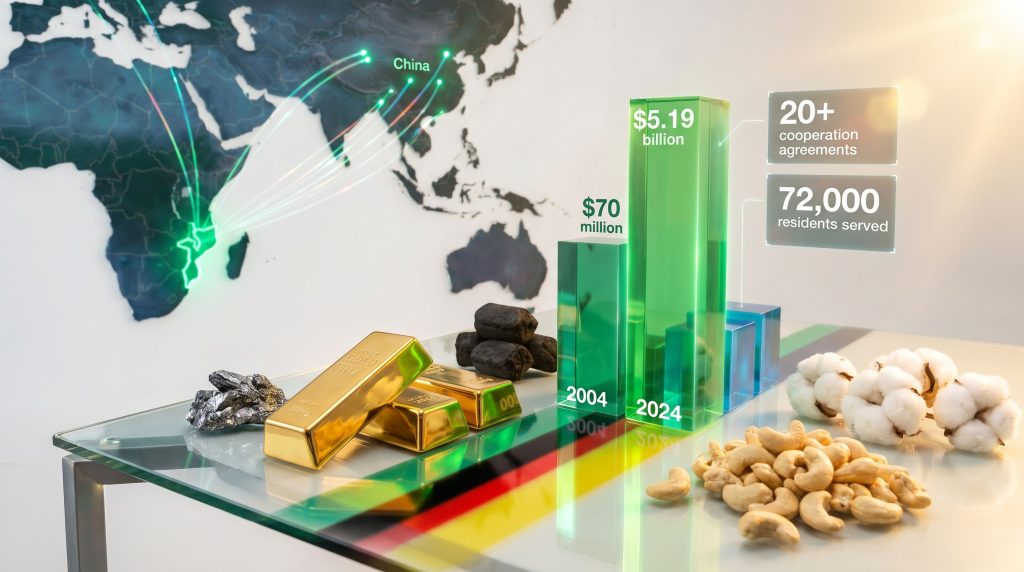
Trade performance between the two nations illustrates the partnership's expanding economic significance. Bilateral trade volumes reached $5.19 billion in 2024, representing extraordinary growth from a baseline of $70 million in 2004. This 74-fold increase over two decades indicates a compound annual growth rate exceeding 20%, demonstrating sustained economic integration across multiple sectors.
Moreover, these trade figures reflect the effectiveness of multi‑polar global economy principles in action. However, such rapid expansion also presents challenges regarding trade balance sustainability and market diversification requirements.
Trade Composition and Market Dynamics
The bilateral trade structure reflects complementary economic capabilities, with Mozambique primarily exporting agricultural products and mineral resources while importing manufactured goods, machinery, and technology products from China. This composition creates opportunities for value-added processing development within Mozambique whilst providing Chinese manufacturers with expanded African market access.
Primary Trade Categories:
| Direction | Product Categories | Strategic Focus |
|---|---|---|
| Mozambique to China | Agricultural products, minerals, processed commodities | Raw material supply, food security |
| China to Mozambique | Machinery, electronics, manufactured goods, construction materials | Industrial capacity building, infrastructure development |
The implementation of duty-free market access beginning May 1, 2026, fundamentally alters these trade dynamics. China's zero-tariff treatment for 53 African countries maintaining diplomatic relations eliminates traditional barriers that previously limited Mozambican export competitiveness in Chinese markets. Additionally, this policy shift creates opportunities for enhanced value-added processing development.
Agricultural Modernisation and Technology Transfer
Agricultural cooperation represents a cornerstone of the expanded partnership framework, with specific emphasis on technology transfer, equipment provision, and processing capacity development. The 2026 agreements include provisions for seed laboratory development, farming technique enhancement, and agricultural equipment supply arrangements that reflect industry evolution trends in agricultural technology.
These agricultural modernisation initiatives target several key objectives:
• Enhanced food security through improved production techniques
• Export capacity expansion for premium agricultural products
• Value-added processing development for international markets
• Technology adoption accelerating productivity growth
Cashew processing exemplifies the partnership's agricultural development potential. Mozambique's coastal geography and favourable growing conditions position it for expanded cashew production, whilst duty-free Chinese market access eliminates tariff barriers. Furthermore, this cooperation demonstrates how traditional agricultural sectors can benefit from modern processing technologies.
Infrastructure Development and Connectivity Enhancement
Infrastructure projects form a critical component of the bilateral cooperation framework, addressing fundamental development constraints whilst creating platforms for expanded economic activity. These initiatives focus on transportation corridors, energy systems, water supply infrastructure, and digital connectivity enhancement that support comprehensive economic transformation.
The infrastructure approach emphasises long-term development objectives rather than short-term extraction activities. In addition, these projects incorporate modern engineering standards and environmental sustainability considerations that align with contemporary development practices.
Transportation and Logistics Infrastructure
Strategic transportation investments emphasise connectivity between Mozambique's port facilities and inland regions, both domestically and for neighbouring countries. These corridor developments serve dual purposes: facilitating Mozambican resource exports whilst positioning the country as a regional trade hub for landlocked Southern African nations.
The infrastructure approach reflects China's Belt and Road Initiative methodology, emphasising connectivity enhancement that supports broader regional economic integration. Port facility improvements at Maputo and other coastal locations create capacity for expanded trade volumes. However, these developments also reduce transportation costs for regional commerce, creating broader economic benefits.
Energy Sector Development
Energy infrastructure cooperation encompasses both traditional resource extraction and renewable energy development. The partnership framework specifically mentions renewable energy projects, mineral resource processing facilities, and energy security enhancement initiatives that incorporate AI technology in mining applications.
This dual approach addresses immediate energy access needs whilst positioning Mozambique for participation in global renewable energy markets. Solar and wind energy development potential, combined with Chinese manufacturing capabilities in renewable technologies, creates opportunities for comprehensive energy sector transformation. Moreover, these initiatives align with green iron sustainability principles in industrial development.
Market Access Revolution Through Trade Policy Reform
The implementation of 100% duty-free market access represents a fundamental shift in China-Africa trade relationships. Effective May 1, 2026, this policy eliminates tariff barriers on all product categories for 53 African countries, creating unprecedented market opportunities for Mozambican exporters.
Nevertheless, this market access expansion requires substantial preparation regarding quality standards, logistics capacity, and market positioning strategies. For instance, agricultural exporters must meet Chinese food safety requirements whilst maintaining competitive pricing structures.
Competitive Advantage Creation
Duty-free access provides Mozambican agricultural and processed goods with significant competitive advantages in Chinese consumer markets. Traditional tariff barriers that previously reduced price competitiveness against other global suppliers are eliminated, enabling expanded market penetration and production capacity utilisation.
Key beneficiary sectors include:
• Agricultural Products: Cashews, seafood, cotton, and processed foods gain enhanced competitiveness
• Mineral Resources: Graphite, coal, and processed mineral products benefit from streamlined market access
• Value-Added Manufacturing: Processed commodities and light manufacturing products achieve better market positioning
The tariffs impact on investment patterns globally demonstrates the significance of preferential trade arrangements. Consequently, Mozambican producers can leverage these advantages to develop sustainable market positions in Chinese consumer segments.
Strategic Trade Asymmetries
Whilst duty-free access applies equally across all 53 participating African countries, the practical benefits vary significantly based on production capacity and export readiness. Mozambique's current manufacturing capacity remains limited compared to Chinese export capabilities, creating asymmetric benefits favouring Chinese manufactured goods in bilateral trade relationships.
This asymmetry presents both opportunities and challenges for Mozambican economic development. Enhanced market access creates incentives for production capacity expansion and value-added processing development. However, Chinese manufactured goods gain preferential access to Mozambican consumer markets, potentially affecting local industrial development strategies.
Investment Patterns and Development Finance
Chinese investment in Mozambique emphasises productive capacity building rather than purely extractive activities. This approach prioritises technology transfer, skills development, and local value addition across multiple economic sectors, distinguishing it from traditional resource extraction models that focus primarily on commodity exports.
Furthermore, these investment patterns reflect broader trends in South-South cooperation that emphasise mutual benefit creation. For example, joint venture structures enable knowledge transfer whilst providing market access for both partners.
Sectoral Investment Priorities
Investment focus areas reflect strategic priorities that align Chinese capabilities with Mozambican development objectives:
Mining Sector: Processing facilities and technology transfer initiatives that add value to mineral resources before export
Manufacturing Development: Industrial park establishment and technology centre creation supporting industrial diversification
Agricultural Processing: Equipment provision and technical assistance enabling higher-value agricultural product development
Infrastructure Enhancement: Transportation, utilities, and telecommunications projects improving economic connectivity
Joint Venture Structures and Knowledge Transfer
Partnership arrangements emphasise knowledge sharing through joint venture structures combining Chinese technical expertise with Mozambican market knowledge and resource access. These arrangements create mechanisms for sustained technology transfer extending beyond initial project implementation.
Technology Transfer Mechanisms:
Research and Development Programs: Joint initiatives developing solutions for local market conditions and resource utilisation
Skills Training Partnerships: Educational programmes building local technical capacity and management expertise
Equipment Leasing Arrangements: Technology access models that include maintenance training and operational support
Technical Advisory Services: Ongoing consultation supporting local capacity development and operational optimisation
Regional Integration and Strategic Geography
Mozambique's strategic location provides access to Southern African markets whilst offering connectivity to Indian Ocean trade routes. This geographic advantage enhances the partnership's value for broader regional economic integration and positions Mozambique as a potential regional hub for Chinese investment and trade activities.
Moreover, this positioning creates opportunities for expanded cooperation with neighbouring countries seeking similar development models. Additionally, regional integration benefits extend beyond bilateral trade relationships to encompass infrastructure sharing and technology transfer spillovers.
Southern African Development Community Integration
The bilateral partnership operates within broader Southern African Development Community (SADC) frameworks, creating opportunities for expanded regional cooperation. Mozambique's improved infrastructure and enhanced trade relationships with China benefit neighbouring landlocked countries seeking efficient export corridors and import access.
Regional Integration Benefits:
• Port facility capacity serving multiple regional economies
• Transportation corridor development linking inland resources to export markets
• Technology transfer spillover effects benefiting regional partners
• Enhanced regional trade facilitation through improved infrastructure
Forum on China-Africa Cooperation Framework
The bilateral relationship operates within the Forum on China-Africa Cooperation (FOCAC) institutional framework, which provides multilateral support for expanded cooperation. Former President Filipe Jacinto Nyusi's participation in FOCAC meetings in September 2024 demonstrates Mozambique's active engagement in continental cooperation mechanisms.
This multilateral context creates opportunities for coordination with other African partners whilst ensuring bilateral cooperation aligns with broader continental development objectives. Furthermore, FOCAC provides platforms for sharing best practices and coordinating development strategies across participating nations.
The next major ASX story will hit our subscribers first
Challenges and Strategic Risk Considerations
Global economic conditions, commodity price volatility, and international financing markets influence partnership development trajectories. These external factors affect investment timing, project prioritisation, and market development strategies, requiring adaptive approaches to cooperation implementation that consider multiple risk scenarios.
However, the comprehensive nature of Mozambique and China cooperation agreements provides resilience against individual sector volatility. In addition, diversified cooperation frameworks reduce dependence on single commodity markets or investment channels.
External Economic Influences
International market dynamics create both opportunities and constraints for expanded cooperation:
Commodity Market Fluctuations: Price volatility affects revenue projections for resource-based development projects
Global Supply Chain Evolution: International trade pattern changes influence strategic corridor development priorities
Climate Change Adaptation: Environmental considerations require sustainable development approaches in all cooperation sectors
International Financing Conditions: Currency exchange rates and credit availability affect project financing structures
Emerging Sector Opportunities
New cooperation areas present expansion potential beyond traditional sectors. Digital economy development, renewable energy projects, and sustainable agriculture techniques align with global development trends whilst creating opportunities for technological leap-frogging in economic development.
Growth Opportunity Sectors:
• Renewable Energy Development: Solar and wind projects leveraging Mozambique's natural resources and Chinese manufacturing capabilities
• Digital Payment Systems: E-commerce platform development and financial technology adoption
• Sustainable Fisheries: Aquaculture development and sustainable fishing technique implementation
• Climate-Resilient Agriculture: Drought-resistant crop varieties and water-efficient farming methods
Long-Term Development Implications and Success Metrics
The comprehensive nature of Mozambique and China cooperation agreements suggests potential for sustained economic transformation extending beyond immediate trade and investment benefits. Long-term partnership development could establish Mozambique as a regional economic hub with enhanced productive capacity and technological sophistication.
Furthermore, successful implementation could create models for similar partnerships across Africa. For instance, technology transfer mechanisms and infrastructure development approaches could be adapted for different regional contexts and development priorities.
Development Outcome Projections
Successful partnership implementation could generate multiple transformative outcomes:
Industrial Diversification: Reduced dependence on commodity exports through manufacturing capacity development and value-added processing expansion
Regional Connectivity Enhancement: Improved transportation and communication infrastructure supporting expanded regional trade relationships
Technology Adoption Acceleration: Knowledge transfer and skills development programmes advancing productive capacity and economic sophistication
Employment Generation: Manufacturing development and processing facility establishment creating sustained employment opportunities
Partnership Effectiveness Measurement
Evaluating partnership success requires assessment across multiple dimensions extending beyond simple trade volume growth:
| Success Dimension | Key Indicators | Measurement Approach |
|---|---|---|
| Economic Integration | Trade diversification, investment sustainability | Annual bilateral trade analysis, sector-specific growth rates |
| Development Impact | Infrastructure functionality, technology adoption | Project completion rates, capacity utilisation metrics |
| Strategic Alignment | Policy coordination effectiveness | Joint project success rates, mutual benefit realisation |
The partnership's evolution from basic trade relationships to comprehensive strategic cooperation demonstrates how South-South cooperation frameworks can create sustained development opportunities. Success in implementing the 2026 cooperation agreements will likely influence similar partnership development across Africa. Consequently, this establishes precedents for comprehensive bilateral cooperation models that emphasise mutual benefit and sustainable development outcomes.
Disclaimer: This analysis is based on publicly available information and should not be construed as investment advice. Bilateral cooperation outcomes depend on numerous variables including global economic conditions, domestic policy implementation, and international market dynamics. Readers should conduct independent research before making investment or policy decisions related to China-Mozambique economic cooperation.
Exploring African Mining Investment Opportunities?
Discovery Alert's proprietary Discovery IQ model delivers instant notifications on significant ASX mineral discoveries, including those with African operations and partnerships that could benefit from enhanced China-Africa trade relationships. Begin your 14-day free trial today at Discovery Alert to identify actionable opportunities ahead of the broader market.