August 24, 2026
The Battery Mineral Chessboard: How Africa's Beneficiation Movement Is Rewriting Global Supply Chains
Across the African continent, a quiet but consequential shift has been underway for the better part of a decade. Resource-rich nations that once accepted their role as raw material exporters are increasingly asserting control over what leaves their borders and in what form. From the lithium fields of Zimbabwe to the cobalt corridors of the Democratic Republic of Congo, the policy direction has become unmistakable: extract value domestically, or face restrictions on what you can sell abroad.
Mozambique's move to restrict raw and semi-processed mineral exports is best understood within this continental context. The Mozambique graphite export ban is not simply a domestic regulatory adjustment. It is the latest and arguably most geopolitically significant chapter in Africa's ongoing minerals sovereignty story, arriving at a moment when the global battery supply chain is under acute pressure to reduce its dependence on Chinese processing capacity. Understanding the global graphite supply risks that underpin this shift is essential for anyone tracking the sector.
When big ASX news breaks, our subscribers know first
What Mozambique's 2026 Mining Law Reform Actually Does
The mechanics of the new regulatory framework deserve careful examination, because imprecise characterisations of the policy can lead to misinformed investment decisions. This is not a blanket prohibition on all graphite exports. Rather, it is an authorisation-linked processing requirement, meaning companies can still export graphite provided they obtain government approval backed by a credible domestic refining commitment.
The structural changes embedded in the 2026 Mining Law reform include several provisions that materially alter the operating environment for foreign mining companies:
- Prohibition on unprocessed or semi-processed mineral exports without government authorisation tied to a domestic refining plan
- Minimum 15% state equity required in standard mining operations
- Minimum 20% state equity required in projects classified as involving strategic minerals
- Establishment of a National Mineral Company holding preferential rights over strategically classified resources
- Creation of a National Institute of Mines as the primary regulatory enforcement body
- Mandatory investment in in-country processing infrastructure, including refineries and battery-grade material production facilities
A presidential decree announced in June 2026 formalised key elements of this framework, though full legislative implementation is not expected before 2027. This gap between decree and enforcement creates a compliance window that forward-thinking producers can use to their advantage.
The Critical Distinction Between a Ban and a Processing Requirement
Investors and supply chain planners should avoid conflating these two concepts. A blanket export ban forecloses all external sales regardless of processing status. A processing-linked authorisation framework, by contrast, rewards companies that commit to domestic value addition while restricting those that seek to extract and ship raw ore without reinvesting in local capacity. The distinction matters enormously for project economics and for understanding which operators are most exposed.
| Policy Type | What It Restricts | Compliance Pathway | Implementation Risk |
|---|---|---|---|
| Raw Export Ban | Unprocessed ore or concentrate | Domestic refinery construction | High capital cost, long lead time |
| Processing Requirement | Export without local value-add | Partial beneficiation before export | Medium, allows phased compliance |
| Authorisation Framework | Export without government approval | Submit credible refining development plan | Regulatory, subject to discretion |
Mozambique's Scale in the Global Graphite Hierarchy
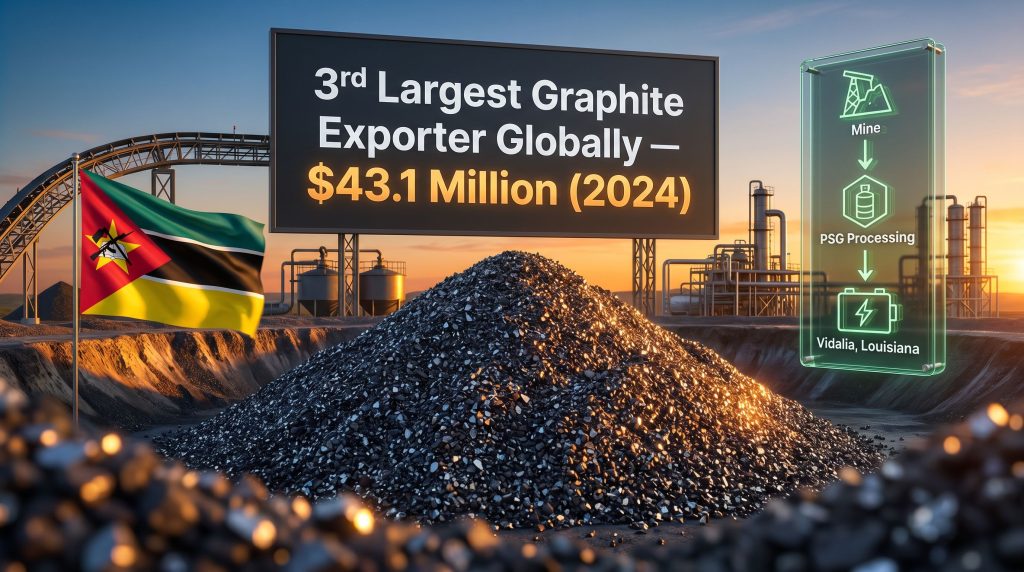
Understanding why the Mozambique graphite export ban generates international concern requires appreciating the country's actual weight in global supply. In 2024, Mozambique exported $43.1 million worth of graphite, positioning it as the third largest graphite exporter globally. That ranking makes domestic policy decisions in Maputo directly relevant to battery manufacturers in Seoul, Detroit, and Munich.
The country's graphite sector is dominated by two significant operations, which together define the scope of potential disruption:
Balama (Syrah Resources, ASX: SYR)
Operated by Australian mining company Syrah Resources, Balama is the largest graphite mine in Mozambique by production volume. The operation has received financial backing from the United States government in connection with its downstream strategy and has increasingly directed output toward its active anode material facility in Vidalia, Louisiana. Vidalia holds the distinction of being the first large-scale active anode material plant outside China, a fact that underscores just how thin the non-Chinese processing pipeline currently is.
Montepuez (Total Graphite)
British company Total Graphite, formerly known as Tirupati Graphite, updated its definitive feasibility study for the Montepuez project in June 2026. The updated study estimates annual production capacity of up to 100,000 metric tonnes, with output intended to feed a planned purified spherical graphite facility in the United States. Total Graphite's stated ambition is to build a fully vertically integrated business spanning the entire graphite value chain from African mine to American battery cell.
| Metric | Balama (Syrah Resources) | Montepuez (Total Graphite) |
|---|---|---|
| Operational Status | Producing | Feasibility/Development Stage |
| Estimated Annual Capacity | Large-scale, established | Up to 100,000 metric tonnes |
| U.S. Market Linkage | Vidalia, Louisiana AAM facility | Planned PSG anode facility (U.S.) |
| DFS Status | Completed | Updated June 2026 |
| Key Regulatory Exposure | Ambiguous under new decree | Development stage, compliance planning required |
The Ambiguity Problem: Existing Mines and the Decree's Scope
One of the most consequential unresolved questions surrounding the new framework is whether it applies to operations that were already producing before the decree took effect. The presidential decree does not explicitly clarify whether established mines like Balama fall within its enforcement scope. This ambiguity is not merely a technical legal question. It carries direct implications for production volumes, offtake agreements, and the financial modelling of every company with Mozambican graphite exposure.
Three regulatory scenarios represent the realistic range of outcomes for producers:
- Scenario A: Grandfathering of Existing Operations Pre-reform producers receive exemptions under prior licensing terms, allowing Balama and similar established mines to continue without immediate compliance obligations.
- Scenario B: Phased Compliance Roadmap All producers must submit a domestic processing development plan within a defined period, with export licences made conditional on demonstrable progress against stated milestones.
- Scenario C: Immediate Broad Enforcement The decree applies to all export activity from the date of sign-off, creating near-term disruption to production schedules and contracted offtake volumes.
Most analysts tracking the situation consider Scenario B the most probable outcome given Mozambique's interest in attracting rather than repelling investment. However, the possibility of selective enforcement based on political or commercial considerations cannot be dismissed.
Vertical Integration as a Compliance Strategy, Not Just a Business Model
There is a compelling argument that companies pursuing vertically integrated supply chains are not merely adopting a smart commercial strategy. They are simultaneously positioning themselves as structurally compliant with the spirit and likely direction of Mozambique's new regulatory architecture.
By committing to domestic beneficiation before export, a company building or planning a local processing facility satisfies the core intent of the processing requirement. Total Graphite's model, linking Montepuez mine output to a U.S. PSG plant while developing local beneficiation capacity in Mozambique, exemplifies this dual-purpose strategic logic.
Producers who treat vertical integration purely as a margin optimisation tool may be missing its more immediate value as a regulatory hedge in jurisdictions where beneficiation-first policies are rapidly becoming the norm.
Furthermore, this perspective is especially relevant given that the Mozambique graphite export ban sits within a broader continental pattern. Zimbabwe introduced export restrictions on unprocessed lithium in 2022. Tanzania has progressively tightened mineral export conditions. The DRC cobalt export restrictions have used state equity requirements and processing mandates to extract greater value from cobalt and copper resources. Mozambique is following an established playbook, not writing a new one.
The Geopolitics of Graphite: Why Washington Watches Maputo
Graphite occupies a peculiar position in the critical minerals conversation. Unlike lithium or cobalt, which receive substantial public attention, graphite's role in battery technology is frequently underappreciated despite the fact that a typical lithium-ion battery anode contains more graphite by weight than any other single material. China currently controls an estimated 60–70% of global natural graphite mining output and over 90% of the processing and refining capacity required to convert raw graphite into battery-grade anode material.
This concentration creates a structural vulnerability for any nation attempting to build a domestic battery manufacturing industry independent of Chinese supply chains. China's use of graphite export restrictions has, consequently, accelerated international efforts to diversify sourcing. Mozambique's position as the third largest graphite exporter globally makes it one of a very limited number of jurisdictions capable of supplying non-Chinese graphite at meaningful scale.
The Mozambique-to-Louisiana supply chain established through Syrah Resources' Balama and Vidalia operations represents the most developed real-world alternative to Chinese anode material supply currently in existence. The potential disruption of that chain, or the uncertainty created by the new export framework, therefore carries implications that extend well beyond the two companies directly involved.
Understanding Purified Spherical Graphite: The Value-Add Target
For readers less familiar with graphite processing terminology, understanding what PSG actually is clarifies why export restriction policies focus so heavily on it. Natural graphite extracted from mines is not directly usable in battery anodes. It must undergo a multi-stage transformation:
- Micronizing: Reducing flake graphite to a specific particle size distribution
- Spheroidization: Mechanically shaping particles into spheres to maximise packing density in battery electrodes
- Purification: Removing impurities using thermal or chemical processes to achieve carbon purity levels typically above 99.95%
- Coating: Applying a carbon coating layer to improve cycle stability and reduce first-cycle capacity loss
The resulting purified spherical graphite commands a price premium of roughly three to five times the value of raw graphite concentrate, which is precisely why African governments are focused on capturing that transformation domestically rather than exporting the raw material and importing the finished product at higher cost.
The next major ASX story will hit our subscribers first
The Oversupply Paradox: Why Timing Matters
Mozambique's export policy arrives at a deeply uncomfortable moment for graphite market economics. Global graphite prices have been under sustained pressure, driven primarily by Chinese production volumes that continue to outpace near-term battery demand growth. This oversupply dynamic creates a cruel paradox: the policy requires investment in domestic processing infrastructure at precisely the moment when low graphite prices make that infrastructure most difficult to finance.
| Market Factor | Short-Term Impact | Long-Term Implication |
|---|---|---|
| Chinese oversupply pressure | Suppresses graphite prices globally | Incentivises non-Chinese supply diversification |
| Low graphite spot prices | Reduces feasibility of local refinery construction | May delay Mozambique's processing buildout |
| Rising EV battery demand | Limited near-term price relief | Structural demand growth supports investment case |
| U.S. supply chain policy | Accelerates investment in Mozambican supply | Creates bilateral pressure to resolve export ambiguity |
In addition, the broader battery metals investment landscape is being reshaped by these dynamics, as capital allocation decisions increasingly factor in processing policy risk alongside conventional market fundamentals. For Total Graphite, which is currently evaluating financing options for both its Mozambican and downstream U.S. operations, this pricing environment adds complexity to capital market conversations.
The company is simultaneously assessing its Vatomina graphite mine in Madagascar as part of a broader portfolio review, a move that signals awareness of the value in geographic diversification across African jurisdictions to reduce single-country regulatory exposure. The evolving critical minerals recycling transition is also beginning to factor into long-term supply modelling, as secondary sources of battery-grade graphite gradually develop alongside primary mining.
Key Takeaways: The Mozambique Graphite Export Ban at a Glance
| Topic | Key Finding |
|---|---|
| Policy Type | Presidential decree linked to 2026 Mining Law reform |
| Core Restriction | Raw/semi-processed mineral export without domestic processing authorisation |
| State Equity Requirement | 15% general mining / 20% strategic minerals |
| Full Implementation Timeline | Not expected before 2027 |
| Mozambique's Global Rank | 3rd largest graphite exporter (2024) |
| 2024 Export Value | $43.1 million |
| Key Affected Operations | Balama (Syrah Resources), Montepuez (Total Graphite) |
| Montepuez Estimated Capacity | Up to 100,000 metric tonnes per annum |
| Primary Downstream Target | U.S. battery anode market (PSG/AAM) |
| Market Headwind | Global graphite oversupply driven by Chinese production |
Frequently Asked Questions
Does the export ban apply to all graphite produced in Mozambique?
The framework targets raw and semi-processed mineral exports specifically, requiring companies to either process minerals domestically or secure government authorisation linked to a credible local refining plan. Fully beneficiated graphite products are not prohibited from export under the current framework.
How does Mozambique's approach compare with other African nations?
Zimbabwe, Tanzania, and the DRC have each introduced comparable beneficiation-first or export restriction frameworks over the past several years. Mozambique's approach reflects a continent-wide trend rather than an isolated policy decision. Consequently, the broader critical minerals demand trajectory driving the energy transition means international investors operating across multiple African jurisdictions will increasingly need to price this regulatory risk into project models.
What should investors watch for as the framework develops?
The most critical near-term signal will be clarification on whether pre-existing operations receive grandfathering provisions. A secondary indicator will be the pace at which the National Institute of Mines establishes operational enforcement capacity. Investors should also monitor whether bilateral discussions between the Mozambican government and U.S.-connected operators result in any project-specific accommodations within the authorisation framework.
Disclaimer: This article contains forward-looking statements and analysis based on publicly available information as of June 2026. It does not constitute financial or investment advice. Readers should conduct independent due diligence before making any investment decisions. Market forecasts referenced herein are subject to material change based on regulatory, macroeconomic, and operational developments.
Want To Stay Ahead Of The Next Major Battery Mineral Discovery?
Discovery Alert's proprietary Discovery IQ model delivers real-time alerts on significant ASX mineral discoveries across graphite, lithium, cobalt, and more than 30 other commodities — instantly translating complex mineral data into actionable investment insights for both short-term traders and long-term investors. Explore Discovery Alert's discoveries page to see the historic returns major mineral discoveries have generated, and begin your 14-day free trial today to secure a market-leading edge in the rapidly shifting critical minerals landscape.