August 14, 2026
Mozambique's graphite sector is experiencing unprecedented investment momentum, with the recent inauguration of a critical minerals energy transition focused Mozambique graphite project valued at $200 million. This development signals a major shift in global battery material supply chains as international investors recognise the strategic importance of diversified natural graphite sources.
Strategic Investment Landscape Analysis
Global battery mineral supply chains are witnessing a fundamental transformation as critical materials shift from resource extraction to integrated processing hubs. Within this context, Mozambique's graphite sector represents a compelling case study of how emerging economies leverage natural resource endowments to capture higher-value segments of industrial value chains.
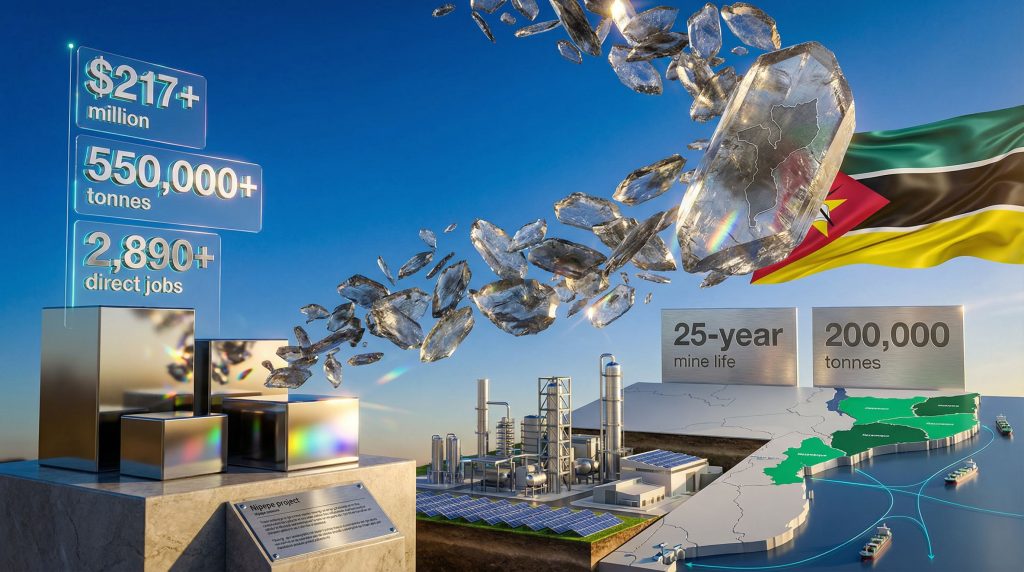
The northern provinces of Mozambique have become focal points for international capital deployment, with confirmed investments exceeding $217 million across multiple Mozambique graphite projects. These investments span both greenfield developments and operational asset acquisitions, indicating sustained confidence in the region's geological potential despite recent market volatility.
Key Investment Metrics:
- Total confirmed sector investment: $217 million across active projects
- Direct employment creation: 2,890+ positions planned across operational phases
- Combined production capacity: 550,000+ tonnes annually when fully operational
- Geographic concentration: Northern provinces dominate with major projects in Niassa and Cabo Delgado
The investment composition reflects diverse financing approaches, with Chinese entities committing $217 million through direct project development and asset acquisitions. Simultaneously, U.S. Development Finance Corporation backing supports existing operations through financial de-risking mechanisms rather than equity participation.
This dual-track investment pattern creates a unique competitive dynamic where geopolitical positioning intersects with commercial mineral development strategies. Furthermore, the scale of committed capital suggests long-term confidence in natural graphite demand fundamentals, particularly as electric vehicle manufacturing capacity expands globally.
When big ASX news breaks, our subscribers know first
What Makes the Nipepe Project a Strategic Game-Changer?
The $200 million Nipepe facility in Niassa province represents more than incremental capacity addition within Mozambique's graphite sector. According to Ecofin Agency reporting from February 2026, this project exemplifies industrial transformation through integrated mineral processing capabilities rather than traditional bulk commodity exports.
Project Technical Specifications:
| Metric | Specification | Timeline |
|---|---|---|
| Annual Production Capacity | 200,000 tonnes graphite concentrate | 25-year mine life |
| Capital Investment | $200 million | Inaugurated January 2026 |
| Employment Phase 1 | 890 workers | Current operational status |
| Employment Phase 2 | 2,000 workers | Expansion timeline TBD |
| Operator | DH Mining (Chinese entity) | Active development |
The project's 25-year operational timeline provides stability for long-term supply agreements while offering flexibility to adapt production volumes based on market conditions. However, this approach reflects lessons learned from recent market volatility that affected established operations.
Capital Efficiency Considerations:
The $1,000 per annual production tonne capital intensity ($200 million divided by 200,000 tonnes annual capacity) positions Nipepe competitively within international benchmarks for natural graphite operations. This metric becomes particularly relevant when evaluating project economics against synthetic graphite production alternatives.
Nipepe's strategic significance extends beyond production metrics. Its inauguration during a period of sector contraction demonstrates counter-cyclical investment conviction, positioning the operation to capture market share as demand recovery materializes. In addition, the project's Chinese backing through DH Mining also represents systematic asset accumulation within Mozambique's critical minerals sector.
Geopolitical Dynamics: How Are Global Powers Positioning in Mozambique's Graphite Sector?
Mozambique graphite projects have become strategic assets within broader geopolitical competition for critical mineral supply chain control. The intersection of Chinese capital deployment and U.S. financial backing creates a complex investment landscape where commercial returns align with national security considerations, reflecting the broader critical minerals strategy being pursued by major powers.
Chinese Strategic Engagement Framework
Chinese entities have established controlling positions across multiple Mozambique graphite projects through systematic capital deployment and asset acquisition strategies:
Active Chinese Investments:
- DH Mining: $200 million Nipepe project (200,000 tonnes annual capacity)
- Shandong Yulong: $17 million planned acquisition of 70% stake in Ancuabe project (60,000 tonnes projected capacity)
- Combined capacity under Chinese influence: 260,000 tonnes annually (47% of total sector capacity)
This strategic positioning reflects China's broader critical minerals security framework, emphasizing vertical integration from mining operations through processing and export capabilities. The 25-year operational timeline at Nipepe provides long-term supply chain visibility for Chinese battery manufacturing sectors.
U.S. Counter-Positioning Strategy
American involvement in Mozambique's graphite sector focuses on downstream integration and supply chain diversification rather than direct mining asset ownership:
U.S. Strategic Investments:
- U.S. Development Finance Corporation backing for Syrah Resources at Balama mine (350,000 tonnes capacity)
- Tesla supply agreements for battery-grade graphite from Balama operations
- Louisiana processing facility development to reduce import dependence
This approach emphasizes financial de-risking of existing operations while building domestic processing capabilities. The DFC backing for Balama represents 63% of Mozambique's operational graphite capacity, providing significant influence over natural graphite supply chains serving Western markets.
Market Control Analysis
The competing geopolitical strategies create overlapping spheres of influence within Mozambique's graphite sector:
- Chinese-influenced capacity: 260,000 tonnes (47% of sector total)
- U.S.-backed capacity: 350,000 tonnes (63% of sector total)
- Operational overlap: Australian-listed companies serve as intermediaries for both Chinese and U.S. interests
This dynamic suggests that Mozambique graphite projects serve multiple geopolitical objectives simultaneously, with Chinese entities pursuing upstream control and U.S. interests focusing on downstream security through financial partnerships with established operators.
Why Did Mozambique's Graphite Production Decline Before This Revival?
Mozambique's graphite sector experienced significant contraction between 2023 and 2024, with production declining 23% from 98,000 tonnes to 75,000 tonnes according to U.S. Geological Survey data cited by Ecofin Agency. This decline preceded the current investment revival, creating opportunities for strategic capital deployment during market dislocation periods.
Market Pressure Analysis
Demand-side challenges created structural headwinds for natural graphite producers globally:
Synthetic Graphite Competition:
- Synthetic alternatives gained cost competitiveness in specific applications
- Natural graphite price volatility reduced customer supply chain predictability
- Battery manufacturers diversified sourcing strategies to manage supply risk
Market Demand Volatility:
According to Ecofin Agency reporting, Mozambique producers faced weak market conditions marked by competition from synthetic graphite and declining prices for natural graphite. This created operational challenges for continuous full-capacity production models prevalent in the sector.
Supply-Side Adjustments
Mozambique operators implemented strategic adjustments to align production with market realities:
AMG's Complete Exit:
The Dutch group AMG confirmed complete closure of Ancuabe operations in 2024, representing strategic portfolio rationalization rather than operational failure. This decision reflected broader market conditions affecting natural graphite economics globally.
Syrah Resources' Production Model Shift:
Balama mine transitioned from continuous full-capacity operations to campaign-based production during mid-2024, resuming operations in June 2025 under market demand-driven volumes. This operational flexibility demonstrates adaptive management in volatile commodity markets.
Production Timeline:
- 2023: Peak production year (98,000 tonnes)
- Mid-2024: Balama operations suspended
- 2024: Total production declined to 75,000 tonnes (-23% YoY)
- June 2025: Balama resumed under campaign-based model
- January 2026: Nipepe project inaugurated with 200,000 tonnes capacity
This contraction-expansion cycle reflects market discipline by operators who prioritized capital preservation during unfavorable conditions while positioning for recovery phases. Consequently, this pattern demonstrates how the mining industry evolution requires adaptive operational strategies during commodity cycles.
Technical Specifications Driving Mozambique's Competitive Advantage
Mozambique graphite projects benefit from geological characteristics that provide competitive advantages in global markets. Resource quality metrics and processing capabilities determine long-term viability within battery supply chains and industrial applications.
Resource Quality Assessment
Balama Mine Technical Specifications:
- Proven reserves: 110 million tonnes at 16% Total Graphitic Carbon (TGC)
- Annual processing capacity: 350,000 tonnes graphite concentrate
- Flake size distribution: Optimized for battery applications
- Infrastructure: Solar-powered operations with battery storage systems
Balama's resource grade and flake characteristics meet specifications for lithium-ion battery anodes, providing quality premiums over lower-grade deposits globally. The solar power integration reduces operational costs while meeting ESG standards required by international battery manufacturers.
Montepuez Project Resource Base:
Tirupati Graphite's development includes:
- Total resources: 119.6 million tonnes graphite-bearing material
- Target production: 100,000 tonnes flake graphite annually
- Development status: Post-acquisition optimization phase
- Processing approach: Beneficiation to battery-grade specifications
Processing Technology Capabilities
Mozambique operations employ beneficiation technologies that transform raw graphite ore into battery-grade concentrates:
Primary Processing Steps:
- Crushing and grinding to optimal particle size distribution
- Flotation separation to achieve 95%+ graphitic carbon purity
- Sizing and classification for battery manufacturing specifications
- Quality control testing for thermal and electrical properties
Advanced Processing Capabilities:
Select Mozambique graphite projects are developing spherical graphite production capabilities that command premium pricing in EV battery applications. This value-added processing increases revenue per tonne while reducing transportation costs for finished products.
Production Economics Impact Investment Decisions
Mozambique graphite projects benefit from cost advantages that enhance project economics compared to international competitors. These factors influence investment allocation decisions and operational strategies across the sector.
Cost Structure Analysis
Operational Advantages:
- Low-cost mining: Shallow deposit access reduces capital and operating expenditures
- Proximity to Nacala port: Transportation costs to export terminals remain competitive
- Competitive labour costs: Local workforce availability at international salary benchmarks
- Established infrastructure: Northern region mining logistics networks support multiple projects
Economic Challenges:
- Power supply reliability: Remote mining areas require diesel backup systems increasing operational costs
- Regulatory compliance: Environmental standards and social impact requirements increase development timelines
- Currency volatility: USD-denominated revenues subject to Mozambican metical exchange rate fluctuations
- Transportation infrastructure: Rail capacity limitations during peak export periods
Capital Efficiency Metrics
Investment per Annual Production Tonne:
- Nipepe project: $1,000 per annual tonne ($200 million ÷ 200,000 tonnes)
- Sector average: Approximately $800-1,200 per annual tonne across active projects
- International benchmark: Australian and Canadian projects typically exceed $1,500 per annual tonne
These capital efficiency metrics position Mozambique graphite projects competitively for international financing and strategic partnerships with downstream customers.
Revenue Optimisation Strategies
Mozambique operators pursue multiple revenue optimisation approaches:
Product Mix Strategy:
- Bulk concentrates for steel industry applications (lower margins, higher volumes)
- Battery-grade materials for EV manufacturers (premium pricing, quality specifications)
- Spherical graphite for advanced battery technologies (highest margins, specialised processing)
Market Diversification:
- Asian steel producers (traditional bulk markets)
- North American and European EV supply chains (premium segments)
- Industrial applications including nuclear and advanced materials sectors
The next major ASX story will hit our subscribers first
Infrastructure's Role in Sector Development
Transportation and logistics infrastructure represents a critical success factor for Mozambique graphite projects. Port access, rail connectivity, and power supply reliability determine operational efficiency and export competitiveness.
Transportation and Logistics Framework
Port Infrastructure:
Nacala Port serves as the primary export terminal for northern Mozambique graphite operations:
- Annual throughput capacity: 25 million tonnes across all commodities
- Graphite handling facilities: Specialised equipment for mineral exports
- Distance from major mines: Balama (300 km), Nipepe (400 km), Ancuabe (250 km)
- International shipping routes: Direct access to Asian and European markets
Alternative Export Routes:
Beira Port provides backup capacity for central and southern operations, though transportation distances from northern projects reduce economic efficiency compared to Nacala routing.
Rail Connectivity:
CFM railway system links mining areas to port facilities:
- Nacala Corridor: Railway capacity of 18 million tonnes annually
- Gauge compatibility: Standard gauge accommodates international rolling stock
- Freight rates: Competitive per-tonne transportation costs compared to trucking alternatives
- Reliability concerns: Maintenance schedules and security in remote areas affect schedule predictability
Power Supply Infrastructure
Energy availability constrains processing facility development and operational efficiency:
Grid Connection Limitations:
- Mozambique's electrical grid provides limited capacity to remote mining areas
- Power outages require diesel backup systems increasing operational costs
- Grid expansion projects lag mining development timelines
Renewable Energy Adoption:
Balama mine operates solar installation with battery storage:
- Installed capacity: 40 MW solar photovoltaic system
- Storage capability: Grid stabilisation and 24-hour operation support
- Cost reduction: Diesel fuel dependency decreased by 60%
- ESG compliance: Carbon footprint reduction meets international sustainability standards
Nipepe project and other new developments are incorporating renewable energy components from project inception to reduce operating costs and meet customer sustainability requirements, supporting broader EV integration trends.
Environmental and Social Governance Standards Shaping Operations
ESG compliance has become a fundamental requirement for Mozambique graphite projects seeking international financing and customer acceptance. Battery manufacturers increasingly require responsible sourcing certifications from mineral suppliers.
Environmental Standards Implementation
Water Management Protocols:
Graphite processing requires significant water volumes for flotation and beneficiation processes:
- Water recycling systems: Closed-loop processing reduces fresh water consumption by 80%
- Tailings management: Engineered storage facilities prevent groundwater contamination
- Environmental monitoring: Quarterly testing of water quality and soil conditions
- Rehabilitation requirements: Progressive restoration of mined areas during operational phases
IRMA Certification:
Balama mine achieved Initiative for Responsible Mining Assurance (IRMA) certification, establishing industry benchmarks for environmental and social performance:
- Biodiversity protection: Conservation programmes for local ecosystems
- Land use planning: Community consultation for mining footprint optimisation
- Waste management: Zero discharge policies for process water and tailings
Social Impact Framework
Local Employment Targets:
Mozambique graphite projects commit to local hiring preferences:
- Employment targets: 70%+ workforce from surrounding communities
- Skills development: Technical training programmes for equipment operation and maintenance
- Management development: Leadership pathways for local employees
- Gender inclusion: Women's participation in mining operations and support services
Community Development Programmes:
Mining operators allocate percentage of revenues to community investment:
- Infrastructure development: Schools, health clinics, and transportation improvements
- Agricultural support: Extension services and market access for local farmers
- Business development: Small enterprise support and local procurement preferences
- Cultural preservation: Traditional practices and heritage site protection
Stakeholder Engagement:
Regular consultation processes ensure community input on mining development decisions:
- Monthly meetings with traditional leaders and community representatives
- Grievance procedures for environmental and social concerns
- Revenue sharing agreements with local government authorities
- Transparency reporting on community investment and environmental performance
These comprehensive approaches complement broader mine reclamation innovations that are becoming industry standard across global mining operations.
Market Dynamics Driving Future Growth Projections
Global demand for natural graphite continues expanding driven by electric vehicle adoption, battery manufacturing capacity, and industrial applications. Mozambique graphite projects are positioning to capture market share in this growth trajectory.
Electric Vehicle Integration Analysis
Battery Manufacturing Expansion:
Asian battery manufacturers are expanding production capacity to meet EV demand:
- China: Gigafactory construction targeting 500 GWh annual capacity by 2030
- South Korea: LG Chem and Samsung SDI facility expansion across multiple countries
- Japan: Panasonic supply chain diversification including African sourcing
European Market Acceleration:
EU battery regulations require supply chain transparency and sustainability compliance:
- Local content requirements favour certified suppliers with ESG credentials
- Carbon footprint calculations include transportation and processing emissions
- Recycling mandates create circular economy opportunities for graphite recovery
North American Supply Chain Localisation:
U.S. Inflation Reduction Act incentives support domestic battery supply chains:
- Tax credits for North American sourced battery materials
- Critical minerals agreements with allied countries including African partners
- Processing facility development to reduce import dependence
Industrial Applications Growth
Steel Production Additive Demand:
Steel industry consumption of natural graphite remains stable:
- Global steel production maintains 2%+ annual growth
- High-grade graphite for speciality steel applications commands premium pricing
- Supply diversification reduces dependence on single-source suppliers
Nuclear Reactor Applications:
Advanced nuclear technologies require high-purity graphite:
- Small modular reactors (SMRs) development increases speciality graphite demand
- Nuclear power expansion in Asia and emerging markets
- Quality specifications favour Mozambique's high-grade deposits
Growth Projection Framework
Export Value Forecasts:
Based on market analysis and capacity expansion plans:
- Compound Annual Growth Rate (CAGR): 12.64% through 2027
- Production capacity targets: 600,000+ tonnes by 2030
- Processing facility additions: 3-4 new plants planned across northern provinces
Market Share Projections:
Mozambique could capture 8-10% of global natural graphite market by 2030 under high-growth scenarios, representing significant expansion from current market positioning.
Investment Scenario Modelling for Strategic Returns
Mozambique graphite projects present multiple investment scenarios with varying risk-return profiles depending on global market evolution and geopolitical dynamics. Scenario analysis provides framework for capital allocation decisions.
High-Growth Scenario Analysis (Probability: 60%)
Market Drivers:
- EV adoption accelerates beyond current forecasts globally
- Battery technology improvements increase natural graphite demand per vehicle
- Synthetic graphite cost structures remain uncompetitive for battery applications
- Supply chain diversification drives premium pricing for African sources
Mozambique Positioning:
- Market share expansion to 8-10% of global natural graphite production
- Processing capabilities develop to battery-grade production domestically
- Infrastructure investments reduce logistics costs by 15-20%
- ESG compliance provides competitive advantage in premium markets
Financial Projections:
- Total sector value: $2+ billion annually by 2030
- Employment creation: 15,000+ direct jobs across mining and processing
- Government revenues: $300+ million annually from taxes and royalties
- Export earnings: $1.8+ billion annual foreign exchange
Base Case Scenario (Probability: 30%)
Market Conditions:
- Steady demand growth aligned with current EV forecasts
- Moderate competition from synthetic alternatives in specific applications
- Limited downstream processing development within Mozambique
- Infrastructure improvements proceed at planned timelines
Investment Outcomes:
- Market share stabilises at 6-7% globally
- Production capacity reaches 500,000 tonnes annually
- Processing remains focused on concentrate production
- Revenue diversification across steel, battery, and industrial segments
Financial Targets:
- Sector value: $1.2-1.5 billion annually
- Employment: 8,000-10,000 direct positions
- Government revenues: $180-240 million annually
- Export value: $1.0-1.3 billion annually
Stress Scenario Considerations (Probability: 10%)
Risk Factors:
- Synthetic graphite achieves cost parity with natural alternatives
- Trade restrictions impact Chinese partnerships and market access
- Infrastructure development delays increase operating costs
- ESG standards become cost prohibitive for smaller operators
Mitigation Strategies:
- Production flexibility to adjust volumes based on market conditions
- Cost optimisation through operational efficiency improvements
- Market diversification to reduce dependency on single applications
- Financial reserves to manage commodity price volatility
Minimum Viable Outcomes:
- Sector value: $800 million-1 billion annually
- Employment: 5,000-7,000 positions
- Focused production on highest-grade, lowest-cost operations
- Consolidation of weaker projects into efficient operators
Investor Evaluation Framework for Mozambique Graphite Opportunities
Due diligence for Mozambique graphite projects requires comprehensive assessment of geological, operational, market, and geopolitical factors. Investment decisions should incorporate multiple evaluation criteria and risk mitigation strategies.
Risk-Return Assessment Matrix
High-Return Investment Opportunities:
Processing Facility Development:
- Value-addition premium: Battery-grade processing commands $2,000-3,000 per tonne vs $800-1,200 for concentrates
- Customer proximity: Domestic processing reduces transportation costs and supply chain complexity
- Employment multiplication: Processing facilities create 2-3x indirect jobs compared to mining operations
- Government support: Tax incentives for value-added manufacturing
Logistics Infrastructure Investment:
- Transportation optimisation: Rail and port improvements reduce per-tonne costs by $50-100
- Capacity expansion: Infrastructure bottlenecks limit production growth
- Regional benefits: Infrastructure serves multiple mining projects simultaneously
- Public-private partnerships: Government co-investment reduces private capital requirements
Due Diligence Priority Framework
Resource Quality Verification:
Independent geological assessment requirements:
- Third-party resource estimation following JORC or NI 43-101 standards
- Metallurgical testing to confirm processing characteristics
- Environmental baseline studies for permitting and impact assessment
- Geotechnical analysis for mine planning and infrastructure design
Market Positioning Analysis:
Competitive assessment against synthetic alternatives:
- Cost curve positioning relative to global suppliers
- Quality specifications meeting customer requirements
- Supply chain reliability and delivery capabilities
- ESG credentials for responsible sourcing certification
Regulatory Stability Assessment:
Government framework evaluation:
- Mining code stability and fiscal regime predictability
- Environmental and social licence requirements
- Foreign investment protection and repatriation policies
- Infrastructure development commitments and timelines
Investment Structure Optimisation
Equity vs. Debt Considerations:
Project finance structures for large-scale developments:
- Debt financing: 60-70% of project costs through international lenders
- Equity requirements: 30-40% from sponsors and strategic partners
- Off-take agreements: Long-term contracts provide revenue certainty for debt service
- Political risk insurance through multilateral agencies
Strategic Partnership Benefits:
Joint ventures with local operators:
- Local knowledge and regulatory navigation
- Community relationships and social licence
- Risk sharing across development phases
- Market access through established networks
Long-Term Strategic Implications for Global Supply Chains
Mozambique graphite projects represent significant supply chain diversification opportunities for global battery manufacturers and industrial consumers. Strategic positioning within African mineral corridors provides long-term competitive advantages.
Supply Chain Security Framework
Geopolitical Risk Mitigation:
Mozambique offers alternative sourcing to Chinese-dominated supply chains:
- Political stability: Democratic governance and rule of law provide investment protection
- Trade relationships: Preferential access to European and North American markets
- Regional integration: African Continental Free Trade Area reduces trade barriers
- Infrastructure connectivity: Southern African Development Community transport corridors
Supply Chain Resilience:
Multiple sourcing strategies reduce concentration risk:
- Geographic diversification: African, Australian, and North American supply sources
- Technology hedge: Natural graphite provides performance advantages for specific applications
- Processing flexibility: Multiple locations for beneficiation and advanced processing
- Inventory management: Strategic reserves buffer supply disruptions
Technology Transfer Opportunities
Processing Technology Advancement:
International partnerships facilitate technology transfer:
- Battery material processing expertise from Asian manufacturers
- Environmental technology for sustainable mining practices
- Automation systems for operational efficiency improvements
- Quality control systems meeting international standards
Research and Development Capabilities:
Innovation hubs for advanced graphite applications:
- University partnerships for materials science research
- Government research facilities for mineral beneficiation
- Private sector R&D centres for product development
- International collaboration on battery technology advancement
Regional Integration Benefits
Southern African Development Community (SADC) Integration:
Regional mineral corridor development:
- Cross-border infrastructure projects linking mining areas to ports
- Harmonised regulations for mining and mineral processing
- Shared services for technical training and capacity building
- Regional development banks supporting infrastructure financing
Processing Hub Development:
Mozambique positioning as regional processing centre:
- Economies of scale from multiple mine inputs
- Skills development for advanced manufacturing
- Technology clusters attracting international investment
- Export infrastructure serving regional producers
Disclaimer: This analysis contains forward-looking projections based on current market conditions and announced project parameters. Investment decisions should be based on comprehensive due diligence and professional financial advice. Mineral project investments carry inherent risks including commodity price volatility, regulatory changes, and operational challenges that may materially affect investment outcomes.
Further Exploration:
Readers interested in learning more about Mozambique's mining sector developments can explore additional perspectives on African mineral resource projects and investment opportunities through various industry publications and research platforms that cover emerging market mining investments.
Looking to Capitalise on Mozambique's Critical Minerals Boom?
Mozambique's $200+ million graphite sector revival demonstrates how major mineral discoveries can transform entire regions and create substantial investment opportunities. Discovery Alert's proprietary Discovery IQ model delivers instant notifications on significant ASX mineral discoveries, helping investors identify actionable opportunities in critical minerals discoveries before the broader market catches on. Begin your 14-day free trial today to position yourself ahead of the next wave of mineral exploration success stories.