June 15, 2026
What Makes the Mozambique LNG Project Resumption a Defining Moment for African Energy?
The global energy landscape faces unprecedented transformation as traditional hydrocarbon projects navigate security risks, regulatory complexity, and evolving market dynamics. Within this context, large-scale liquefied natural gas developments in frontier markets represent critical test cases for industry resilience and adaptation strategies. The Mozambique LNG project resumption demonstrates how energy security transition creates momentum that transcends immediate obstacles when projects reach sufficient scale and commercial commitment.
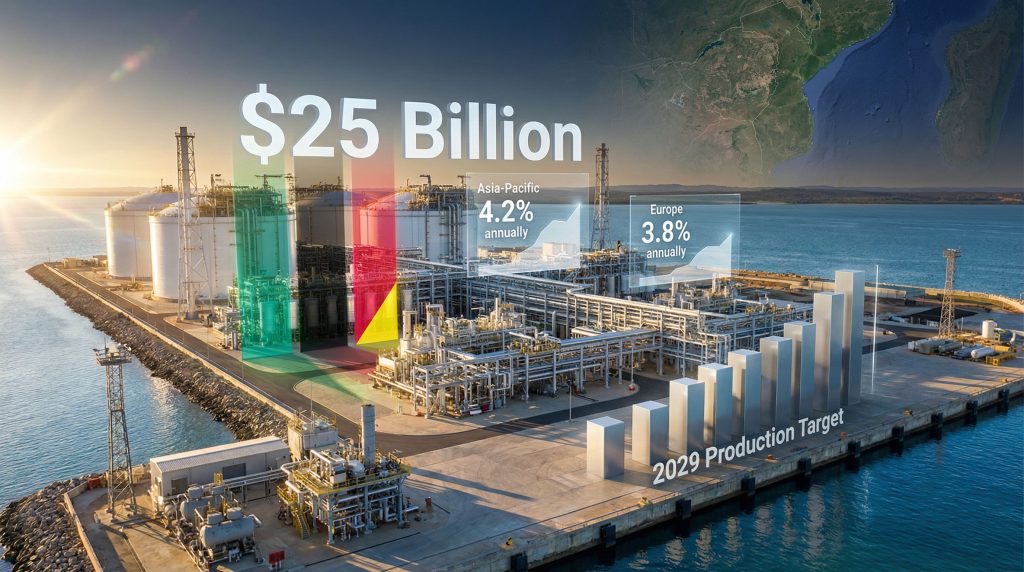
The Strategic Imperative Behind a $25 Billion Commitment
The Mozambique LNG project resumption demonstrates how financial architecture and commercial certainty create project momentum that becomes virtually unstoppable. Following TotalEnergies' $3.9 billion acquisition of Anadarko's African assets in September 2019, the project gained a 26.5% operator stake that positioned it as a cornerstone asset rather than a portfolio component.
The economic calculation shifted decisively when 90% of projected LNG volumes secured long-term contracts with international buyers across Asia and Europe. This commercial coverage, combined with a $14.9 billion debt financing package secured in July 2020, created contractual obligations that made abandonment financially destructive for all parties involved.
Key Financial Restructuring Elements:
• Total project investment estimated at $20 billion USD
• Project reached 40% completion by January 2026 resumption date
• Final Investment Decision made in June 2019, creating 10-year timeline to first production
• Export credit agencies withdrew partial support during suspension, offset by increased partner equity contributions
The restart decision reflects sunk cost rationality combined with contractual lock-in mechanisms. Once commercial architecture achieved this scale, the mathematical calculation favoured resumption over write-off. Furthermore, comprehensive debt financing insights reveal that project momentum overcame ongoing security challenges through financial commitment structures.
Regional Energy Security Implications for Southern Africa
The project's positioning extends beyond LNG export to potential regional energy hub development. The Afungi facility in Cabo Delgado represents fixed onshore infrastructure capable of supporting broader regional gas distribution networks, pending additional pipeline investments and bilateral agreements.
Regional energy independence scenarios depend on recipient countries' willingness to invest in gas-to-power infrastructure and modify energy policy frameworks. The Southern Africa Power Pool (SAPP) provides existing regional electricity trading mechanisms that could incorporate gas-based power generation if distribution infrastructure develops.
Infrastructure Development Spillover Effects:
• Pipeline extension potential to Tanzania, Malawi, and South Africa
• Regional gas-to-power facility development opportunities
• Cross-border energy trading mechanism integration
• Domestic energy security enhancement for Mozambique through retained gas allocation
The success of this resumption could establish precedent for other suspended African energy developments. Additionally, TotalEnergies announced the full restart of all activities, demonstrating that frontier market projects can achieve production despite security complexity when commercial fundamentals remain strong.
When big ASX news breaks, our subscribers know first
How Do Security Challenges Transform Into Operational Frameworks?
The Evolution of Resource Project Security Models
The Joint Task Force established in 2020 represents a hybrid public-private security framework where operational responsibility for site protection is shared between Mozambican state security forces and private security coordination under operator direction. This structure balances state sovereignty with operational effectiveness requirements.
Security deterioration in Cabo Delgado began in 2017 with increasing armed attacks, culminating in the March 2021 Palma town attack that precipitated personnel evacuation and the April 26, 2021 force majeure declaration. The four-year suspension period allowed security architecture development and threat assessment refinement.
Comparative Security Framework Analysis:
| Security Model | Country | Operator Approach | Effectiveness Metrics |
|---|---|---|---|
| Joint Task Force | Mozambique | State-private hybrid coordination | Resumption achieved 2026 |
| Military Integration | Nigeria | State forces with private support | 100,000-200,000 bpd disruptions annually |
| State Protection | Chad | Military-led with contractor support | Continuous operation since 2003 |
| Offshore Focus | Angola/Equatorial Guinea | State forces primary, private secondary | Minimal onshore security requirements |
The Mozambique model represents evolution from conventional commercial security toward conflict-zone operational frameworks. Traditional commercial security providers lack capacity to address armed insurgent threats, necessitating state security integration with private coordination capabilities.
Risk Mitigation Strategies That Enable Project Continuation
Multi-layered security architecture operates across perimeter defence, intelligence operations, response capability, and personnel protection systems. The $200 million Pamoja Tunaweza Foundation established following a May 2023 independent mission assessment represents explicit acknowledgement that security costs extend beyond direct protection to community stabilisation measures.
Security Investment Framework Components:
• Perimeter Security: Fixed installations, checkpoint protocols, access control systems
• Response Capability: Joint Task Force rapid response with coordinated state-private elements
• Intelligence Operations: Threat monitoring and early warning systems
• Community Engagement: $200 million foundation for human rights compliance and local development
Legal proceedings have emerged from 2023 survivor complaints alleging security failures, leading to March 2025 preliminary investigation by Nanterre Prosecutor's Office for involuntary manslaughter and failure to assist persons in danger. Additional allegations emerged regarding July-September 2021 events described as container massacre incidents.
Risk Mitigation Evolution: The transition from conventional site security to comprehensive community engagement represents industry acknowledgement that social licence requires explicit human rights compliance investments alongside traditional protection measures.
November 2025 criminal complaint filed by European Centre for Constitutional and Human Rights accusing TotalEnergies of complicity in war crimes demonstrates ongoing legal complexity. The company rejects all accusations while maintaining that community stabilisation investments are both ethical obligations and operational risk management tools.
What Are the Long-Term Market Dynamics Driving This Decision?
Global LNG Demand Projections Through 2035
Global LNG demand trajectories are driven by three primary vectors: Asian power generation expansion, European energy security diversification following 2022 geopolitical disruptions, and emerging market industrial demand growth. Regional growth rates vary significantly based on energy policy frameworks and renewable energy deployment speeds.
Regional LNG Demand Analysis:
| Region | 2025 Baseline (Mt) | 2030 Projection (Mt) | 2035 Projection (Mt) | Annual Growth Rate |
|---|---|---|---|---|
| Asia-Pacific | 285 | 340 | 380 | 4.2% |
| Europe | 95 | 110 | 125 | 3.8% |
| Middle East | 45 | 65 | 85 | 6.5% |
| Americas | 85 | 95 | 105 | 2.8% |
Asia-Pacific Growth Drivers:
• Japan's post-Fukushima shift to LNG for baseload power generation
• South Korea's gas-dependent electricity generation expansion
• China's industrial demand growth and air quality improvement policies
• India's power sector modernisation and manufacturing development
European Demand Transformation:
European LNG demand fundamentally shifted following 2022 energy security disruptions, with pipeline gas replacement driving structural import requirement increases. Consequently, natural gas trends indicate that long-term European contracts provide revenue stability for new LNG developments, supporting project financing and commercial viability.
Mozambique's Strategic Position in Global Supply Chains
The project's 13 million tonnes per annum capacity positions Mozambique as a mid-tier LNG exporter, distinct from Qatar's North Field expansion (48 mtpa) but comparable to regional competitors. Geographic positioning provides shipping route advantages to key Asian markets compared to Australian and Qatari suppliers.
Competitive Positioning Analysis:
• Shipping Distance: Shorter routes to India and Southeast Asian markets versus Australian suppliers
• Contract Structures: Long-term agreements with price escalation clauses provide revenue predictability
• Cost Competitiveness: Lower development costs than Arctic or deepwater alternatives
• Supply Reliability: Diversification value for buyers seeking non-Middle Eastern sources
The Golfinho and Atum fields in the Rovuma Basin provide resource base for two liquefaction trains, with reserve estimates supporting 20+ year production profiles. This longevity supports long-term buyer contract negotiations and debt service requirements.
How Will Production Timeline Delays Impact Market Positioning?
The 2029 Production Target: Realistic or Optimistic?
The 2029 first production target represents a 10-year timeline from the June 2019 Final Investment Decision, including the four-year suspension period. Construction acceleration requirements include workforce scaling, equipment procurement completion, and weather window optimisation for offshore installations.
Critical Path Analysis Factors:
• Workforce Scaling: Several thousand workers deployed as of January 2026 resumption
• Equipment Installation: Offshore and onshore infrastructure completion requirements
• Weather Windows: Seasonal construction limitations in Cabo Delgado region
• Security Integration: Ongoing Joint Task Force coordination with construction activities
Construction acceleration scenarios depend on sustained security stability and uninterrupted workforce deployment. The 40% completion status at resumption provides substantial progress foundation but requires consistent execution through 2029 to achieve production targets.
Competitive Landscape Analysis: Who Benefits from Delays?
Extended timeline delays create market opportunities for existing LNG exporters and new project developments targeting similar buyer markets. Qatar's continued expansion and US Gulf Coast developments compete for Asian and European contract commitments during the Mozambique LNG project resumption timeline.
Market Share Implications:
• Existing Exporters: Qatar, Australia, and US producers capture delayed volumes
• New Projects: Competing developments accelerate FID decisions to capture market windows
• Buyer Strategies: Long-term contract flexibility allows alternative sourcing during delays
• Price Dynamics: Delayed supply supports current market pricing levels for existing producers
Contract enforcement mechanisms during force majeure periods provide some protection for commercial positioning. However, the LNG industry reports suggest extended delays risk buyer contract modification or alternative sourcing development.
What Does the Financial Structure Reveal About Project Viability?
Debt Financing Evolution and Partner Commitment Levels
The $14.9 billion debt package underwent significant modifications during the suspension period, with export credit agency withdrawals offset by partner equity increases. This financial restructuring demonstrates partner commitment levels and project viability assessment under stress conditions.
Financial Architecture Evolution:
• Export Credit Agencies: Partial withdrawal of public-backed support during suspension
• Commercial Banks: Maintained participation with modified terms and conditions
• Partner Equity: Increased contributions from TotalEnergies, ENI, and ONGC to offset public financing gaps
• Multilateral Support: African multilateral institution participation continued
Partner Commitment Indicator: The willingness of equity partners to increase financial contributions during suspension demonstrates confidence in long-term project economics despite immediate operational challenges.
Revenue protection mechanisms include long-term contract enforcement during force majeure periods, price escalation clauses aligned with market conditions, and volume flexibility arrangements that accommodate production ramp-up schedules.
Revenue Protection Mechanisms and Contract Security
Commercial contract architecture provides revenue certainty through multiple protection layers designed to maintain project viability during operational disruptions. Long-term buyer agreements include force majeure provisions that preserve contractual relationships during suspension periods.
Contract Security Elements:
• Force Majeure Provisions: Buyer obligation maintenance during operational suspensions
• Price Escalation Clauses: Automatic adjustments aligned with market conditions and inflation
• Volume Flexibility: Production ramp-up accommodation and delivery schedule adjustment
• Take-or-Pay Requirements: Minimum purchase obligations regardless of delivery timing variations
Partner cash flow requirements through construction completion include milestone-based funding releases, cost overrun allocation mechanisms, and completion guarantee structures that distribute financial risk across the operator and equity partners.
How Do Regulatory and Legal Challenges Shape Operational Parameters?
Human Rights Compliance Frameworks for Extractive Industries
Corporate accountability mechanisms for extractive industries have evolved significantly, with the Mozambique LNG project resumption representing a test case for human rights compliance in conflict-affected regions. International legal precedent implications extend beyond immediate project operations to industry-wide standards development.
Legal Proceeding Timeline:
• 2023: Survivor complaints filed in France alleging security failures
• September 2024: Initial reporting on container massacre allegations
• March 2025: Nanterre Prosecutor's Office preliminary investigation initiated
• November 2025: Criminal complaint filed by European Centre for Constitutional and Human Rights
Operational modifications required to address stakeholder concerns include enhanced community consultation frameworks, independent monitoring systems, and transparent reporting mechanisms for security incidents and community impacts.
Government Partnership Models and Revenue Sharing
The memorandum between TotalEnergies' Mozambican subsidiary and the Mozambican state for Joint Task Force establishment demonstrates government partnership evolution in resource projects. Revenue sharing frameworks include traditional fiscal terms plus additional community development obligations.
Partnership Framework Components:
• Local Content Requirements: Employment and procurement obligations for Mozambican participation
• Technology Transfer: Skills development programmes and capability building commitments
• Community Benefits: Direct investment through Pamoja Tunaweza Foundation and infrastructure development
• Revenue Distribution: Government take through royalties, taxes, and profit-sharing arrangements
Skills development programmes focus on technical training for LNG operations, general education initiatives, and local business development support. These programmes serve dual purposes of regulatory compliance and operational workforce development.
The next major ASX story will hit our subscribers first
What Are the Broader Implications for African Energy Development?
The Precedent Effect for Suspended African Mega-Projects
The successful Mozambique LNG project resumption establishes precedent for other stalled energy developments across Africa. Moreover, industry evolution trends demonstrate that sufficient commercial architecture and partner commitment can overcome operational challenges, whilst investor confidence indicators suggest willingness to maintain long-term commitments when project fundamentals remain strong.
Precedent Applications for African Projects:
• Nigeria: Onshore developments facing security challenges in Niger Delta region
• Chad: Expansion projects requiring enhanced security frameworks
• Tanzania: Adjacent LNG developments could adopt similar security models
• West Africa: Offshore projects with onshore processing requirements
Regional integration opportunities through cross-border infrastructure development could emerge as successful projects demonstrate viability and create spillover investment justification for neighbouring countries.
Technology and Innovation Acceleration Opportunities
Digital monitoring and remote operation capabilities developed during the suspension period represent technological advancement opportunities that could enhance operational efficiency and security effectiveness. Environmental and social governance improvements integrated into restart plans establish higher industry standards.
Innovation Integration Areas:
• Digital Monitoring: Real-time security and environmental monitoring systems
• Remote Operations: Reduced onsite personnel requirements through automation
• Community Engagement: Technology-enabled consultation and feedback mechanisms
• Environmental Compliance: Advanced monitoring and reporting systems for ecological impact management
Next-generation LNG processing technologies integrated into restart plans could provide competitive advantages and operational efficiency improvements compared to conventional processing approaches.
How Will Success or Failure Impact Future Energy Investment?
Scenario Analysis: Three Potential Outcomes by 2030
Scenario 1: Full Production Achievement
Successful achievement of 13 mtpa production capacity by 2029-2030 would capture targeted market share and generate projected revenue streams. Regional economic development acceleration would create positive spillover effects and establish template for other African LNG developments.
Success Indicators:
• Market Share: 3-4% of global LNG trade by 2030
• Revenue Generation: $6-8 billion annual export value at current price projections
• Regional Development: Infrastructure development and employment creation in Cabo Delgado
• Industry Template: Replicable security and development model for frontier markets
Scenario 2: Partial Success with Ongoing Challenges
Reduced capacity utilisation due to continued security constraints would impact financial returns while maintaining some production capability. Ongoing security cost requirements would reduce profitability but provide operational continuity.
Partial Success Characteristics:
• Capacity Utilisation: 60-80% of design capacity achieved
• Security Costs: 15-25% premium on operational expenses
• Market Position: Limited but stable LNG export volumes
• Development Impact: Reduced but positive regional economic effects
Scenario 3: Secondary Suspension or Project Modification
Additional operational disruptions leading to renewed suspension would create significant sunk cost implications and potential partner exit strategies. Alternative development pathways could include phased development or modified project scope.
Failure Implications:
• Sunk Costs: $20+ billion investment at risk of impairment
• Partner Relations: Potential equity partner exit or restructuring
• Regional Credibility: Negative impact on African energy sector investment attraction
• Alternative Pathways: Possible project scope reduction or timeline extension
What Does This Mean for Global Energy Transition Strategies?
Natural gas positioning as transition fuel versus renewable energy acceleration represents ongoing strategic tension in energy transition planning. LNG projects like the Mozambique LNG project resumption require 20+ year operational periods to achieve investment returns, creating potential misalignment with aggressive decarbonisation timelines.
Energy Transition Considerations:
• Carbon Intensity: LNG provides lower carbon emissions than coal for power generation
• Transition Timeline: Natural gas serves as bridge fuel during renewable capacity development
• Stranded Asset Risk: Long-term LNG investments face potential demand destruction from renewable acceleration
• Integration Potential: Gas-fired power provides grid stability for intermittent renewable generation
Investment allocation implications for energy companies include portfolio balance requirements between traditional hydrocarbons and clean energy technologies. Furthermore, energy transition strategies continue evolving as carbon pricing and regulatory frameworks develop, creating risk-adjusted returns across energy investment categories.
Strategic Positioning Elements:
• Portfolio Diversification: Balance between LNG investments and renewable energy development
• Timeline Management: Align project lifecycles with energy transition scenarios
• Market Evolution: Position for long-term energy market transformation while capturing near-term opportunities
• Risk Assessment: Evaluate stranded asset risk against transition fuel demand projections
The Mozambique LNG project resumption represents a critical test case for large-scale energy infrastructure development in frontier markets. Consequently, its implications extend far beyond immediate production targets to broader questions of investment resilience, security framework evolution, and energy transition strategy integration.
Disclaimer: This analysis contains forward-looking projections and scenario assessments that involve significant uncertainty. Energy market dynamics, security conditions, and regulatory frameworks may evolve in ways that materially affect project outcomes and investment returns. Readers should conduct independent research and consult qualified advisors before making investment or commercial decisions related to LNG markets or African energy projects.
Ready to capitalise on the next major African energy opportunity?
Discovery Alert's proprietary Discovery IQ model delivers real-time alerts on significant ASX mineral discoveries, instantly empowering subscribers to identify actionable opportunities ahead of the broader market. Understand why major mineral discoveries can lead to substantial returns by exploring historic examples of exceptional outcomes, then begin your 14-day free trial today to position yourself ahead of the market.