Qmines Ltd
- ASX Code: QML
- Market Cap: $39,371,565
QMines Shifts Gears: Mt Chalmers DFS in Full Swing with Seven Specialist Firms Now Engaged
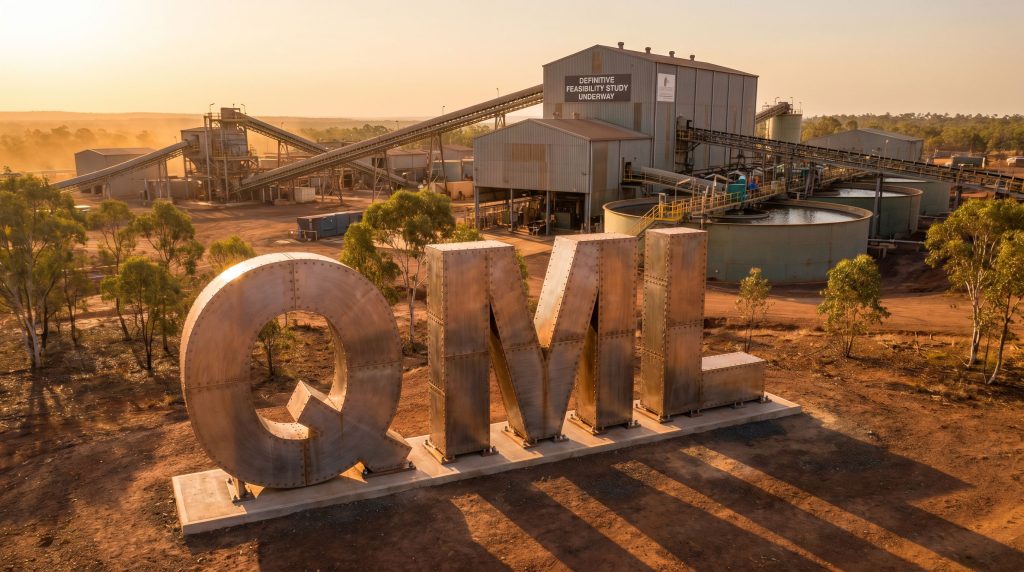
QMines Limited (ASX: QML) has released a comprehensive progress update on its Definitive Feasibility Study (DFS) for the Mt Chalmers copper and gold project in Central Queensland, revealing broad and simultaneous advancement across every major technical workstream. The Qmines Ltd Mt Chalmers DFS progress update confirms the company is backed by a recently secured $15 million strategic funding package from QIC, meaning it is fully funded through DFS completion, with delivery targeted by year end 2026.
The scale of activity underway is notable. In a matter of months, QMines has assembled a roster of seven specialist consulting firms, completed initial metallurgical and mineralogical programs, drilled six dedicated geotechnical holes, installed four groundwater monitoring bores, submitted a major power connection application, and completed an updated three-dimensional geological model — all simultaneously.
For a company transitioning from explorer to developer, the pace of execution signals serious intent.
When big ASX news breaks, our subscribers know first
A Project With Deep Roots and a High-Grade History
Mt Chalmers is not a greenfield concept. It is a historic high-grade mine that produced 1.2 million tonnes at 2.0% copper, 3.6 g/t gold and 19 g/t silver between 1898 and 1982. That production history gives QMines a significant technical and contextual advantage — infrastructure corridors are understood, the mineralised system is well characterised, and the project sits within 90km of Rockhampton, one of regional Queensland's key logistics hubs.
The current resource and reserve base reflects that heritage and adds considerably to it:
Mt Chalmers Ore Reserve (JORC 2012)
| Category | Tonnes (Mt) | Cu (%) | Au (g/t) | Zn (%) | Ag (g/t) |
|---|---|---|---|---|---|
| Proved | 5.1 | 0.72 | 0.58 | 0.25 | 4.70 |
| Probable | 4.5 | 0.57 | 0.37 | 0.29 | 5.50 |
| Total | 9.6 | 0.65 | 0.48 | 0.27 | 5.20 |
Mt Chalmers Mineral Resource Estimate (JORC 2012)
| Category | Tonnes (Mt) | Cu (%) | Au (g/t) | Zn (%) | Ag (g/t) |
|---|---|---|---|---|---|
| Measured | 4.2 | 0.89 | 0.69 | 0.23 | 4.97 |
| Indicated | 5.8 | 0.69 | 0.28 | 0.19 | 3.99 |
| Inferred | 1.3 | 0.60 | 0.19 | 0.27 | 5.41 |
| Total | 11.3 | 0.75 | 0.42 | 0.23 | 4.60 |
Beyond Mt Chalmers, QMines holds additional resources at Develin Creek and Mt Mackenzie, giving the combined portfolio a total resource base of 15.5Mt at 0.82% Cu, 0.35 g/t Au, 0.47% Zn and 5 g/t Ag across its Central Queensland projects.
Portfolio Resource Summary
| Project | Total Resource (Mt) | Key Grades |
|---|---|---|
| Mt Chalmers | 11.3 | 0.75% Cu, 0.42 g/t Au |
| Develin Creek | 4.13 | 1.07% Cu, 1.16% Zn |
| Woods Shaft | 0.54 | 0.50% Cu, 0.95 g/t Au |
| Mt Mackenzie | 3.4 | 1.40 g/t Au, 8.4 g/t Ag |
Seven Firms, One Goal: A World-Class DFS by Year End
One of the most significant signals in this announcement is the deliberate parallel execution model QMines is running. Rather than sequencing studies one after another, the Company has engaged multiple specialist firms to work simultaneously across all major DFS workstreams. This approach compresses the timeline and reduces the risk of bottlenecks.
"We are simultaneously progressing environmental approvals, mining studies, geotechnical works, metallurgical testwork, process engineering, infrastructure studies and stakeholder engagement, all while continuing to strengthen the technical foundations of the project."
— Andrew Sparke, Executive Chairman
DFS Workstream Summary
| Workstream | Engaged Firm | Key Activities |
|---|---|---|
| Environmental & Permitting | Onterris (formerly EPIC Environmental) | Baseline studies, groundwater monitoring, regulatory approvals |
| Mine Planning & Optimisation | AMDAD | Pit optimisation, mine scheduling, waste dump design |
| Geotechnical & Hydrogeology | PSM | Pit slope analysis, hydrogeological modelling |
| Process Plant & Infrastructure | GR Engineering Services (GRES) | DFS-level plant design, 1Mtpa and 2Mtpa cases |
| Metallurgy & Concentrate Quality | Mineralis | Geometallurgy, process optimisation, concentrate marketing |
| Mineral Resource Estimate | AMC Consultants | Updated JORC-compliant MRE |
| Community & Stakeholder Engagement | CQG Consulting | Engagement plans, cultural heritage, stakeholder liaison |
What Is a Definitive Feasibility Study — and Why Does It Matter?
For investors less familiar with mining development cycles, understanding why the DFS represents such a critical milestone is essential to appreciating QMines' current trajectory.
A Definitive Feasibility Study (DFS) is the most rigorous pre-construction technical and economic assessment a mining company undertakes. It goes beyond earlier scoping studies and pre-feasibility studies (PFS) to deliver bankable-grade analysis covering mine design, processing plant specifications, capital and operating cost estimates, environmental approvals pathways, and project scheduling.
The DFS effectively serves as the document that:
- Confirms whether a project is economically viable at a detailed engineering level
- Underpins Ore Reserve declarations under the JORC Code
- Forms the basis for project financing discussions with banks and institutional lenders
- Provides the engineering specifications required to move into construction
In short, the DFS is the bridge between resource definition and construction. Completion of a high-quality DFS typically represents one of the most significant re-rating events in a development company's lifecycle — because it converts a geological asset into a financeable project.
Glossary of Key Terms
- DFS (Definitive Feasibility Study): Bankable-level technical and economic study that supports a final investment decision
- FEED (Front End Engineering Design): Detailed engineering that follows a DFS and precedes construction
- MRE (Mineral Resource Estimate): JORC-compliant estimate of mineralised material with geological confidence categorised as Measured, Indicated or Inferred
- AACE Class 3: Capital cost estimate with accuracy typically in the range of -10% to +15%, considered appropriate for project financing
- VMS (Volcanogenic Massive Sulphide): A specific deposit type formed on the seafloor, associated with polymetallic (copper, zinc, gold, silver) mineralisation
- TSF (Tailings Storage Facility): Engineered containment structure for processing waste material
- OTV (Optical Televiewer): Downhole geotechnical imaging tool used to assess rock structure and discontinuities
Metallurgy: Early Results Point Toward Strong Processing Potential
One of the more technically encouraging elements of this update is the completion of initial metallurgical and mineralogical programs by McArthur Ore Deposit Assessments (MODA), covering 15 Mt Chalmers drill core samples.
The report states that key findings include:
- Chalcopyrite confirmed as the dominant copper-bearing sulphide mineral — a well-understood mineral with established flotation recovery characteristics
- Favourable mineralogical characteristics and flotation recovery potential demonstrated across multiple samples
- Strong potential copper recoveries at a nominal 100µm grind size, with several samples indicating theoretical maximum flotation recoveries capable of producing a 20% copper concentrate
Mineralis Consultants — with experience across 39 VMS projects globally — has been engaged to extend this work into full geometallurgical modelling, process optimisation and concentrate quality assessment. Furthermore, additional metallurgical drill holes have been designed to support expanded variability testing as part of the ongoing DFS programme.
Favourable early metallurgy is important for investors because recovery rates and concentrate quality directly influence project economics. Strong copper recoveries into a high-grade concentrate reduce processing costs and enhance revenue per tonne processed.
The Geological Model Gets Sharper
Alongside the external DFS workstreams, QMines has completed a significant internal technical milestone: an updated three-dimensional geological and structural model for Mt Chalmers, prepared by Dr James Lally.
The model integrates:
- The 2024 Mineral Resource Estimate
- Original Geopeko cross sections from 1977
- Recent QMines drilling results
- Lithological mapping and structural interpretation from the historic pit walls
According to the announcement, the key outcome is a simplified structural framework — with a single northwest-striking, southwest-dipping fault interpreted as the principal structure offsetting the ore-bearing exhalite horizon. Several previously interpreted fault offsets are now understood to reflect natural variation in the dip and elevation of the host horizon, rather than discrete structural disruptions.
In practical terms, a simpler and better-understood geological model reduces uncertainty in resource estimation, supports more reliable mine planning, and reduces technical risk in the DFS process. The Company views this as a positive step in de-risking the project's technical foundations ahead of the upcoming MRE update by AMC Consultants.
New copper, zinc, gold and lead grade domains were also generated using Leapfrog indicator modelling techniques, incorporating element-specific cut-off grades and structural trends to better constrain the geometry of mineralised zones.
Hub-and-Spoke: Engineering for a Larger Future
A notable element of the GR Engineering Services scope is the inclusion of a parallel 2Mtpa expansion case alongside the primary 1Mtpa staged restart design. This expansion scenario incorporates blended feed from both Mt Chalmers and Develin Creek — reflecting QMines' broader hub-and-spoke development strategy.
The strategic logic is straightforward:
- Mt Chalmers provides the primary processing hub
- Develin Creek — with a resource of 4.13Mt at 1.07% Cu and 1.16% Zn — provides complementary feed at higher copper and zinc grades
- A combined throughput scenario has the potential to materially improve plant utilisation and project economics at scale
The GRES scope is being developed to support AACE Class 3 capital and operating cost estimation, meaning the output will be of a standard suitable for project financing discussions.
QMines has also submitted its Ergon major connection application for power supply, an important infrastructure milestone that removes a potential scheduling bottleneck ahead of construction readiness.
Environmental Approvals: Moving in Step with the DFS
Environmental and approvals activities are reported to be tracking in parallel with technical studies — an important scheduling discipline that aims to avoid delays downstream.
According to the announcement, Onterris (formerly EPIC Environmental) is leading the approvals and permitting pathway, which includes:
- DFS-level environmental baseline studies across groundwater, surface water, flora and fauna
- Four groundwater monitoring bores now installed
- Pre-lodgement engagement with the Department of Environment established
- An integrated approvals working group involving five Queensland government departments and Livingstone Shire Council
- Advancement of the Site-Specific Environmental Authority (SSEA) and Progressive Rehabilitation and Closure Plan (PRCP) pathways
Running environmental approvals in parallel with engineering studies is a deliberate strategy to compress the overall project timeline. Indeed, securing environmental approvals after completing a DFS — rather than concurrently — can add 12 to 24 months to a project development schedule.
Timeline: What to Watch For
The announcement outlines a clear near-term development agenda. The following milestones are expected to drive newsflow through the remainder of 2026:
| Milestone | Status / Expected Timing |
|---|---|
| Updated geological and structural model | Complete |
| Geotechnical drill program (6 holes) | Complete |
| Groundwater monitoring bore installation (4 bores) | Complete |
| Initial metallurgical and mineralogical programs | Complete |
| Mt Mackenzie drilling campaign (~9,500–9,800m, 71 holes) | Complete — data being finalised |
| Updated JORC Mineral Resource Estimate (AMC) | In progress — DFS timeline |
| Whittle pit optimisation and staged pit designs (AMDAD) | In progress |
| DFS-level process plant and infrastructure design (GRES) | In progress |
| TSF design and consultant selection | In progress |
| DFS completion | Targeted year end 2026 |
The Investment Case in Focus
QMines presents a development-stage investment thesis built on several converging factors.
1. Fully Funded Through a Decisive Milestone
The $15 million strategic funding package from QIC removes near-term capital risk and provides the financial runway to deliver the DFS without the dilutive uncertainty of capital raises during a critical technical phase.
2. Parallel Workstream Execution Compresses Timeline
By running seven specialist workstreams simultaneously, QMines is executing at a pace more consistent with a well-capitalised mid-tier developer than a typical junior explorer. This approach targets DFS delivery by year end 2026 — an aggressive but credible timeline given the progress already achieved.
3. A Technically Improving Project
The updated geological model, early metallurgical results, and appointment of globally recognised specialists are all incrementally reducing technical risk. Consequently, each study completed narrows the uncertainty range around project economics.
4. Multi-Asset Portfolio with Strategic Optionality
With Mt Chalmers as the flagship, Develin Creek as a potential blended feed source, and Mt Mackenzie adding gold-silver exposure, QMines holds a portfolio of assets that provides optionality around scale, commodity mix and production sequencing.
5. Copper and Gold in a Favourable Macro Context
Mt Chalmers produces a polymetallic concentrate rich in copper, gold and silver. These commodities occupy complementary roles in the energy transition and monetary system conversations currently driving institutional capital allocation.
The next major ASX story will hit our subscribers first
Why Investors Should Keep Watching QMines
The Qmines Ltd Mt Chalmers DFS progress update positions the company at a stage of its development lifecycle that historically generates significant investor attention: the transition from resource definition to bankable feasibility.
The upcoming MRE update from AMC, Whittle pit optimisation results, and process plant design outputs from GRES each represent discrete catalysts that could sharpen the market's view of project value.
The combination of a high-grade historic production profile, a strengthening technical model, a fully funded DFS programme, and a target completion date within 2026 creates a clear and near-term event horizon for investors tracking the company's progress.
Key Takeaway: QMines (ASX: QML) has rapidly assembled a full DFS delivery team and is executing across all major technical, environmental and engineering workstreams simultaneously. With $15 million in strategic funding secured, an updated geological model complete, early metallurgical programs returning favourable results, and the Qmines Ltd Mt Chalmers DFS progress update confirming completion targeted by year end 2026, the Company is executing its transition from explorer to developer at pace. Investors should monitor upcoming resource estimate updates, pit optimisation results, and process plant design outputs as near-term catalysts.
Want to Know More About QMines and the Mt Chalmers Project?
QMines (ASX: QML) is advancing one of Queensland's most compelling copper-gold development stories — a fully funded DFS programme, seven specialist firms engaged, and a year-end 2026 delivery target. For investors looking to understand the full scope of the Mt Chalmers opportunity and what it could mean for QML shareholders, visit the company's dedicated project page at qmines.com.au.