June 17, 2026
Understanding Murban Crude's Strategic Position in Global Energy Markets
The global energy landscape continues evolving through complex interactions between supply chain optimization, geopolitical risk management, and market structural transformations. These macro-economic forces reshape how crude oil producers, refiners, and trading entities navigate an increasingly interconnected petroleum ecosystem where regional benchmark dynamics influence pricing mechanisms across continents. Furthermore, understanding these broader market forces requires examining how Murban crude exports have gained strategic importance within Asia-Pacific refining complexes, particularly as petrochemical integration drives demand for specific feedstock qualities that optimize downstream product yields and processing economics.
The technical specifications that define premium crude grades create measurable economic advantages throughout the refining value chain. Light sweet crudes deliver superior yields for high-value products while reducing processing costs through lower sulfur management requirements.
What Makes Murban Crude a Critical Benchmark for Asian Refineries
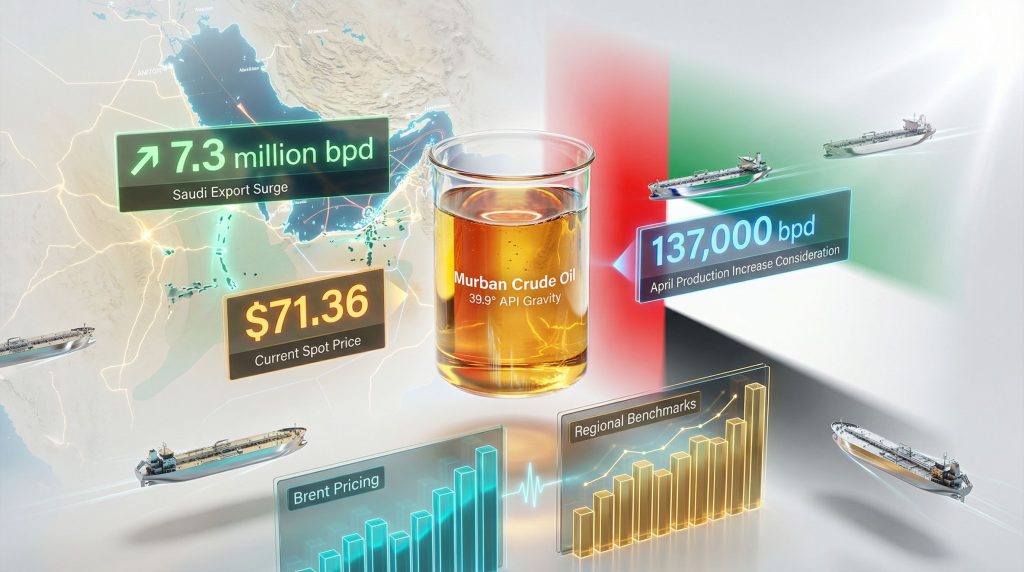
Murban crude's 39.9° API gravity and 0.79% sulfur content position it as an optimal feedstock for Asian petrochemical complexes focused on maximising gasoline and light petrochemical yields. These specifications translate directly into economic advantages through several mechanisms:
• Higher gasoline yields: Light crude produces 15-20% more gasoline per barrel compared to medium gravity grades
• Reduced hydrotreating costs: Lower sulfur content minimises hydrogen consumption and catalyst replacement
• Enhanced petrochemical feedstock production: Optimal naphtha yields support growing Asian petrochemical demand
• Simplified refinery operations: Consistent quality reduces blending complexity and operational adjustments
Asian refineries have increasingly configured their operations around light sweet crude processing capabilities. The 2 million barrels per day production capacity from ADNOC Onshore provides substantial supply security for partner companies including BP, TotalEnergies, China National Petroleum Corp, Inpex, Zhenhua Oil, and GS Energy, who collectively hold entitlement to approximately 40% of total production.
ICE Futures Abu Dhabi: The Physical Delivery Revolution
The evolution of Middle Eastern crude pricing mechanisms reflects broader changes in global commodity markets where physical delivery obligations enhance price discovery accuracy. ICE Futures Abu Dhabi has established itself as a legitimate alternative to traditional Dubai benchmark pricing through several innovations.
Physical Settlement Advantages:
| Feature | Traditional Paper Trading | ICE Physical Delivery |
|---|---|---|
| Price Discovery | Limited by speculation | Enhanced by actual supply/demand |
| Market Depth | Concentrated liquidity | Broader participation |
| Regional Relevance | Generic benchmarks | Location-specific pricing |
| Arbitrage Opportunities | Limited physical connection | Direct arbitrage with spot |
The January 2026 methodology changes removing Dubai floor constraints represent a significant shift toward independent price formation. This development allows Murban futures to reflect true supply-demand dynamics rather than being artificially constrained by relationships to other regional benchmarks.
Regional Integration and Supply Chain Optimisation
The geographic proximity between UAE production centres and key Asian demand centres creates natural economic advantages that extend beyond crude quality specifications. Transportation costs, storage facilities, and established trade relationships contribute to Murban crude exports maintaining competitive positions in target markets.
Asian refineries have made substantial capital investments in processing infrastructure specifically designed for Middle Eastern light sweet crudes. These investments create switching costs that provide incumbent suppliers with competitive advantages, as refineries face significant expenses when modifying operations for different feedstock specifications.
When big ASX news breaks, our subscribers know first
How Do Geopolitical Tensions Drive Middle Eastern Supply Strategy?
Regional security considerations fundamentally influence production planning and export strategies across Middle Eastern oil producers. Current geopolitical tensions create both risks and opportunities that shape tactical supply decisions, whilst advanced oil price rally insights help market participants navigate these complex dynamics.
UAE's Production Flexibility as a Strategic Asset
ADNOC Onshore's partnership structure provides unique operational flexibility compared to fully state-controlled production systems. The consortium arrangement with international oil companies creates multiple decision-making channels and diverse market perspectives that can enhance supply optimisation strategies.
Partner Company Capabilities:
• BP: Global trading network and downstream integration
• TotalEnergies: European market access and petrochemical expertise
• CNPC: Chinese market intelligence and strategic coordination
• Inpex: Japanese market relationships and technology sharing
• GS Energy: South Korean refinery partnerships
• Zhenhua Oil: Trading expertise and market making capabilities
This partnership diversity enables more sophisticated supply allocation strategies than single-company operations might achieve. Each partner brings distinct market knowledge, customer relationships, and operational capabilities that collectively enhance the consortium's ability to respond to changing market conditions.
Regional Supply Coordination Amid Iran-US Tensions
The strategic coordination between Gulf producers reflects sophisticated contingency planning for potential supply disruptions. Saudi Arabia's recent production increases serve as insurance against geopolitical risks while simultaneously defending market share during periods of demand uncertainty.
Current supply strategy reflects several key principles:
- Pre-emptive capacity utilisation: Bringing additional supply online before disruptions occur
- Market share defence: Maintaining customer relationships through consistent supply availability
- Price stability support: Preventing excessive volatility that could damage long-term demand
- Alliance coordination: Balancing competitive positioning with OPEC+ obligations
The 137,000 barrels per day production increase consideration for April 2026 represents careful calibration of these competing objectives. This volume represents approximately 0.14% of global oil production, suggesting measured rather than aggressive supply policy adjustments.
Risk Premium Assessment and Market Psychology
Geopolitical risk premiums in crude oil pricing reflect market participants' assessment of supply disruption probability and magnitude. Current Middle Eastern supply increases suggest producers are pricing these risks differently than financial markets, potentially creating arbitrage opportunities for sophisticated participants who understand market volatility hedging strategies.
The divergence between physical supply decisions and financial market risk pricing often signals underlying market inefficiencies that experienced traders can exploit through various hedging and positioning strategies.
What Economic Factors Are Reshaping OPEC+ Production Decisions?
The evolution of OPEC+ policy reflects changing global demand patterns, particularly the resurgence of Asian consumption growth and the structural shifts in global refining capacity utilisation. However, understanding these dynamics requires awareness of broader oil futures trends that influence decision-making processes.
Asian Demand Recovery Driving Output Adjustments
Chinese and Indian crude oil import growth creates the fundamental demand backdrop against which OPEC+ production decisions are evaluated. These markets represent the primary growth centres for global oil consumption, making their import patterns critical variables in producer strategy formation.
Key Demand Indicators:
• China: Refinery throughput recovery and strategic reserve filling
• India: Economic growth driving transportation fuel demand
• Southeast Asia: Petrochemical capacity expansions requiring feedstock
• Japan/South Korea: Refinery optimisation favouring light sweet crudes
The first quarter 2026 production pause followed by April increases reflects OPEC+ responding to these demand signals with tactical flexibility rather than rigid quota enforcement. This approach allows for more responsive supply management whilst maintaining overall market stability objectives.
Market Structure Changes Favouring Light Sweet Grades
Global refining capacity additions have increasingly focused on sophisticated processing units capable of maximising valuable product yields from light sweet feedstocks. This structural shift creates persistent demand premiums for grades like Murban crude that optimise these refining configurations.
Refining Trend Analysis:
| Region | Capacity Addition Focus | Preferred Crude Types | Economic Driver |
|---|---|---|---|
| Asia | Petrochemical integration | Light sweet | Margin optimisation |
| Middle East | Export refineries | Regional crudes | Domestic value-add |
| Americas | Shale oil processing | Light tight oil | Feedstock availability |
| Europe | Efficiency upgrades | Flexible feedstock | Environmental compliance |
These structural changes support sustained demand for Murban crude exports as refiners optimise their operations around feedstocks that deliver the highest economic returns.
Supply-Demand Balancing and Price Formation
The recent compression in spot crude premiums to less than $2 per barrel above Dubai quotes signals temporary oversupply conditions that may prompt tactical production adjustments. This premium level represents the lower end of the typical trading range, suggesting market participants expect supply-demand rebalancing.
OPEC market influence production policy increasingly emphasises market responsiveness over rigid quota adherence. This evolution reflects recognition that maintaining market share requires flexibility in responding to demand variations and competitive pressures from non-OPEC producers.
How Are Transportation Costs Affecting Global Crude Trade Flows?
Maritime transportation costs represent a significant component of delivered crude oil prices, particularly for long-haul routes between Middle Eastern producers and Asian consumers. Recent dramatic increases in shipping rates have reshaped trade flow economics and supplier competitiveness.
VLCC Rate Surge Impact on Economics
Very Large Crude Carrier (VLCC) rates exceeding $200,000 per day represent six-year highs that fundamentally alter the economics of crude oil transportation. These rate levels add approximately $3-4 per barrel to the delivered cost of Middle Eastern crude in Asian markets.
Transportation Cost Components:
• Base charter rate: $200,000+ daily for VLCCs
• Fuel costs: Bunker prices affecting voyage economics
• Canal fees: Suez Canal transit charges
• Insurance premiums: War risk and marine coverage
• Port charges: Loading and discharge fees
The magnitude of shipping cost increases creates incentives for supply chain optimisation strategies that can partially offset these impacts. These strategies include voyage scheduling optimisation, alternative routing analysis, and enhanced coordination between loading and discharge operations.
Route Optimisation Strategies for Middle Eastern Exporters
High shipping costs drive exporters to pursue operational efficiencies that reduce total transportation expenses per barrel delivered. These optimisations can provide competitive advantages in price-sensitive markets.
Key Optimisation Areas:
- Cargo sizing: Maximising vessel utilisation to spread fixed costs
- Scheduling coordination: Reducing demurrage through efficient operations
- Route selection: Evaluating alternative paths based on total cost
- Storage utilisation: Using strategic storage to optimise shipping timing
- Partner coordination: Sharing vessels among consortium members
ADNOC's partnership structure with multiple international oil companies creates opportunities for shipping cost optimisation through coordinated cargo planning and vessel sharing arrangements. These efficiencies can translate into competitive advantages in delivered pricing.
Spot Premium Compression and Market Signals
The relationship between shipping costs and crude price premiums reflects the complex interaction of supply availability, transportation capacity, and end-user demand. Current premium compression despite high shipping costs suggests abundant supply availability that pressures pricing despite increased logistics expenses.
Market Equilibrium Factors:
| Variable | Current Impact | Market Response |
|---|---|---|
| Supply Availability | Increased offerings | Premium compression |
| Shipping Costs | Six-year highs | Route optimisation |
| Demand Growth | Moderate Asian recovery | Selective purchasing |
| Storage Levels | Adequate inventory | Reduced urgency |
This market configuration suggests that supply increases have more than offset transportation cost impacts, at least in the short term. However, sustained high shipping costs may eventually support higher crude premiums as the full cost impact flows through to end users.
What Investment Implications Emerge from Supply Expansion Strategies?
The current expansion of Murban crude exports creates multiple investment implications for equity holders, trading entities, and downstream processors. Understanding these implications requires analysing both immediate cash flow impacts and longer-term strategic positioning effects.
Partner Equity Monetisation Patterns
International oil companies holding equity stakes in ADNOC Onshore face complex decisions regarding how to optimise the value of their crude oil entitlements. The 40% partner share of approximately 2 million barrels per day production represents substantial cash flows subject to various optimisation strategies.
Partner Optimisation Strategies:
• Direct refining: Processing equity crude in owned refineries
• Spot market sales: Monetising crude at current market prices
• Term contract optimisation: Securing premium pricing through long-term agreements
• Trading arbitrage: Exploiting location and timing differentials
• Strategic storage: Using inventory to optimise selling timing
Each partner company brings different capabilities and market access that influence their optimal crude utilisation strategies. Companies with extensive refining operations may prefer direct processing, whilst those with strong trading capabilities might focus on market arbitrage opportunities.
Forward Price Curve Analysis and Hedging Opportunities
The evolution of forward crude prices reflects market expectations regarding future supply-demand balances, geopolitical risks, and economic growth patterns. Current price curve configurations create specific hedging and positioning opportunities for sophisticated market participants seeking comprehensive investment strategy insights.
Forward Curve Structure (Projected):
| Contract Period | Price Level | Market Implication |
|---|---|---|
| Current Spot | $71.36/bbl | Near-term supply pressure |
| 3-Month Forward | $70.16/bbl | Modest contango structure |
| 12-Month Forward | $61.83/bbl | Long-term demand concerns |
| 24-Month Forward | $63.85/bbl | Economic recovery expectations |
This curve structure suggests that whilst near-term supply appears adequate, longer-term pricing reflects continued uncertainty about global economic growth and energy demand patterns. The contango structure creates opportunities for storage-based arbitrage strategies for entities with adequate storage capacity.
Capital Allocation and Return Optimisation
The increased Murban crude availability enables partner companies to optimise their capital allocation strategies between upstream equity positions and alternative investments. The cash flows from equity crude sales can be reinvested in various ways that affect overall portfolio returns.
Investment Alternatives Assessment:
- Additional upstream equity: Expanding production through new concessions
- Downstream integration: Building or acquiring refining capacity
- Trading infrastructure: Developing market-making capabilities
- Storage assets: Acquiring strategic storage for optimisation
- Alternative energy: Diversifying into renewable energy investments
The optimal allocation depends on each company's strategic objectives, existing asset base, and market outlook. Companies with strong downstream operations may prefer vertical integration, whilst those focused on upstream activities might pursue additional production opportunities.
How Do Regional Benchmark Dynamics Affect Global Pricing?
The evolution of regional crude oil benchmarks reflects broader changes in global trade patterns, refining configurations, and financial market development. Understanding these dynamics provides insights into long-term pricing relationships and arbitrage opportunities.
Middle Eastern Crude Complex Evolution
The development of independent pricing mechanisms for Middle Eastern crudes represents a significant shift away from traditional benchmark dependencies. This evolution creates both opportunities and risks for market participants who must adapt to changing price relationships.
Benchmark Relationship Changes:
• Murban-Dubai spread: Growing independence from traditional correlation
• Brent-Middle East differential: Reflecting transportation and quality factors
• Asia-Europe arbitrage: Driven by refining configuration differences
• Light-heavy crude differentials: Influenced by global refining capacity mix
The January 2026 methodology changes removing Dubai floor constraints for Murban pricing represent a critical step toward independent price discovery. This development may reduce correlation with traditional benchmarks whilst increasing responsiveness to specific supply-demand dynamics.
Futures Market Liquidity and Price Discovery
The growth of Middle Eastern crude futures trading enhances price transparency and provides additional risk management tools for market participants. ICE Futures Abu Dhabi has achieved significant liquidity improvements that support more efficient price discovery.
Market Development Indicators:
• Daily volume growth: Increased participation by financial and physical players
• Open interest expansion: Growing hedging and speculative positions
• Delivery obligations: Physical settlement ensuring price convergence
• International participation: Broader geographic representation in trading
These developments create more sophisticated pricing mechanisms that better reflect actual supply-demand conditions rather than historical pricing relationships that may no longer accurately represent market fundamentals.
Quality Differential Valuations in Market Conditions
The premium paid for light sweet crudes varies significantly based on overall market tightness, refining margins, and product demand patterns. Understanding these relationships enables better forecasting of crude price differentials and optimisation of supply strategies.
Market Condition Analysis:
| Market State | Light Sweet Premium | Key Drivers |
|---|---|---|
| Tight Supply | High premiums | Quality becomes critical |
| Oversupply | Compressed premiums | Buyers become price sensitive |
| Strong Demand | Moderate premiums | Balanced quality/price focus |
| Weak Demand | Variable premiums | Depends on refinery utilisation |
Current market conditions suggest oversupply pressures that compress quality premiums, but this situation could reverse quickly if supply disruptions occur or demand growth accelerates beyond expectations.
The next major ASX story will hit our subscribers first
What Long-term Supply Chain Restructuring Is Occurring?
The global energy transition and changing consumption patterns drive fundamental restructuring of crude oil supply chains. These changes affect everything from production planning to refining configurations to transportation infrastructure.
Asian Refinery Configuration Trends
Asian refineries continue investing in sophisticated processing capabilities that maximise value from light sweet crude inputs. These investments create long-term demand patterns that support sustained premiums for grades like Murban crude.
Configuration Trends:
• Petrochemical integration: Maximising high-value chemical feedstock production
• Flexibility enhancement: Enabling processing of various crude types
• Environmental compliance: Meeting increasingly stringent emissions standards
• Efficiency optimisation: Reducing processing costs through advanced technology
These trends create structural demand for light sweet crudes that extends beyond traditional fuel production into chemical feedstock applications. This diversification provides more stable demand patterns and potentially higher value realisation for producers.
Strategic Reserve and Security Stock Implications
Government strategic reserve policies increasingly influence commercial crude oil demand patterns. Asian governments have expanded their strategic storage capabilities and filling programmes, creating additional demand that supports producer planning.
Strategic Reserve Impacts:
• Demand smoothing: Government purchases reduce market volatility
• Supply security: Reduced dependence on spot market availability
• Price support: Reserve filling provides demand floor during weak periods
• Emergency release: Potential supply augmentation during crisis periods
These programmes create more predictable demand patterns that enable producers to plan supply strategies with greater confidence. The existence of strategic reserves also provides some insurance against extreme price volatility during supply disruptions.
Investment in Supply Chain Infrastructure
The growth of Middle Eastern crude exports requires continued investment in transportation, storage, and handling infrastructure. These investments create competitive advantages for regions that develop superior logistics capabilities.
Infrastructure Development Areas:
- Port expansion: Increasing loading capacity and efficiency
- Pipeline systems: Reducing transportation costs to export terminals
- Storage facilities: Enabling supply optimisation and market timing
- Digital systems: Improving operational efficiency and customer service
- Environmental compliance: Meeting international shipping and handling standards
These investments create barriers to entry for competing supply sources whilst enhancing the competitiveness of established exporters. The scale of required investments also favours larger producers with access to significant capital resources.
Frequently Asked Questions About Murban Crude Export Dynamics
Why Is Murban Crude Particularly Valuable to Asian Refineries?
The value of Murban crude to Asian refineries stems from its optimal specifications for maximising high-value product yields whilst minimising processing costs. The 39.9° API gravity provides excellent gasoline yields, whilst the 0.79% sulfur content reduces hydrotreating requirements and associated hydrogen consumption.
Asian petrochemical complexes particularly benefit from Murban's consistent quality, which enables optimised operations and reduced blending complexity. The geographic proximity between UAE production and Asian consumption centres also provides transportation cost advantages compared to alternative supply sources.
How Do OPEC+ Decisions Specifically Impact UAE Export Strategy?
UAE export strategy operates within the OPEC+ framework whilst maintaining flexibility through its partnership structure with international oil companies. The 137,000 barrels per day production increase consideration for April 2026 represents coordinated policy aimed at market stabilisation rather than competitive supply expansion.
The UAE's ability to offer additional volumes to equity partners provides tactical flexibility that complements broader OPEC+ objectives. This approach enables responsive supply management whilst maintaining alliance coordination and avoiding destructive competition among member states.
What Role Does Geopolitical Risk Play in Current Export Increases?
Geopolitical risk management drives preemptive supply strategies designed to maintain market stability and customer relationships during periods of uncertainty. The current supply increases reflect contingency planning rather than immediate threat response, positioning Gulf producers to maintain market share if disruptions occur elsewhere.
This approach recognises that maintaining customer relationships requires consistent supply availability, even during periods when immediate market conditions might not justify production increases. The long-term benefits of customer loyalty often outweigh short-term revenue optimisation considerations. Moreover, ADNOC's expanded oil partnerships demonstrate the strategic importance of maintaining strong industry relationships during volatile market conditions.
Furthermore, recent developments in crude oil market analysis highlight how these supply strategies align with broader market expectations and OPEC+ coordination efforts.
Disclaimer: The analysis presented in this article is based on available market information and industry trends. Commodity markets involve significant risks, and past performance does not guarantee future results. Readers should conduct their own research and consult qualified professionals before making investment decisions. Forward-looking statements regarding prices, production levels, and market developments are subject to substantial uncertainty and may not materialise as projected.
Looking to Capitalise on Energy Market Opportunities?
Discovery Alert's proprietary Discovery IQ model delivers real-time alerts on significant ASX mineral discoveries, including energy and commodities sectors, instantly empowering subscribers to identify actionable opportunities ahead of the broader market. Begin your 14-day free trial today and secure your market-leading advantage.