August 12, 2026
Africa's Critical Minerals Are Rewriting the Rules of Global Resource Diplomacy
The global race to secure critical minerals demand is no longer playing out quietly in boardrooms. It is reshaping sovereign relationships, redirecting capital flows across continents, and forcing commodity-rich nations to rethink their position in the international economic order. Nowhere is this dynamic more visible right now than in southern Africa, where a small but extraordinarily resource-endowed nation is negotiating its place in the emerging industrial geography of the 21st century.
Namibia's July 2026 state visit to Beijing — the first overseas diplomatic engagement by President Netumbo Nandi-Ndaitwah outside the African continent since taking office in 2025 — was not a routine bilateral courtesy call. It was a structured negotiation at the heart of the Namibia China infrastructure mining and energy deals story, sitting atop some of the world's most strategically valuable minerals and the planet's largest consumer of those same resources. Understanding what was agreed, what remains unresolved, and what the broader implications are for southern African resource markets requires looking well beyond the headline figures.
When big ASX news breaks, our subscribers know first
The Economic Pressures Driving Namibia's Strategic Outreach
Namibia enters this relationship from a position of genuine economic urgency. Despite holding world-class mineral assets, the country continues to face structural unemployment and deep inequality — problems that drove voter frustration and shaped the political platform on which Nandi-Ndaitwah campaigned. Her inauguration speech called explicitly for a green revolution anchored in agriculture, water resource monetisation, and industrial diversification.
The IMF has separately identified structural reforms as the central lever for sustainable job creation in Namibia, pointing to agriculture, fisheries, emerging oil and gas production, and green hydrogen as the sectors most capable of broadening the employment base beyond primary mineral extraction. These are not niche observations. They reflect a well-documented pattern across commodity-dependent economies: resource wealth alone does not translate into broad-based prosperity without deliberate industrial policy and downstream investment.
China, as the world's largest lender and second-largest economy, represents the most accessible source of capital and technology transfer at the scale Namibia needs. The decision to prioritise Beijing as the first destination outside Africa was therefore less a statement of geopolitical alignment than a pragmatic response to economic necessity.
What the Eight Cooperation Agreements Actually Cover
The July 2026 Beijing summit produced eight formal cooperation documents. The most consequential are a green minerals cooperation agreement and a comprehensive economic partnership framework, which together signal a qualitative shift in the bilateral relationship from simple commodity trade toward structured industrial collaboration. Reuters reporting on these agreements confirms the breadth of the sectors covered.
| Sector | Agreement Focus | Strategic Objective |
|---|---|---|
| Critical Minerals | Uranium, lithium, rare earth development | Shift from raw export to in-country beneficiation |
| Energy | Green technology and offshore oil cooperation | Diversify Namibia's energy production base |
| Infrastructure | Schools, healthcare, and water projects | Social infrastructure tied to N$486 million Chinese grant |
| Economic Framework | Trade expansion and export diversification | Grow Namibian exports including agricultural products to China |
| Technology Transfer | Local skills development and processing capability | Reduce dependency on raw commodity exports |
The joint statement language specifically highlighted the strategic value of critical minerals and confirmed mutual agreement to deepen cooperation across uranium, lithium, and rare earth elements. Importantly, the statement also emphasised local processing, technology transfer, and skills localisation as explicit policy commitments, not aspirational footnotes.
Green Minerals: Uranium Dominance and the Lithium Opportunity
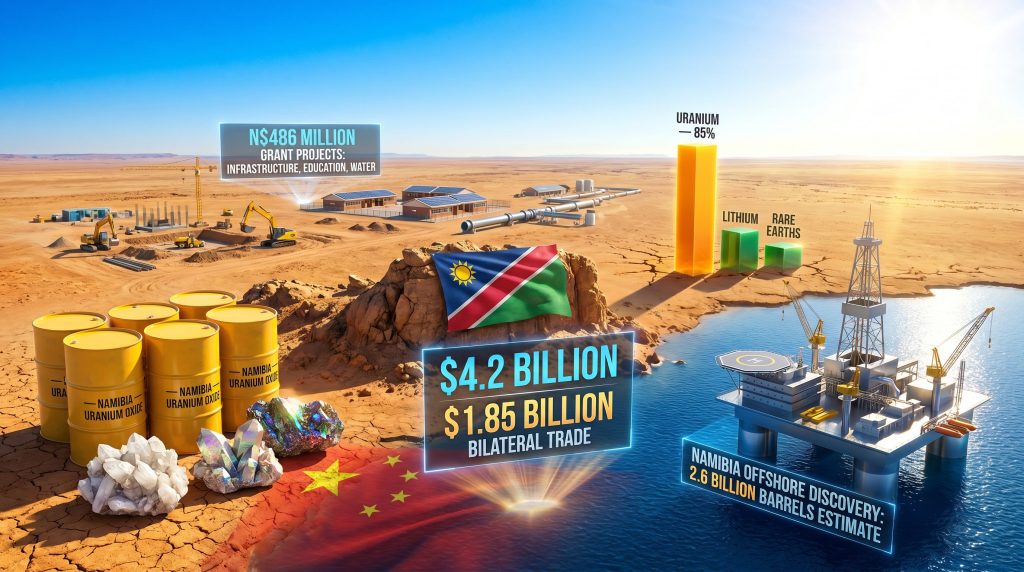
Uranium currently anchors the commercial relationship in a way that few observers fully appreciate. According to IMF reporting, China purchased approximately $1.3 billion worth of Namibian goods in the most recent reporting period, with uranium accounting for roughly 85% of that total. This extraordinary concentration is partly a function of Namibia's status as one of the world's top uranium producers, home to the Husab mine operated by a Chinese state-linked entity and the Rössing mine in which Chinese interests hold a significant stake.
Husab is among the largest uranium mines globally by resource volume, producing low-cost oxide from a large-tonnage, relatively lower-grade deposit. This matters from a mineral economics standpoint: Namibian uranium is competitive on a cost-per-pound basis precisely because of the scale of the ore bodies involved, which offsets the lower head grades compared to some Canadian or Kazakh deposits. China's substantial investment in Namibian uranium is not incidental. It reflects a deliberate upstream security strategy for nuclear energy, which Beijing continues to expand at a pace unmatched globally.
Lithium and rare earth supply chains represent the forward dimension of the minerals agreement. While Namibia is not yet a major lithium producer, several exploration projects are advancing, and the country's geology is considered prospective for pegmatite-hosted lithium mineralisation. Rare earths are similarly at an earlier stage commercially, but their inclusion in the joint statement language reflects China's interest in securing multiple nodes across the full critical mineral spectrum, particularly as trade tensions with Western partners make supply chain diversification more urgent.
Beneficiation — the processing of raw minerals within the producing country before export — has become the defining policy battleground across African commodity nations. Namibia's insistence on embedding this principle into the cooperation framework reflects a continent-wide shift in negotiating posture.
The structural challenge of beneficiation should not be underestimated. Building processing infrastructure requires substantial upfront capital, technical expertise that takes years to localise, reliable and affordable energy supply, and access to end markets willing to absorb processed product. Countries that have succeeded in capturing downstream value — such as Morocco in phosphates or Botswana in diamond cutting and polishing — did so over decades and with consistent policy commitment. Namibia's ambition is real, but implementation will test that commitment.
Energy: Offshore Oil Potential and the Green Hydrogen Horizon
Perhaps the most transformative dimension of Namibia's economic outlook is its offshore petroleum position. Shell and TotalEnergies have identified an estimated 2.6 billion barrels of crude in the Orange Basin, giving Namibia a credible pathway to becoming Africa's fourth-largest oil producer by 2030, behind Nigeria, Angola, and Libya.
The Angola comparison is instructive. Angola currently produces approximately 1.1 million barrels per day and has used that oil revenue to finance a broad economic restructuring programme that includes Chinese-backed infrastructure and a deliberate pivot away from fossil fuel dependency. Namibia is watching this model closely, and the inclusion of energy cooperation in the Beijing agreements reflects Namibian interest in attracting Chinese participation in both the upstream oil development and the longer-term energy security transition.
Green hydrogen occupies a longer time horizon but features prominently in Namibia's strategic narrative. The country's combination of strong solar and wind resources, available land, and potential deep-water port access makes it one of a small number of African nations with genuine green hydrogen export potential. Chinese cooperation in this space remains at the framework level for now, but the direction is established.
Infrastructure: The N$486 Million Grant and Development Priorities
The Chinese grant component of the agreements, valued at approximately N$486 million, is directed toward social infrastructure including schools, healthcare facilities, and water projects. This type of investment connects directly to Namibia's 6th National Development Plan and reflects China's established pattern of pairing resource sector investment with visible community infrastructure to build political goodwill and long-term bilateral stability.
Chinese enterprises are reported to have generated more than 10,000 direct jobs across Namibia's mining, energy, agriculture, and infrastructure sectors. This figure represents meaningful employment in an economy of roughly 2.7 million people, though critics note that the quality, longevity, and skills transfer associated with these positions varies considerably across sectors and project types.
Mapping the $4.2 Billion Chinese Investment Footprint
Total Chinese investment in Namibia stands at approximately $4.2 billion, according to data from the American Enterprise Institute. The sectoral distribution is stark: all but roughly $100 million of that total is concentrated in the metals mining sector. This pattern is not unique to Namibia but is characteristic of Chinese resource investment across Sub-Saharan Africa more broadly.
The concentration creates a structural paradox. On one hand, mining investment has delivered capital, employment, and export revenue at scale. On the other, it has deepened Namibia's dependence on a single sector and a single commodity class — the exact vulnerability that the new economic partnership framework is designed to address. Bilateral trade now exceeds $1.85 billion, with China absorbing approximately 25% of Namibia's total exports, a market relationship significant enough to create real leverage on both sides.
The new framework's agricultural component, which aims to expand Namibian exports of table grapes and other produce into China's consumer market, represents one concrete mechanism for diversification. However, agricultural market access involves phytosanitary approvals, cold chain logistics, and consumer preference development that take years to build. These are not quick wins.
China's Broader Critical Minerals Playbook in Africa
The Namibia China infrastructure mining and energy deals fit within a well-documented pattern of Chinese resource diplomacy across the African continent. State-linked enterprises anchor upstream positions in strategic mineral sectors, infrastructure investment follows to build bilateral goodwill and reduce logistical barriers, and framework agreements create institutional channels for deepening commercial ties over time. Furthermore, Namibia's critical minerals strategy mirrors the kind of deliberate resource policy increasingly adopted by nations seeking to avoid the pitfalls of raw commodity dependency.
The three minerals at the centre of China's long-term technology manufacturing security concern — uranium for nuclear energy, lithium for battery storage, and rare earths for permanent magnets used in electric vehicles and wind turbines — are precisely the minerals named in the Namibia joint statement. This alignment is not coincidental.
What makes the current moment distinct from earlier cycles of Chinese resource investment in Africa is the explicit insertion of beneficiation and technology transfer language into formal agreements. African governments have become more sophisticated in their negotiating positions, driven partly by the commodity price volatility of the 2010s and partly by a growing continental consensus that raw material exports alone do not generate the industrial development or employment multiplier effects that populations need.
Risks That Demand Serious Attention
Several risk categories deserve honest assessment alongside the opportunity narrative.
- Commodity concentration risk: Namibia's export profile remains heavily exposed to uranium price cycles. A structural downturn in uranium demand or pricing would disproportionately affect the bilateral trade relationship.
- Debt dynamics: Infrastructure financing from Chinese institutions has historically involved terms that deserve careful scrutiny. Namibia's government will need to ensure that grant and loan components are clearly distinguished and that debt service obligations are manageable within realistic revenue projections.
- Technology transfer substance: The difference between nominal technology transfer compliance and genuine localisation of processing capability is enormous. Without enforceable milestones and independent monitoring, these provisions can remain aspirational rather than operational.
- Governance and accountability: Large-scale resource agreements involving state-linked foreign enterprises create governance challenges around transparency, local procurement, environmental standards, and community benefit sharing.
It is also worth noting that Namibia's nuclear ties with other global partners add a further layer of complexity to the country's energy diplomacy, as Windhoek simultaneously navigates relationships with multiple major powers across its uranium sector.
Investors and policymakers watching Namibia's China engagement should apply a framework that distinguishes between the value of the agreements as signed and the value that will actually be realised through implementation. These are rarely the same number.
The next major ASX story will hit our subscribers first
Frequently Asked Questions: Namibia China Infrastructure Mining and Energy Deals
What sectors did Namibia and China agree to cooperate on during the 2026 state visit?
Cooperation spans critical minerals including uranium, lithium, and rare earths, alongside energy covering green technology and offshore oil, infrastructure construction, agriculture, education, and science and technology transfer. Detailed coverage of the signed agreements provides further context on each cooperation document.
How much has China invested in Namibia to date?
Chinese firms have invested approximately $4.2 billion in Namibia, with the overwhelming majority directed toward the metals mining sector, according to American Enterprise Institute data.
What is Namibia's potential as an oil producer?
Following offshore discoveries by Shell and TotalEnergies in the Orange Basin, Namibia holds an estimated 2.6 billion barrels of crude and is projected to potentially become Africa's fourth-largest oil producer by 2030.
Why does local mineral processing matter so much in these agreements?
Beneficiation allows Namibia to capture significantly more economic value per tonne of mineral output compared to raw commodity export. Processing creates higher-skilled employment, develops industrial capability, and reduces exposure to commodity price volatility at the raw material end of the supply chain.
How many jobs have Chinese enterprises created in Namibia?
Chinese firms operating across mining, energy, agriculture, and infrastructure sectors have generated more than 10,000 jobs in Namibia.
What is the total value of bilateral trade between Namibia and China?
Bilateral trade exceeded $1.85 billion in the most recent reporting period, with China purchasing approximately 25% of Namibia's total exports.
What the Namibia-China Deals Signal for Southern African Resource Markets
The July 2026 Namibia China infrastructure mining and energy deals represent a meaningful upgrade in the structural nature of the bilateral relationship. Whether that upgrade translates into genuine industrial transformation or simply deeper commodity dependency will depend on the rigour with which beneficiation, technology transfer, and local skills development commitments are implemented and monitored.
The rest of southern Africa is watching. Zambia, Zimbabwe, the Democratic Republic of Congo, and Tanzania all hold critical mineral assets and are all navigating similar negotiations with Chinese counterparts. How Namibia manages the tension between attracting Chinese capital and building durable sovereign industrial capacity will consequently inform the strategic calculus of every resource-rich nation in the region.
This article contains forward-looking analysis, projections, and commentary on geopolitical and economic developments. It is intended for informational purposes only and does not constitute financial or investment advice. Readers should conduct their own due diligence before making any investment or policy decisions.
Want to Identify the Next Major Critical Minerals Discovery Before the Market Does?
Discovery Alert's proprietary Discovery IQ model delivers real-time alerts on significant ASX mineral discoveries — instantly translating complex geological data into actionable investment insights across uranium, lithium, rare earths, and more than 30 other commodities. Explore historic discoveries and their extraordinary returns, then begin your 14-day free trial at Discovery Alert to position yourself ahead of the market.