June 26, 2026
When Commodity Cycles Collide With a Growing Services Economy
Resource-dependent economies across sub-Saharan Africa share a structural paradox: the same natural endowments that attract foreign capital and generate export revenue also create deep vulnerabilities to price cycles, production disruptions, and demand shifts happening thousands of kilometres away. Understanding how an economy navigates that tension, especially in a single quarter, reveals far more about its underlying trajectory than any headline growth figure alone.
The news that the Namibia economy grows 2% in the first quarter of 2026 sits precisely within this paradox. It is simultaneously a recovery story, a slowdown story, and a structural story, all compressed into one data release.
When big ASX news breaks, our subscribers know first
Unpacking the Q1 2026 Result: Recovery From Near-Stagnation, But Slower Than a Year Ago
The Namibia Statistics Agency published its first-quarter 2026 GDP figures on June 25, 2026, confirming that real output expanded by 2.0% year-on-year. The result marked a significant rebound from the near-stagnant 0.1% growth recorded in Q4 2025, offering an initial impression of positive momentum.
However, placing this figure within a slightly longer timeline complicates that optimistic reading. The equivalent quarter one year earlier delivered 2.8% growth, meaning the 2026 result represents a deceleration on an annual comparison basis. Nominal GDP output reached N$70.9 billion, equivalent to approximately USD 4.2 billion for the quarter.
The IMF had previously projected full-year 2025 growth at 1.7%, flagging persistent weakness in the diamond sector and slower-than-expected progress in offshore oil exploration as the primary constraints. The Q1 2026 data aligns broadly with the IMF's cautious 2026 outlook, which identifies weak diamond production, lower gold output, and elevated fuel prices as the economy's dominant near-term headwinds.
"The 2.0% result is less a cause for alarm and more a diagnostic signal. It reveals an economy with genuine services-led dynamism that is being systematically suppressed by commodity sector underperformance, a tension that will define Namibia's macroeconomic story throughout the mid-2020s."
Services Sector: The Engine Keeping Namibia's Economy Moving
Tertiary Activity Expands 5.1% Across Broad Sub-Sectors
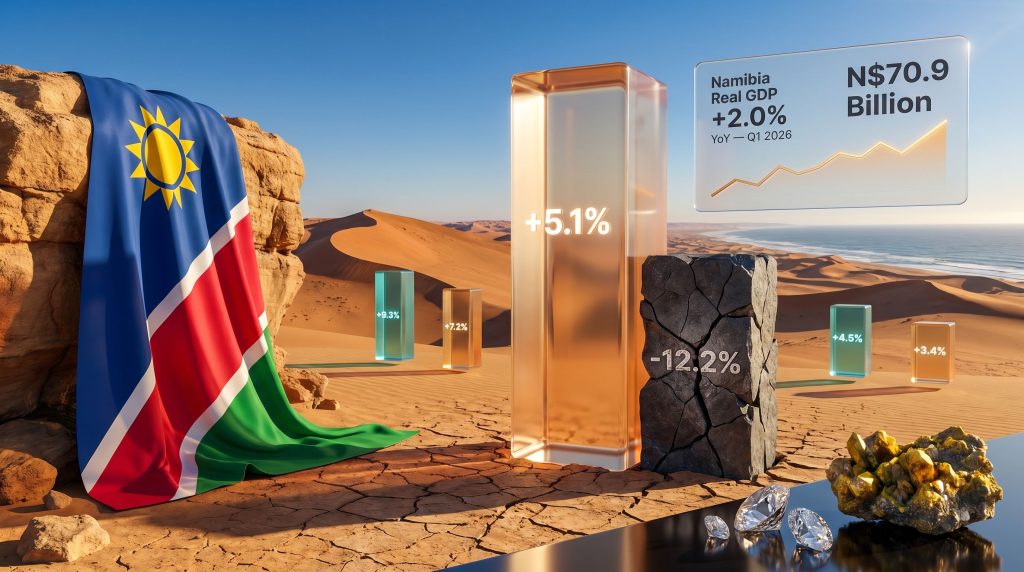
The clearest positive story within the Q1 2026 data is the sustained strength of Namibia's services economy. Tertiary activities expanded by 5.1% in real terms during the quarter, providing the bulk of upward momentum that prevented a far weaker headline result.
The breadth of services growth is particularly notable. Rather than concentration in a single sub-sector, expansion was distributed across both public and private activity:
| Services Sub-Sector | Year-on-Year Growth (Q1 2026) |
|---|---|
| Wholesale and Retail Trade | +9.3% |
| Financial Services | +7.2% |
| Health | +6.4% |
| Education | +4.6% |
| Public Administration | +3.7% |
Wholesale and retail trade's 9.3% expansion is the standout figure, suggesting that distribution-level activity is capturing genuine improvements in goods movement and domestic commerce, even as household-level consumption moderates. Financial services growth of 7.2% points toward deepening credit intermediation and financial inclusion dynamics, a pattern consistent with broader trends observed across faster-growing African economies.
The simultaneous growth in health (+6.4%) and education (+4.6%) reflects continued public investment in human capital infrastructure, while public administration growth of 3.7% aligns with the demand-side data showing elevated government expenditure. Furthermore, these figures collectively reinforce that the services sector is not narrowly concentrated but structurally broad.
What the Expenditure Data Reveals About Demand Conditions
On the demand side of the national accounts, three figures deserve careful attention:
- Household consumption rose by 1.4% in Q1 2026, a sharp deceleration from the 8.4% recorded in the same quarter of 2025.
- Government expenditure increased by 4.5%, indicating that public sector spending continued to function as a demand support mechanism.
- Fixed capital investment advanced by 3.4%, suggesting that capital formation activity remained intact despite commodity sector headwinds.
The contraction in household consumption growth from 8.4% to 1.4% within a single year is arguably the most significant demand-side signal in this dataset. It points directly toward tightening consumer conditions, most likely driven by higher fuel prices and slower income growth in communities tied to the resource sector.
This compression in consumer spending capacity is a dynamic worth monitoring carefully. When household expenditure growth falls this sharply, it typically signals that real incomes in resource-adjacent communities are being squeezed — a feedback loop that can amplify the broader economic effect of mining sector weakness beyond what the production data alone would suggest.
Mining's 12.2% Contraction: The Weight Pulling Against Growth
Diamond and Gold at the Core of the Decline
The most consequential figure in the entire Q1 2026 dataset is the 12.2% contraction in mining and quarrying in real terms. Primary activities overall declined by 5.7%, and the industrial sector fell by 3.1%, compounded further by a 12.2% slump in manufacturing output.
The NSA attributed the mining decline directly to reduced output in diamonds and gold. This dual weakness is analytically important because the two commodities face fundamentally different market conditions, yet both disappointed simultaneously.
- Diamond sector: Structural headwinds include softening global demand, inventory oversupply in key consumer markets, and competition from laboratory-grown diamonds, which have captured an increasing share of jewellery purchasing particularly in the United States and China. These are not cyclical factors that will resolve with a single quarter of market improvement.
- Gold sector: The weakness in Namibian gold production is particularly notable given that international record gold prices were reached through 2025 and into 2026. When production falls despite strong prices, the implication is that operational or geological constraints rather than demand issues are the limiting factor. This distinction matters for investors and policymakers assessing recovery timelines.
A Less-Discussed Dynamic: The Upstream-Downstream Disconnect
One structural characteristic of Namibia's mining economy that amplifies the GDP impact of production declines is the limited degree of downstream mineral processing that occurs within the country. A significant share of value addition, refining, cutting (in the case of diamonds), and manufacturing takes place outside Namibian borders.
This means that when raw mineral output contracts, Namibia absorbs the full production-side GDP loss without retaining the downstream value chain activity that partially cushions more vertically integrated resource economies. This upstream-only exposure creates a structural asymmetry: production volumes are highly sensitive to international market conditions, but value capture during production upturns is also structurally constrained.
Partial Offsets Within the Primary Sector
Not all primary sector activity moved in the same direction. Two partial counterbalances prevented an even deeper primary sector contraction:
- Uranium production delivered strong output during the quarter, providing a meaningful offset within the extractive sector. Namibia hosts some of the world's largest uranium deposits, and the global nuclear energy demand recovery — driven by energy security concerns and clean energy transition commitments across Europe and Asia — has provided a more supportive pricing and demand environment. In addition, Namibia nuclear energy ties with international partners continue to evolve, adding a geopolitical dimension to the country's uranium outlook. Furthermore, broader uranium market volatility remains an important factor shaping production decisions and investor sentiment.
- Livestock activity showed gradual improvement, contributing modestly to agricultural performance and reflecting the gradual normalisation of conditions in Namibia's extensive commercial and communal farming sectors.
These offsets were insufficient to reverse the overall primary sector decline but demonstrate that Namibia's resource base is not under uniform pressure — an important nuance for any assessment of the economy's medium-term trajectory.
Structural Vulnerability: Why One Sector Contraction Can Suppress the Whole Economy
The Diversification Deficit in Quantitative Terms
The Q1 2026 data provides a quantitative illustration of Namibia's structural diversification challenge. A single sector contraction of 12.2% in mining was sufficient to suppress headline GDP growth to 2.0% despite services expanding at 5.1%. This relationship — where commodity sector weakness overrides broad-based services growth — is the defining structural feature of Namibia's current economic architecture.
| Sector | Q1 2026 Performance | Role in Growth Outcome |
|---|---|---|
| Tertiary (Services) | +5.1% | Primary growth driver |
| Mining and Quarrying | -12.2% | Major drag |
| Primary Activities (Overall) | -5.7% | Net drag |
| Industrial and Manufacturing | -3.1% / -12.2% | Compounding drag |
| Household Consumption | +1.4% | Moderate demand support |
| Government Spending | +4.5% | Supportive |
| Fixed Capital Investment | +3.4% | Supportive |
The Orange Basin Oil Variable: A Structural Transformation Catalyst?
Namibia's offshore oil exploration activity, concentrated in the Orange Basin along its southern Atlantic coastline, represents the single most significant potential catalyst for structural economic transformation in the country's near-to-medium-term outlook. Discoveries made in the Orange Basin by major international operators have attracted sustained industry attention, though the timeline from discovery to commercial production remains subject to considerable uncertainty.
The IMF identified slower-than-expected oil exploration progress as a 2025 growth constraint. Separately, recent industry activity has included new partnership formations within offshore licence areas, signalling continued investor interest in Namibia's petroleum potential. Successful commercialisation of offshore oil reserves would alter Namibia's GDP composition significantly, reduce dependency on the diamond cycle, and generate a new category of export revenue with different demand drivers and price dynamics.
"If Orange Basin oil development reaches production phase within the medium-term IMF forecast window, it could accelerate Namibia's growth trajectory toward and potentially beyond the 3% medium-term projection. However, this scenario carries substantial execution and timing risk, and no production timeline should be treated as confirmed absent formal operator announcements."
The next major ASX story will hit our subscribers first
Risks, Opportunities, and the Path to 3% Growth
Near-Term Headwinds Facing the Economy
The IMF and NSA data together identify a consistent set of near-term pressures:
- Continued structural weakness in global diamond demand, with laboratory-grown diamond competition adding a secular rather than purely cyclical dimension to the challenge.
- Lower gold production despite internationally strong prices, suggesting the constraints are supply-side rather than market-driven. The gold price impact on mining equities highlights how production shortfalls can weigh on investment sentiment even when spot prices remain elevated.
- Elevated domestic fuel prices eroding household purchasing power and compressing consumer spending growth.
- The sharp slowdown in household consumption growth from 8.4% to 1.4% signalling potential demand fragility in the domestic economy.
Medium-Term Recovery Scenarios
The IMF's forecast of gradual recovery toward approximately 3% annual growth over the medium term rests on several conditions. According to annual GDP growth data, Namibia has demonstrated the capacity to sustain multi-quarter expansion runs, making the medium-term recovery scenario credible, albeit contingent on commodity stabilisation.
- Stabilisation and eventual recovery in diamond production volumes and pricing.
- Resolution of operational constraints limiting gold output.
- Sustained services sector momentum, particularly in wholesale trade and financial intermediation.
- Continued government expenditure support without unsustainable fiscal deterioration.
- Progress in uranium sector output capitalising on global nuclear energy demand recovery. In addition, critical minerals demand driven by the energy transition may further support Namibia's broader extractive sector beyond uranium alone.
"Scenario Watch: If diamond and gold production stabilise through the second half of 2026 while services maintain current expansion rates, Namibia's full-year growth could approach or reach the IMF's medium-term 3% target ahead of schedule. Conversely, further commodity deterioration combined with ongoing consumer spending weakness could suppress full-year 2026 growth below the IMF's 2025 estimate of 1.7%, reversing the modest Q1 recovery entirely."
Investment Signals Embedded in the Quarterly Data
For investors monitoring Namibia's economic trajectory, the Q1 2026 data contains several signal layers beyond the headline figure:
- The 3.4% rise in fixed capital investment confirms that capital formation activity is continuing despite sector-specific headwinds, a positive indicator for medium-term productive capacity development.
- Financial services expansion of 7.2% suggests deepening financial inclusion and credit activity that may generate compounding economic returns as more participants access formal financial infrastructure.
- Uranium sector resilience positions Namibia within the global clean energy transition investment narrative, given the renewed interest in nuclear power generation capacity across multiple major economies.
- The compression of household consumption growth from 8.4% to 1.4% warrants monitoring as a potential leading indicator of broader demand-side deterioration if fuel prices remain elevated through 2026.
Disclaimer: This article contains forward-looking economic assessments and IMF projections that are inherently subject to uncertainty. Nothing in this article constitutes investment advice. Readers should conduct independent research and seek professional financial guidance before making investment decisions based on macroeconomic data or forecasts.
Want to Track the Next Major Mineral Discovery Before the Broader Market Does?
Discovery Alert's proprietary Discovery IQ model delivers real-time alerts on significant ASX mineral discoveries across more than 30 commodities — including uranium, gold, and beyond — instantly converting complex geological data into actionable investment insights for both short-term traders and long-term investors. Explore how historic discoveries have generated extraordinary returns on Discovery Alert's dedicated discoveries page, and begin your 14-day free trial today to position yourself ahead of the market.