June 8, 2026
Economic Diversification Through Mineral Resource Optimization
African resource economies have historically struggled with commodity concentration risk, where overdependence on single export products creates fiscal vulnerability during market downturns. This challenge becomes particularly acute when traditional revenue streams face structural disruption from technological innovation or shifting consumer preferences. The gold and uranium boost Namibia's tax revenue scenario exemplifies how the mining sector's capacity for revenue diversification through multiple mineral extraction offers a pathway toward enhanced economic resilience, though success requires strategic resource allocation and market timing.
The transformation of revenue streams within resource-dependent economies demonstrates how geological endowments can be leveraged across different market cycles. When established commodity markets experience decline, alternative mineral resources may simultaneously benefit from global price appreciation or increased demand fundamentals. This dynamic creates opportunities for countries with diversified mineral portfolios to maintain fiscal stability even as individual commodity segments contract.
When big ASX news breaks, our subscribers know first
Understanding Namibia's Mining Revenue Diversification Strategy
The Structural Shift from Diamond Dependency
Namibia's economy has traditionally relied heavily on diamond exports, which historically represented approximately 30% of total export earnings according to recent mining sector analysis. This concentration created significant fiscal exposure when diamond markets experienced disruption, as evidenced by the dramatic revenue declines observed in recent financial periods.
The vulnerability of single-commodity dependence became starkly apparent when tax revenue from diamonds declined 79% year-on-year in the six-month period ending September 2025. This decline followed a previous 49% reduction in the prior financial year, demonstrating accelerating weakness in diamond-derived government revenues.
Quantifying the Revenue Transformation
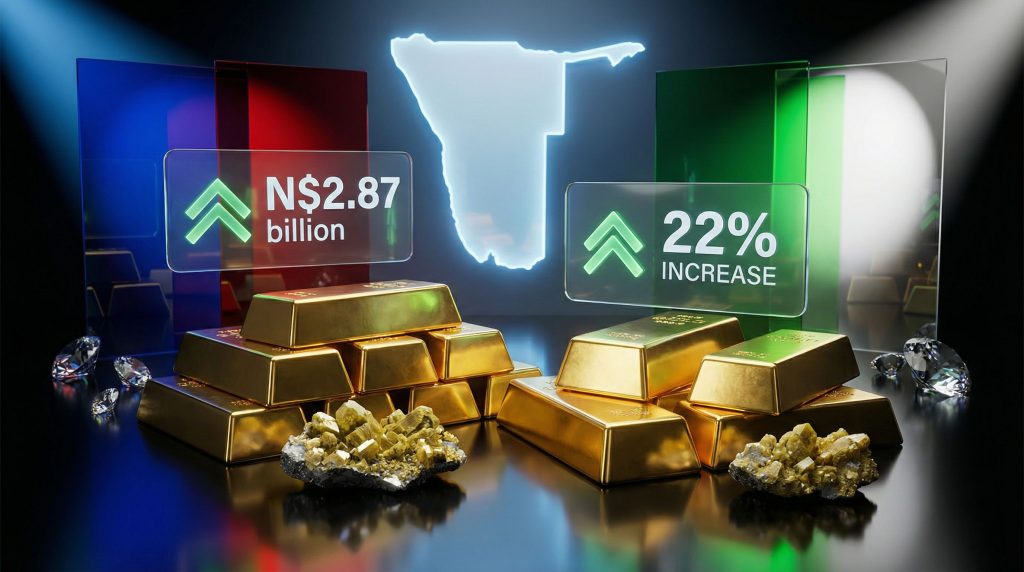
The emergence of alternative mineral revenues has fundamentally altered Namibia's fiscal landscape. Furthermore, this shift represents a crucial aspect of mining industry evolution as countries adapt to changing market conditions. Tax revenue from non-diamond minerals, primarily uranium and gold, reached N$2.87 billion (approximately USD $171.09 million) in the most recent financial year, representing nearly double the original budget estimates.
This revenue surge is projected to continue, with expectations for non-diamond mineral revenues to increase to N$3.54 billion in the current financial year. Additionally, non-diamond royalty income exceeded budgeted projections, rising from N$747.8 million to N$1.03 billion, indicating sustained outperformance across multiple revenue categories.
"For the first time in Namibia's mining history, non-diamond mineral revenues have surpassed diamond revenues, marking what the Chamber of Mines of Namibia characterises as evidence of a structural shift toward a more diversified and resilient mining revenue base."
What Factors Are Driving Gold's Contribution to Namibian Tax Revenues?
Global Gold Price Rally Impact Analysis
The gold mining sector's contribution to Namibian tax revenues has been significantly enhanced by exceptional price performance in global bullion markets. For instance, the historic gold surge explained provides context for understanding how spot gold prices reached peaks of $4,380 per ounce during October 2025, representing approximately 60% appreciation compared to the previous year's levels.
This price momentum has directly benefited Namibia's two primary gold mining operations: the Navachab mine and B2Gold Corporation's Otjikoto facility. Both operations experienced substantial revenue multiplication effects as the bullion price rally translated into enhanced per-ounce profitability margins.
Production Capacity and Operational Efficiency Metrics
Gold mining operations benefit from relatively straightforward revenue scaling when commodity prices appreciate significantly. With production costs typically remaining stable in the short term, price increases translate almost directly into margin expansion and increased tax contributions.
The sustained nature of the gold price rally, rather than isolated price spikes, provided Namibian gold mining operations with extended periods of enhanced profitability. This allowed for potential reinvestment in operational efficiency improvements and production optimisation strategies. Moreover, gold market performance demonstrates how these favourable conditions created optimal conditions for revenue maximisation.
Key Performance Indicators:
- Gold price appreciation: 60% year-over-year growth
- Peak pricing: $4,380 per ounce in October 2025
- Primary beneficiaries: Navachab and Otjikoto mining operations
- Revenue impact: Direct correlation with tax contribution increases
Why Is Uranium Becoming Namibia's Strategic Revenue Pillar?
Global Uranium Market Positioning
Namibia holds a strategically important position in global uranium supply chains as the world's third-largest uranium producer, trailing only Kazakhstan and Canada. This ranking provides the country with significant influence in a concentrated global market where production capacity is limited to relatively few major suppliers.
The strategic importance of uranium extends beyond traditional commodity dynamics due to its critical role in nuclear technologies and energy security considerations. As countries worldwide reassess their energy portfolios, uranium demand fundamentals have strengthened considerably. Additionally, uranium market dynamics show how supply constraints and increasing nuclear energy adoption have created favourable conditions for producers.
Nuclear Energy Demand Fundamentals
Uranium production in Namibia increased by 22% year-on-year during the first ten months of 2025, indicating strong operational performance across the country's uranium mining sector. This production growth occurred during a period of favourable market conditions and increasing global demand for nuclear fuel.
The uranium market's supply-demand dynamics differ significantly from more commoditised minerals. Long-term supply contracts, geopolitical considerations, and the specialised nature of nuclear fuel processing create market conditions that can sustain higher prices and more stable revenue streams. Furthermore, critical minerals energy security concerns have elevated uranium's strategic importance globally.
Production and Market Data:
- Global ranking: 3rd largest uranium producer worldwide
- Production growth: 22% increase (January-October 2025)
- Market concentration: Limited number of major global suppliers
- Strategic classification: Critical resource for nuclear technologies
| Uranium Market Factor | Namibia's Position | Strategic Advantage |
|---|---|---|
| Global Production Rank | 3rd largest producer | Supply chain influence |
| Production Growth Rate | 22% year-over-year | Operational expansion |
| Market Concentration | Few major suppliers | Pricing power potential |
| End-Use Applications | Nuclear technologies | Strategic resource status |
How Are Diamond Market Challenges Reshaping Namibia's Mining Strategy?
Diamond Industry Disruption Analysis
The natural diamond industry has confronted significant structural challenges since mid-2022, primarily driven by the growing popularity of lab-grown diamonds as alternatives to mined stones. This technological disruption has fundamentally altered consumer preferences and pricing dynamics within the jewelry market.
Lab-grown diamonds offer several competitive advantages over natural stones, including lower production costs, shorter time-to-market, and environmental positioning that appeals to sustainability-conscious consumers. These factors have created sustained downward pressure on natural diamond pricing and market share. As reported by Mining.com, this shift has significantly impacted traditional diamond-dependent economies.
Revenue Impact Quantification
The financial impact of diamond market disruption on Namibian government revenues has been severe and accelerating. The progression from a 49% revenue decline in one financial year to a 79% decline in the subsequent six-month period demonstrates the compounding effects of market share erosion.
This revenue contraction reflects not just pricing pressure but fundamental shifts in consumer demand patterns. Traditional marketing strategies that emphasised the unique value of natural diamonds have proven insufficient to maintain market position against technologically produced alternatives.
Diamond Revenue Decline Timeline:
- Mid-2022: Natural diamond price decline commenced
- Previous financial year: 49% tax revenue reduction
- Six months to September 2025: 79% tax revenue decline
- Market driver: Lab-grown diamond popularity growth
What Does Namibia's Mining Revenue Diversification Mean for Economic Stability?
Fiscal Revenue Optimisation Framework
The mining sector's overall contribution to Namibia's economy reached N$89.1 billion, representing a 9.3% increase over the measurement period. This growth occurred despite significant diamond sector contraction, demonstrating the effectiveness of diversification strategies in maintaining aggregate mining revenues.
Mining represents 13.7% of Namibia's GDP, making it a critical economic pillar whose stability directly impacts national fiscal health. The successful transition from diamond dependency to multi-mineral revenue generation has enhanced the sustainability of this GDP contribution.
Economic Resilience Building Strategies
Gold and uranium exports experienced 25.4% growth, more than offsetting diamond export declines and contributing to overall export performance stability. This export growth has important implications for foreign currency earnings and balance of payments management.
The diversification success provides Namibia with enhanced fiscal predictability and reduced vulnerability to single-commodity market disruptions. Multiple revenue streams create natural hedging effects where strength in one mineral sector can compensate for weakness in another. According to a report by 360 Mozambique, Namibia's mining industry has consistently demonstrated its capacity to generate substantial state revenues.
Economic Impact Metrics:
- Total mining sector value: N$89.1 billion
- Mining GDP contribution: 13.7% of national GDP
- Combined export growth: 25.4% for gold and uranium
- Revenue diversification: First-time non-diamond revenue supremacy
The next major ASX story will hit our subscribers first
Mining Sector Performance Metrics and Comparative Analysis
Revenue Source Performance Comparison
| Mineral Sector | Revenue Performance | Market Dynamics | Strategic Outlook |
|---|---|---|---|
| Gold Mining | 60% price appreciation | Global bullion rally | Sustained high prices |
| Uranium Production | 22% output increase | Nuclear energy demand | Strategic resource position |
| Diamond Operations | 79% revenue decline | Lab-grown competition | Structural market challenges |
| Combined Non-Diamond | N$2.87B revenue achievement | Diversification success | Growth to N$3.54B projected |
Comparative Revenue Analysis
The transformation in Namibia's mining revenue composition represents a fundamental shift in economic structure. Non-diamond mineral revenues achieving N$2.87 billion compared to sharply declining diamond revenues demonstrates successful resource portfolio rebalancing.
This revenue diversification provides multiple benefits including reduced volatility, enhanced fiscal predictability, and decreased vulnerability to single-market disruptions. However, the gold and uranium boost Namibia's tax revenue phenomenon also highlights the importance of maintaining operational efficiency across multiple mining sectors. The nearly double budget estimate achievement in non-diamond revenues indicates either conservative initial forecasting or exceptional commodity market performance.
Future Outlook: Sustainable Mining Revenue Projections
Medium-Term Revenue Forecasting
Projected non-diamond mineral revenue of N$3.54 billion for the current financial year represents continued growth momentum in Namibia's diversified mining strategy. This projection assumes sustained commodity price strength and operational capacity maintenance across gold and uranium sectors.
Economic growth projections for Namibia range between 3.3% to 3.75% for 2025, with mining sector performance representing a significant contributor to overall economic expansion. The mining sector's enhanced stability through diversification supports these optimistic growth forecasts.
Strategic Risk Assessment
While revenue diversification has proven successful, several risk factors require ongoing monitoring. Consequently, understanding how gold and uranium boost Namibia's tax revenue trends might evolve requires careful analysis of multiple variables.
Commodity Price Volatility: Gold and uranium prices remain subject to global market fluctuations that could impact future revenue projections.
Operational Capacity Constraints: Sustained production increases require continued investment in mining infrastructure, processing facilities, and skilled workforce development.
Regulatory Framework Evolution: Changes in mining taxation, environmental regulations, or royalty structures could affect long-term revenue optimisation strategies.
Risk Management Framework:
- Price volatility: Multi-commodity portfolio reduces single-commodity exposure
- Operational constraints: Infrastructure investment requirements for sustained growth
- Regulatory changes: Policy stability importance for long-term planning
- Global demand shifts: Monitoring nuclear energy and gold demand trends
Key Takeaways for Namibia's Mining-Dependent Economy
Diversification Success Indicators
The achievement of non-diamond revenues exceeding diamond revenues for the first time represents a historic milestone in Namibia's economic development. This transition demonstrates successful adaptation to changing global commodity markets and technological disruption.
The 9.3% increase in total mining sector contribution despite severe diamond sector contraction validates the effectiveness of revenue diversification strategies. Multiple mineral revenue streams have provided the resilience necessary to maintain aggregate sector performance.
Investment and Development Implications
Namibia's mining sector transformation creates opportunities for further modernisation and technological adoption. Enhanced revenue stability provides fiscal resources for infrastructure investment, skills development, and exploration activities that could identify additional mineral resources.
The success of gold and uranium boost Namibia's tax revenue outcomes may encourage expanded exploration and development activities in these sectors, potentially leading to new mining operations and further diversification of the country's mineral portfolio.
Strategic Development Priorities:
- Infrastructure modernisation: Transportation, processing, and energy systems
- Workforce development: Technical skills for advanced mining operations
- Exploration expansion: Identifying additional mineral resources
- Technology adoption: Operational efficiency improvements
- Market development: Long-term supply contracts and strategic partnerships
Disclaimer: This analysis is based on publicly available information and industry reports current as of December 2025. Commodity market conditions, mining production levels, and government revenue figures are subject to change based on various economic, operational, and geopolitical factors. Readers should conduct independent research and consult with qualified financial advisors before making investment decisions related to mining sector exposure or Namibian economic opportunities.
Ready to Capitalise on the Next Major Mineral Discovery?
Namibia's mining revenue transformation demonstrates how significant mineral discoveries can reshape entire economies, as seen with the uranium and gold sectors now outperforming traditional diamond revenues. Discovery Alert's proprietary Discovery IQ model delivers instant notifications on major ASX mineral discoveries, empowering investors to identify actionable opportunities in gold, uranium, and other critical minerals before the broader market responds. Explore historic examples of exceptional discovery returns and begin your 30-day free trial today to secure your market-leading advantage.