
May 19, 2026
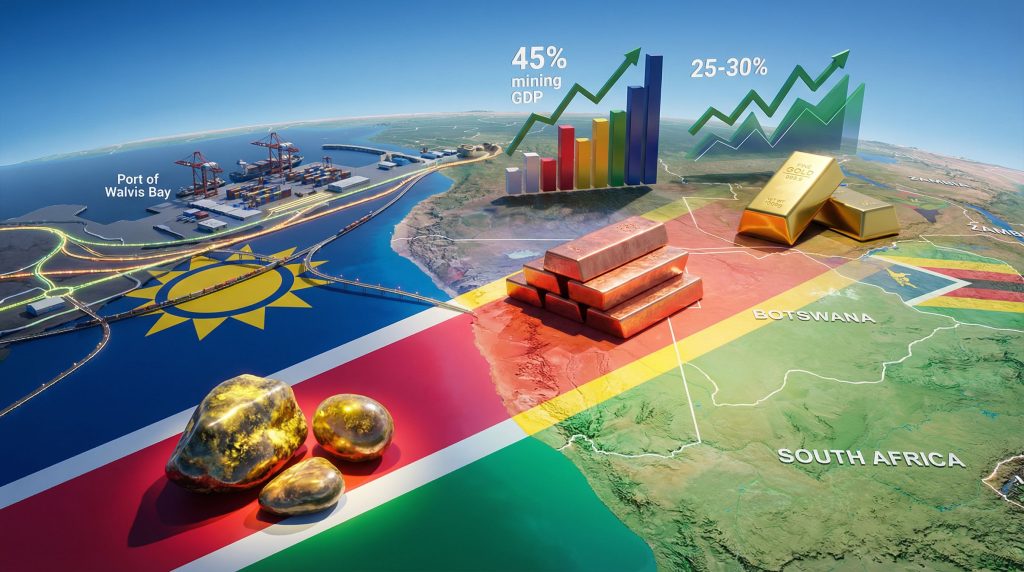
The global mining landscape experiences unprecedented transformation as traditional single-commodity economies reassess their strategic positioning amid evolving industrial demands. Namibia mining sector diversification into copper and gold exemplifies sophisticated risk management approaches that address commodity price volatility whilst capitalising on existing infrastructure investments. Furthermore, this strategic evolution demonstrates how nations can leverage established mining capabilities to access growth markets driven by electrification trends.
Modern portfolio theory applications at national scale reveal significant potential for reduced revenue volatility through multi-commodity approaches. However, successful implementation requires comprehensive evaluation of infrastructure leverage opportunities, regional competitive dynamics, and long-term demand scenarios that extend beyond traditional extraction models.
Strategic Portfolio Theory Applications in Resource-Dependent Economies
Risk Diversification Through Multi-Commodity Approaches
Namibia mining sector diversification into copper and gold represents sophisticated risk management principles applied at national scale. Modern portfolio theory suggests that combining assets with different correlation patterns reduces overall volatility whilst maintaining return potential. This economic framework translates effectively to mineral resource management, where uranium market volatility historically demonstrates limited correlation with copper and gold market movements.
The country's strategic positioning leverages existing infrastructure investments whilst expanding into growth sectors driven by electrification trends. This approach reduces exposure to single-commodity price shocks that have historically impacted uranium-dependent revenue streams. Economic modelling indicates that diversified mineral portfolios demonstrate 20-30% lower revenue volatility compared to single-commodity dependencies across similar timeframes.
Infrastructure Leverage and Capital Efficiency Models
Shared infrastructure utilisation creates significant capital allocation advantages for multi-commodity operations. Existing port facilities at Walvis Bay, originally developed for uranium exports, provide cost-effective expansion opportunities for copper and gold shipments. Energy networks and transportation corridors established during uranium development phases reduce greenfield capital requirements for additional mineral ventures.
This infrastructure leverage model demonstrates particular relevance given Paladin Resources' continued operational status at the Langer Heinrich mine. The facility's ongoing uranium production maintains critical infrastructure capacity that supports broader mining sector expansion initiatives. Consequently, active operations preserve logistics networks, skilled workforce availability, and regulatory frameworks that facilitate new project development.
| Infrastructure Component | Original Capacity | Multi-Commodity Potential | Capital Savings |
|---|---|---|---|
| Port handling facilities | Uranium concentrate | Copper/gold concentrates | 25-35% reduction |
| Power generation networks | Mining operations | Expanded processing | 20-30% savings |
| Transportation corridors | Single commodity | Multiple mineral types | 15-25% efficiency |
| Skilled workforce base | Uranium expertise | Transferable mining skills | 30-40% training reduction |
When big ASX news breaks, our subscribers know first
Regional Comparative Analysis of Diversification Strategies
SADC Mining Transformation Models
Regional mining diversification across Southern African Development Community nations reveals varying strategic approaches to commodity dependency reduction. Botswana's transition from diamond dependency involves coal and copper exploration, whilst Zambia focuses on cobalt beneficiation alongside traditional copper operations. These comparative models provide frameworks for evaluating Namibia mining sector diversification into copper and gold within regional competition dynamics.
Botswana's diversification timeline spans 2020-2025, targeting reduced diamond export dependency through coal project development and copper exploration initiatives. Success metrics focus on export revenue distribution across multiple commodity streams rather than single-mineral dominance. However, diamond market resilience during recent periods has moderated diversification urgency compared to initial projections.
Zambia's approach emphasises value-addition strategies through cobalt processing capabilities development. The country leverages existing copper mining infrastructure to support cobalt production, creating operational synergies similar to Namibia's multi-commodity strategy. Timeline implementation extends from 2018-2025, with processing facility development representing key milestones for achieving diversification objectives.
Competitive Positioning Within Regional Markets
Furthermore, competitive positioning within established regional frameworks requires sophisticated differentiation strategies. Namibia expands mining sector beyond uranium through processing capabilities, logistics advantages, and operational efficiency rather than volume-based competition approaches. South Africa maintains dominant gold production capabilities, whilst Zambian copper operations represent significant regional capacity.
The country's geographic positioning provides logistics advantages for Asian market access through established shipping routes. Port infrastructure at Walvis Bay offers competitive transit times compared to alternative regional facilities, creating cost advantages for export-oriented operations. These structural benefits support market penetration strategies for both copper and gold production.
Global Electrification Demand Scenarios and Supply Chain Positioning
Electric Vehicle Supply Chain Integration Opportunities
Copper demand projections for electric vehicle manufacturing create substantial market opportunities for new production capacity. Conservative growth models indicate 15% annual demand increases through 2030, driven by expanding EV adoption across major automotive markets. In addition, accelerated transition scenarios project 25% annual growth rates, supported by policy mandates and infrastructure investment programmes.
Technology breakthrough cases suggest potential 35% growth rates if battery innovation developments require increased copper intensity per vehicle. These scenarios reflect different assumptions about charging infrastructure deployment, grid modernisation requirements, and vehicle electrification penetration rates across geographic markets. Moreover, understanding copper-uranium investment dynamics provides insights into portfolio diversification strategies.
Each scenario creates different implications for Namibian copper project economics:
- Conservative scenarios support steady project development timelines with moderate price appreciation
- Accelerated adoption justifies premium project valuations and compressed development schedules
- Technology breakthrough cases create supply shortage conditions favouring higher-cost production sources
Critical Minerals Framework Implications
Copper's designation as a critical mineral across multiple jurisdictions enhances supply security considerations for importing nations. European Union critical materials frameworks, United States supply chain security initiatives, and Asian industrial policy directives create preference structures for diversified supply sources. Namibia's political stability and established mining sector governance provide competitive advantages within these policy frameworks.
Gold market dynamics offer counter-cyclical revenue potential during periods of economic uncertainty. Historical price correlations demonstrate gold prices as inflation hedge characteristics against currency volatility, inflation pressures, and geopolitical tensions. This portfolio insurance function supports overall mining sector stability during commodity market downturns.
Investment Framework Analysis and Capital Allocation Models
Foreign Direct Investment Attraction Mechanisms
Namibia's regulatory stability creates compelling investment propositions for international mining capital seeking African exposure. The country's established legal frameworks, transparent licensing procedures, and consistent policy implementation record reduce political risk premiums typically associated with emerging market mining ventures. These governance advantages translate into lower required returns for investor capital, improving project economics for marginal deposits.
Infrastructure advantages compound these regulatory benefits through reduced capital expenditure requirements. Existing power generation capacity, transportation networks, and port facilities eliminate significant upfront investment barriers that constrain greenfield projects in less developed regions. Consequently, this infrastructure availability accelerates project development timelines and improves return metrics for investor evaluation processes.
Due Diligence Frameworks for Multi-Commodity Exposure
Investment evaluation for Namibian mining opportunities requires assessment across multiple commodity markets simultaneously. Traditional single-commodity due diligence approaches must expand to encompass geological potential, infrastructure access, and market positioning evaluation across copper, gold, and uranium sectors. This multi-dimensional analysis creates complexity but also diversification benefits for portfolio construction strategies.
Geological evaluation requires expertise across different mineralisation styles and deposit types. Uranium roll-front deposits, epithermal gold systems, and sediment-hosted copper occurrences demand specialised technical assessment capabilities. For instance, mineral exploration insights provide valuable frameworks for assessing resource potential across diverse geological environments.
Capital Structure Optimisation for Diversified Operations
Multi-commodity projects enable sophisticated capital structure arrangements that leverage different revenue streams for financing optimisation. Copper cash flows support debt service capabilities during gold exploration phases, whilst uranium operations provide base revenue streams supporting expansion capital requirements. This revenue diversification improves debt capacity and reduces financing costs compared to single-commodity projects.
| Financing Component | Single Commodity | Multi-Commodity | Advantage |
|---|---|---|---|
| Debt capacity ratio | 60-70% of revenue | 70-80% of revenue | Higher leverage |
| Interest rate spreads | Base + 200-300bps | Base + 150-250bps | Lower cost |
| Repayment flexibility | Single revenue stream | Multiple streams | Reduced risk |
| Expansion financing | Additional equity required | Internal cash generation | Self-funding capacity |
Risk Scenario Modelling and Mitigation Strategies
Commodity Price Correlation Analysis
Diversification benefits depend critically on correlation patterns between uranium, copper, and gold prices. Historical analysis indicates limited correlation between uranium and precious metals markets, whilst copper-gold correlations vary significantly during different economic cycles. Understanding these relationships enables portfolio optimisation for risk-adjusted return maximisation.
Scenario modelling reveals potential correlation increases during synchronised global economic downturns. Financial crisis periods demonstrate higher correlation coefficients across commodity markets as demand contracts simultaneously. These correlation breakdowns reduce diversification benefits precisely when risk mitigation becomes most valuable, requiring additional risk management strategies.
Three primary risk scenarios require consideration:
- Synchronised commodity decline: All three metals experience simultaneous price weakness, reducing diversification benefits
- Infrastructure constraints: Limited port or power capacity restricts expansion pace below market demand growth
- Geopolitical disruption: Regional instability impacts operations across all commodity sectors simultaneously
Operational Risk Assessment Frameworks
Multi-commodity operations create operational complexity that requires sophisticated risk management frameworks. Different processing requirements, environmental compliance standards, and workforce skill sets across uranium, copper, and gold operations demand integrated management systems. This operational complexity increases administrative costs but provides revenue stability benefits. Furthermore, examining infrastructure optimisation case studies reveals best practices for managing complex operational requirements.
Environmental risk management becomes particularly complex when multiple mineral processing operations share infrastructure. Uranium operations require radiological safety protocols, copper processing generates acid mine drainage concerns, and gold extraction involves cyanide handling requirements. Integrated environmental management systems must address these diverse risk profiles simultaneously.
Water resource management represents a critical constraint across all three commodity types. Processing requirements vary significantly between uranium leaching, copper flotation, and gold cyanidation processes. However, integrated water management systems must optimise allocation across different operational requirements whilst maintaining environmental compliance standards.
Long-Term Economic Transformation and Value Creation
Employment Generation Through Processing Integration
Value-added processing operations create employment multiplier effects beyond primary extraction activities. Copper refining, gold processing, and uranium conversion facilities generate higher-skilled employment opportunities compared to raw ore extraction. These processing capabilities transform Namibia mining sector diversification into copper and gold from a commodity exporter to a regional manufacturing hub within specific mineral value chains.
Skills development initiatives support long-term industrial capacity building beyond the mining sector. Technical expertise developed through mineral processing operations transfers to broader manufacturing applications, creating foundation capabilities for economic diversification. This human capital development represents strategic national asset creation extending beyond immediate mining sector benefits.
Technology Transfer and Innovation Ecosystem Development
Multi-commodity operations facilitate knowledge transfer across mining disciplines, building domestic expertise through technology adoption and adaptation. International partnerships required for complex processing operations introduce advanced technologies and management systems that enhance overall industrial capability. Moreover, global interest in Namibian copper demonstrates increasing investor confidence in the country's technological capabilities.
Research and development initiatives focused on processing optimisation, environmental management, and operational efficiency generate intellectual property assets with commercial value beyond immediate mining applications. University partnerships and training programmes develop local expertise capable of supporting regional mining sector development across Southern Africa.
The next major ASX story will hit our subscribers first
Strategic Investment Considerations for Portfolio Construction
Geographic Diversification Within African Mining Exposure
Namibian mining investments provide geographic diversification within African portfolio allocations whilst maintaining exposure to multiple commodity sectors through single-country allocation strategies. This concentration approach reduces political risk management complexity compared to multi-country African mining portfolios whilst preserving commodity diversification benefits.
The country's established infrastructure and governance frameworks reduce execution risk compared to frontier mining jurisdictions. Investor evaluation processes benefit from transparent regulatory environments, established legal precedents, and operational track records that facilitate due diligence completion. These risk reduction factors support higher allocation percentages within emerging market mining portfolios.
Portfolio Insurance Through Precious Metals Allocation
Gold exposure within diversified Namibian mining portfolios provides portfolio insurance characteristics during periods of macroeconomic uncertainty. Historical performance analysis demonstrates gold's counter-cyclical properties during currency devaluation, inflation acceleration, and geopolitical tension periods. This insurance function justifies allocation percentages beyond pure return optimisation calculations.
Strategic metal classification for copper enhances portfolio resilience through supply security premiums during geopolitical tensions. Critical mineral frameworks across major importing nations create preference structures for politically stable supply sources. These policy-driven demand premiums provide downside protection during commodity market weakness.
Investment Disclaimer: The analysis presented examines general market trends, economic scenarios, and strategic frameworks related to Namibian mining sector developments. All financial projections, market scenarios, and investment considerations represent analytical frameworks rather than specific recommendations. Potential investors should conduct comprehensive due diligence, including geological assessment, financial analysis, and risk evaluation appropriate to their investment objectives and risk tolerance. Commodity markets demonstrate significant volatility, and mining investments involve substantial risks including operational, environmental, regulatory, and market-related factors that could result in partial or total loss of invested capital.
Ready to Position Yourself in Namibia's Mining Diversification Story?
Discovery Alert instantly identifies significant ASX mineral discoveries across copper, gold, and uranium sectors using its proprietary Discovery IQ model, empowering investors to capitalise on emerging opportunities before broader market recognition. Explore how major mineral discoveries generate substantial returns through historic examples and begin your 14-day free trial today to gain a market-leading advantage.