June 5, 2026
Namibia's uranium sector stands at a critical juncture where technical excellence must align with market dynamics to achieve development success. The intersection of engineering capabilities, financial modelling, and strategic timing creates complex decision frameworks that distinguish successful mining ventures from premature capital deployments. Furthermore, uranium market volatility and sophisticated uranium investment strategies provide insights into how advanced uranium projects navigate the path from technical readiness to commercial production.
Engineering Excellence: Foundation for Uranium Production Infrastructure
The Tumas Uranium Project development represents a sophisticated integration of engineering disciplines, resource validation, and infrastructure design that demonstrates advanced technical preparation. With 65% completion of detailed engineering work as of March 2026, the project has progressed beyond conceptual phases into executable construction documentation. This completion level indicates that critical design specifications, equipment selections, and construction methodologies have been formally established and validated.
Resource Base Validation and Mining Design Parameters
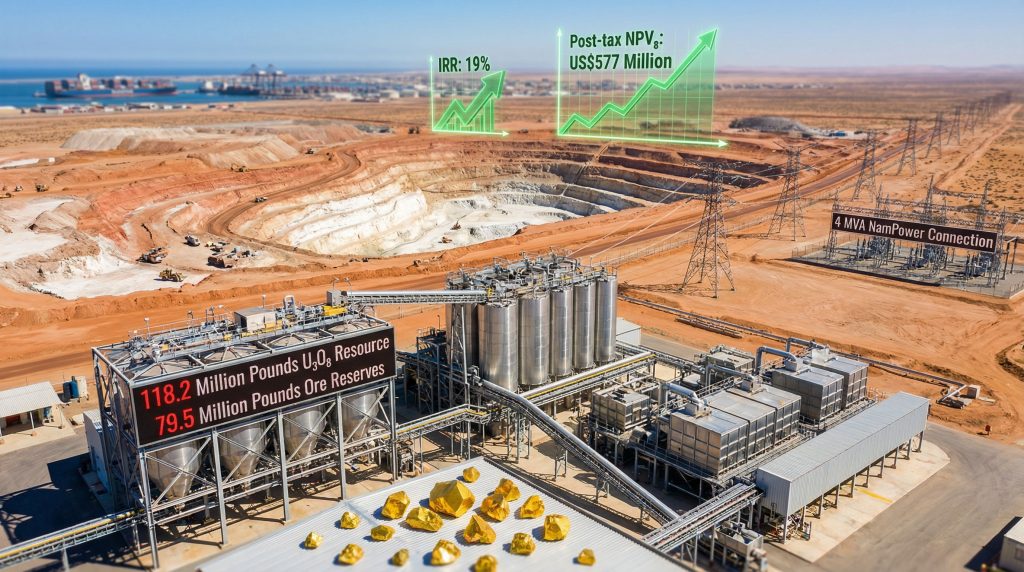
The project's resource classification reveals substantial uranium reserves with 118.2 million pounds U₃O₈ in total resources and 79.5 million pounds in ore reserves. These figures represent the culmination of extensive geological investigation, ore body modelling, and resource classification according to international reporting standards. The distinction between resources and reserves reflects geological confidence levels and economic extraction viability under current technical and financial assumptions.
Key Resource Metrics:
- Total uranium resource: 118.2 million pounds U₃O₈
- Ore reserves: 79.5 million pounds U₃O₈
- Reserve-to-resource ratio: 67% (indicating high geological confidence)
- Theoretical mine life: 22+ years at 3.6 million pound annual production
The multi-decade operational design parameters establish the project as a long-term uranium supplier rather than a short-cycle extraction operation. This longevity provides operational stability and justifies substantial infrastructure investments that can be amortised across extended production periods.
Infrastructure Integration and Power Supply Architecture
Critical infrastructure development has progressed to formal agreement stages, with Deep Yellow executing a Transmission Power Supply Agreement with NamPower for dedicated grid connectivity. The 22 km, 220 kV transmission line with 4 MVA capacity represents purpose-built infrastructure designed specifically for mining operations rather than reliance on existing grid capacity.
This infrastructure approach offers several operational advantages:
- Power supply security: Dedicated transmission reduces dependency on shared grid infrastructure
- Capacity optimisation: 4 MVA capacity aligns with process plant electrical requirements
- Operational flexibility: Direct utility relationship enables load management and maintenance scheduling
The strategic positioning relative to Namibia's port infrastructure at Walvis Bay provides export logistics advantages for uranium concentrate transport to international markets. This geographic positioning reduces transportation costs and enables efficient integration with global uranium supply chains.
When big ASX news breaks, our subscribers know first
Financial Framework: Economic Modelling and Investment Returns
The Tumas Uranium Project development's financial architecture demonstrates sophisticated capital allocation planning with detailed cost modelling and sensitivity analysis. Initial capital expenditure requirements of US$474 million establish the project within the mid-tier range for uranium development ventures globally, while operational cost projections position the project competitively within global production cost curves.
Capital Efficiency and Production Capacity Metrics
The relationship between capital investment and production capacity provides critical benchmarking data for industry comparison. At US$474 million initial capex for 3.6 million pounds annual production, the project exhibits capital intensity of approximately US$131.67 per pound of annual production capacity.
| Economic Parameter | Value | Industry Context |
|---|---|---|
| Initial Capex | US$474 million | Mid-tier uranium project |
| Annual Production | 3.6 million lbs U₃O₈ | Significant regional producer |
| Capital Intensity | US$131.67/lb capacity | Competitive range (US$100-200/lb) |
| All-In Sustaining Costs | US$45/lb | Lower mid-cost tier |
Return Profile Analysis and Risk Assessment
Financial modelling at a long-term contract price of US$82.50 per pound generates compelling return metrics with a post-tax NPV₈ of US$577 million and an internal rate of return of 19%. These returns exceed typical mining project thresholds and provide margin above cost of capital assumptions embedded in the 8% discount rate.
Return Calculation Framework:
- Gross annual revenue (at US$82.50/lb): US$296.7 million
- Operating costs (at US$45/lb AISC): US$162 million
- Annual operating profit (pre-tax): US$134.7 million
- Estimated payback period: 3.5 years (simplified, pre-tax)
The all-in sustaining cost of US$45 per pound positions Tumas within the global cost curve's lower-middle tier, providing operational flexibility across various price scenarios. This cost structure creates substantial margin above long-term uranium price floors whilst maintaining competitiveness against established producers.
Balance Sheet Strength and Financing Flexibility
Deep Yellow's financial position with A$187 million cash and approximately A$2.5 billion market capitalisation provides multiple financing pathways for project development. This balance sheet strength enables selective capital deployment without immediate equity dilution pressure, supporting disciplined decision-making regarding Final Investment Decision timing.
The substantial positive NPV profile and robust cost structure suggest the project could support project-level debt financing. Typical mining project finance structures accommodate debt-to-equity ratios of 60:40 to 70:30, indicating potential debt capacity of US$200-250 million, which would reduce equity requirements and enhance shareholder returns.
Strategic Decision Framework: Price Sensitivity and Market Timing
The distinction between technical readiness and economic justification represents a sophisticated capital allocation philosophy that prioritises sustainable returns over rapid deployment. Deep Yellow's approach of deferring Final Investment Decision pending long-term contract certainty reflects industry best practices in commodity-exposed sectors where revenue predictability drives development timing. Additionally, understanding US uranium market challenges provides crucial context for strategic planning.
Contract Security vs. Spot Price Volatility
The uranium market's structural characteristics create significant distinctions between spot price strength and sustainable demand signals. Spot prices reflect immediate supply-demand imbalances, whilst long-term contracts indicate utilities' forward planning and fuel supply requirements. The emphasis on contract-backed pricing provides revenue certainty that justifies substantial capital deployment.
Market Dynamics Considerations:
- Spot price volatility creates execution risk for development projects
- Long-term contracts provide predictable cash flow forecasting
- Contract pricing typically includes escalation mechanisms
- Utility procurement cycles operate on 3-5 year planning horizons
Operational Readiness Validation
Technical preparation continues advancing across multiple workstreams, with major process plant equipment contracts tendered or awarded and bulk earthworks in progress. This procurement timing indicates equipment delivery schedules have been established, with typical lead times for mining process equipment ranging 12-18 months from order to delivery.
Water supply infrastructure planning represents a critical dependency for uranium processing operations in Namibia's semi-arid environment. Detailed planning phases suggest hydrogeological investigations have been completed, with infrastructure design and construction sequencing under development.
How Does Namibian Uranium Positioning Compare Globally?
Namibia's established position as a significant global uranium producer provides infrastructure, regulatory, and operational advantages for new project development. The country's existing mining framework, skilled workforce availability, and export logistics infrastructure reduce development risks compared to frontier uranium jurisdictions.
Production Capacity and Market Share Analysis
The Tumas Uranium Project development's 3.6 million pounds annual production target positions it as a substantial addition to Namibian uranium output. This production level represents meaningful incremental supply within regional context whilst maintaining manageable scale for operational management and market integration.
Strategic Location Benefits:
- Proximity to established mining infrastructure reduces development costs
- Access to experienced mining workforce and service providers
- Transportation advantages through Walvis Bay port infrastructure
- Regulatory framework familiarity and permitting precedents
Technical Advantages in Paleochannel Deposits
The Tumas deposit's paleochannel/calcrete characteristics offer processing advantages compared to hard rock uranium deposits. These geological formations typically enable:
- Lower energy requirements for ore preparation
- Simplified metallurgical processing flowsheets
- Reduced environmental footprint through surface extraction methods
- Enhanced water recovery and recycling opportunities
These technical characteristics contribute to the project's competitive all-in sustaining cost positioning and operational flexibility across various market conditions.
Risk Assessment Framework: Technical and Market Dependencies
Uranium project development involves multiple risk categories that require comprehensive assessment and mitigation strategies. The Tumas Uranium Project development's risk profile encompasses geological, technical, market, and regulatory factors that influence development success and operational performance.
Market Price Sensitivity and Demand Projections
Uranium price volatility represents the primary commercial risk for development-stage projects. Historical price ranges from US$20-140 per pound over the past two decades demonstrate the commodity's susceptibility to supply disruptions, policy changes, and demand fluctuations. In addition, uranium production trends and the role of ISR in uranium production provide fundamental support, but timing and pricing remain subject to geopolitical and policy influences.
Price Sensitivity Considerations:
- Break-even price analysis below US$45/lb AISC threshold
- Contract price escalation mechanisms and indexation
- Currency exposure management (AUD/USD operational dynamics)
- Long-term nuclear fuel demand growth scenarios
Operational and Technical Risk Mitigation
Geological uncertainty in resource extraction represents inherent mining risk despite extensive exploration and resource validation. Processing plant performance optimisation, water availability, and environmental compliance require ongoing operational attention and contingency planning.
The project's technical risk profile benefits from proven technologies, established metallurgical processes, and environmental management systems aligned with international standards. Regulatory compliance frameworks in Namibia provide clear operational guidelines and permitting precedents.
Global Uranium Supply Impact and Energy Transition Role
The Tumas project's contribution to global uranium supply occurs within the context of nuclear energy renaissance and clean energy transition acceleration. Understanding this broader context illuminates the project's strategic importance beyond immediate financial returns.
Production Timeline and Supply Chain Integration
The project's development timeline and ramp-up schedule will influence global uranium supply dynamics during a period of increasing nuclear fuel demand. Integration with global supply chains requires coordination with conversion, enrichment, and fuel fabrication facilities that serve nuclear utility customers worldwide.
Supply Chain Considerations:
- Uranium concentrate specification and quality parameters
- Conversion facility capacity and scheduling requirements
- Transportation and logistics coordination for export markets
- Long-term supply agreement structures and pricing mechanisms
What Role Does Energy Security Play in Strategic Planning?
Nuclear power's role in clean energy transition creates strategic value for uranium supply security among energy-importing nations. The Tumas project's geographic location in a politically stable jurisdiction enhances its value proposition for utilities seeking supply diversification and security of fuel supply.
This strategic positioning supports premium pricing potential for long-term supply agreements whilst contributing to global energy transition objectives through reliable, low-carbon nuclear fuel supply.
The next major ASX story will hit our subscribers first
Investment Evaluation: Valuation Metrics and Shareholder Considerations
The Tumas project's investment characteristics combine resource longevity, competitive cost structure, and strategic market positioning to create compelling value propositions for equity investors. Understanding these investment drivers provides framework for evaluating the project's contribution to shareholder value creation.
Shareholder Value Creation Mechanisms
Net present value sensitivity to uranium price scenarios demonstrates the project's leverage to commodity price improvements whilst maintaining positive economics at conservative price assumptions. The 19% internal rate of return at base case pricing provides substantial margin above equity cost of capital expectations for mining investments.
Valuation Framework Considerations:
- NPV sensitivity across US$60-100/lb uranium price scenarios
- Dividend policy implications during production phase
- Share price catalysts through development milestones
- Peer comparison metrics within uranium sector
ESG Framework and Sustainability Integration
Environmental, social, and governance considerations increasingly influence investment decisions in the mining sector. The Tumas Uranium Project development incorporates environmental management systems, community benefit sharing arrangements, and corporate governance standards aligned with international best practices.
ESG Integration Elements:
- Environmental impact mitigation and monitoring systems
- Local community engagement and economic participation
- Safety management systems and operational protocols
- Corporate governance transparency and stakeholder communication
Peer Comparison and Competitive Positioning
Comparative analysis within the uranium development sector provides context for the Tumas project's investment attractiveness. Key comparison metrics include capital intensity per pound of production, resource quality indicators, infrastructure advantages, and cost structure competitiveness.
| Comparison Metric | Tumas Project | Industry Range |
|---|---|---|
| Capital Intensity | US$131.67/lb capacity | US$100-200/lb capacity |
| Resource Grade | Calcrete/paleochannel | Varies by deposit type |
| Infrastructure Access | Established (Namibia) | Variable by jurisdiction |
| Political Risk | Low (stable jurisdiction) | Variable globally |
The project's positioning within established ranges for development-stage uranium projects, combined with advantageous infrastructure access and political stability, supports competitive investment returns whilst managing development and operational risks.
Disclaimer: This analysis contains forward-looking statements and projections based on current information and assumptions. Actual results may vary significantly due to market conditions, operational performance, regulatory changes, and other factors beyond company control. Investors should conduct independent due diligence and consult financial advisors before making investment decisions. Uranium prices and mining operations involve substantial risks including commodity price volatility, operational challenges, environmental compliance requirements, and regulatory changes.
Ready to Capitalise on the Next Major Uranium Discovery?
Discovery Alert's proprietary Discovery IQ model delivers real-time alerts on significant ASX uranium and mineral discoveries, instantly empowering subscribers to identify actionable opportunities ahead of the broader market. Understand why historic discoveries can generate substantial returns by exploring proven examples of exceptional outcomes, then begin your 14-day free trial today to position yourself ahead of the market.