
August 6, 2026
How Nanotechnology Innovations Are Transforming Catalyst Efficiency Economics
The engineering economics of green hydrogen production face fundamental constraints rooted in electrochemical performance requirements and material availability. Recent breakthrough developments in nanoscale catalyst design demonstrate how precision engineering at the molecular level can reshape the entire economic foundation of electrolysis technology, particularly in lowering green hydrogen's iridium barrier.
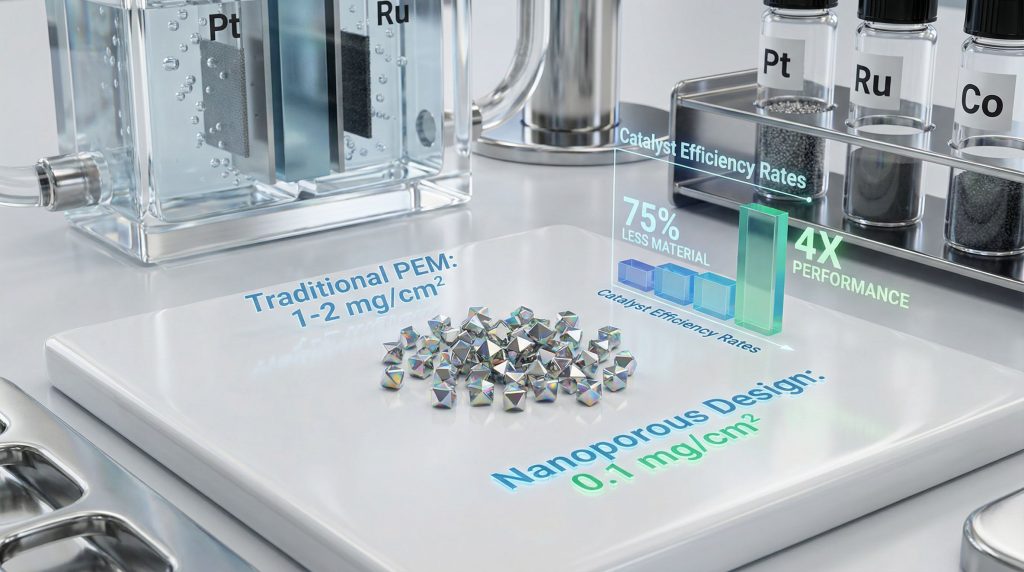
Traditional proton exchange membrane (PEM) electrolysers require substantial iridium loadings between 1-2 mg/cm² to achieve baseline performance standards. These systems typically operate at 2.0 A/cm² current density with cell voltages around 1.8V, delivering durability ratings of 5,000-8,000 operational hours. The material cost implications are severe: a single gigawatt electrolyser system demands approximately 350 kilograms of iridium, translating to over $52 million in catalyst materials alone at current market pricing of $150-160 per gram.
Nanoscale engineering solutions developed through continuous-flow synthesis processes now enable industrial-scale production of precisely defined catalyst nanoparticles. This technological advancement increases reaction-active surface area per gram of iridium whilst maintaining the electrochemical stability requirements necessary for acidic PEM environments. Furthermore, the breakthrough achieves 4:1 performance-to-material ratios, meaning nanoscale catalysts containing only 7 milligrams of iridium across 25 square centimetres deliver equivalent performance to traditional systems using four times the material quantity.
Surface area optimisation through nanotechnology represents a departure from linear performance improvements, instead delivering exponential efficiency gains. Nanoparticles with typical diameters of 2-10 nanometres exhibit surface areas reaching 50-200 m²/g compared to 1-5 m²/g for conventionally-sized catalysts. This dramatic increase in surface area per gram directly correlates with enhanced electrochemical activity, enabling lower material loadings without performance degradation.
Manufacturing process innovations centre on continuous-flow synthesis methodologies that contrast sharply with traditional batch production approaches. Continuous-flow systems enable precise control of particle nucleation and growth through flowing precursor solutions in microreactor channels or packed beds. Consequently, this precision manufacturing eliminates the broad size distribution ranges typical in batch synthesis, resulting in consistent nanoparticle specifications suitable for commercial deployment.
When big ASX news breaks, our subscribers know first
The Irreplaceable Role of Iridium in Electrochemical Water Splitting
Iridium's unique position in electrolyser technology stems from dual properties that remain unmatched amongst available catalyst materials: exceptional durability and electrochemical effectiveness in highly acidic environments. PEM electrolysers operate in proton exchange membrane conditions with pH levels typically below 2, creating severely corrosive environments that eliminate most transition metal alternatives.
The acidic environment requirements present fundamental chemistry constraints that limit catalyst material options. Operating potentials between 1.5-2.5 volts combined with acidic electrolyte conditions cause most metals to undergo corrosion or phase transitions that destroy catalytic activity. However, iridium's corrosion resistance under these extreme conditions represents its primary technical advantage, distinguishing it from alternatives that may demonstrate adequate performance in neutral or basic electrolytes but fail in acidic PEM systems.
Electrochemical performance benchmarks establish minimum thresholds that alternative catalysts must achieve for viable substitution. The voltage efficiency metric of approximately 1.8V for water splitting represents near-theoretical minimum requirements for electrochemical water splitting, leaving limited margin for performance improvement through alternative materials. Current density requirements of 2.0 A/cm² or higher ensure adequate hydrogen production rates for industrial applications, whilst durability ratings of 5,000-8,000 hours represent minimum operational lifespans for economic viability.
Chemical stability requirements in PEM systems create additional constraints beyond simple corrosion resistance. Catalysts must maintain structural integrity and electrochemical activity throughout thousands of operational cycles involving oxidation and reduction reactions. In addition, the combination of chemical stability, electrochemical activity, and durability requirements creates a narrow performance envelope that iridium uniquely fills amongst currently available materials.
Research into alternative catalyst systems has explored ruthenium, platinum, and cobalt-based materials, yet none demonstrate equivalent performance across all critical parameters simultaneously. Ruthenium exhibits adequate electrochemical activity but suffers from stability limitations in acidic conditions. Platinum provides excellent electrochemical properties but lacks the specific activity for oxygen evolution reactions required in PEM electrolysis. For instance, cobalt-based catalysts show promise in laboratory conditions but struggle with durability requirements in industrial applications.
Understanding the Global Supply Chain Bottleneck for Green Hydrogen
The mathematics of iridium supply constraints reveal structural limitations that transcend temporary market dynamics or pricing mechanisms. Global annual production of approximately 7,000 kilograms creates an absolute ceiling on electrolyser manufacturing capacity independent of demand or investment levels. With 350 kg required per gigawatt of electrolyser capacity, current production theoretically enables only 20 GW of annual electrolyser manufacturing, assuming zero allocation to other industrial applications including automotive catalytic converters, crucibles, and chemical processing electrodes.
Geographic concentration risks compound supply constraints through dependency on single-nation production sources. South African mining operations represent the primary global iridium supply source, creating vulnerability to political disruption, labour disputes, regulatory changes, or mining operation incidents. Furthermore, this concentration differs from more distributed commodity metals where multiple production regions provide supply security through geographic diversification, highlighting the challenges within the global mining landscape.
Price volatility impacts extend beyond simple cost fluctuations to affect fundamental project financing decisions. Each $10 per gram price movement represents $3.5 million in catalyst cost variation per gigawatt of capacity, sufficient to alter project financial viability assessments. The current price range of $150-160 per gram means catalyst materials alone account for a substantial percentage of total electrolyser capital costs, demonstrating how commodity prices impact project financing decisions.
Market dynamics in iridium trading reflect the unique characteristics of a metal with extremely limited supply and highly concentrated demand from specific industrial applications. Unlike metals with diverse end-use markets that provide demand stability, iridium faces potential demand shocks from rapid electrolyser deployment that could drive prices to levels that make green hydrogen economically unviable relative to alternative energy storage and industrial process technologies.
Supply chain vulnerability extends beyond current production limitations to encompass the long lead times required for mining capacity expansion. Iridium extraction occurs as a byproduct of platinum group metal mining operations, meaning production increases require substantial capital investments in primary mining infrastructure with development timelines extending 5-10 years from initial investment to production increases.
Revolutionary Catalyst Technologies Reducing Material Dependencies
Nanotechnology approaches to lowering green hydrogen's iridium barrier focus on maximising surface area utilisation rather than pursuing complete material substitution. The breakthrough advanced catalyst synthesis method enables industrial-scale production of high-quality, precisely defined catalyst nanoparticles with dramatically reduced material requirements whilst maintaining or improving electrochemical performance.
The core technological achievement demonstrates that 7 milligrams of iridium distributed across 25 square centimetres achieves performance equivalent to conventional catalyst layers using 28 milligrams of material. This 4:1 efficiency ratio represents a paradigm shift from bulk catalyst approaches toward precision nanoscale engineering that optimises every atom of precious metal for maximum catalytic activity.
Manufacturing scalability represents a critical distinction between laboratory demonstrations and commercial viability. The patented continuous-flow synthesis methodology addresses traditional limitations of nanoparticle production, including batch-to-batch variation, scalability constraints, and quality control challenges. Consequently, continuous-flow systems enable consistent particle size distributions, precise surface area specifications, and manufacturing volumes suitable for industrial electrolyser production.
Surface area maximisation techniques through nanotechnology achieve unprecedented levels of material utilisation efficiency. Traditional bulk catalysts expose only surface atoms to electrochemical reactions, whilst nanostructured catalysts maximise the percentage of atoms participating in catalytic activity. However, this approach transforms the fundamental economics of precious metal utilisation, enabling higher performance with substantially lower material costs.
Alternative catalyst development pathways pursue complementary strategies for reducing iridium dependency through multi-metal oxide systems and earth-abundant material combinations. Ruthenium-cobalt-manganese combinations show promise for specific operating conditions, whilst cobalt phosphide systems demonstrate improved stability characteristics compared to single-metal alternatives. Nevertheless, these approaches typically require trade-offs in performance, durability, or operating condition flexibility compared to optimised iridium systems.
Research methodologies employing high-throughput screening approaches enable systematic evaluation of catalyst combinations across broad composition ranges. Megalibrary testing systems can evaluate thousands of catalyst formulations simultaneously, accelerating the discovery of materials with suitable performance characteristics for PEM electrolyser applications. Furthermore, these systematic approaches complement nanotechnology optimisation of existing materials with exploration of entirely new catalyst chemistries.
Comparative Performance Analysis of Advanced Catalyst Systems
| Catalyst Technology | Iridium Loading (mg/cm²) | Current Density (A/cm²) | Voltage Efficiency (V) | Durability (Hours) | Material Cost Reduction |
|---|---|---|---|---|---|
| Traditional PEM | 1-2 | 2.0 | 1.8 | 5,000-8,000 | Baseline |
| Nanoporous Design | 0.1 | 3.0 | 1.74 | 8,000+ | 75-90% |
| Carbon-Supported | 0.05 | 3.18 | 1.9 | Testing Phase | 95%+ |
| Multi-Metal Oxide | 0.2 | 2.5 | 1.85 | 3,000+ | 60-80% |
| Iridium-Free Systems | 0 | Variable | 1.9+ | 1,500+ | 100% |
Performance benchmarking reveals that nanoporous catalyst designs achieve superior current density ratings of 3.0 A/cm² compared to traditional systems operating at 2.0 A/cm². This 50% improvement in current density directly translates to higher hydrogen production rates per unit of electrolyser area, improving overall system economics beyond material cost reductions alone.
Voltage efficiency improvements demonstrate that nanotechnology optimisation can simultaneously reduce material costs and enhance electrochemical performance. Nanoporous designs achieve 1.74V cell voltage compared to 1.8V for traditional systems, representing meaningful energy efficiency gains that compound with material cost savings to improve overall system economics.
Durability testing results indicate that properly engineered nanoscale catalysts exceed traditional system lifespans, achieving over 8,000 operational hours compared to 5,000-8,000 hours for conventional designs. Extended operational lifespans reduce replacement costs and improve long-term system reliability, critical factors for industrial hydrogen production applications requiring continuous operation.
Carbon-supported catalyst systems demonstrate the most aggressive material reduction achievements, utilising only 0.05 mg/cm² of iridium whilst achieving current densities of 3.18 A/cm². However, these systems remain in testing phases with durability characteristics still under evaluation, representing promising but not yet commercially validated technology.
Manufacturing process advantages of advanced catalyst systems include simplified production workflows and enhanced quality control capabilities. Dry production methods eliminate wet chemistry complications that introduce variability in traditional catalyst manufacturing. In addition, continuous-flow synthesis enables real-time quality monitoring and adjustment, ensuring consistent specifications across production runs.
Economic Transformation Through Catalyst Innovation
Material cost reduction pathways through nanotechnology optimisation create multiple layers of economic benefit extending beyond simple catalyst cost savings. The primary savings of 75-95% reduction in iridium requirements translate to $40-50 million in material cost reduction per gigawatt of electrolyser capacity, representing a substantial decrease in total system capital expenditure.
Manufacturing efficiency gains emerge from simplified production processes enabled by continuous-flow synthesis methodologies. These streamlined manufacturing approaches reduce production complexity, decrease quality control requirements, and enable higher production throughputs compared to traditional batch synthesis methods. Consequently, simplified manufacturing translates to reduced labour costs, shorter production timelines, and improved manufacturing yield rates.
Recycling optimisation opportunities expand significantly with nanoscale catalyst designs that concentrate precious metals in more easily recoverable forms. Enhanced precious metal recovery rates from spent catalysts can approach 90-95% efficiency compared to 70-80% recovery rates from traditional bulk catalysts. Therefore, higher recovery rates reduce long-term material costs and improve supply chain sustainability for large-scale hydrogen production.
Investment threshold analysis reveals that catalyst cost reductions create cascading economic benefits throughout hydrogen production systems. Lower catalyst costs enable more aggressive electrolyser pricing, which improves green hydrogen cost competitiveness relative to conventional hydrogen production methods. This competitive positioning accelerates market adoption timelines and creates larger market opportunities for technology providers, particularly as part of the broader critical minerals energy transition.
Commercial deployment scenarios require careful consideration of technology maturation timelines and industrial validation requirements. Pilot project implementations expected in 2026-2027 will provide critical real-world performance data necessary for full commercial adoption. Industrial partners require demonstrated reliability and performance consistency before committing to large-scale production line modifications.
Market penetration barriers include technology transfer challenges from research institutions to commercial production environments. Scaling from laboratory demonstrations to industrial manufacturing requires substantial capital investments in specialised production equipment and skilled workforce development. Additionally, existing electrolyser manufacturing facilities require significant modifications to implement continuous-flow synthesis capabilities, reflecting broader challenges in mining industry innovation.
The next major ASX story will hit our subscribers first
Future Impact on Global Hydrogen Production Capacity
Production capacity projections based on nanotechnology catalyst adoption suggest potential for 4x multiplication of global hydrogen output using existing iridium reserves. This capacity expansion could theoretically enable 80 GW of annual electrolyser manufacturing instead of the current 20 GW ceiling, assuming widespread adoption of material-efficient catalyst technologies across the industry.
Regional deployment strategies must align electrolyser manufacturing capacity with renewable energy availability and industrial demand patterns. Areas with abundant renewable energy resources but limited existing industrial infrastructure may become preferred locations for large-scale hydrogen production facilities utilising advanced catalyst technologies. Furthermore, this geographic rebalancing could reshape global energy trade patterns and industrial location decisions.
Industrial Application Priorities
Industrial application priorities will likely focus on sectors with the highest carbon reduction potential and economic value creation opportunities. Steel production, cement manufacturing, and chemical processing represent primary targets for hydrogen adoption, each requiring different hydrogen purity levels and delivery infrastructure. However, advanced catalyst technologies enable more flexible hydrogen production systems that can serve multiple industrial applications simultaneously.
The development of European critical raw materials strategies will likely influence regional priorities for hydrogen production infrastructure deployment. European initiatives to secure critical mineral supply chains create opportunities for integrated approaches combining domestic hydrogen production with strategic materials processing.
Technology maturation roadmaps indicate that durability testing represents the most critical validation requirement for widespread commercial adoption. Long-term catalyst stability under industrial operating conditions requires demonstration periods of 10,000+ hours to provide confidence for commercial deployment. Accelerated aging tests and predictive modelling approaches can reduce validation timelines but require careful correlation with real-world operating conditions.
Supply chain development for advanced catalyst technologies requires coordination between research institutions, catalyst manufacturers, and electrolyser system integrators. Manufacturing infrastructure scaling must anticipate future demand growth whilst avoiding overcapacity investments that could undermine economic viability. Strategic partnerships between technology developers and industrial manufacturers will likely determine successful commercialisation timelines.
Technical Validation and Market Adoption Challenges
Industrial condition testing presents significant challenges for validating laboratory-demonstrated catalyst performance in real-world operating environments. Electrolyser systems experience varying load conditions, temperature fluctuations, and electrolyte contamination that may not be fully replicated in controlled laboratory settings. Therefore, comprehensive field testing requires extended operational periods to validate durability claims and identify potential failure modes.
Performance standardisation across the electrolyser industry requires development of consistent testing protocols and certification processes. Industry benchmarking standards must account for different operating conditions, system designs, and application requirements whilst providing reliable performance comparisons between catalyst technologies. Consequently, standardisation efforts require coordination between equipment manufacturers, technology developers, and end-users.
Integration compatibility between advanced catalysts and existing electrolyser systems creates potential barriers for technology adoption. Retrofitting existing systems with new catalyst technologies may require modifications to operating procedures, control systems, or mechanical components. New catalyst technologies must demonstrate compatibility with established electrolyser designs to minimise adoption barriers for existing facility operators.
Understanding Degradation Mechanisms
Degradation rate analysis under operational stress conditions requires comprehensive understanding of failure mechanisms specific to nanoscale catalysts. Traditional bulk catalysts exhibit well-characterised degradation patterns, whilst nanoscale systems may experience different failure modes related to particle sintering, support material degradation, or surface contamination. Therefore, predictive models for catalyst lifetime must account for these nanoscale-specific degradation mechanisms.
Capital investment cycles in the electrolyser industry typically span 10-15 years, creating natural resistance to frequent technology changes. Industrial operators require confidence in technology maturity and long-term supplier support before committing to new catalyst systems. Technology adoption timelines must align with natural equipment replacement cycles to minimise economic disruption for existing operations.
Regulatory approval processes for new catalyst technologies involve safety assessments, environmental impact evaluations, and performance certifications. These approval timelines can extend 2-3 years beyond technical readiness, particularly for applications in regulated industries such as transportation fuel production or industrial chemical processing. Early engagement with regulatory agencies can help streamline approval processes for breakthrough technologies.
The transformation of green hydrogen economics through advanced catalyst technologies represents a critical enabling technology for the broader clean energy transition. By addressing the fundamental materials bottleneck that has constrained hydrogen production scaling, nanotechnology innovations create pathways for achieving cost-competitive green hydrogen production at industrial scales. Success in commercialising these breakthrough technologies will determine whether hydrogen can fulfil its potential as a cornerstone of global decarbonisation efforts.
Ready to Capitalise on Green Hydrogen's Breakthrough Moment?
As nanotechnology transforms catalyst efficiency and reshapes hydrogen production economics, investors face unprecedented opportunities in companies developing these revolutionary technologies. Discovery Alert's proprietary Discovery IQ model delivers real-time notifications on significant ASX mineral discoveries, including critical materials essential for green hydrogen infrastructure, instantly empowering subscribers to identify actionable investment opportunities ahead of the broader market.