May 21, 2026
Understanding National Security Threat Classifications in U.S. Policy
The architecture of American foreign policy relies on sophisticated legal frameworks that enable the executive branch to respond to evolving geopolitical challenges. National security threat designations represent one of the most potent regulatory tools available to U.S. policymakers, creating pathways for comprehensive sanctions regimes that extend far beyond traditional diplomatic measures.
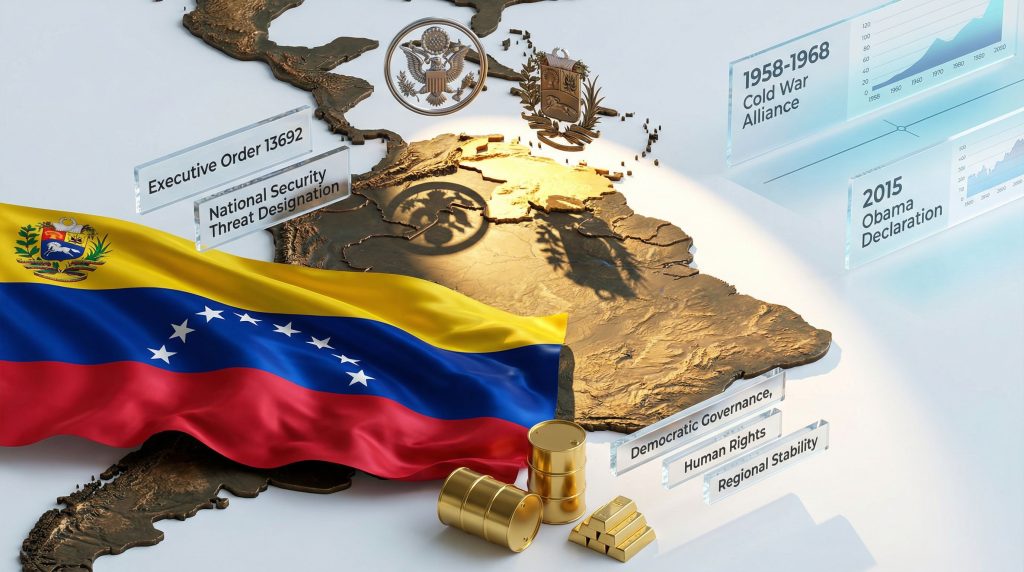
Under the International Emergency Economic Powers Act and National Emergencies Act, Executive Order 13692 established the legal foundation for classifying foreign nations as threats to U.S. national security interests. This dual legal authority enables the Treasury Department to implement sectoral sanctions targeting entire economic sectors, individual asset freezes, and comprehensive trade restrictions that effectively isolate designated countries from the global financial system.
Furthermore, these regulatory frameworks intersect with broader policy initiatives, including the executive order on critical minerals that affects strategic resource access across multiple sectors.
The 2015 Regulatory Framework Implementation
The Obama administration's 2015 declaration targeting Venezuela as a Venezuela national security threat established specific regulatory triggers that transformed bilateral relations. This designation required documented evidence of systematic violations across multiple categories: democratic governance failures, human rights abuses, regional destabilisation activities, and state-sponsored criminal enterprises.
Unlike standard economic sanctions that target specific individuals or entities, national security threat classifications enable comprehensive policy responses. The Venezuelan designation permitted the U.S. government to restrict financial transactions, freeze assets, prohibit investment in key sectors, and coordinate international pressure campaigns through allied nations.
Evidence thresholds for such designations involve extensive interagency coordination between the State Department, Treasury, Defense Department, and intelligence community. Congressional oversight mechanisms require regular briefings and classified assessments demonstrating continued threat levels, though specific evidentiary standards remain classified to protect intelligence sources and methods.
When big ASX news breaks, our subscribers know first
Cold War Alliance Architecture and Strategic Partnership
The foundation of U.S.-Venezuela relations emerged from the chaotic collapse of military dictatorship in January 1958, when widespread protests forced Marcos Pérez Jiménez to flee the country. This transition occurred during the height of Cold War tensions, with communist movements gaining strength across Latin America following the Cuban Revolution.
The Puntofijo Pact of 1958 represented a critical power-sharing agreement among three main Venezuelan political parties that explicitly excluded communist participation. This democratic framework aligned perfectly with U.S. strategic objectives in the region, providing Washington with a stable, oil-rich ally positioned to counter Soviet influence in the Caribbean Basin.
Vice President Richard Nixon's May 1958 goodwill visit dramatically illustrated the volatile political environment. His motorcade faced violent attacks from protesters angry about U.S. asylum grants to the former dictator and his secret police chief. The assault was severe enough to force Nixon and his entourage to seek refuge in the U.S. Embassy, though Venezuelan authorities attributed the incident to communist agitators exploiting social unrest.
The Betancourt Doctrine and Anti-Communist Alignment
President Rómulo Betancourt's victory in December 1958 established Venezuela as a cornerstone of U.S. hemispheric strategy. Betancourt, characterised as an anti-communist democrat sympathetic to American interests, provided Washington with leverage over a key OPEC member while countering Cuban revolutionary influence.
Betancourt's anti-communist credentials became evident through decisive actions: outlawing the Communist Party of Venezuela in May 1962 and opposing British Guiana's independence movement due to fears that socialist leaders would provide guerrilla training for Venezuelan insurgents. His administration also revived territorial claims to Guyana's Essequibo region, which constitutes nearly two-thirds of that nation's landmass and contains significant mineral resources.
Military cooperation during this period reached unprecedented levels. By the 1960s, the United States was selling advanced weaponry to Venezuela and providing military advisers who modernised the country's armed forces. A U.S. military mission was established at Fuerte Tiuna, Venezuela's principal military complex in Caracas, where both nations shared intelligence and conducted joint operations.
Economic Nationalisation and the First Regulatory Fractures
The relationship's first major stress point emerged with President Carlos Andrés Pérez's 1976 oil nationalisation decision. This bold move by a social democratic administration aimed to maximise benefits from Venezuela's vast petroleum reserves, creating the state-controlled Petróleos de Venezuela S.A. (PDVSA) to assume control of all oil production.
U.S. energy corporations had invested at least $5 billion in Venezuelan oil infrastructure by the early 1970s, controlling approximately 70% of all production. Companies including ExxonMobil, ConocoPhillips, and Chevron were forced to cede direct operational control, though some maintained service contracts and technical partnerships.
Despite this regulatory shift, economic interdependence continued strengthening. Venezuela's proximity to U.S. Gulf Coast refineries (approximately 2,000 miles) and the availability of heavy crude blends at discounts to Brent benchmark prices created compelling economic incentives. Gulf Coast refiners constructed or upgraded facilities specifically to handle Venezuelan heavy crude, securing cheaper feedstock during a period when America remained a net oil importer.
Import Volume Trajectory and Energy Security
Venezuelan oil shipments to the United States demonstrated the relationship's economic foundation despite political tensions:
| Year | Daily Import Volume | Strategic Significance |
|---|---|---|
| 1989 | 495,000 barrels | Decade-high during economic crisis |
| 1997 | 1.4 million barrels | All-time peak before sanctions era |
| 2020 | Minimal volumes | Sanctions-induced collapse |
This data, documented by the U.S. Energy Information Administration, illustrates how Venezuelan heavy crude became the dominant feedstock for Gulf Coast refineries throughout the 1990s. The economic relationship persisted even as political tensions mounted, demonstrating the complex interplay between energy security and diplomatic relations.
Constitutional Transformation and Democratic Erosion
Hugo Chávez's electoral victory in 1998 marked the beginning of systematic institutional changes that would fundamentally alter Venezuela's governance structure. After taking office on February 2, 1999, Chávez implemented a new constitution that concentrated executive power whilst dismantling traditional checks and balances.
The 1999 Constitution served as the legal foundation for what Chávez termed his "Bolivarian Revolution," a radical socialist transformation that extended presidential terms, weakened legislative oversight, and subordinated judicial independence to executive control. These changes enabled subsequent nationalisation campaigns and the creation of parallel security institutions loyal to the regime.
Chávez's authoritarian tendencies intensified following a failed 2002 coup attempt, after which his administration grew increasingly hostile toward U.S. interests and democratic opposition groups. The constitutional framework facilitated the creation of the Bolivarian National Intelligence Service (SEBIN), a secret police organisation tasked with suppressing regime opponents through methods including arbitrary detention, torture, and extrajudicial killings.
Institutional Control Mechanisms
The constitutional transformation enabled several key changes that concentrated power within the executive branch:
- Extended presidential terms from five to six years with unlimited reelection
- Weakened legislative oversight through constitutional assembly procedures
- Subordinated judicial appointments to executive branch control
- Created parallel military structures loyal to the Bolivarian ideology
- Established information control through media regulation and censorship
These institutional modifications provided the legal framework for subsequent human rights violations that would eventually trigger U.S. sanctions and the national security threat designation.
Sanctions Escalation and Regulatory Violations
The first U.S. sanctions against Venezuela emerged in 2005 during the Bush administration, initially focusing on arms sales restrictions due to Caracas's failure to cooperate on counter-terrorism efforts. This arms embargo represented the initial regulatory response to deteriorating bilateral relations under the Chávez government.
Congressional Research Service documentation indicates that sanctions expanded progressively in response to mounting evidence of human rights abuses, anti-democratic actions, and regional destabilisation activities. The regulatory framework evolved from targeted measures against specific individuals to comprehensive sectoral sanctions affecting entire economic sectors.
The 2015 national security threat designation under President Obama represented a qualitative escalation in U.S. policy. This classification enabled Treasury Department implementation of comprehensive economic warfare measures, including financial system isolation, asset freezes, and trade restrictions that effectively cut Venezuela off from international markets.
Moreover, these escalating measures have occurred alongside broader policy shifts, such as the senate uranium import ban that reflects similar strategic resource concerns.
Documentation of Regulatory Violations
State Department human rights reporting, including the 2024 Country Reports on Human Rights Practices, documented systematic violations by Venezuelan security forces. SEBIN operations involving arbitrary detention, torture, and extrajudicial killings provided the evidentiary foundation for escalating sanctions regimes.
The regulatory violation pattern continued escalating even under maximum pressure campaigns. Nicolás Maduro's fraudulent declaration of victory in the 2024 presidential election, despite polling data showing opposition candidate Edmundo González winning by substantial margins, demonstrated the regime's continued defiance of democratic norms.
Specific Actions Leading to Security Threat Status
President Obama's 2015 declaration of Venezuela as a Venezuela national security threat resulted from documented violations across multiple policy categories that threatened U.S. regional interests and democratic values in the Western Hemisphere.
The designation followed years of escalating tensions as the Chavista regime implemented increasingly authoritarian measures whilst engaging in activities that destabilised neighbouring countries. Intelligence assessments documented Venezuelan support for illegal armed groups, state-sponsored narcotics trafficking, and systematic persecution of political opposition.
Policy Violation Framework Analysis
The 2015 designation encompassed four primary violation categories that collectively justified national security threat classification:
| Violation Category | Documented Evidence | Regional Impact |
|---|---|---|
| Democratic Governance | Electoral fraud, opposition persecution | Refugee crisis, institutional contagion |
| Human Rights Violations | SEBIN torture, arbitrary detention | International Court proceedings |
| Regional Destabilisation | Support for armed groups | Colombia-Venezuela border tensions |
| Criminal Enterprise | State narcotics trafficking | Caribbean transit route disruption |
The systematic nature of these violations, combined with their cross-border implications, provided the legal justification for classifying Venezuela as a threat to U.S. national security interests rather than simply a sanctions target.
Intelligence Documentation and Verification
Inter-agency threat assessments involving the CIA, Defense Intelligence Agency, and State Department intelligence units provided the classified foundation for the 2015 designation. While specific intelligence remains classified, public documentation through State Department human rights reporting and DEA counter-narcotics assessments corroborated key violation patterns.
Congressional briefings and oversight hearings provided additional verification mechanisms, though most detailed evidence remains protected to safeguard intelligence sources and ongoing investigations into Venezuelan government criminal activities.
The next major ASX story will hit our subscribers first
Current Sanctions Architecture and Implementation
The existing sanctions framework against Venezuela represents one of the most comprehensive economic pressure campaigns in U.S. foreign policy history. Building upon the 2015 national security threat designation, successive administrations have implemented sectoral sanctions targeting oil, gold, mining, and financial sectors whilst designating hundreds of individuals and entities.
Sectoral sanctions under Executive Order 13850 prohibit transactions involving Venezuelan government bonds, PDVSA securities, and dividend payments to the government. These measures effectively cut Venezuela off from international capital markets whilst preventing new debt issuance.
The oil sector sanctions implemented in 2019 prohibited most transactions with PDVSA and blocked U.S. imports of Venezuelan crude oil. However, specific licences have been granted for transactions supporting humanitarian activities or democratic transition processes.
These comprehensive measures align with broader policy trends examining tariffs and investment markets, demonstrating how economic tools increasingly shape geopolitical relationships.
Humanitarian Exemptions and Implementation Challenges
The Treasury Department's Office of Foreign Assets Control (OFAC) maintains general licences permitting transactions for humanitarian purposes, including:
- Medical supplies and pharmaceutical imports
- Food and agricultural products for civilian consumption
- Communications technology supporting civil society
- Educational materials and academic exchanges
- Remittances to Venezuelan families (subject to monetary limits)
Implementation challenges arise from financial institutions' risk-averse compliance approaches, often resulting in over-compliance that restricts legitimate humanitarian transactions. Venezuelan civil society organisations report difficulties accessing international funding and conducting cross-border financial transactions even for authorised activities.
Comparative Threat Assessment Analysis
Venezuela's national security threat designation exists within a broader framework of U.S. threat classifications that includes Iran, North Korea, Syria, and Russia. Each designation reflects distinct threat patterns and regional security concerns that justify comprehensive sanctions regimes.
Iran's designation stems primarily from nuclear proliferation activities and regional proxy warfare, particularly support for Hezbollah and other militant groups threatening U.S. allies. The threat assessment focuses on weapons of mass destruction capabilities and asymmetric warfare tactics.
North Korea's classification reflects nuclear weapons development, ballistic missile testing, and cyber warfare capabilities that directly threaten U.S. territory and allied nations. The regime's isolation and unpredictability create unique deterrence challenges requiring comprehensive pressure campaigns.
Syria's designation results from civil war dynamics, chemical weapons usage, and Iranian proxy activities that destabilise the broader Middle East. The threat assessment encompasses humanitarian concerns and regional refugee flows affecting allied nations.
Threat Escalation Patterns and Policy Responses
Comparative analysis reveals distinct escalation patterns among designated threat nations:
| Threat Nation | Primary Concern | Escalation Pattern | Policy Response Effectiveness |
|---|---|---|---|
| Iran | Nuclear proliferation | Gradual capability building | Mixed results, ongoing negotiations |
| North Korea | Nuclear weapons | Rapid testing acceleration | Limited effectiveness, continued development |
| Syria | Regional destabilisation | Civil war exploitation | Humanitarian focus, limited impact |
| Venezuela | Democratic breakdown | Authoritarian consolidation | Economic collapse, regime persistence |
Venezuela's pattern differs significantly from other threat nations in that economic sanctions have succeeded in collapsing state capacity whilst failing to achieve regime change objectives. This suggests fundamental limitations in sanctions effectiveness against consolidated authoritarian regimes with limited international integration.
Regional Security Architecture and Caribbean Implications
Venezuela's classification as a Venezuela national security threat has profound implications for Caribbean Basin security arrangements and hemispheric stability. The country's collapse has generated the largest refugee crisis in Western Hemisphere history, with over 7 million Venezuelans displaced throughout the region.
Migration flows have strained social services and political systems across Latin America, with Colombia hosting over 2.5 million Venezuelan refugees and Peru, Ecuador, and Chile each hosting hundreds of thousands. This demographic displacement creates long-term regional instability that extends far beyond Venezuela's borders.
Drug trafficking networks have exploited Venezuelan state collapse to establish new transit routes through the Caribbean toward U.S. markets. Intelligence assessments indicate that Colombian criminal organisations now operate freely in Venezuelan territory, using corrupt officials and weakened border controls to facilitate narcotics smuggling.
The U.S. military operation in Venezuela has further complicated regional dynamics, as neighbouring countries grapple with the implications of direct military intervention.
Guyana Territorial Dispute and Energy Security
Venezuela's renewed territorial claims against Guyana's Essequibo region have gained urgency following major offshore oil discoveries. ExxonMobil's Stabroek Block contains estimated reserves exceeding 11 billion barrels, transforming Guyana from a poor agricultural nation into a potential regional energy power.
The territorial dispute, dormant for decades, has escalated as Venezuela faces economic collapse whilst Guyana's oil wealth grows. Caracas claims approximately two-thirds of Guyana's territory based on 19th-century boundary disputes, threatening to destabilise the entire region.
U.S. security guarantees to Guyana have expanded significantly, including military cooperation agreements and diplomatic support for Georgetown's territorial integrity. This represents a direct confrontation between U.S. regional interests and Venezuelan territorial ambitions.
Policy Options and Strategic Scenario Planning
U.S. policymakers face limited options for addressing Venezuela's continued classification as a national security threat, with each approach carrying significant risks and uncertain prospects for success.
Enhanced sanctions could include secondary sanctions against third-country entities transacting with Venezuelan government officials, potentially targeting Chinese and Russian companies supporting the Maduro regime. However, such measures risk escalating tensions with major powers whilst potentially increasing humanitarian suffering.
Diplomatic engagement through multilateral frameworks offers theoretical pathways toward negotiated transition, but requires Venezuelan regime willingness to participate in good faith. Previous negotiation attempts have failed due to regime intransigence and opposition fragmentation.
Military intervention remains theoretically possible under various legal authorities, but would likely prove catastrophic for regional stability and democratic governance. Historical precedents suggest that military solutions rarely produce stable democratic outcomes.
These policy considerations intersect with broader trade dynamics, as evidenced by analysis of trump tariff implications that affect global economic relationships.
Strategic Scenario Analysis
Policy effectiveness depends heavily on external variables beyond direct U.S. control:
| Scenario | Probability | Implementation Requirements | Success Factors |
|---|---|---|---|
| Negotiated Transition | Low | Opposition unity, regime incentives | International guarantees, amnesty provisions |
| Economic Collapse | High | Continued sanctions pressure | Alternative leadership emergence |
| Regional Intervention | Medium | Multilateral coordination | Colombian/Brazilian participation |
| Status Quo Persistence | High | Chinese/Russian support continuation | Regime adaptation to sanctions |
The most likely scenario involves continued regime survival through adaptation to sanctions pressure, supported by authoritarian allies willing to provide economic lifelines. This suggests that current policy approaches may prove insufficient for achieving stated objectives.
Congressional Oversight and Legal Constraints
The War Powers Resolution requires Congressional authorisation for sustained military operations, limiting executive branch options for direct intervention. International law considerations, including UN Charter restrictions on force usage, create additional constraints on policy responses.
Allied consultation obligations through NATO, OAS, and bilateral agreements require extensive coordination before implementing major policy shifts. European allies maintain different perspectives on Venezuela policy, preferring diplomatic engagement over maximum pressure approaches.
Future Threat Status Evolution and Policy Frameworks
Venezuela's eventual removal from national security threat status will require demonstrated compliance with democratic governance standards, human rights protections, and regional stability commitments. The transition process could span years or decades depending on political developments within Venezuela and regional dynamics.
Democratic transition requirements include free and fair elections monitored by international observers, restoration of separated powers, dismantlement of parallel security structures, and accountability measures for human rights violations. These conditions represent fundamental regime change rather than incremental reform.
Economic reconstruction will require massive international investment and technical assistance to rebuild collapsed infrastructure, restore institutional capacity, and reintegrate Venezuela into global markets. World Bank estimates suggest reconstruction costs exceeding $100 billion over multiple decades.
Regional reintegration depends on addressing refugee flows, normalising border controls, dismantling criminal networks, and resolving territorial disputes with neighbouring countries. These challenges extend beyond Venezuela's internal transformation to encompass hemispheric security architecture.
Understanding how Venezuela became a national security threat provides crucial context for developing effective policy frameworks that address both current challenges and future reconstruction needs.
Institutional Learning and Policy Framework Evolution
Venezuela's experience offers important lessons for U.S. threat assessment and sanctions policy development:
- Early intervention may prove more effective than reactive responses to consolidated authoritarian regimes
- Multilateral coordination enhances sanctions effectiveness whilst reducing circumvention opportunities
- Humanitarian considerations must be integrated into sanctions design to maintain international legitimacy
- Exit strategies require advance planning to ensure policy coherence across multiple administrations
Future threat assessments should incorporate lessons learned from Venezuela's democratic breakdown, particularly regarding the speed with which democratic institutions can erode under populist pressure and external support from authoritarian powers.
The broader implications of these policies extend to global trade relationships, as demonstrated by ongoing analysis of U.S.-China trade war impact on international markets.
Frequently Asked Questions About Venezuela's Security Threat Status
What specific laws authorise Venezuela's national security threat designation?
The designation operates under Executive Order 13692, implemented through authorities granted by the International Emergency Economic Powers Act and National Emergencies Act. These statutes provide the President with broad powers to restrict economic transactions during declared national emergencies.
Can the threat designation be reversed without regime change?
Legal mechanisms exist for designation removal through administrative procedures, but require demonstrated compliance with democratic governance standards, human rights protections, and international law obligations. Partial relief could occur through specific licence modifications without full designation removal.
How does this designation affect U.S. citizens and businesses?
The designation enables comprehensive sanctions restricting financial transactions, investment activities, and trade relationships with designated Venezuelan entities. U.S. persons must obtain specific licences from Treasury's Office of Foreign Assets Control before engaging in most transactions involving the Venezuelan government or sanctioned individuals.
What role does Congress play in threat designation oversight?
Congress receives regular classified briefings on threat assessments and maintains oversight authority through appropriations processes, confirmation hearings, and investigation powers. However, threat designations primarily fall within executive branch foreign policy authorities, limiting direct Congressional control over implementation decisions.
Disclaimer: This analysis is based on publicly available information and should not be construed as investment advice. Political and economic conditions in Venezuela remain highly volatile and unpredictable. Sanctions regulations change frequently and require consultation with qualified legal counsel before any business activities.
Ready to Navigate the Next Geopolitical Investment Shift?
Discovery Alert's proprietary Discovery IQ model delivers real-time alerts on significant ASX mineral discoveries, helping investors identify actionable opportunities that can emerge from geopolitical developments affecting global resource markets. Whether it's supply chain disruptions from sanctions or territorial disputes affecting critical mineral access, subscribers receive instant notifications when Australian companies make discoveries that could benefit from shifting market dynamics.