July 13, 2026
When the Law Meets the Land: Understanding the Stakes of Native Title Compensation in Australia's Iron Ore Heartland
Few legal contests in Australia's resources sector capture the complexity of Indigenous rights, commercial scale, and cultural identity quite like a native title compensation dispute over a major producing mine. These cases force courts to answer questions that Western legal systems were never originally designed to address: how do you assign a dollar figure to a people's spiritual connection to their ancestral land? What is the fair economic value of mineral wealth extracted from Country over which a community holds registered rights? And when a gap of more than $1.7 billion separates two parties' positions, what does any eventual ruling actually resolve?
The Federal Court's May 2026 ruling over the FMG Solomon Hub compensation to Yindjibarndi sits squarely within this contested terrain. It represents one of the largest native title compensation awards in Australian legal history, and yet for the Yindjibarndi people, the outcome falls dramatically short of what they argued was fair restitution for more than a decade of economic exclusion and cultural disruption.
When big ASX news breaks, our subscribers know first
The Solomon Hub Mine: Scale, Significance, and the Yindjibarndi Connection
An Iron Ore Operation at the Heart of a Rights Dispute
The Solomon Hub mine occupies a significant position in Fortescue Metals Group's Pilbara iron ore production network. Located in the West Pilbara region of Western Australia, the operation began producing iron ore in 2013 and has since become a core contributor to FMG's overall export capacity. The Pilbara as a whole is one of the world's premier iron ore provinces, and the iron ore demand outlook for Solomon Hub's output remains deeply tied to the global steel supply chain.
For FMG, the mine represents substantial commercial value accumulated over more than a decade of continuous extraction. For the Yindjibarndi people, however, the same area of land carries a fundamentally different meaning.
Who Are the Yindjibarndi?
The Yindjibarndi are the registered native title holders over the land on which the Solomon Hub operation sits. Their representative body, the Yindjibarndi Ngurra Aboriginal Corporation (YNAC), functions as the legal and commercial entity through which the community asserts its rights and engages with resource operators across the Pilbara.
For the Yindjibarndi, the concept of Country is not separable from identity, livelihood, or spiritual wellbeing. Land is not merely a physical resource; it is the foundation of cultural practice, ancestral connection, and community cohesion. This is precisely why a compensation claim that might appear, at face value, to be a purely financial dispute carries dimensions that extend well beyond any dollar figure a court can award.
The Native Title Framework
Australia's Native Title Act 1993 (Cth) establishes the legal basis through which Indigenous Australians can assert rights over traditional lands and seek compensation where those rights are affected by commercial or government activity. The foundational principles were established through landmark High Court decisions including Mabo v Queensland [No 2] (1992), which recognised the existence of native title at common law for the first time.
Where a mining operation proceeds on land subject to registered native title rights, those rights holders are entitled to seek compensation for the impact on their enjoyment and use of their Country. The central legal question in the Solomon Hub case was not whether compensation was owed, but how much.
The $1.8 Billion Claim: How YNAC Built Its Case
Breaking Down the Compensation Categories
YNAC's total compensation demand of approximately $1.8 billion was structured across several distinct categories, each reflecting a different dimension of the harm the Yindjibarndi argued the mine had caused:
| Compensation Category | Amount Sought by YNAC |
|---|---|
| Cultural and spiritual loss | $1 billion |
| Economic loss | $678 million |
| Destruction of sacred and cultural sites | $3.4 million |
| Healing trauma and social disruption | $1.1 million |
| Total | ~$1.8 billion |
The Royalty Benchmarking Methodology
The economic loss figure of $678 million was not arrived at arbitrarily. YNAC's legal team employed a royalty benchmarking approach, drawing on negotiated agreements between other Indigenous communities and mining operators across Australia's resource sector. The argument was straightforward in principle: if other native title groups secured royalty-style arrangements with mining companies operating on their Country, then the Yindjibarndi's economic loss should be calculated by reference to what a reasonably negotiated agreement would have yielded across the mine's operational life.
This methodology carries significant implications. Royalty benchmarking essentially treats the native title holders' position as analogous to that of a commercial landowner or resource rights holder entitled to ongoing income from extraction activity. Furthermore, if accepted by courts as standard practice, it would shift the compensation calculus substantially toward what miners actually earn from the land, rather than what they are willing to offer.
FMG's Counterposition: A Fraction of the Claim
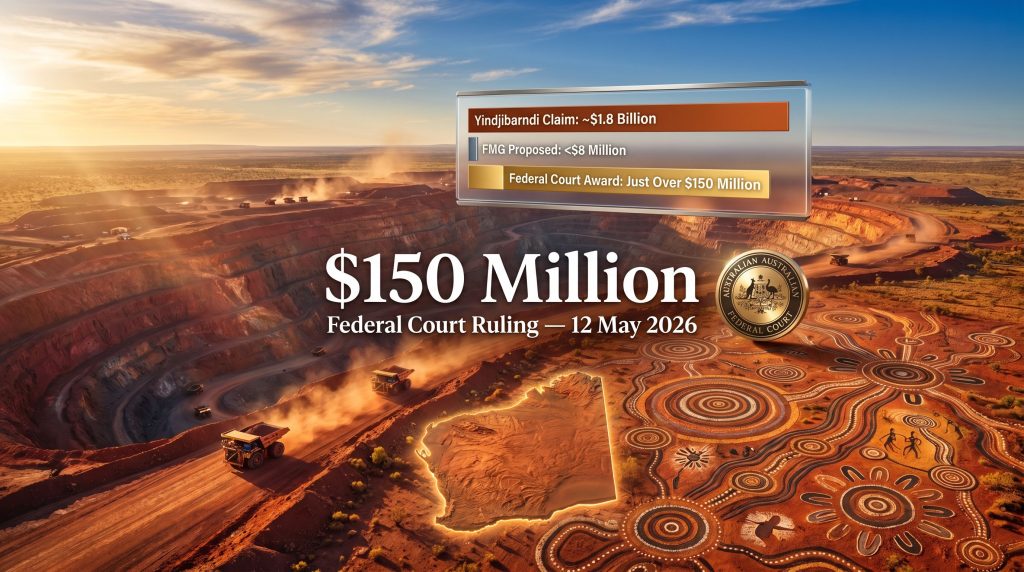
FMG's legal position reflected a fundamentally different philosophy about how native title compensation should be calculated. The company proposed an economic loss ceiling of approximately $95,000, explicitly rejecting the royalty benchmarking approach. For cultural and spiritual loss, FMG proposed a figure below $8 million.
The contrast with YNAC's position is stark:
| Party | Compensation Position |
|---|---|
| Yindjibarndi (YNAC) | ~$1.8 billion |
| FMG (proposed) | Under $8 million (cultural) + ~$95,000 (economic) |
| Federal Court Ruling | Just over $150 million |
The gap between the parties' positions represents one of the widest valuation divergences in Australian native title compensation history, reflecting deep structural disagreement over how courts should quantify the intersection of Indigenous cultural connection and commercial resource extraction.
Justice Burley's $150 Million Ruling: What the Court Decided
The Award and What It Covers
Federal Court Justice Stephen Burley handed down his ruling on 12 May 2026, ordering FMG to pay just over $150 million to YNAC for both economic and spiritual loss arising from the Solomon Hub mine's establishment and operation. According to reporting on the ruling, the decision formally recognises that both categories of harm are compensable under Australian native title law.
The ruling positions itself at roughly 8.3% of the Yindjibarndi's total claim, yet represents approximately 18 times the combined maximum FMG had proposed paying. By any measure, the quantum falls between two radically different worldviews about what Indigenous land rights are worth in the context of large-scale resource extraction.
Why the Outcome Fell Short of Expectations
For the Yindjibarndi community and their supporters, a $150 million award for more than a decade of harm, during which billions of dollars worth of iron ore was extracted from their Country, does not reflect the full scope of what was lost. Community advocates have described the outcome as falling well short of what justice required, even as they acknowledge the court's formal recognition of cultural and spiritual harm as legally compensable losses.
The tension here is not simply about the number. It is about what the number communicates regarding how Australian law values Indigenous cultural connection relative to commercial productivity.
Why This Case Matters Beyond Solomon Hub
Spiritual Loss as a Legally Recognised Category
One of the most significant dimensions of Justice Burley's ruling is its explicit treatment of spiritual and cultural loss as a compensable component of a native title claim. While the High Court's 2019 Timber Creek decision established foundational principles for native title compensation and confirmed that non-economic loss could be recognised, the FMG Solomon Hub compensation to Yindjibarndi applies those principles at a dramatically larger scale, reflecting the size and commercial significance of the mine involved.
The Timber Creek decision (formally Northern Territory v Mr A Griffiths (deceased) and Lorraine Jones*) awarded approximately $2.53 million in total compensation, establishing methodological principles that courts now apply to far larger disputes. The Solomon Hub ruling represents a quantum leap in the scale at which those principles operate.*
The precedential implication is considerable. If spiritual and cultural loss is formally quantifiable, then every future native title compensation claim involving a major mining operation will require operators to account for this dimension in their liability assessments.
The Royalty Benchmarking Debate: A Potential Turning Point
Whether the court fully endorsed YNAC's royalty benchmarking methodology or adopted a modified version of it will be critical to how other operators assess their exposure on native title land. If benchmarking against negotiated royalty agreements becomes an accepted judicial tool, the financial implications for resource companies across Western Australia and the Northern Territory could be substantial.
Key questions that future cases will need to resolve include:
- Which royalty agreements constitute appropriate comparators, and who determines that?
- How are royalty benchmarks adjusted for site-specific factors such as ore grade, infrastructure access, and tenure type?
- Does benchmarking apply retrospectively across the full operational life of a mine, or only prospectively?
- How do courts weigh benchmarked royalties against the specific procedural history of how a mine's approvals were obtained?
Comparable Cases: Understanding the Legal Landscape
| Case | Operator | Outcome | Key Legal Issue |
|---|---|---|---|
| Solomon Hub (2026) | Fortescue Metals Group | ~$150M awarded | Economic and spiritual loss combined |
| Timber Creek (2019) | NT Government | ~$2.53M (High Court) | Foundational compensation methodology |
| Mariana Dam (UK Courts) | BHP | Appeal denied (2026) | Environmental and community harm liability |
| Yindjibarndi vs Rio Tinto | Rio Tinto | Ongoing dispute | Power infrastructure and land access |
ESG Dimensions: What This Ruling Signals to the Mining Sector
FMG's Financial and Reputational Position
A $150 million liability is material in absolute terms, though its significance relative to FMG's annual revenues depends on current financial disclosures that investors should review directly. What is not in doubt is that a decade-long legal contest with registered native title holders carries costs that extend well beyond any court-ordered payment, including reputational damage, management distraction, and the compounding effect of delayed resolution on community relations.
Whether this figure was provisioned in FMG's financial statements ahead of the ruling is a question that investors and analysts will be examining carefully in the period following the decision. In addition, Australia's iron ore dominance means that how operators manage these disputes will have consequences far beyond any single company's balance sheet.
The Social Licence Imperative
The Solomon Hub case illustrates a broader dynamic that is reshaping how major resource companies must think about operating on or near native title land. The business case for early, good-faith negotiation has rarely been clearer:
- Protracted litigation amplifies costs far beyond what early negotiated agreements would have required.
- Reputational exposure accumulates over the life of a dispute, affecting recruitment, investor relations, and regulatory goodwill.
- Legal precedents generated through adversarial processes tend to be less commercially favourable than consensual agreements, because courts must resolve contested methodologies rather than adopt pragmatic commercial solutions.
- ESG rating frameworks are increasingly incorporating Indigenous land rights management as a material governance risk factor, meaning that unresolved disputes affect institutional investor appetite.
What Institutional Investors Are Watching
For ESG-focused fund managers and institutional investors with exposure to Australian resource companies, the Solomon Hub ruling generates several points of scrutiny:
- Litigation provisions: Are companies with pending native title compensation claims adequately provisioning for potential liabilities?
- Community engagement quality: Are engagement programmes genuinely consultative, or performative?
- Agreement coverage: What proportion of a company's operational footprint is covered by formal, mutually agreed Indigenous Land Use Agreements?
- Precedent sensitivity: How much of a company's operational land bank is subject to native title rights that could generate compensation claims if the royalty benchmarking methodology gains traction on appeal?
Furthermore, the WA resources sector impact of rulings like this one extends beyond individual operators, shaping the broader investment climate for Pilbara-based projects for years to come.
The next major ASX story will hit our subscribers first
The Yindjibarndi's Broader Strategy: Rights Across Multiple Fronts
A Multi-Operator Assertion of Rights
The FMG Solomon Hub compensation to Yindjibarndi does not represent the entirety of the community's current legal and commercial activity in the Pilbara. YNAC is simultaneously engaged in a dispute with Rio Tinto over power infrastructure and land access, signalling that the Yindjibarndi are pursuing a coordinated, multi-front strategy to assert their rights across multiple resource operators in their Country.
This reflects a broader maturation of Indigenous economic advocacy in Australia's resource sector. Organisations like YNAC are increasingly sophisticated legal and commercial actors, capable of sustaining complex, multi-year litigation across different legal jurisdictions and factual contexts simultaneously.
The Appeal Question
The May 2026 ruling is unlikely to be the final word on this dispute. Both parties retain appeal rights under Federal Court procedure. FMG may pursue grounds to reduce the award, particularly if they contest the methodologies used to calculate spiritual loss or economic harm. YNAC, for its part, may seek a higher award on the basis that the court undervalued either category of loss or failed to fully apply royalty benchmarking principles.
An appeal process could extend resolution by several years, carrying significant emotional and financial costs for the Yindjibarndi community, and ongoing uncertainty for FMG's liability position. Consequently, the mining taxes and royalties framework underpinning these disputes will continue to evolve as courts refine their approach to large-scale compensation claims.
Frequently Asked Questions
What is the Yindjibarndi Ngurra Aboriginal Corporation?
YNAC is the registered native title body corporate representing the Yindjibarndi people in legal and commercial dealings with resource operators and other parties in the Pilbara region of Western Australia. It functions as the formal entity through which the community asserts its collective rights under the Native Title Act 1993 (Cth).
Why did the Yindjibarndi seek $1.8 billion from FMG?
The total claim encompassed cultural and spiritual loss, economic loss calculated through royalty benchmarking, destruction of sacred sites, and costs associated with healing social disruption. The economic loss component alone was valued at $678 million, based on what the Yindjibarndi argued they could have negotiated through royalty-style arrangements comparable to those secured by other Indigenous communities with mining operators.
How was the $150 million figure reached?
Justice Burley's ruling balanced the competing valuation methodologies presented by both parties, arriving at a figure that recognises both economic and spiritual harm but positions itself well below the Yindjibarndi's total claim and significantly above FMG's proposed maximum. Detailed analysis of the decision highlights the complexity of the court's reasoning on cultural loss quantification.
Can the Yindjibarndi appeal the ruling?
Yes. Appeals against Federal Court judgments can be pursued to the Full Federal Court and potentially the High Court of Australia. YNAC may seek a higher award; FMG may seek to reduce the liability. The grounds, timeline, and outcome of any appeal will shape the final legal precedent this case establishes.
What does this ruling mean for other mining companies on native title land?
Resource operators across Western Australia and the Northern Territory will be closely monitoring whether the royalty benchmarking methodology survives appeal scrutiny and whether the scale of spiritual loss compensation established here becomes a reference point in future claims. Companies with significant native title exposure face growing incentive to negotiate proactive agreements rather than contest compensation through litigation. However, governance red flags in how companies manage Indigenous engagement can also signal broader management and investment risk for shareholders.
How does this case relate to the Yindjibarndi's dispute with Rio Tinto?
The Yindjibarndi are separately engaged with Rio Tinto over power infrastructure and land access in the Pilbara, demonstrating that their legal strategy extends across multiple resource operators. The Solomon Hub ruling adds weight and credibility to the Yindjibarndi's broader assertion of economic and cultural rights across their Country.
Key Takeaways
- The $150 million Federal Court award represents one of the largest native title compensation figures in Australian legal history, even as it falls significantly short of what YNAC sought.
- Spiritual and cultural loss is now formally established as a compensable category in large-scale native title compensation cases, with real financial consequences for resource operators.
- The royalty benchmarking methodology remains legally contested and its long-term viability will depend heavily on appeal outcomes.
- Resource companies operating on native title land face growing legal, financial, and reputational exposure where they have not established good-faith negotiated agreements with rights holders.
- The Yindjibarndi's coordinated legal strategy across multiple Pilbara operators signals a broader shift toward Indigenous economic self-determination that the resource sector cannot afford to underestimate.
This article is intended for informational purposes only and does not constitute legal or financial advice. Readers should consult qualified legal counsel for advice specific to their circumstances. Forward-looking statements and analysis of potential appeal outcomes involve inherent uncertainty and should not be relied upon as predictions of future legal or financial results.
Want to Stay Ahead of Major ASX Mineral Discoveries Before the Market Moves?
Discovery Alert's proprietary Discovery IQ model delivers real-time alerts on significant ASX mineral discoveries, instantly turning complex data across more than 30 commodities into clear, actionable insights for both short-term traders and long-term investors. Explore why major mineral discoveries have historically generated substantial returns and begin your 14-day free trial today to secure your market-leading edge.