May 12, 2026
When the Market Gets It Wrong: Decoding Sibanye-Stillwater's Valuation Paradox
Commodity cycles have a well-documented tendency to punish mining companies for decisions made years earlier. Debt accumulated during expansion phases becomes a liability during price downturns, and the reputations forged in bull markets rarely survive bear markets intact. Understanding this psychological dynamic is essential to interpreting what is happening with the Sibanye-Stillwater strategy under Richard Stewart, because the market's current reading of the company appears to be anchored in a narrative the business is actively working to dismantle.
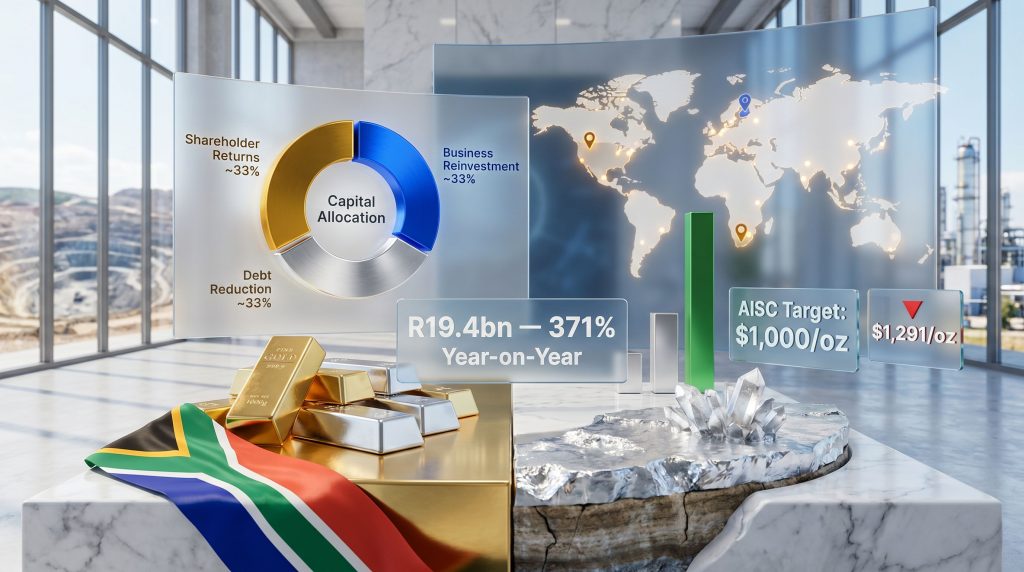
The numbers tell a striking story. Quarterly earnings reached R19.4 billion, representing a 371% year-on-year increase driven by elevated gold and PGM prices. Yet the company's shares declined approximately 10% year to date over the same period. This is not a minor discrepancy. It is a significant valuation disconnect that implies the market is pricing in structural concerns rather than responding to fundamental performance.
That gap between earnings reality and share price perception sits at the heart of this evolving corporate transformation, and understanding it is the starting point for assessing whether the company's new direction can close it.
When big ASX news breaks, our subscribers know first
From Empire-Building to Surgical Simplification
The era preceding Stewart's appointment was defined by transformative, debt-funded acquisitions that constructed a sprawling global portfolio spanning precious metals, battery minerals, and base metals across multiple continents. That strategy created enormous asset scale but also introduced balance sheet complexity, overhead drag, and the kind of operational heterogeneity that makes consistent delivery difficult.
Stewart's mandate represents a structural departure from that model. Speaking to MiningMX and its sister publication Currency in May 2026, Stewart acknowledged that while the company holds phenomenal long-life assets, the business had not maximised the value available from its existing portfolio. His diagnosis identified a stretched balance sheet, portfolio complexity, and underperforming operations as the key constraints, not asset quality.
The strategic pivot can be summarised in a single word: simplification. This is not a retreat or an admission of failure. It is a recalibration toward what Stewart describes as sustainable, through-cycle profitability, where operational consistency becomes the primary value driver rather than commodity price leverage.
The Three-Pillar Capital Allocation Framework
The most concrete expression of the Sibanye-Stillwater strategy under Richard Stewart is a disciplined, tripartite approach to capital allocation. Rather than discretionary deployment of profits, Stewart has committed to a structured framework that addresses three competing priorities simultaneously.
| Capital Allocation Pillar | Target Proportion | Strategic Rationale |
|---|---|---|
| Shareholder distributions | ~33% | Reward patient equity holders who endured acquisition-era dilution |
| Gross debt reduction | ~33% | Halve gross debt within 18 months at prevailing prices |
| Business reinvestment | ~33% | Fund operational optimisation and selective organic growth |
The distinction between net debt management and gross debt targeting deserves particular attention. Stewart has shifted the internal benchmark from net debt-to-EBITDA (which closed the prior fiscal year at 0.6x, well within the company's comfort threshold below 1x) to the absolute halving of gross debt. This is a more demanding and structurally meaningful target because gross debt excludes the offset of cash holdings, meaning it cannot be managed through treasury optimisation.
At prevailing metal prices, Stewart believes gross debt halving is achievable within 18 months. Furthermore, this framework also reflects a counter-cyclical discipline that is uncommon in mining. Rather than using high commodity prices to fund acquisitions at cycle peaks, Stewart is deploying the current earnings surge to repair the balance sheet, positioning the company to pursue growth during the next downturn when asset valuations are more attractive.
Stewart has explicitly identified elevated gross debt as one of the primary drags on the company's share price, making its reduction both a financial and a market re-rating priority.
The capital raising methods available to mining companies in today's environment make this approach even more significant, as balance sheet discipline increasingly determines access to favourable funding terms.
The Five Core Assets: A Deliberately Concentrated Portfolio
What Assets Make the Cut?
The Sibanye-Stillwater strategy under Richard Stewart centres on five core assets, each selected for their long-term cash generation potential, strategic positioning, or irreplaceable geographic attributes.
| Core Asset | Geography | Current Status | Strategic Role |
|---|---|---|---|
| South African PGM Operations | South Africa | Cash-generating | Primary earnings engine |
| South African Gold Operations | South Africa | Margin optimisation phase | Legacy base in lifecycle transition |
| Stillwater PGM Operations | United States | Mechanisation-led restructuring | Strategic optionality; geopolitically unique |
| Recycling Operations | Global | Operational | Diversified PGM revenue stream |
| Keliber Lithium Project | Finland | Construction/ramp-up phase | Critical minerals exposure |
Everything outside these five is being evaluated for exit through sales, partnerships, or closure. Stewart has been specific about the non-core candidates:
- An equity stake in an Argentine copper project, identified as the most straightforward divestment
- A minority interest in a Canadian PGM project that will never be developed internally
- A French nickel refinery that shifted to producing PCAM (a precursor cathode active material used in battery production), which no longer aligns with the core strategy
- New Century Resources in Australia, with approximately 18 months of zinc production remaining and no long-term commitment beyond the current mine life
The strategic rationale for this pruning exercise extends beyond financial returns. Stewart emphasised that the primary benefit of portfolio simplification is management time and capital redeployment, recognising that complex multi-geography portfolios consume disproportionate executive bandwidth relative to their value contribution. Integrated PGM business synergies are expected to generate approximately R2 billion in annual overhead savings over an 18-month period.
Stillwater: The Asset That Paid for Itself and Then Became a Problem
Few episodes in recent mining history illustrate the danger of acquisition timing better than the Stillwater story. Purchased during the palladium price supercycle, the asset delivered a remarkable outcome in its early years, paying for itself within four years of acquisition. The original two-mine configuration was producing approximately 550,000 oz per year across Stillwater West and East Boulder.
The decision to build a third mine, Stillwater East, targeting an additional 300,000 oz annually and lifting total production toward 850,000 oz per year, introduced the cost structure that now defines the challenge. Infrastructure, services, and workforce were scaled for an 800,000 oz operation. When production targets were not achieved and palladium and palladium dynamics shifted unfavourably, the company was left with costs sized for a business it never fully built.
The corrective action began at the end of 2024, when Stillwater West, the oldest and most expensive operation, was placed on care and maintenance. This reduced production to current levels but also eliminated the most loss-making ounces from the portfolio. For further context on how platinum and palladium dynamics are evolving, the broader PGM market outlook remains a critical variable for Stillwater's recovery trajectory.
The Mechanisation-Led Cost Reduction Path
Stewart's roadmap for returning Stillwater to profitability rests on a single structural lever: mechanisation. The logic is straightforward. Labour is the dominant cost driver in US underground mining operations. By increasing mechanised mining intensity, the company can extract more material with fewer people, improving productivity per employee and reducing the cost per ounce recovered.
The targets are specific and auditable:
| Operational Metric | Current Position | Target | Mechanism |
|---|---|---|---|
| All-In Sustaining Cost (AISC) | ~$1,291/oz | ~$1,000/oz | Mechanisation-led productivity gains |
| Rock processed per person | Baseline | +60% increase | Higher mechanisation ratio |
| Metal recovered per person | Baseline | +40% increase | Improved yield per mechanised unit |
| Net unit cost reduction | Baseline | ~20% lower | Combined productivity effect |
| Implementation timeline | In progress | ~2 years | Phased rollout |
The geological case for persevering with Stillwater is compelling. The orebody carries an official 40-year mine life, but geological assessments suggest a resource base capable of supporting production for up to 100 years. Moreover, Stillwater is the only significant PGM producer operating outside South Africa, Russia, and Zimbabwe. This geographic exclusivity carries strategic weight that pure cost economics cannot fully capture, particularly in a supply chain diversification environment.
Stewart has also articulated a specific price floor assumption underpinning the Stillwater investment thesis: palladium is not expected to sustain below $1,000/oz over the long term. If the $1,000/oz AISC target is achieved, Stillwater becomes an operation capable of breaking even at worst-case price scenarios and generating meaningful returns during price recoveries.
The Stillwater orebody's estimated 100-year resource life is a geological characteristic that fundamentally separates this asset from most mining investments, where resource depletion is a finite constraint on long-term value.
Keliber: Europe's Only Integrated Lithium Refinery
The Keliber lithium project in Finland represents the most distinctive and arguably most misunderstood component of the portfolio. With total capital expenditure of approximately R15 billion and construction now substantially complete, the project is entering its operational ramp-up phase at a moment when the lithium market downturn has created considerable uncertainty around near-term pricing.
What makes Keliber genuinely unique is its mine-to-market integration. The project encompasses a mine, a concentrator, and a refinery within a single operational structure, eliminating the processing dependencies that expose most Western lithium producers to Chinese refining capacity. That dependency is significant: approximately 70% of global lithium refining capacity is currently concentrated in China.
Keliber is currently the only integrated lithium extraction technology facility of its kind operating in Europe. This is not a marginal distinction. When Stewart began developing Keliber approximately five years ago, roughly five peer European projects were at a similar feasibility stage. As of mid-2026, none of those competing projects have advanced to construction, largely due to permitting bottlenecks across European jurisdictions.
The Lithium Market Timing Challenge
The lithium price environment complicates the near-term investment case. After a severe correction that saw prices fall sharply from their 2022–2023 peaks, the market has stabilised in the low $20,000s per tonne. Stewart's outlook acknowledges this near-term pressure while positioning Keliber for a structural shift expected by the end of the decade.
| Timeframe | Market Condition | Price Implication |
|---|---|---|
| 2024-2026 | Oversupply or near-balance | Prices in low $20,000s/tonne |
| 2027-2029 | Tightening supply dynamic | Gradual price recovery anticipated |
| 2030+ | Potential structural deficit | Prices possibly exceeding $30,000/tonne required to incentivise new supply |
The supply-side case rests on a critical insight: the permitting and development timelines for new lithium projects across Western jurisdictions are far longer than demand growth models typically assume. Stewart has directly observed that European projects which were at feasibility stage simultaneously with Keliber remain stuck in permitting processes. This regulatory attrition among competing projects, combined with accelerating battery technology adoption, creates the conditions for the supply deficit scenario Stewart anticipates beyond 2030.
The geopolitical dimension further strengthens Keliber's strategic positioning. Western governments, particularly in the United States, have accelerated policies designed to reduce dependence on Chinese-controlled critical mineral supply chains. Keliber satisfies both criteria through its European geography, Western ownership structure, and fully integrated domestic processing capability.
It is important to note that Keliber has not been confirmed as a recipient of specific government funding, project designation, or accelerated permitting from any government body. The policy environment described reflects broader industry trends rather than project-specific support.
The next major ASX story will hit our subscribers first
South African Gold: Managing a Mature Asset for Maximum Cash Generation
Gold was the foundation on which Sibanye-Stillwater was originally built, but the South African gold operations now occupy a different strategic position within the portfolio. These are mature, deep assets in an advanced lifecycle phase, and the management philosophy reflects that reality. The relationship between gold and mining equities remains consequential here, as elevated gold prices are currently providing meaningful support to these operations' cash generation profiles.
The current approach prioritises margin over volume. Rather than pursuing production growth at the cost of capital intensity, Stewart is optimising existing operations for cash generation while beginning the investment cycle that will define the next phase of South African gold production.
The transition roadmap focuses on shallower mining infrastructure, where capital costs and safety risks are lower than in the company's deep-level operations. The Burnstone gold project represents a restart option that becomes viable at approximately R2.6 million per kilogram of gold, while the Beisa uranium joint venture provides low-capital organic optionality within the same geographic footprint. Stewart anticipates this transition playing out over a four-to-five year horizon, preserving optionality without requiring immediate large-scale capital commitments.
What Would Trigger a Market Re-Rating?
The valuation disconnect between Sibanye-Stillwater's earnings performance and its share price is not irrational from the market's perspective. It reflects genuine execution risk across multiple fronts. The market is essentially asking: can this company deliver on its promises consistently, across a complex portfolio, during a commodity price environment that may not remain as favourable?
The answer to that question will be determined by progress against five measurable catalysts:
| Re-Rating Catalyst | Current Status | Required Progress |
|---|---|---|
| Gross debt reduction | Elevated absolute levels | Halving within 18 months at current prices |
| Stillwater cost normalisation | AISC at ~$1,291/oz | Mechanisation delivering target $1,000/oz |
| Keliber operational proof | Ramp-up phase | Demonstrated production and commercial sales |
| Portfolio simplification | Non-core exits under evaluation | Board decisions and divestment execution |
| Operational consistency | Improving | Sustained quarter-on-quarter delivery |
Each of these catalysts is within management's control, which is precisely Stewart's point. The market's characterisation of Sibanye-Stillwater as a binary precious metals bet understates the degree to which operational decisions, cost management, and capital discipline can generate value independently of commodity prices.
A ~10% share price decline against a 371% earnings increase does not reflect fundamental deterioration. It reflects the market's scepticism that the execution will follow the articulation.
Industry Context: Understanding PGM Market Dynamics and the AISC Benchmark
How Does AISC Shape Investment Decisions?
For investors less familiar with mining economics, the all-in sustaining cost metric deserves explanation. AISC is the most comprehensive cost measure in precious metals mining, capturing not only direct mining and processing costs but also sustaining capital expenditure, royalties, and administrative overhead. It represents the minimum price at which a mine can sustain current production levels without eroding its asset base.
The gap between Stillwater's current AISC of approximately $1,291/oz and the target of $1,000/oz is not trivial. A 23% cost reduction through mechanisation requires both capital investment and operational transformation across workforce practices, equipment deployment, and mine design. The two-year implementation timeline reflects the genuine complexity of this transition in an underground hard-rock environment.
PGM recycling, one of Sibanye-Stillwater's five core assets, is an often-overlooked component of the portfolio. The recycling business processes spent automotive catalytic converters to recover platinum, palladium, and rhodium, providing a revenue stream that is partially insulated from primary production risks and benefits from the same price environment as mining operations. You can read more about Sibanye-Stillwater's sustainability commitments and how they integrate into the company's long-term value creation model.
A Strategic Blueprint Built for the Cycle, Not Just the Moment
The Sibanye-Stillwater strategy under Richard Stewart is ultimately a bet on operational discipline outperforming price timing. The framework is internally consistent: use the current earnings strength to repair the balance sheet, simplify the portfolio to concentrate expertise and capital, prove the commercial viability of Keliber, and mechanise Stillwater toward cost competitiveness. If these milestones are delivered, the company that emerges will be structurally different from the one the market currently prices.
The five-pillar blueprint in summary:
- Gross debt halving within 18 months at current commodity prices, shifting the internal benchmark from net debt ratios to absolute debt reduction
- Portfolio concentration around five core assets, with non-core exits via sales, partnerships, or closures to free management bandwidth and capital
- Stillwater mechanisation targeting a 20% unit cost reduction over two years, bringing AISC from approximately $1,291/oz toward $1,000/oz
- Keliber operational delivery, proving Europe's only integrated lithium refinery can produce and sell competitively as the global supply deficit materialises post-2030
- South African gold transition, managing current operations for margin while investing in shallower infrastructure over a four-to-five year horizon
Whether the market assigns credit for this vision on the basis of the plan or waits for empirical proof of execution will determine how quickly the valuation gap closes. Consequently, Stewart's position appears to be that proof of delivery is the only legitimate answer to market scepticism, and the next 18 to 24 months will be the testing ground for that thesis.
This article draws on publicly available interview content published by MiningMX and its sister publication Currency on May 11, 2026. It is intended for informational purposes only and does not constitute financial or investment advice. Forward-looking statements regarding commodity prices, production targets, cost reductions, and market conditions involve inherent uncertainty and should not be relied upon as predictions of future outcomes.
Want to Identify the Next Major Mineral Discovery Before the Market Does?
While Sibanye-Stillwater navigates its corporate transformation, Discovery Alert's proprietary Discovery IQ model scans ASX announcements in real time, delivering instant alerts on significant mineral discoveries — from gold and PGMs to critical minerals like lithium — so subscribers can act on actionable opportunities ahead of the broader market. Explore historic examples of major discoveries and their extraordinary returns to understand what early positioning can mean, then begin your 14-day free trial to secure your market-leading edge.