
May 12, 2026
When Trading Houses Become Strategic Partners: The New Architecture of Critical Minerals Supply
The structure of global commodity trading is undergoing a quiet but profound transformation. For decades, the relationship between a mining developer and a commodity merchant was transactional, arms-length, and purely commercial. Volume was agreed, pricing was indexed, and the merchant's role ended at the point of sale. That model is no longer sufficient in an era where governments are legislating domestic sourcing targets, defence procurement agencies are scrutinising mineral provenance, and the minerals underpinning modern electronics and weapons systems are concentrated in politically sensitive jurisdictions.
What is emerging in its place is a hybrid structure, one where the trading house functions simultaneously as a market access provider, a project finance facilitator, and in some cases a direct capital investor. The Traxys ETM Penouta mine offtake agreement, formalised in May 2026, is among the clearest expressions of this structural shift in the critical minerals sector.
When big ASX news breaks, our subscribers know first
What the Traxys ETM Penouta Mine Offtake Agreement Actually Covers
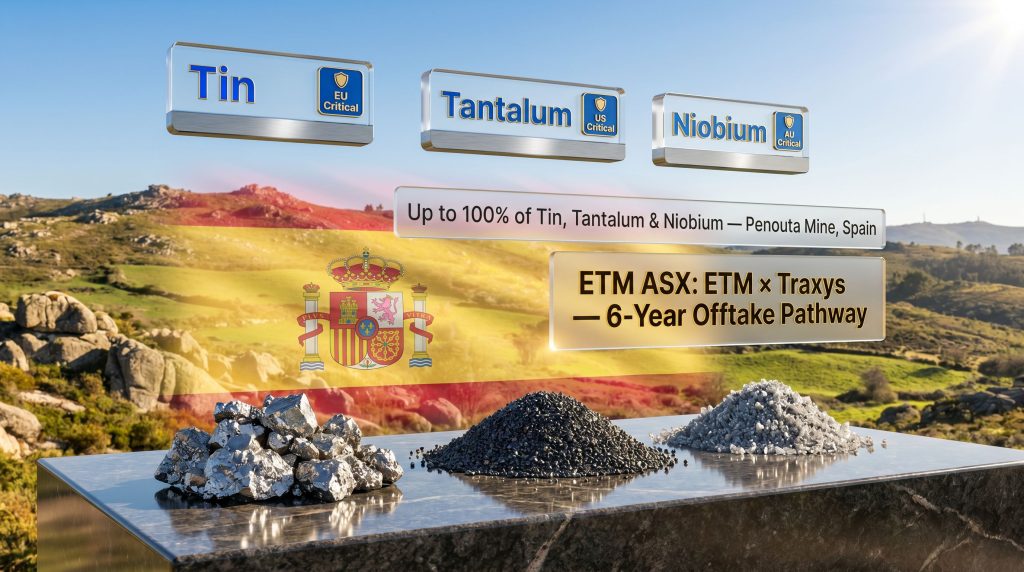
On 12 May 2026, ASX-listed Energy Transition Minerals (ETM) and global commodity trader Traxys signed a non-binding Memorandum of Understanding granting Traxys exclusive rights to market, distribute, and sell up to 100% of the tin, tantalum, and niobium concentrates produced at the Penouta mine in northwestern Spain.
The agreement is structured across two phases:
-
A 12-month non-binding MoU period, during which both parties will finalise binding documentation, evaluate production timelines, and assess funding pathways.
-
A target binding offtake term of six years from first production, covering exclusive commercial marketing rights subject to ETM's consent on each individual sale to end-consumers.
Beyond the conventional offtake framework, the MoU explicitly incorporates a funding evaluation mandate. Both parties will assess opportunities for Traxys to make a direct investment into Penouta and/or ETM, introduce third-party debt or equity investors into the project, or both. This dual commercial-and-capital structure represents a meaningful departure from traditional merchant offtake arrangements and positions Traxys as a potential project development partner rather than a passive downstream buyer.
Pricing under the binding agreement, once executed, will be linked to prevailing market indices for each of the three minerals, preserving exposure to market dynamics while providing structural revenue certainty for project financing purposes.
Penouta's Rare Position in the Global Critical Minerals Landscape
Europe's Only Integrated Three-Mineral Operation
The strategic significance of the Penouta mine is not immediately obvious from its size. What makes it exceptional is its mineralogical profile. As recently as October 2024, when the mine last operated, it was the only facility within the European Union simultaneously producing tin, tantalum, and niobium from a single site. This is not simply a logistical distinction; it reflects the geological rarity of co-hosted mineralisation at economically extractable grades.
| Mineral | Primary Industrial Applications | Classified Critical By |
|---|---|---|
| Tin | Electronics soldering, semiconductor packaging, coatings | US, EU, Australia |
| Tantalum | Capacitors, aerospace components, medical devices | US, EU, Australia |
| Niobium | High-strength steel alloys, superalloys, next-generation EV batteries | US, EU, Australia |
All three minerals appear on the formal critical minerals registers maintained by the United States, the European Union, and Australia. Their inclusion in multiple jurisdictions simultaneously reflects documented supply concentration risks, with production of tantalum dominated by the Democratic Republic of Congo and niobium overwhelmingly sourced from Brazil, with significant Chinese processing involvement across both supply chains. Furthermore, the critical minerals demand surge anticipated through 2025 and beyond makes European domestic production increasingly urgent for Western industrial planners.
Why the "3T" Classification Matters to Investors
Industry practitioners commonly refer to tin, tantalum, and tungsten collectively as the "3T" markets, a terminology originating partly from conflict minerals regulations under Section 1502 of the US Dodd-Frank Act, which required companies to audit and disclose sourcing of these minerals from conflict zones. The Penouta mine covers two of the three "3T" minerals (tin and tantalum) while also producing niobium, giving it relevance across both the conflict minerals compliance framework and the broader critical mineral supply chains security agenda.
This overlap is commercially significant. End-users in consumer electronics and defence manufacturing already have compliance infrastructure for 3T sourcing audits. A Western-origin, EU-produced source of certified conflict-free tin and tantalum simplifies compliance obligations and potentially commands a provenance premium.
Speculative Insight: As responsible sourcing legislation tightens across the EU and US, Western-origin critical mineral concentrates may attract a structural price premium above market indices over the medium term, a factor not yet explicitly reflected in standard index-linked offtake agreements but increasingly discussed among project developers and institutional buyers.
Understanding the Two Parties: ETM and Traxys
Energy Transition Minerals: A Development-Stage ASX Miner
ETM is an ASX-listed critical minerals development company in the process of completing the acquisition of the Penouta mine. The company's strategic positioning centres on minerals with documented relevance to the global energy transition and defence supply chains. At the time of the MoU announcement, ETM Managing Director Daniel Mamadou identified Traxys as the leading trading partner in the critical minerals space, specifically citing their established presence in EU markets and their documented track record across the tin, tantalum, and niobium categories as the primary reasons for selecting them as the offtake partner of choice for Penouta.
Mamadou also emphasised that the value of the partnership extended beyond pure trading capabilities to encompass Traxys' capacity to originate or facilitate funding for the project itself. ETM's current status as an acquisition-stage company rather than an operating producer is a key factor in how this MoU should be interpreted.
The mine is not yet producing under ETM's ownership, and the path from current status to first production involves completing the acquisition, securing capital, restarting operations, and satisfying any applicable permitting requirements. The MoU is designed to de-risk and support precisely this process.
Traxys: Expanding From 3T Merchant to Critical Minerals Platform
Traxys operates as a global commodity trader and merchant with particular depth in the 3T markets. Chairperson Alan Docter confirmed at the time of the Penouta MoU announcement that Traxys is actively participating in Project Vault, a US-aligned programme focused on strengthening America's critical minerals supply chain and national security. This publicly stated alignment signals that Traxys is positioning itself not merely as a price-taking intermediary but as an institutionally connected actor in Western supply chain resilience strategy.
Traxys' broader critical minerals portfolio is expanding in parallel. A binding offtake agreement signed with Nouveau Monde Graphite (NMG) for its Matawinie Mine in Canada provides additional context:
| Agreement | Producer | Minerals | Volume | Term | Take-or-Pay |
|---|---|---|---|---|---|
| ETM MoU (2026) | Energy Transition Minerals (ASX) | Tin, Tantalum, Niobium | Up to 100% of output | 12-month MoU, then 6-year binding | Under negotiation |
| NMG Agreement (2025) | Nouveau Monde Graphite | Graphite | Up to 20,000 tpa | 7 years post-production | 10,000 tpa firm |
The pattern is deliberate. Traxys is systematically anchoring offtake positions across critical mineral categories ahead of the demand acceleration widely expected from energy transition and defence industrial buildout. The portfolio now spans graphite, tin, tantalum, and niobium, covering inputs for battery anodes, capacitors, aerospace components, and high-strength steel simultaneously.
How the MoU Structure Functions: A Technical Breakdown
The Non-Binding Phase: What It Actually Achieves
A common misconception among retail investors is that a non-binding MoU represents little more than a letter of intent with limited commercial value. In the context of critical minerals project finance, however, this misunderstands how the instrument functions. The 12-month non-binding period serves several simultaneous purposes:
-
Validates the commercial relationship between producer and merchant before capital is committed to binding documentation.
-
Creates an exclusive negotiating window, preventing ETM from simultaneously approaching competing traders, which provides Traxys with deal certainty.
-
Allows lenders and equity investors evaluating the project to see a credible route-to-market, which is often a prerequisite for project-level debt financing.
-
Provides a structured framework within which the funding evaluation mandate can operate, enabling Traxys to assess whether direct investment into Penouta is commercially justified given production timelines.
The Binding Agreement Framework: Six Years from First Production
The target six-year binding term from first production mirrors industry-standard practice for greenfield and restart mining projects, where lenders typically require three to seven years of contracted revenue to underwrite project-level debt. The producer consent requirement on individual consumer sales is a notable carve-out.
While Traxys holds exclusive marketing rights, ETM retains approval authority over who ultimately purchases Penouta's output. This preserves ETM's ability to manage customer relationships, enforce end-use restrictions if required by applicable regulations, and ensure alignment with provenance and compliance obligations under EU and US responsible sourcing frameworks.
The Investment Evaluation Mechanism: Where This Deal Diverges from Standard Offtake
Key Structural Distinction: The explicit inclusion of an investment evaluation mandate within an offtake MoU is not standard practice in conventional commodity trading agreements. It represents a convergence of the merchant function and the project finance function, a model increasingly observed in critical minerals but relatively rare in base metals and bulk commodities.
The three identified pathways are:
-
Direct equity or debt investment by Traxys into the Penouta project vehicle and/or ETM as a listed entity.
-
Introduction of third-party equity investors by Traxys, leveraging the merchant's institutional relationships with offtake-linked capital providers.
-
Introduction of third-party debt investors or lenders, potentially including structured commodity finance facilities where the offtake agreement itself serves as collateral.
What This Means for Europe's Critical Minerals Supply Chain
The EU's Sourcing Deficit and the 2030 Target
The EU's Critical Raw Materials Act establishes a target of sourcing at least 10% of annual consumption of listed critical minerals from domestic extraction by 2030. For tin, tantalum, and niobium, current EU domestic production is effectively zero following Penouta's October 2024 cessation of operations. In this context, Europe's strategic metals projects are under increasing scrutiny from both policymakers and institutional investors.
The reactivation of Penouta under ETM's ownership would, depending on output volumes and EU consumption levels, represent a meaningful contribution toward this target across all three minerals simultaneously. No other single project within EU borders is positioned to deliver this across all three categories.
Europe's current import dependency for these minerals is concentrated in geopolitically sensitive jurisdictions. Tantalum supply chains run heavily through the Democratic Republic of Congo, while niobium is dominated by Brazilian production with significant concentration among a small number of producers. Tin supply chains involve substantial Southeast Asian and Chinese processing capacity. Each of these dependencies represents a documented vulnerability in the EU's industrial and defence manufacturing base.
Spain, NATO, and the Trusted-Source Premium
Spain's dual membership in the EU and NATO elevates Penouta's geopolitical value beyond its mineralogical characteristics. Consequently, defence critical materials procurement frameworks in both the US and EU are increasingly incorporating mineral provenance requirements. Tin solders in military electronics, tantalum capacitors in weapons guidance systems, and niobium-strengthened alloys in aerospace structures all carry heightened scrutiny regarding sourcing jurisdiction.
A Spanish-origin supply chain for all three inputs simultaneously satisfies EU domestic sourcing requirements, NATO allied-nation procurement preferences, and US critical minerals security frameworks.
The next major ASX story will hit our subscribers first
Key Risks and Conditions Investors Should Monitor
The Traxys ETM Penouta mine offtake agreement carries several material risk factors that warrant careful consideration. Furthermore, evolving mining finance trends globally suggest that non-binding structures of this kind are becoming more common as developers seek to attract institutional capital before production commences. The key risks include:
-
Non-binding status: Neither party is legally obligated under the current MoU. The 12-month negotiation window may not result in a binding agreement.
-
Acquisition completion risk: ETM has not yet completed the Penouta mine acquisition. Any complications in this process could delay or prevent the MoU from progressing to its binding phase.
-
Production restart timeline uncertainty: The mine has been inactive since October 2024. Restart involves capital deployment, operational preparation, and confirmation of applicable permitting status. No confirmed timeline to first production has been publicly disclosed.
-
Commodity price exposure: Index-linked pricing exposes revenue projections to volatility across tin, tantalum, and niobium markets, each of which carries distinct supply and demand dynamics.
-
Binding documentation risk: Transitioning from a non-binding MoU to a six-year binding agreement requires detailed alignment on pricing formulas, volume specifications, quality parameters, logistics, and investment terms. These negotiations can be protracted and may not conclude within the 12-month window.
Disclaimer: This article is intended for informational purposes only and does not constitute financial advice. All forecasts, structural analyses, and speculative insights presented here involve uncertainty and should not be relied upon as the basis for investment decisions. Readers should conduct their own due diligence and consult qualified financial advisers before making any investment decisions related to companies or projects discussed in this article.
Frequently Asked Questions: Traxys ETM Penouta Mine Offtake Agreement
What minerals does the Traxys ETM Penouta mine offtake agreement cover?
The MoU grants Traxys exclusive marketing rights over up to 100% of tin, tantalum, and niobium concentrates produced at the Penouta mine in Spain.
Is the current agreement legally binding?
No. The May 2026 agreement is a non-binding Memorandum of Understanding valid for 12 months. The stated objective is to negotiate a binding six-year offtake agreement from first production during this window.
What is the Penouta mine and why is its location significant?
The Penouta mine is located in northwestern Spain and was, as recently as October 2024, the only operating mine in the European Union producing tin, tantalum, and niobium simultaneously from a single site. Spain's EU and NATO membership adds considerable geopolitical significance to its output.
What is Project Vault?
Project Vault is a US-aligned initiative focused on strengthening America's critical minerals supply chain and national security. Traxys has publicly identified itself as a critical minerals supplier for the programme, contextualising its involvement in the Penouta MoU within broader Western supply chain resilience objectives.
Could Traxys invest directly in ETM or the Penouta mine?
The MoU includes provisions for both parties to evaluate direct investment opportunities, including potential equity or debt investment by Traxys into Penouta and/or ETM, as well as the introduction of third-party capital providers.
What are the 3T markets and why are they relevant here?
The 3T markets refer to tin, tantalum, and tungsten, a designation originating from conflict minerals regulation. Traxys has documented experience across these categories. Penouta produces tin and tantalum (two of the three 3T minerals) alongside niobium, giving it relevance across both conflict minerals compliance frameworks and broader critical minerals security agendas.
Want to Know When the Next Major Critical Minerals Discovery Hits the ASX?
Discovery Alert's proprietary Discovery IQ model delivers real-time alerts the moment significant mineral discoveries — including critical minerals like tin, tantalum, and niobium — are announced on the ASX, transforming complex data into actionable insights for investors at every level. Explore Discovery Alert's dedicated discoveries page to understand how historic ASX mineral discoveries have generated substantial returns, and begin your 14-day free trial today to position yourself ahead of the broader market.