July 27, 2026
The Energy Security Imperative Reshaping Global Capital in 2026
When geopolitical shocks sever the arteries of global energy supply, capital does not stand still. It relocates. The disruption of tanker traffic through the Strait of Hormuz, triggered by the Iran war, has compressed energy market timelines that might otherwise have played out over a decade into a single investment cycle. The result is a capital reallocation of historic proportions, one that is simultaneously accelerating the clean energy transition, reviving fossil fuel infrastructure spending, and forcing every major energy consumer to confront the uncomfortable gap between long-term climate ambition and near-term supply reality.
Understanding this moment requires moving beyond individual project announcements and examining the architecture of global energy finance itself. The numbers that emerge from that examination are striking. With natural gas spending to hit a 10-year high in 2026, the forces reshaping energy markets are not temporary responses to a single crisis. They reflect a durable restructuring of how the world prices, procures, and secures its energy supply.
When big ASX news breaks, our subscribers know first
A $3.4 Trillion Year: The Scale of the Capital Rotation
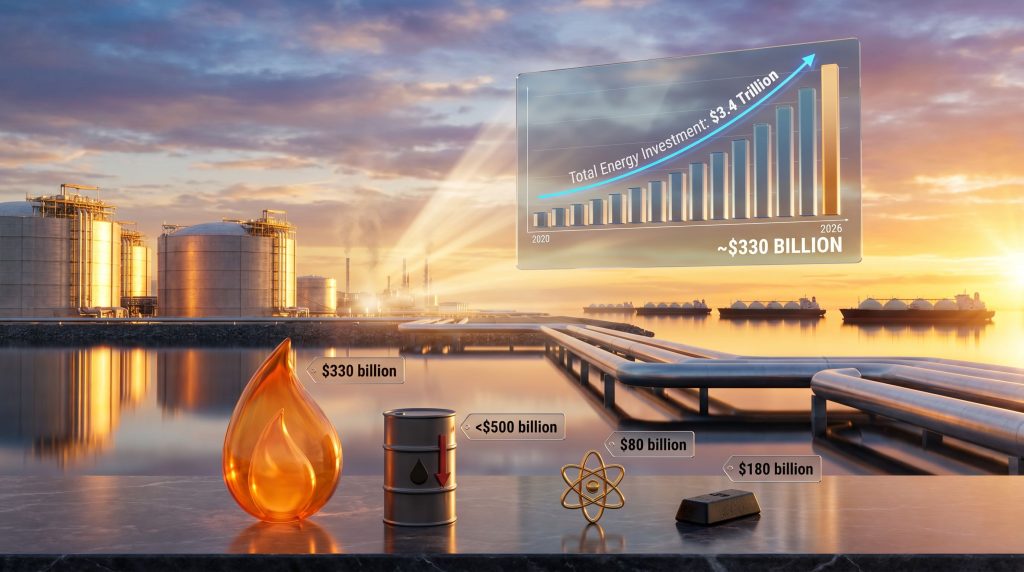
Total global energy investment is forecast to reach $3.4 trillion in 2026, according to the International Energy Agency's World Energy Investment 2026 report. That figure represents a 5% increase year on year, a remarkable acceleration given the simultaneous revenue pressures affecting producers across the Middle East and the broader uncertainty introduced by active conflict in a critical energy corridor.
The composition of that capital tells a more nuanced story than the headline figure alone. Clean energy systems, encompassing renewable power generation, battery and grid-scale storage, transmission infrastructure, and low-emission fuel development, will attract $2.2 trillion, or roughly 65% of total investment. This confirms that the energy transition outlook remains financially intact even as security concerns pull capital in multiple directions.
However, it is the behaviour of fossil fuel investment within this landscape that carries the most immediate market implications. Oil and gas are diverging sharply:
- Upstream oil investment is declining for a third consecutive year, falling below $500 billion globally
- Natural gas project investment is climbing by more than 10%, reaching approximately $330 billion
- Coal investment is projected to reach $180 billion, a 14-year high, driven overwhelmingly by China and India
- Nuclear spending is staging a notable recovery at $80 billion, underscoring renewed interest in low-carbon baseload capacity
This is not a story of fossil fuels uniformly advancing or retreating. It is a story of selective acceleration, with capital flowing toward assets perceived as capable of delivering supply reliability in a disrupted geopolitical environment.
Why Natural Gas Spending Is Hitting a 10-Year High
The convergence of factors driving natural gas spending to hit a 10-year high is neither accidental nor reversible in the short term. Several distinct forces are compounding simultaneously.
The Hormuz Factor and Supply Chain Fragility
The Strait of Hormuz has historically handled approximately 20% of the world's total liquid petroleum trade. Its effective closure to normal tanker traffic, resulting from the Iran conflict, has exposed the degree to which global energy systems remain concentrated around a small number of maritime chokepoints. According to IEA Director Fatih Birol, the disruption has prompted intensified efforts by both producer and consumer nations to diversify their trade routes and energy sourcing strategies (IEA, World Energy Investment 2026, May 2026).
The response from energy companies and sovereign entities has been to accelerate investment in infrastructure that either bypasses the affected corridor or reduces dependency on it entirely. Natural gas, particularly in its liquefied form, is uniquely suited to this reorientation because LNG shipments are geographically flexible in ways that pipeline-dependent oil supply chains are not. Furthermore, concerns around energy security and critical minerals are amplifying this shift across multiple fronts.
The U.S. LNG Buildout as a Structural Capital Engine
A substantial portion of the gas investment surge originates in the United States. The natural gas supply outlook points to Lower 48 production averaging 118.9 billion cubic feet per day (Bcf/d) in 2026, with further growth expected through 2027. This production foundation is enabling the commercial viability of a wave of new LNG export terminal construction that has been years in the making.
What distinguishes this investment cycle from previous LNG buildout phases is its underpinning. Earlier waves were largely driven by commodity price expectations and speculative demand assumptions. The current cycle is anchored by long-term supply agreements between U.S. exporters and international buyers, reducing the financial risk profile of terminal construction and accelerating final investment decisions. These are multi-decade capital commitments with consequences extending well into the 2040s.
Asian Importer Hesitancy: A Structural Tension
An underappreciated dynamic within the broader gas investment narrative is the cautious stance of Asian LNG importers. Despite the global supply security push, major Asian economies including Japan and South Korea are approaching new long-term gas dependency commitments with considerable restraint. Japan and South Korea have recently formalised bilateral energy supply security arrangements specifically designed to reduce their collective exposure to single-corridor dependencies (Zawya, May 2026).
This hesitancy creates a structural paradox. Supply-side investment is accelerating, but demand-side contracting caution means the commercial framework underpinning new capacity is more fragile than the investment headlines suggest. Asian buyers are effectively diversifying across multiple fuel types and supply routes simultaneously, using LNG as one component of a broader portfolio rather than doubling down on it as a primary long-term solution.
The tension between a supply-side investment surge and demand-side contracting caution is not a temporary mismatch. It reflects a fundamental rethinking of energy dependency risk in economies that have historically been among the world's most aggressive long-term gas contract signatories.
Mapping the Capital: Where Investment Is and Is Not Flowing
The geographic distribution of the 2026 energy investment wave reveals patterns that extend well beyond the headline gas figures.
Middle East: Contraction Under Pressure
Middle East oil and gas investment is expected to decline by approximately 1% in 2026. The combination of physical infrastructure damage, revenue compression from production disruptions, and reduced operational capacity is constraining the region's ability to deploy capital even where intent exists. Critically, a UAE energy operator has confirmed that full restoration of Hormuz shipping flows is not expected until at least the first half of 2027 (Zawya, May 2026). This timeline is shaping investor risk assessments across the entire region.
Africa and Latin America: The Momentum-Driven Frontier
Upstream investment in Africa and Central and South America is forecast to grow by more than 10% in 2026. This acceleration reflects the maturation of existing project pipelines rather than entirely new capital commitments, an important distinction. The projects driving this growth were largely initiated during earlier planning cycles and are now entering execution phases that happen to align with a period of elevated energy security concern. Both regions benefit from relatively lower geopolitical risk perception compared to the Middle East corridor.
| Region | 2026 Investment Direction | Primary Driver |
|---|---|---|
| United States | Strong growth | LNG terminal expansion, production growth |
| Africa | Growth of 10%+ | Existing project pipeline execution |
| Central and South America | Growth of 10%+ | Portfolio diversification away from Middle East |
| Middle East | Decline of ~1% | Conflict damage, revenue compression |
The Investment Lag Problem: When Does $330 Billion Actually Change Supply?
One of the least discussed aspects of the gas investment surge is its temporal disconnect from market conditions. Capital committed to LNG infrastructure in 2026 does not translate into available supply in 2026 or even 2027. LNG terminal construction timelines typically range from three to seven years depending on regulatory environments, site conditions, and supply chain complexity. Upstream gas production expansions carry their own two to five year development cycles.
This creates a critical implication for energy markets: the record investment being deployed now is primarily a response to a supply crisis, but it will deliver its capacity effects into a market landscape that may look substantially different by 2028 to 2031. The natural gas price trends of today, consequently, may bear little resemblance to the commercial environment into which this new capacity ultimately arrives. Several scenarios could fundamentally alter that landscape:
- A negotiated resolution to the Iran conflict restoring Hormuz flows ahead of the 2027 forecast
- Accelerated renewable deployment in Asian markets reducing LNG import demand growth
- Demand destruction effects from sustained high energy prices reshaping industrial consumption patterns
- Competing LNG capacity from Qatar, Australia, and East Africa arriving simultaneously
Each of these scenarios carries stranded asset risk for investors in long-duration gas infrastructure projects. This does not invalidate the investment rationale, but it demands that capital allocation decisions incorporate scenario range analysis rather than point forecasts. The IEA's natural gas outlook provides a useful framework for stress-testing these assumptions across demand and supply variables.
Coal and Nuclear: The Underreported Dimensions of the 2026 Energy Picture
The coal investment figure deserves particular attention precisely because it tends to be underreported in energy transition narratives. At $180 billion, the 2026 coal investment level represents the highest annual figure since 2012. This is not a function of changing environmental values in Beijing or New Delhi. It is a function of energy security arithmetic in economies where coal provides the most scalable, domestically controllable baseload power option available.
Nuclear energy's $80 billion investment figure is equally significant. Unlike previous nuclear revivals, which were concentrated in a small number of markets, the current recovery reflects broader policy momentum across Europe, North America, and parts of Asia. The combination of zero-carbon output and continuous baseload generation makes nuclear uniquely positioned in a landscape where neither solar and wind intermittency nor gas price volatility are acceptable long-term supply risks for grid operators.
The simultaneous record highs in gas, coal, and nuclear investment, occurring within the same year that clean energy attracts $2.2 trillion, reveals an energy system pursuing security on every available front at once rather than following a single transition pathway.
The next major ASX story will hit our subscribers first
What the 2026 Cycle Signals for the Energy Decade Ahead
The scale of LNG infrastructure investment being committed in 2026 will lock natural gas into a significant role within the global energy mix for two to three decades. This is not a policy choice. It is a financial and physical reality created by the capital commitments being made now, the infrastructure that will be constructed as a result, and the long-term supply agreements underpinning project financing.
For investors, the 2026 energy investment landscape presents both opportunity and complexity. The gas infrastructure buildout creates clear exposure points across the LNG value chain, from upstream production through liquefaction, shipping, and regasification. However, positions in long-duration assets must be evaluated against the full range of demand scenarios, particularly in Asian markets where import strategy is actively evolving. In addition, monitoring global oil futures remains essential for contextualising how capital rotates across the broader energy complex.
The broader lesson from the 2026 capital data is that energy transitions are rarely linear. As the Reuters report on energy investment confirms, the forces driving record clean energy investment and the forces driving natural gas spending to hit a 10-year high are not contradictory. They are parallel responses to a world that simultaneously needs to decarbonise over decades and secure supply over years.
Disclaimer: This article is intended for informational purposes only and does not constitute financial or investment advice. Forward-looking statements and projections, including those sourced from the IEA's World Energy Investment 2026 report and the U.S. Energy Information Administration, are subject to change and carry inherent uncertainty. Readers should conduct independent research before making any investment decisions.
Want to Position Yourself Ahead of the Next Major Resource Discovery?
As capital rotates across the global energy complex and mineral demand surges alongside record infrastructure investment, Discovery Alert's proprietary Discovery IQ model delivers real-time ASX mineral discovery alerts, turning complex data across 30+ commodities into clear, actionable insights. Explore historic discoveries and the returns they generated, then begin your 14-day free trial to ensure you're positioned before the broader market moves.