July 20, 2026
Global energy security operates within a delicate framework where maritime chokepoints serve as critical vulnerability nodes in the international supply chain. The strategic positioning of naval forces to control these arteries represents one of the most potent tools in modern geopolitical warfare, capable of reshaping entire economic landscapes within hours of implementation.
Defining Modern Naval Blockades in Energy Geopolitics
Contemporary maritime enforcement operations differ substantially from traditional wartime blockades under international law. Modern naval interdiction focuses on selective vessel targeting rather than complete port closures, operating within gray zones of maritime jurisdiction that blur the lines between sanctions enforcement and acts of war.
Under the United Nations Convention on the Law of the Sea (UNCLOS), freedom of navigation principles generally prohibit blockades during peacetime. However, enforcement actions justified under existing sanctions regimes create legal ambiguities that naval powers exploit to project influence without triggering formal declarations of hostility.
The US blockade of Iranian oil routes through the Strait of Hormuz represents this evolved approach to maritime energy control. Unlike the comprehensive blockades of previous centuries, selective interdiction allows non-Iranian vessels to maintain passage rights while targeting specific commodity flows from designated origins.
The Strait of Hormuz as a Strategic Chokepoint
The geographic constraints of the Strait of Hormuz create unparalleled strategic leverage for any force controlling its waters. At its narrowest point, the strait measures merely 21 miles in width, with navigable shipping channels even more constrained by underwater topography and established traffic separation schemes.
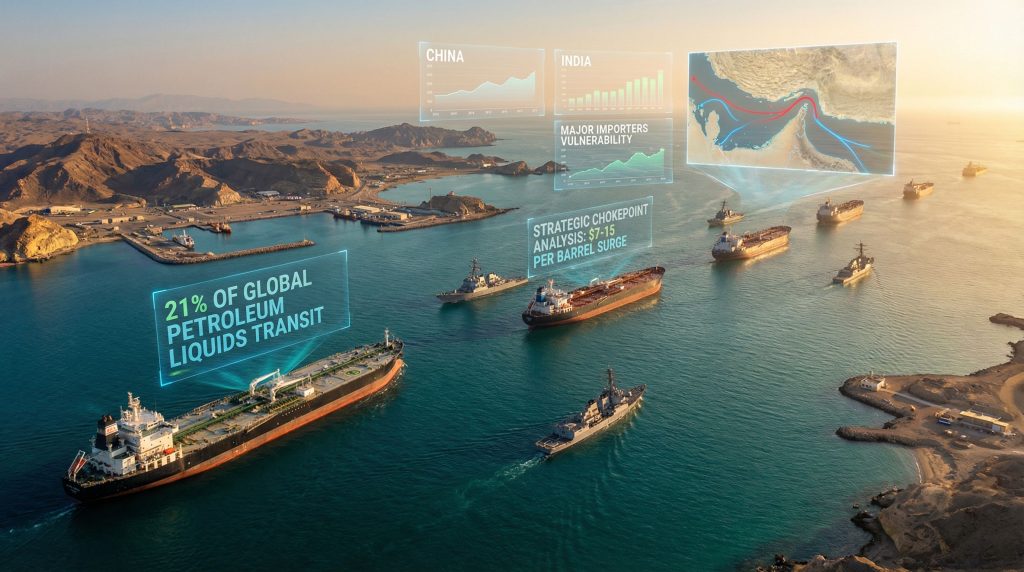
Daily petroleum throughput statistics demonstrate the global significance of this maritime corridor. Approximately 21% of worldwide petroleum liquids transit through these waters, representing roughly 18-20 million barrels per day during peak flow periods. Any disruption to this volume creates immediate supply chain stress across multiple continents.
Alternative routing options for affected shipments involve substantial cost penalties and timeline extensions:
- Pipeline diversions: 15-30 day delays through Central Asian corridors
- Overland transport: 200-400% cost increases via truck and rail
- Cape of Good Hope routing: Additional 6,000 nautical miles and 3-4 weeks transit time
- Insurance surcharges: 300-500% premium increases for conflict zone coverage
When big ASX news breaks, our subscribers know first
What Economic Scenarios Could Unfold from Sustained Maritime Enforcement?
Energy market dynamics respond to geopolitical shocks through multiple transmission mechanisms, each operating on different timescales and affecting distinct segments of the global economy. Furthermore, understanding these oil price rally factors becomes essential when assessing the broader implications of naval enforcement actions.
Immediate Price Impact Modeling (0-30 days)
Risk premium calculations during the initial shock phase demonstrate the market's immediate response to supply uncertainty. Based on historical precedents from the 1980s Tanker War and recent Middle Eastern conflicts, risk premiums typically surge $7-15 per barrel during the first 72 hours of confirmed enforcement actions.
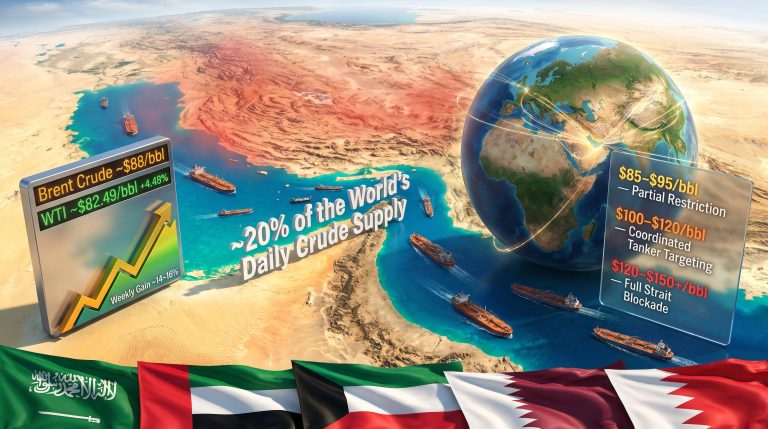
Physical crude markets diverge sharply from paper futures during crisis periods. While Brent crude futures reached $102.23 per barrel and WTI climbed to $103.88 per barrel on April 13, 2026, physical barrels of specific grades traded at steep premiums approaching $150 per barrel for immediate delivery.
Regional price differentials expand dramatically as transportation costs and insurance premiums escalate:
| Market Hub | Typical Differential | Crisis Differential | Premium Expansion |
|---|---|---|---|
| Asia-Pacific | Brent +$2-4/bbl | Brent +$12-18/bbl | 300-350% |
| Northwest Europe | Brent -$1-2/bbl | Brent +$6-10/bbl | 400-600% |
| US Gulf Coast | WTI +$1-3/bbl | WTI +$8-14/bbl | 250-400% |
| Mediterranean | Brent +$0-2/bbl | Brent +$10-16/bbl | 500-800% |
Medium-Term Supply Chain Restructuring (1-6 months)
Strategic Petroleum Reserve deployments across International Energy Agency member nations provide temporary supply buffers during extended disruptions. Combined IEA strategic reserves exceed 1.5 billion barrels, theoretically sufficient to offset complete Iranian export cessation for 4-6 months at current consumption rates.
Alternative supplier capacity utilization accelerates as importers diversify source portfolios. However, the OPEC production impact must be carefully monitored as these nations coordinate their response:
- Saudi Arabia: Can increase output by 2-3 million barrels daily within 30-60 days
- United Arab Emirates: Additional 500,000-800,000 barrels daily capacity available
- Iraq: Southern export terminal expansions could add 1-1.5 million barrels daily
- US Shale: 6-12 month lag time for significant production increases
Shipping route optimization creates new logistical challenges as vessel operators reassess fleet deployment. Tanker charter rates increase 200-400% for alternative routing, while insurance providers implement war risk exclusions that effectively double coverage costs for Persian Gulf operations.
Long-Term Market Architecture Changes (6+ months)
Permanent supply chain diversification trends emerge as energy security considerations override pure economic optimization. Infrastructure investment acceleration in non-Persian Gulf regions reflects strategic repositioning by major importers seeking to reduce chokepoint dependence.
The US blockade of Iranian oil routes catalyzes policy recalibrations across major consuming nations. Energy security frameworks prioritize supply source diversity over cost minimization, driving long-term shifts in trade patterns that persist well beyond immediate crisis resolution.
Which Global Stakeholders Face the Greatest Strategic Exposure?
Energy import dependency patterns reveal asymmetric vulnerability distributions across the global economy. Consequently, analysing trade war market effects becomes crucial for understanding the broader strategic exposure assessment that must account for both direct import relationships and indirect economic transmission channels that amplify localized disruptions into systemic risks.
Primary Energy Import Dependencies
Regional vulnerability analysis demonstrates varying degrees of strategic exposure to Iranian supply disruptions:
| Region | Iranian Oil Dependence | Alternative Supply Access | Strategic Vulnerability | Adjustment Timeline |
|---|---|---|---|---|
| China | 8-12% of crude imports | Russia, Saudi Arabia, Angola | Medium-High | 60-90 days |
| India | 3-5% of crude imports | Iraq, UAE, US shale | Medium | 30-60 days |
| European Union | 1-2% of crude imports | Norway, Algeria, US LNG | Low | 15-30 days |
| Japan/South Korea | <1% of crude imports | Australia, Middle East alternatives | Low | 7-21 days |
| Turkey | 15-20% of crude imports | Russia, Iraq, Libya | High | 90-120 days |
China faces the most significant adjustment challenges due to existing supply contracts and payment mechanisms established outside traditional financial systems. Alternative supplier negotiations require substantial lead times and often involve complex barter arrangements or currency swap agreements.
Shipping and Insurance Sector Risk Assessment
Lloyd's of London war risk premium calculations incorporate multiple risk factors beyond direct military engagement. Base war risk premiums increase from 0.05% to 0.35% of vessel value during active enforcement periods, with additional surcharges for Persian Gulf transits reaching 0.5-0.75% per voyage.
Tanker fleet reallocation requirements create capacity constraints across the global shipping network:
- Very Large Crude Carriers (VLCCs): 25-30% reduction in Persian Gulf deployment
- Suezmax tankers: Increased demand for alternative route capabilities
- Aframax vessels: Regional redistribution to accommodate shorter hauls
- Product tankers: Refined petroleum routing shifts to non-Gulf suppliers
Maritime security service demand surge analysis indicates 300-500% increases in private security contracting for vessels transiting Middle Eastern waters. Armed guard deployment costs add $50,000-100,000 per voyage for commercial operators maintaining Persian Gulf operations.
How Might Iran Respond to Escalate or De-escalate the Crisis?
Iranian strategic response capabilities encompass both conventional and asymmetric options designed to impose costs on enforcement efforts while maintaining plausible deniability. Historical patterns suggest multi-vector approaches combining diplomatic, economic, and military elements to create escalation pressure without triggering overwhelming retaliation.
Asymmetric Response Capability Analysis
Proxy force activation across regional theaters provides Iran with escalation options beyond direct naval confrontation. Houthi forces in Yemen possess demonstrated capabilities to disrupt Red Sea shipping lanes using anti-ship missiles and drone swarms, potentially extending the geographic scope of supply disruptions.
Hezbollah deployment from southern Lebanon creates additional pressure on Israeli energy infrastructure, whilst Iraqi militia coordination threatens pipeline networks and port facilities serving regional energy exports. These distributed response options complicate defensive planning and force resource allocation across multiple fronts.
Cyber warfare targeting energy infrastructure vulnerabilities represents a low-cost, high-impact escalation pathway. Critical control system penetration of refineries, pipeline networks, and port facilities can create widespread operational disruptions without direct attribution to state actors. The Guardian reports that such capabilities have significantly evolved since 2020.
Missile and drone swarm tactics against commercial shipping have evolved significantly since 2019 incidents. Iranian naval capabilities include:
- Fateh-class submarines: Diesel-electric boats capable of mine laying and torpedo attacks
- Fast attack craft swarms: 50+ vessels carrying anti-ship missiles and torpedoes
- Shore-based missile batteries: 300+ kilometre range covering Gulf approaches
- Drone boat operations: Unmanned explosive vessels for asymmetric attacks
Economic Countermeasures and Sanctions Evasion
Dark fleet operations utilising aging tankers with obscured ownership structures enable continued export activities despite maritime enforcement. Ship-to-ship transfer methodologies in international waters beyond territorial limits create detection and interdiction challenges for naval forces.
Cryptocurrency and barter trade mechanisms circumvent traditional financial systems, with blockchain-based payment platforms providing transaction privacy that complicates sanctions enforcement. Regional ally coordination with Russia and China offers alternative payment systems and trade financing outside SWIFT-connected networks.
The US blockade of Iranian oil routes may accelerate development of alternative reserve currencies and trading platforms designed to reduce dollar dependence in energy transactions. These long-term structural changes could diminish the effectiveness of future sanctions regimes.
What Are the Broader Geopolitical Implications Beyond Energy Markets?
Regional power balance shifts extending beyond immediate energy considerations reshape strategic calculations across the Middle East and adjacent regions. In addition, examining tariffs impact analysis reveals how the demonstration of naval interdiction capabilities sends signals about broader maritime control options in other contested waters, particularly regarding Taiwan scenarios and South China Sea access routes.
Regional Power Balance Shifts
Saudi Arabia and UAE strategic positioning as swing producers enhances their diplomatic leverage during crisis periods. Both nations possess sufficient spare capacity to partially offset Iranian export losses whilst maintaining pricing influence through coordinated production adjustments.
Israel's security calculations benefit from reduced Iranian revenue streams that limit funding for proxy forces and weapons programs. However, escalation risks through Lebanese and Syrian borders create offsetting vulnerabilities that complicate strategic assessment.
Turkey's role as a potential diplomatic mediator reflects its unique position maintaining relationships with all parties whilst controlling access to alternative energy transit routes through Bosphorus and Dardanelles straits.
US Strategic Objectives and Success Metrics
Naval power projection demonstrations serve multiple strategic purposes beyond immediate Iranian pressure. Alliance coordination testing with European and Asian partners reveals coalition cohesion under stress whilst establishing precedents for collective responses to future energy security threats.
The US blockade of Iranian oil routes reinforces domestic energy independence narratives whilst demonstrating global reach capabilities that complement strategic competition with China and Russia. Success metrics include:
- Revenue impact assessment: Measuring Iranian oil export value reductions
- Alternative supplier coordination: Evaluating allied capacity utilisation
- Alliance burden-sharing: Monitoring partner contributions to enforcement efforts
- Economic isolation effectiveness: Tracking Iranian financial system stress indicators
How Should Energy Companies and Investors Position for Multiple Scenarios?
Portfolio risk management strategies must account for multiple scenario pathways with varying probability distributions and timeline horizons. The US blockade of Iranian oil routes creates both immediate volatility opportunities and fundamental structural shifts requiring different analytical frameworks.
Portfolio Risk Management Strategies
Upstream asset diversification away from Persian Gulf exposure requires careful evaluation of replacement capacity quality and political risk profiles. North American shale assets offer rapid production response capabilities but face regulatory uncertainties around environmental policies and infrastructure constraints.
West African offshore developments provide alternative supply sources with established infrastructure but require assessment of maritime security risks and local political stability. Latin American conventional resources offer geographic diversification benefits with varying fiscal terms and operational complexities.
Downstream refinery optimisation for alternative crude slate processing creates both challenges and opportunities. Furthermore, understanding the broader energy security transition becomes essential for long-term planning:
- Heavy crude processing capability: Refineries configured for Venezuelan or Canadian heavy oils gain competitive advantages
- Light sweet crude flexibility: Facilities handling US shale or West African grades benefit from increased availability
- Product yield optimisation: Refined product demand patterns shift based on transportation fuel substitution
Energy storage and trading position optimisation during volatility periods requires sophisticated risk management frameworks. Contango market structures create inventory carrying incentives, whilst backwardation rewards rapid turnover strategies.
Infrastructure Investment Acceleration Opportunities
LNG export facility expansion in non-conflict zones addresses European energy security concerns whilst creating long-term revenue streams. US Gulf Coast capacity additions face 36-48 month development timelines but benefit from domestic supply security and established shipping routes.
Australian LNG expansion projects offer Indo-Pacific supply alternatives with shorter transit routes to Asian markets. Political stability and regulatory frameworks provide additional risk mitigation compared to alternative locations.
Strategic pipeline development opportunities include:
- East Mediterranean corridors: Cyprus-Greece connections bypassing Turkish territory
- Trans-Caspian routes: Central Asian supply access avoiding Russian territory
- Arctic developments: Long-term supply diversification despite environmental challenges
- African cross-border networks: Regional integration projects reducing chokepoint dependence
Renewable energy deployment accelerates as a geopolitical risk hedge rather than purely economic investment. Energy security considerations justify premium pricing for domestic generation capacity that reduces import dependence.
The next major ASX story will hit our subscribers first
What Historical Precedents Inform Potential Resolution Pathways?
Historical analysis of maritime conflict resolution provides frameworks for assessing potential pathway scenarios and timeline expectations. The US blockade of Iranian oil routes operates within established precedents whilst incorporating technological and legal innovations that complicate traditional diplomatic approaches.
Successful De-escalation Models
The 1988 Iran-Iraq War ceasefire mechanisms demonstrate the effectiveness of international mediation combined with economic exhaustion pressures. United Nations Resolution 598 provided a framework for cessation of hostilities that preserved face-saving opportunities for both parties whilst establishing monitoring mechanisms for compliance verification.
Economic pressure versus military engagement cost-benefit analysis from this historical period indicates that sustained financial strain proves more effective than escalatory military responses. Iranian decision-making appears particularly sensitive to domestic economic conditions and public welfare considerations.
The 2019 Strait of Hormuz crisis resolution through diplomatic channels illustrates rapid de-escalation possibilities when communication channels remain open. Oman's mediator role provided neutral ground for indirect negotiations whilst maritime insurance markets created economic incentives for swift resolution.
Key success factors from historical precedents include:
- Face-saving exit strategies for all parties
- Economic incentive alignment through graduated relief mechanisms
- Third-party guarantees for agreement implementation
- Monitoring mechanisms for compliance verification
- Domestic political considerations in timing and sequencing
Failed Containment Scenarios and Lessons Learned
Prolonged sanctions effectiveness limitations emerge clearly from Iraqi experience during the 1990s and Iranian isolation from 2010-2015. Economic adaptation mechanisms develop over time that reduce pressure whilst imposing humanitarian costs on civilian populations.
Unintended consequence cascade effects on regional stability create secondary problems that often exceed original policy objectives. Iraqi WMD program acceleration during sanctions periods and Iranian nuclear programme advancement during isolation demonstrate counterproductive outcomes from extended pressure campaigns.
Alliance cohesion maintenance proves challenging during extended crisis periods as economic costs accumulate unevenly among partners. European energy dependency creates different cost tolerance levels compared to US domestic energy security, potentially fracturing coordinated responses over time.
The US blockade of Iranian oil routes must account for these historical lessons in designing sustainable pressure mechanisms that achieve objectives without creating worse regional instability or alliance fragmentation. Reuters analysis suggests that these considerations are paramount in current strategic planning.
Frequently Asked Questions About Maritime Energy Blockades
How Long Can Global Oil Markets Sustain Supply Disruption?
Market sustainability during supply disruptions depends primarily on Strategic Petroleum Reserve capacity and alternative supplier response rates. Combined global strategic reserves exceed 4 billion barrels, theoretically sufficient for 6-12 months of complete Iranian export cessation at current consumption levels.
However, economic pain thresholds emerge much earlier than physical supply exhaustion. Historical precedents suggest that sustained price levels above $120-130 per barrel trigger demand destruction and economic recession risks that create political pressure for resolution within 90-120 days.
Alternative supplier ramp-up capabilities provide the most realistic timeline constraints. Saudi spare capacity can offset 2-3 million barrels daily within 60 days, whilst US shale production requires 6-12 months for significant increases. This creates a critical vulnerability window during months 2-6 of sustained disruption.
What Legal Mechanisms Could End the Blockade?
International legal frameworks provide multiple pathways for blockade termination, though enforcement mechanisms remain limited. United Nations Security Council resolutions calling for cessation would require avoiding permanent member vetoes, creating complex diplomatic negotiations.
International Court of Justice proceedings under UNCLOS provisions could establish legal precedents, but compliance remains voluntary without enforcement mechanisms. Historical precedents suggest that economic pressure and alliance coordination prove more effective than legal challenges.
Bilateral diplomatic agreements between the US and Iran offer the most direct resolution pathway, potentially structured as graduated sanctions relief in exchange for verifiable compliance measures. Third-party guarantees from regional allies could provide implementation assurance.
How Do Energy Futures Markets Price Long-term Geopolitical Risk?
Futures curve structures reflect market expectations about conflict duration and resolution probability. Steep backwardation indicates expectations of near-term resolution, whilst sustained contango suggests prolonged disruption anticipation.
Options market volatility pricing provides insights into uncertainty levels and tail risk assessment. Elevated implied volatility across multiple expiration months indicates market expectations of continued uncertainty even after initial price spikes subside.
Risk premium persistence in longer-dated contracts reveals structural changes in market assumptions about geopolitical stability. The US blockade of Iranian oil routes may establish permanently higher risk premiums for Middle Eastern supply routes.
Strategic Outlook: Navigating Energy Security in an Uncertain Environment
The evolving landscape of energy geopolitics requires sophisticated analytical frameworks that account for multiple scenario pathways and their varying probability distributions. The US blockade of Iranian oil routes represents a fundamental shift toward using energy infrastructure as a primary tool of strategic competition rather than merely an economic commodity.
Key Monitoring Indicators for Market Participants
Daily tanker traffic data through alternative chokepoints provides early warning indicators of supply chain stress propagation. Suez Canal throughput, Turkish Straits traffic, and Cape of Good Hope routing patterns reveal emerging bottlenecks before they translate into price impacts.
Strategic reserve drawdown rates across major consuming nations indicate government assessment of crisis duration and severity. Coordinated releases suggest alliance coordination and confidence in near-term resolution, whilst unilateral drawdowns indicate increasing concern about extended disruption.
Diplomatic engagement frequency and multilateral coordination efforts provide leading indicators of potential resolution pathways. High-level diplomatic activity typically precedes de-escalation announcements by 7-14 days, offering positioning opportunities for market participants.
Critical monitoring metrics include:
- Insurance claim frequencies for Persian Gulf transits
- Alternative supplier production data from Saudi Arabia, UAE, and Iraq
- Cryptocurrency transaction volumes for Iran-related trade
- Regional proxy force activity levels across multiple theaters
- Chinese and Russian diplomatic engagement intensity
Long-term Energy Security Architecture Evolution
Accelerated energy transition investment gains momentum as a geopolitical hedge rather than purely environmental initiative. Energy security considerations justify premium pricing for domestic renewable capacity that reduces import dependence and exposure to supply chain disruptions.
Regional energy independence initiatives proliferate across major consuming nations as the costs of chokepoint dependency become apparent. Policy frameworks prioritise supply source diversity and domestic production capacity over pure economic optimisation.
Technology innovation priorities shift toward supply chain resilience rather than purely cost reduction. Advanced storage systems, rapid deployment capabilities, and flexible fuel switching technologies gain strategic value beyond their economic returns.
The US blockade of Iranian oil routes accelerates these structural transitions by demonstrating the vulnerability of traditional energy security assumptions. Market participants must balance short-term volatility opportunities against fundamental shifts in the geopolitical architecture governing global energy flows.
Disclaimer: This analysis contains forward-looking statements and scenario modelling based on historical precedents and current market conditions. Energy market investments involve substantial risks including geopolitical instability, price volatility, and regulatory changes. Past performance of similar scenarios does not guarantee future outcomes. Investors should conduct independent research and consider professional financial advice before making investment decisions.
Could These Geopolitical Energy Disruptions Signal Your Next Investment Opportunity?
Whilst global energy markets navigate these unprecedented maritime enforcement scenarios, Discovery Alert's proprietary Discovery IQ model continues identifying significant mineral discoveries across the ASX that could benefit from heightened commodity price volatility and supply chain diversification trends. Experience how real-time discovery alerts can position your portfolio ahead of market-moving announcements by beginning your 14-day free trial today and gain the strategic advantage you need in these uncertain times.