
August 7, 2026
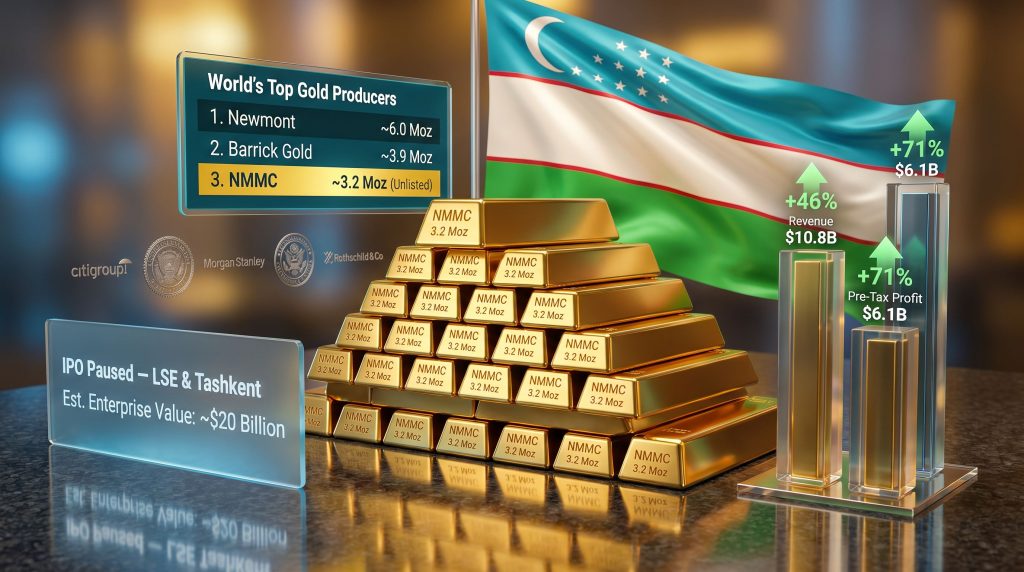
When a Government Becomes Its Own Biggest Obstacle to Privatisation
There is a paradox at the heart of sovereign wealth management that rarely receives the attention it deserves: the more financially successful a state-owned enterprise becomes, the harder it is for governments to let go of it. This dynamic plays out most visibly in resource-rich nations where commodity exports underpin not just export earnings, but the very functioning of the national budget. When gold is simultaneously a monetary reserve asset, an export commodity, a dividend engine, and a geopolitical tool, the decision to dilute ownership becomes far more complex than any investment bank valuation model can fully capture.
That is the strategic bind Uzbekistan now finds itself in, following reports that work on the Navoi Mining IPO has been paused. The decision, or more precisely the indecision, surrounding the public listing of the Navoi Mining and Metallurgical Company (NMMC) offers a rare window into the fiscal architecture of a Central Asian economy navigating the tensions between sovereign control and international capital market integration.
When big ASX news breaks, our subscribers know first
Understanding the Scale of NMMC: A Gold Giant Without a Ticker Symbol
To appreciate why the Navoi Mining IPO pause matters beyond Uzbekistan's borders, the company's financial and operational profile demands scrutiny. NMMC produced 3.2 million ounces of gold in 2025, positioning it as the world's fourth-largest gold producer by output volume — a significant contributor to global gold production — trailing only Newmont, Barrick Gold, and closely rivalling AngloGold Ashanti depending on the reporting period.
The following table provides a comparative snapshot of the world's largest gold producers by estimated annual output:
| Rank | Producer | Est. Annual Output (Moz) | Primary Listing(s) |
|---|---|---|---|
| 1 | Newmont | ~6.0 | NYSE / ASX |
| 2 | Barrick Gold | ~3.9 | NYSE / TSX |
| 3 | AngloGold Ashanti | ~2.6 to 3.0 | NYSE / JSE |
| 4 | NMMC (Navoi Mining) | ~3.2 | Unlisted |
| 5 | Gold Fields | ~2.3 | NYSE / JSE |
Note: Output figures are approximate and based on publicly available 2025 reporting. NMMC figures are sourced from its 2025 IFRS financial statements.
What makes this comparison structurally significant is the final column. Every other producer in the top five has been subject to public market scrutiny, institutional shareholder oversight, quarterly earnings calls, and the capital allocation discipline that comes with a public listing. NMMC operates entirely outside this framework. It is state-owned, privately held by Uzbekistan's Ministry of Economy and Finance, and reports to no external shareholders.
The financial metrics reinforce how anomalous this is. According to NMMC's 2025 IFRS financial statements, the company generated revenue of $10.8 billion, a 46% increase year-on-year, while profit before tax reached $6.1 billion, representing 71% growth compared to the prior year. These are numbers that would place NMMC among the most profitable mining companies on earth, publicly listed or otherwise.
At a pre-tax profit margin approaching 56%, NMMC's financial efficiency surpasses many of its publicly listed peers, raising a fundamental question for capital markets: what would an institution of this scale actually be worth on the open market?
The estimated enterprise value attached to the proposed IPO was approximately $20 billion inclusive of debt obligations, based on reporting from Bloomberg ahead of the pause announcement. With only a 5% stake proposed for public sale, even this limited divestiture would have represented a transaction of roughly $1 billion in proceeds at that valuation. Furthermore, according to recent coverage, the pause has drawn considerable attention from international mining analysts tracking the deal's progress.
What the Dual-Listing Structure Was Designed to Achieve
The original plan called for a simultaneous listing on both the London Stock Exchange (LSE) and the Tashkent Stock Exchange, a dual-listing architecture that reflected two distinct objectives operating in parallel. London would deliver international institutional capital and credibility, while the Tashkent component would demonstrate domestic political commitment to economic reform and market development.
This structure is not unusual for emerging market resource companies seeking international visibility while retaining a domestic footprint. What was unusual was the ambition: bringing a fully state-owned, multi-billion-dollar gold miner to public markets in a jurisdiction where international capital market infrastructure is still maturing requires a degree of regulatory, legal, and investor relations preparation that typically spans multiple years.
The advisory consortium assembled for this task reflected the deal's institutional seriousness, with major global investment banks engaged as consultants on the transaction. The calibre of the advisors assigned to this mandate signalled that this was not a speculative or aspirational exercise, but a structured process with genuine momentum — at least until it was not.
Uzbekistan's Broader Privatisation Mandate
The NMMC listing was never conceived in isolation. It formed the centrepiece of a sweeping privatisation agenda outlined in a presidential decree issued in April 2025, identifying twelve state-owned enterprises earmarked for public offerings between 2025 and 2028. NMMC was the most prominent name on that list and was described as the flagship transaction.
However, rather than proceeding with NMMC first, the Uzbek authorities pivoted to listing the National Investment Fund of Uzbekistan (UzNIF) in London, with that deal confirmed as nearing completion in early May 2026. This sequencing shift is itself instructive. UzNIF's London IPO functions as a market-entry proof-of-concept, testing institutional appetite for Uzbek sovereign assets before committing the flagship to international scrutiny. Following NMMC in the privatisation queue, the presidential decree identified uranium producer Navoiyuran and Uzbekistan Airways as additional IPO candidates.
The Fiscal Conflict Driving the Navoi Mining IPO Pause
The core issue is not valuation uncertainty or market timing in the conventional sense. It is something more structurally embedded: NMMC's dividends flow directly to the Uzbek state budget, and a public listing would introduce a competing class of claimants on those earnings.
Gold plays an extraordinary role in Uzbekistan's macroeconomic architecture. Consider the interlocking dependencies:
- Gold sales constitute a dominant share of Uzbekistan's total export earnings
- The metal accounts for the majority of the country's international reserves
- The Central Bank of Uzbekistan ranks among the world's most active sovereign gold buyers, reflecting broader central bank gold demand trends observed globally in 2025
- NMMC's dividend stream functions as a direct fiscal transfer mechanism to the state budget
Even a 5% equity sale to public shareholders creates a legally binding obligation to share future dividends with those shareholders on a proportional basis. In a high gold price environment, this is not a trivial concession. With gold having surpassed $5,500 per ounce in January 2026 and remaining elevated through May 2026, the opportunity cost of diluting ownership at a revenue peak is measurably higher than it would have been in a lower price environment.
Elevated commodity prices are typically interpreted as IPO tailwinds, because they inflate valuations and attract investor appetite. For Uzbekistan, however, high gold prices simultaneously increase the cost of surrendering equity, making the government more reluctant to list precisely when markets would be most receptive.
This inverse dynamic is a feature of sovereign asset monetisation that rarely surfaces in mainstream IPO analysis. A privately held sovereign enterprise generating billions in annual profit at peak commodity prices has little fiscal incentive to open its books to external shareholders, regardless of what the international capital markets might offer in return. Indeed, the broader gold market outlook for 2025 and beyond only reinforces why Tashkent views full ownership as an increasingly valuable position.
What Institutional Investors Need to Understand About Sovereign Mining IPOs
Investors evaluating sovereign-owned mining company listings need to account for a set of risk factors that do not apply to conventionally structured public companies:
- Dividend policy opacity: State-owned enterprises often lack formally codified dividend policies, creating uncertainty for minority public shareholders about payout ratios and timing
- Governance transparency gaps: Without existing public disclosure obligations, the transition to listed company governance standards requires significant institutional change
- Geopolitical concentration risk: Single-country, state-owned assets carry sovereign risk that is difficult to hedge within a diversified equity portfolio
- Regulatory sequencing complexity: Dual-listed entities must satisfy regulatory requirements across multiple jurisdictions simultaneously, increasing execution risk
- Valuation methodology divergence: Analysts in different markets may apply materially different valuation frameworks, creating pricing tension between domestic and international listing venues
How the IPO Pause Fits Into Uzbekistan's Capital Market Trajectory
The decision to pause rather than cancel is a meaningful distinction. Cancellation would represent a policy reversal with reputational consequences for Uzbekistan's international capital market credibility. A pause, however, preserves optionality while allowing the government to assess the outcomes of the UzNIF London listing and recalibrate the timing conditions for NMMC.
Uzbekistan's position as Central Asia's second-largest economy gives the privatisation program strategic significance beyond the individual transactions it contains. The country has been methodically building institutional credibility with international investors, and the UzNIF IPO represents an important milestone in that process regardless of NMMC's timeline.
For context, consider how comparable Central Asian and emerging market sovereigns have approached state-asset listings. Kazakhstan's Samruk-Kazyna sovereign wealth fund has pursued partial listings of national champions including Kazatomprom, the world's largest uranium producer, on the London and Astana exchanges simultaneously. That precedent demonstrates that dual-listed sovereign resource companies can successfully attract institutional capital, though the governance conditions and investor communication frameworks required are substantial.
The London Stock Exchange's mining sector has itself experienced declining new listings in recent years, making a transaction of NMMC's scale potentially transformative for the exchange's resource sector profile. Furthermore, this dynamic adds an additional layer of interest from the LSE's perspective in seeing the NMMC listing eventually proceed. Consequently, the gold sector M&A activity and listing momentum observed across global markets in 2025 suggests institutional appetite for large-cap gold equity remains robust.
What a Completed NMMC Listing Would Mean for Global Gold Equity Markets
If and when the Navoi Mining IPO does proceed, the implications for global gold equity markets would be far-reaching:
- At a ~$20 billion market capitalisation, NMMC would immediately rank among the top five publicly traded gold miners globally
- Index inclusion eligibility across FTSE and MSCI indices would generate structural buying pressure from passive funds tracking those benchmarks
- Portfolio managers currently allocated to existing gold majors would face rebalancing decisions as a new large-cap option entered the investable universe
- The London Stock Exchange's mining sector would receive a material injection of liquidity and profile from a high-volume, high-revenue gold producer
- Competitive benchmarking for Barrick Gold, Newmont, and AngloGold Ashanti would shift as analysts incorporated NMMC's cost structure and margin profile into peer comparison frameworks
The cost-per-ounce metric, known in the industry as all-in sustaining cost (AISC), would be one of the most closely scrutinised data points upon any resumption of listing preparations. NMMC's geographic positioning in Uzbekistan, with its combination of lower labour costs and established mining infrastructure developed over decades, may yield a competitive AISC profile relative to peers operating in higher-cost jurisdictions such as Australia, Canada, or parts of West Africa.
In addition, the gold miners investment outlook for 2025 suggests that institutional appetite for large-scale gold equity exposure remains exceptionally strong, which would further support demand for NMMC shares in the event the IPO eventually proceeds.
For institutional gold equity investors, a publicly listed NMMC would represent one of the most significant new additions to the investable gold mining universe in more than a decade, potentially rivalling the market impact of major gold sector mergers in terms of index weight and liquidity implications.
The next major ASX story will hit our subscribers first
Frequently Asked Questions: Navoi Mining IPO Paused
What is Navoi Mining and Metallurgical Company (NMMC)?
NMMC is a fully state-owned gold producer headquartered in Uzbekistan. With 3.2 million ounces of gold produced in 2025, it ranks as the world's fourth-largest gold producer by output volume, behind Newmont and Barrick Gold and ahead of Gold Fields.
Why has the Navoi Mining IPO been paused?
Uzbekistan's government has expressed concern that proceeding with a public listing would reduce the substantial dividend income NMMC generates for the national budget. Gold's central role in Uzbekistan's export earnings, international reserves, and central bank strategy creates a structural incentive to retain full ownership, particularly during periods of elevated gold prices.
What exchanges was the Navoi Mining IPO planned for?
The original structure called for a simultaneous dual listing on the London Stock Exchange and the Tashkent Stock Exchange.
What is Navoi Mining's estimated valuation?
Investment banks and analysts estimated NMMC's enterprise value at approximately $20 billion inclusive of debt, based on a proposed offering of up to 5% of total equity.
Will the Navoi Mining IPO still happen?
No definitive timeline has been established. NMMC has stated that the listing decision rests entirely with its shareholder, the Ministry of Economy and Finance, and any decision will be announced when and if it is made. The Ministry did not respond to media requests for comment.
What comes next in Uzbekistan's privatisation pipeline?
Following the UzNIF London IPO, uranium producer Navoiyuran and Uzbekistan Airways are identified as upcoming candidates in the presidential privatisation decree.
Key Takeaways: The Strategic Weight of the NMMC IPO Pause
- The pause reflects a fiscal timing calculation, not a reversal of Uzbekistan's privatisation ambitions, as the broader program remains active with UzNIF proceeding in London
- Elevated gold prices create a counterintuitive deterrent to listing, increasing the opportunity cost of equity dilution precisely when market conditions appear most favourable
- NMMC's role as a direct budget revenue mechanism through dividends creates a structural conflict that standard IPO analysis frameworks do not adequately capture
- The dual-listing architecture and advisory relationships remain intact conceptually, preserving the optionality to restart when fiscal conditions and policy priorities align
- For global gold equity investors, an eventual NMMC listing would introduce a top-five producer to public markets, reshaping index compositions, competitive benchmarking, and institutional allocation frameworks across the gold sector
Disclaimer: This article is intended for informational purposes only and does not constitute financial or investment advice. All financial figures referenced are sourced from NMMC's 2025 IFRS financial statements and publicly reported Bloomberg data. Valuations, production rankings, and market projections involve estimates that may differ from actual outcomes. Readers should conduct independent research before making any investment decisions.
Want to Stay Ahead of the Next Major Gold Discovery on the ASX?
Discovery Alert's proprietary Discovery IQ model delivers real-time alerts on significant ASX mineral discoveries, instantly cutting through complex data to surface actionable opportunities — explore the historic returns major discoveries have generated and begin your 14-day free trial to position yourself ahead of the broader market.