July 23, 2026
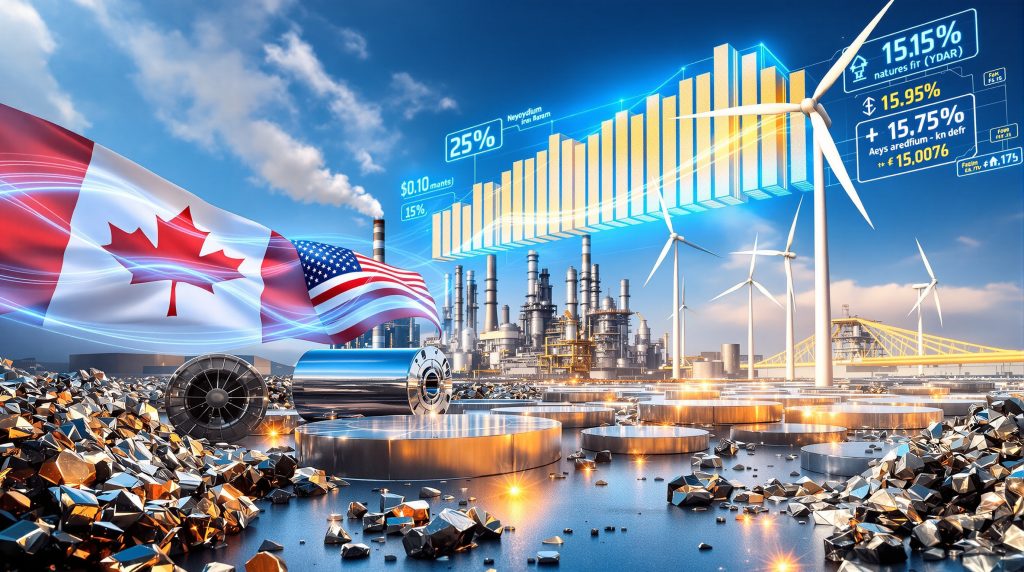
The electric vehicle revolution and wind energy expansion are fundamentally reshaping the NdFeB magnets market in North America, creating unprecedented demand for high-performance permanent magnet materials. These rare earth magnets achieve their exceptional magnetic properties through carefully controlled compositions that maximize energy density while maintaining structural integrity under demanding operating conditions. Furthermore, the region's strategic positioning within the global supply chain creates both opportunities and vulnerabilities that industry participants must carefully navigate.
Understanding Neodymium-Iron-Boron Technology
Neodymium-iron-boron (NdFeB) magnets represent the most powerful permanent magnet technology commercially available today, fundamentally transforming applications across automotive, renewable energy, and industrial sectors. These rare earth permanent magnets achieve their superior performance through a carefully controlled composition that maximizes magnetic flux while maintaining structural integrity under demanding operating conditions.
| Component | Percentage | Function |
|---|---|---|
| Neodymium (Nd) | 25-35% | Primary magnetic element |
| Iron (Fe) | 60-70% | Structural foundation |
| Boron (B) | 1-2% | Crystal structure stabiliser |
| Dysprosium (Dy) | 2-8% | High-temperature performance |
The crystalline structure of NdFeB magnets centres around the Nd₂Fe₁₄B tetragonal phase, which provides exceptional uniaxial magnetic anisotropy enabling maximum energy products (BHmax) ranging from 40-52 MGOe for standard grades. Advanced compositions can achieve up to 60 MGOe, delivering saturation magnetisation values approaching 1.6 Tesla and remanence values of 1.3-1.4 Tesla in optimised microstructures.
Manufacturing processes significantly impact final magnet properties:
- Sintered magnets: Highest performance, mass production capability, complex multi-step powder metallurgy process
- Bonded magnets: Complex geometries possible, lower magnetic properties, polymer binder integration
- Hot-deformed magnets: Anisotropic properties, enhanced grain alignment, specialised applications
Critical to NdFeB performance is the grain boundary phase, enriched with neodymium and boron, which provides magnetic decoupling between individual grains. This microstructural feature enables high coercivity achievement in sintered magnets, while dysprosium and terbium preferentially segregate to these boundaries, providing essential high-temperature coercivity stability.
Temperature derating represents a crucial consideration for North American applications, with NdFeB magnets experiencing approximately 0.11% magnetic flux loss per degree Celsius above 20°C. This characteristic necessitates careful thermal management in automotive and industrial applications where sustained high temperatures occur.
When big ASX news breaks, our subscribers know first
North America's Strategic Market Position
North America commands a strategically significant position within the global permanent magnets ecosystem, representing 15% of worldwide consumption in a market valued at $24 billion globally as of 2025. The region's $5.1 billion permanent magnets market demonstrates robust growth dynamics, expanding at a 5.5% compound annual growth rate that outpaces the global average of approximately 4.8%.
This outperformance reflects several structural advantages unique to the North American market environment. Proximity to end-use industries including automotive manufacturing, aerospace systems, and renewable energy infrastructure creates natural demand concentrations that support localised supply chain development. Additionally, policy frameworks increasingly prioritise supply chain resilience and domestic manufacturing capabilities, particularly for technologies considered critical to national security interests.
The regional market structure operates across three distinct tiers that collectively define North America's magnet supply ecosystem:
Tier 1 – Raw Material Supply:
- Mountain Pass rare earth mining operations (California)
- Strategic partnerships with international suppliers
- Emerging domestic separation capabilities
Tier 2 – Processing and Separation:
- MP Materials Texas facility development
- USA Rare Earth Oklahoma processing expansion
- Lynas Corporation North American partnerships
Tier 3 – Magnet Manufacturing:
- Integrated producers with full supply chain control
- Specialised manufacturers focusing on specific applications
- Custom magnet designers serving niche markets
Competitive positioning within the NdFeB magnets market in North America benefits from several unique factors compared to Asia-dominated production regions. North American manufacturers can leverage shorter supply chains to automotive and aerospace customers, reducing logistics costs and enabling rapid customisation responses. Environmental and labour standards, while increasing production costs, create differentiated value propositions for customers requiring supply chain transparency and sustainability compliance.
However, significant challenges constrain market expansion. Manufacturing costs remain 40-60% higher than Chinese operations due to labour, environmental compliance, and infrastructure factors. Consequently, access to separated rare earth elements continues to depend heavily on international suppliers, creating supply chain vulnerabilities that domestic capacity expansion aims to address over the next decade.
Current Market Valuation and Growth Trajectory
The NdFeB magnets market in North America achieved a total valuation of $5.1 billion in 2025, positioning the region for sustained expansion toward a projected $8.2 billion market by 2035. This growth trajectory represents a 5.5% compound annual growth rate, significantly exceeding global market expansion rates and reflecting accelerated electrification across transportation and energy infrastructure sectors.
Global context provides essential perspective on North America's market dynamics. The worldwide permanent magnets industry reached $24 billion in 2025, with projections indicating growth to $38.5 billion by 2035, establishing a global compound annual growth rate of approximately 4.8%. North America's outperformance against this baseline demonstrates the region's structural demand drivers and policy support mechanisms driving above-average expansion.
Market Composition Analysis (2025):
| Magnet Type | Market Share | Estimated Value | Primary Applications |
|---|---|---|---|
| NdFeB magnets | 51% | $2.6 billion | EV motors, wind turbines |
| Ferrite magnets | 30-35% | $1.5-1.8 billion | Industrial motors, speakers |
| SmCo and Alnico | 14-19% | $0.7-1.0 billion | Aerospace, high-temperature |
NdFeB magnets command the largest market share at 51%, reflecting their dominance in high-performance applications where magnetic strength and energy density provide critical competitive advantages. These applications include electric vehicle traction motors, direct-drive wind turbine generators, and precision industrial automation systems.
Regional growth differentials within North America reveal varying expansion rates reflecting local industrial concentrations and policy environments:
- United States: 5.5% CAGR driven by automotive electrification and defence spending
- Mexico: 5.1% CAGR supported by manufacturing hub development and USMCA trade benefits
- Canada: 4.8% CAGR focused on mining equipment and renewable energy applications
Investment flows into domestic manufacturing capabilities demonstrate market confidence in long-term growth sustainability. Capital commitments exceeding $3 billion across the next five years target vertical integration from rare earth processing through finished magnet production, indicating industry recognition of supply chain security importance and economic opportunity.
Market pricing dynamics reflect both supply constraints and demand growth pressures. NdFeB magnet pricing averaged $45-65 per kilogram in 2025, with premium grades commanding $80-120 per kilogram depending on magnetic properties and temperature ratings. However, price volatility remains tied to rare earth commodity markets, particularly neodymium and dysprosium pricing fluctuations driven by Chinese export policies and global supply-demand imbalances.
What's Driving Electric Vehicle Magnet Demand?
The automotive sector represents the most significant growth driver within the NdFeB magnets market in North America, contributing 40% of total regional demand valued at approximately $2.04 billion in 2025. Electric vehicle adoption fundamentally transforms magnet consumption patterns, with each EV requiring 1-3 kilograms of high-performance NdFeB magnets primarily for traction motor applications.
North American EV production trajectories indicate sustained magnet demand acceleration. Current production levels of approximately 1.6-1.7 million electric vehicles annually are projected to reach 3.5 million units by 2026, representing a 106% increase that directly translates to proportional magnet consumption growth. This expansion generates an estimated 5,250 tonnes of annual NdFeB demand from automotive applications alone by 2026.
Permanent Magnet Synchronous Motor Architecture:
Electric vehicle manufacturers predominantly deploy permanent magnet synchronous motors (PMSM) for traction applications due to superior efficiency and power density characteristics:
- Efficiency ratings: 92-96% continuous operation across wide speed ranges
- Power density: 3-5 kW/kg for integrated motor and magnet assemblies
- Torque characteristics: Immediate full torque availability from zero RPM
- Operating temperature: -40°C to +150°C with established derating curves
- Magnetic requirements: 1.5-2.5 kg NdFeB per 100 kW motor output
Technical specifications for automotive magnet applications demand precise performance parameters to meet efficiency targets and durability requirements. Motor designers typically specify N38-N52 grade magnets for standard operational profiles, while high-performance vehicles requiring sustained high-temperature operation utilise N35H-N48H temperature-resistant variants capable of maintaining magnetic properties at sustained 100-120°C operating temperatures.
Regional Manufacturing Hub Development:
North American automotive electrification benefits from expanding domestic manufacturing infrastructure:
- Tesla Gigafactory Texas: Integrated vehicle and motor production capability
- Ford Rouge Electric Vehicle Centre: F-150 Lightning and future EV platforms
- GM Spring Hill Assembly: Cadillac Lyriq and future Ultium platform vehicles
- BMW Spartanburg: iX and i4 model production with integrated supply chains
Supply chain localisation efforts increasingly emphasise reduced dependence on international magnet suppliers. Automotive manufacturers recognise magnet supply as a critical bottleneck potentially constraining EV production scale-up, driving investment in North American magnet production capabilities and long-term supply agreements with domestic manufacturers.
Alternative powertrain technologies present both opportunities and risks for magnet demand growth. Hydrogen fuel cell vehicles require significantly lower magnet content, typically 200-500 grams per vehicle compared to battery electric vehicles. Furthermore, plug-in hybrid vehicles represent a middle ground, requiring 0.5-1.5 kg of magnets per vehicle depending on electric motor sizing and operational requirements.
Market Psychology and Investment Implications:
Automotive magnet demand exhibits high correlation with EV adoption rates, creating investment opportunities in companies positioned across the magnet supply chain. However, technological risks including potential shifts toward magnet-free motor designs (switched reluctance motors, induction motors with advanced materials) require careful evaluation for long-term investment strategies.
How Wind Energy Drives Infrastructure Expansion
Wind energy represents the second-largest demand driver for the NdFeB magnets market in North America, commanding 25% of regional magnet consumption valued at $1.28 billion in 2025. Direct-drive wind turbine generators require substantial magnet quantities, with a typical 3 MW offshore turbine containing approximately 600 kilograms of rare earth permanent magnets, of which 75% consists of NdFeB materials.
North American offshore wind development creates unprecedented magnet demand concentrations. Planned offshore wind capacity of 30 GW by 2030 represents approximately 10,000 turbines of 3 MW average capacity, generating cumulative magnet demand exceeding 4,500 tonnes of NdFeB materials valued at approximately $315 million at current pricing levels.
"Each offshore wind turbine installation represents a 20-25 year operational commitment with minimal magnet replacement requirements, creating sustained demand visibility that supports long-term supply chain investment planning."
Turbine Generator Technology Requirements:
Direct-drive permanent magnet generators eliminate mechanical gearboxes through low-speed, high-torque designs enabled by powerful rare earth magnets:
- Generator speed: 10-20 RPM operational range requiring high pole count designs
- Magnet grades: N35-N42 for standard applications, N35H-N40H for extreme weather conditions
- Operating temperatures: -40°C to +60°C with 20-year durability requirements
- Magnetic flux density: 0.8-1.2 Tesla air gap flux density for optimal efficiency
- Corrosion resistance: Marine environment protection through specialised coatings and encapsulation
Regional Wind Development Projects:
Major North American offshore wind projects demonstrate scale and magnet demand concentration:
| Project | Capacity | Location | Estimated Magnet Demand |
|---|---|---|---|
| Vineyard Wind | 800 MW | Massachusetts | 160 tonnes NdFeB |
| South Fork Wind | 132 MW | New York | 26 tonnes NdFeB |
| Ocean Wind | 1,100 MW | New Jersey | 220 tonnes NdFeB |
| Empire Wind | 2,076 MW | New York | 415 tonnes NdFeB |
Onshore wind development contributes additional magnet demand, though typically utilising smaller turbines with correspondingly reduced per-unit magnet requirements. A typical 2.5 MW onshore turbine contains approximately 400-500 kg of rare earth magnets, supporting domestic wind farm expansion across the Great Plains and mountain west regions.
Supply Chain Considerations:
Wind turbine magnet requirements create unique supply chain challenges due to size, weight, and precision manufacturing requirements:
- Segment manufacturing: Large turbine magnets require segmented construction for practical manufacturing and transportation
- Quality control: Magnetic property uniformity across large magnet assemblies demands specialised testing and certification
- Logistics coordination: Turbine installation schedules require precise magnet delivery timing and on-site inventory management
- Service and maintenance: 20-year operational life requires spare parts availability and potential magnet replacement capabilities
Technological Trends and Future Demand:
Turbine technology evolution toward larger, more efficient designs drives increased per-unit magnet content. Next-generation 15-18 MW offshore turbines under development may require 2-3 tonnes of rare earth magnets per unit, substantially increasing magnet intensity compared to current installations.
In addition, recycling considerations gain importance as first-generation wind farms approach end-of-life. Magnet recovery from decommissioned turbines presents both economic opportunities and environmental imperatives, with recovered magnets potentially supplying 15-20% of annual demand by 2035 based on installation timing and recycling technology advancement.
Critical Supply Chain Dependencies and Vulnerabilities
The NdFeB magnets market in North America faces fundamental supply chain constraints that threaten long-term growth sustainability and energy security objectives. China's overwhelming dominance in rare earth element refining creates systemic vulnerabilities that policy makers and industry participants increasingly recognise as strategic risks requiring urgent mitigation.
China's Supply Chain Control:
China maintains 90% control of global rare earth refining capacity, extending far beyond raw material extraction to encompass the sophisticated separation and purification processes essential for magnet-grade rare earth compounds. This control encompasses multiple critical minerals energy transition elements required for high-performance NdFeB magnets:
| Element | Chinese Control | North American Production | Strategic Importance |
|---|---|---|---|
| Neodymium | 85% | MP Materials (15%) | Essential for all NdFeB |
| Praseodymium | 88% | Limited processing | Magnetic strength enhancement |
| Dysprosium | 95% | None | High-temperature stability |
| Terbium | 97% | None | Coercivity improvement |
Processing Cost Differentials:
North American rare earth processing operates under significant cost disadvantages compared to Chinese operations:
- Labour costs: 300-400% higher than Chinese facilities
- Environmental compliance: Stricter standards increase processing costs by 25-35%
- Infrastructure development: Greenfield facilities require $500 million to $2 billion capital investments
- Scale economics: Chinese facilities benefit from integrated operations and decades of optimisation
- Technology licensing: Intellectual property costs and restricted access to proprietary processes
Raw Material Availability Constraints:
North American rare earth oxide production represents less than 5% of global supply, creating fundamental feedstock limitations for domestic magnet manufacturing. Mountain Pass mine in California provides the region's primary rare earth source, but capacity constraints and processing bottlenecks limit expansion potential without substantial additional investment.
Critical element shortages pose particular challenges for high-performance magnet applications. Dysprosium and terbium, essential for temperature-resistant magnet grades required in automotive and aerospace applications, demonstrate virtually complete dependence on Chinese supply chains with no significant alternative sources under development.
Strategic Reserve and Stockpiling:
Current North American strategic reserves provide approximately 30 days of rare earth supply for magnet production, insufficient for sustained operations during supply disruptions. Defence stockpiling focuses primarily on military applications rather than commercial magnet production, creating gaps in supply security for civilian critical infrastructure applications.
Geopolitical Risk Assessment:
Trade tensions and export restrictions represent active risks rather than theoretical concerns. Historical precedents including China's 2010 rare earth export restrictions demonstrate the vulnerability of international supply chains to geopolitical manipulation. Current export quotas and licensing requirements maintain Chinese leverage over global rare earth markets.
Alternative Supplier Development:
Diversification efforts focus on developing partnerships with non-Chinese suppliers:
- Lynas Corporation (Australia): Established rare earth producer with North American processing plans
- MP Materials: Vertical integration from California mining through Texas processing
- Canadian rare earth projects: Quebec and Northwest Territories exploration and development
- Greenland and other Arctic resources: Long-term strategic potential requiring international cooperation
However, these alternatives require years of development and billions in capital investment before achieving meaningful production volumes capable of reducing Chinese dependence.
The next major ASX story will hit our subscribers first
Domestic Manufacturing Capacity Development
North American companies are implementing aggressive capacity expansion strategies to establish domestic magnet production capabilities and reduce dependence on Chinese supply chains. These initiatives represent over $3 billion in committed capital investments targeting vertical integration from rare earth processing through finished magnet manufacturing.
Major Investment Projects:
MP Materials Corporation leads North American capacity development through comprehensive vertical integration:
- Texas Processing Facility: $700 million investment targeting 2025 completion for rare earth separation and magnet production
- Mountain Pass Mine Expansion: Enhanced rare earth concentrate production from existing California operations
- Technology Development: Partnerships with General Motors for automotive supply chain integration
- Capacity Targets: 50,000 tonnes annual rare earth oxide production with integrated magnet manufacturing
USA Rare Earth focuses on domestic processing capabilities:
- Oklahoma Processing Plant: $200 million facility development for rare earth separation
- Feedstock Strategy: Domestic and Canadian rare earth concentrate sourcing
- Production Timeline: Commercial operations targeted for 2026-2027
Quadrant Magnetics expands specialised manufacturing:
- Pennsylvania Operations: Enhanced production capacity for custom magnet applications
- Defence Contracting: Specialised magnets for aerospace and military systems
- Technology Focus: High-temperature and radiation-resistant magnet grades
Canadian Rare Earth Elements Corporation:
- Quebec Separation Facility: Integrated processing for Canadian rare earth concentrates
- Strategic Partnerships: Technology licensing from international separation specialists
- Environmental Permits: Advanced permitting for commercial operations
Manufacturing Technology Transfer:
Domestic capacity development requires sophisticated technology acquisition and workforce development:
- Process Engineering: Hydrometallurgical separation requires specialised chemical engineering expertise
- Quality Control: Magnet-grade rare earth specifications demand precise analytical capabilities
- Equipment Sourcing: Specialised processing equipment from international suppliers
- Workforce Training: Technical education programmes for rare earth processing and magnet manufacturing
Production Timeline and Milestones:
Realistic capacity development timelines extend across multiple years due to complex permitting, construction, and commissioning requirements:
- 2025-2026: Initial rare earth separation capacity online
- 2027-2028: Integrated magnet production capabilities
- 2029-2030: Significant domestic supply chain independence
- Post-2030: Potential export capability to allied nations
Investment Risk Factors:
Substantial capital commitments face multiple risk factors that could impact project completion and commercial viability:
- Commodity Price Volatility: Rare earth pricing fluctuations affect project economics
- Technology Risks: Unproven processing technologies in North American operating conditions
- Permitting Delays: Environmental and regulatory approval processes
- Market Demand: EV adoption rates and wind energy development pace
- Chinese Competition: Potential pricing strategies to discourage domestic competition
Government Policy Support and Strategic Initiatives
Government policy frameworks across North America provide unprecedented support for domestic magnet supply chain development, recognising rare earth permanent magnets as critical technologies for energy independence and national security. Policy mechanisms combine financial incentives, regulatory support, and strategic coordination to accelerate private sector investment in magnet manufacturing capabilities.
United States Policy Framework:
Inflation Reduction Act (IRA) provisions allocate $2.8 billion in rare earth and critical mineral incentives:
- Production Tax Credits: $0.15-0.30 per pound for domestic rare earth production
- Investment Tax Credits: 30% credit for qualified magnet manufacturing facilities
- Battery Material Processing: Incentives extending to magnet applications in energy storage
- Buy American Requirements: Federal procurement preferences for domestic magnet suppliers
Defense Production Act (DPA) applications target strategic material security:
- Title III Investments: Direct government funding for critical facility development
- Supply Chain Assessments: Systematic evaluation of magnet supply vulnerabilities
- Stockpile Expansion: Strategic reserve development for military and civilian applications
- Priority Ratings: Expedited permitting and resource allocation for critical projects
Critical Materials Security Program coordinates research and development:
- $150 million annual funding for materials research and alternative technology development
- University Partnerships: Advanced degree programmes in critical minerals and materials science
- International Cooperation: Technology sharing agreements with allied nations
USMCA Trade Agreement provisions support regional integration:
- Regional Content Requirements: Automotive trade benefits require North American magnet content
- Tariff Elimination: Reduced trade barriers for magnet materials between member nations
- Investment Protections: Enhanced security for cross-border magnet manufacturing investments
Canadian Policy Support:
Critical Minerals Strategy allocates CAD $3.8 billion over eight years:
- Processing Capacity: Support for domestic rare earth separation and magnet production
- Infrastructure Development: Transportation and power infrastructure for mining regions
- Indigenous Partnerships: Community agreements for resource development projects
- Export Finance: Support for Canadian companies in international markets
Mexican Manufacturing Incentives:
IMMEX Programme benefits extend to magnet manufacturing:
- Tax Benefits: Temporary importation of raw materials without duties
- Investment Incentives: Accelerated depreciation for manufacturing equipment
- Infrastructure Support: Industrial park development for automotive and electronics manufacturing
Environmental Permitting Streamlining:
Regulatory agencies implement expedited review processes for critical mineral projects:
- Fast-Track Permitting: Reduced timeline for environmental impact assessments
- Regulatory Coordination: Single-point contact for multi-agency approval processes
- Environmental Mitigation: Standardised approaches for rare earth processing environmental impacts
The US mineral production order demonstrates government commitment to supply chain security through comprehensive policy coordination.
International Coordination:
Minerals Security Partnership coordinates allied nation critical minerals strategies:
- Technology Sharing: Joint research and development programmes
- Supply Chain Mapping: Comprehensive analysis of global magnet supply vulnerabilities
- Financial Coordination: Multilateral development bank support for alternative supply chains
Recycling and Circular Economy Solutions
Magnet recycling represents a strategic pathway toward supply chain independence, offering economic and environmental advantages while reducing dependence on primary rare earth mining. Advanced recycling technologies can recover 85-95% of rare earth content from end-of-life magnets at costs 30-40% below virgin material pricing.
Current Recycling Capacity:
North American magnet recycling capabilities currently process approximately 2,500 tonnes annually, representing a small fraction of total magnet consumption but providing proof-of-concept for scaled operations:
- Urban Mining Company: Advanced hydrometallurgical processing in New York
- Noveon Magnetics: Specialised recycling processes with $12 million investment commitment
- American Elements: Research and development focus on recycling technology advancement
- University Research Programmes: Technical development at multiple institutions
Projected Capacity Expansion:
Industry projections indicate 12,000 tonnes annual recycling capacity by 2030, representing meaningful contribution to domestic supply security:
- Recovery Efficiency: 90% of original rare earth content recoverable through advanced processing
- Environmental Benefits: 75% reduction in environmental impact compared to primary mining
- Cost Advantages: Processing costs 30-40% below virgin rare earth pricing
- Quality Standards: Recycled materials meet magnet-grade specifications for most applications
This battery recycling breakthrough demonstrates technological advancement in sustainable recovery processes that can be adapted for magnet recycling applications.
End-of-Life Magnet Sources:
Multiple waste streams provide feedstock for recycling operations:
Automotive Applications:
- EV Motors: Vehicle end-of-life processing yields 1-3 kg magnets per vehicle
- Manufacturing Scrap: Production waste from motor assembly operations
- Warranty Returns: Defective components requiring reprocessing
Wind Energy Infrastructure:
- Turbine Decommissioning: First-generation wind farms approaching 20-25 year operational life
- Component Replacement: Maintenance operations generating magnet waste
- Upgrade Projects: Technology improvements requiring equipment replacement
Electronics and Consumer Goods:
- Hard Disk Drives: Legacy computer storage devices containing small but high-grade magnets
- Audio Equipment: Speakers and headphones with permanent magnet components
- Industrial Motors: HVAC, pump, and compressor motor replacements
Recycling Process Technology:
Advanced magnet recycling involves sophisticated four-stage processing:
- Demagnetisation: Thermal treatment at 350-400°C removes magnetic properties for safe handling
- Mechanical Separation: Physical breakdown removes non-magnetic components and coatings
- Hydrometallurgical Dissolution: Acid leaching dissolves rare earth elements into solution
- Selective Precipitation: Chemical processes separate and purify individual rare earth elements
Economic Analysis:
Recycling economics demonstrate favourable cost structures compared to primary production:
| Cost Component | Recycling | Primary Mining | Advantage |
|---|---|---|---|
| Raw Material | $0 | $15-25/kg REO | 100% savings |
| Processing | $35-45/kg REO | $45-65/kg REO | 25-35% savings |
| Environmental | $5-8/kg REO | $12-18/kg REO | 60% reduction |
| Total Production | $40-53/kg REO | $72-108/kg REO | 35-45% savings |
Technological Innovation:
Emerging recycling technologies promise improved efficiency and reduced environmental impact:
- Selective Leaching: Targeted extraction reduces chemical consumption and waste generation
- Bioleaching: Microorganism-based extraction for reduced environmental impact
- Electrochemical Recovery: Direct metal recovery without chemical precipitation
- Additive Manufacturing Integration: Direct use of recycled powders in 3D printing applications
Policy Support for Recycling:
Government programmes increasingly recognise recycling as strategic capability:
- Extended Producer Responsibility: Requirements for manufacturers to support product end-of-life management
- Tax Incentives: Credits for recycling facility development and operations
- Research Funding: Technology development support through national laboratories and universities
- Regulatory Framework: Streamlined permitting for recycling operations compared to mining projects
Technology Innovation and Future Development
Technological advancement drives the evolution of the NdFeB magnets market in North America through improved magnetic properties, manufacturing processes, and application-specific designs. Innovation focuses on enhanced performance, reduced rare earth content, and alternative compositions that maintain magnetic strength while addressing supply chain constraints.
Advanced Magnet Compositions:
Grain Boundary Diffusion Technology achieves 15% performance improvement through targeted enhancement of magnetic properties:
- Process Innovation: Selective dysprosium diffusion increases coercivity without bulk composition changes
- Material Efficiency: Reduces heavy rare earth element consumption by 30-50%
- Temperature Performance: Enhanced high-temperature stability for automotive and industrial applications
- Cost Benefits: Lower rare earth content reduces raw material costs while improving performance
Hot-Deformed Magnet Technology:
Advanced processing techniques create magnets with superior temperature stability and mechanical properties:
- Microstructural Control: Grain alignment optimisation through controlled deformation processes
- Coercivity Enhancement: Improved magnetic domain structure for higher performance
- Temperature Tolerance: Operational capability to 200°C with minimal performance degradation
- Automotive Applications: Specialised grades for high-performance EV motor requirements
Additive Manufacturing Integration:
3D printing technologies enable complex magnet geometries and reduced material waste:
- Design Flexibility: Complex internal structures impossible with traditional manufacturing
- Material Utilisation: 95%+ material utilisation compared to 60-70% for traditional machining
- Customisation Capability: Small-batch production for specialised applications
- Rapid Prototyping: Accelerated development cycles for new applications
Nanocrystalline Magnet Development:
Advanced materials science creates magnets with superior magnetic properties through controlled crystalline structures. According to North American neodymium magnet market research, these technological advances are driving significant market expansion opportunities.
- Grain Size Control: Nanometre-scale grain boundaries enhance magnetic isolation
- Exchange Coupling: Optimised magnetic interactions between crystalline phases
- Energy Product Enhancement: Theoretical maximum energy products approaching 70 MGOe
- Processing Challenges: Complex manufacturing requires specialised equipment and expertise
Alternative Magnet Technologies:
Research into rare-earth-free alternatives addresses supply chain concerns while maintaining performance. The NdFeB permanent magnets market outlook indicates growing investment in alternative technologies that could reshape the industry.
Iron-Nitride Magnets:
- Composition: Iron-nitrogen compounds with theoretical energy products comparable to NdFeB
- Supply Chain: Utilises abundant iron without rare earth dependencies
- Development Status: Laboratory-scale demonstration with industrial scale-up challenges
- Timeline: Commercial availability estimated 2028-2032
Manganese-Aluminium-Carbon (MnAlC) Magnets:
- Resource Availability: Uses abundant, non-critical elements
- Temperature Stability: Superior high-temperature performance compared to NdFeB
- Current Limitations: Lower energy product limits applications to specific niches
- Development Focus: Automotive applications where temperature tolerance compensates for lower magnetic strength
Hybrid Magnet Systems:
Integration of multiple magnet types optimises cost and performance, supporting the broader sustainable mining transformation occurring across the industry.
- Ferrite-NdFeB Combinations: High-volume, low-cost ferrite with strategic NdFeB placement
- Variable Composition: Location-specific magnet grades within single applications
- Cost Optimisation: Maximum performance at minimum rare earth content
- Manufacturing Integration: Automated assembly of hybrid magnet systems
Strategic Outlook and Investment Implications
The convergence of electrification trends, policy support, and technological innovation creates a compelling investment landscape within the NdFeB magnets market in North America. Multiple factors align to support sustained market growth while presenting both opportunities and risks that investors must carefully evaluate.
Market Growth Fundamentals:
Structural demand drivers indicate sustained market expansion beyond current projections. Electric vehicle production targets, offshore wind development commitments, and industrial electrification trends collectively generate magnet demand growth that exceeds current supply development timelines. This supply-demand imbalance creates pricing power for established suppliers and opportunities for new market entrants.
Investment Risk Assessment:
However, significant risks require careful consideration. Technology disruption through magnet-free motor designs could fundamentally alter demand patterns. Geopolitical tensions affecting rare earth supply chains present both risk and opportunity for domestic manufacturers. Environmental regulations and community opposition may delay facility development and increase capital costs.
Strategic Positioning Recommendations:
Successful market participation requires comprehensive supply chain strategy extending from raw materials through finished products. Vertical integration provides supply security but demands substantial capital investment and technical expertise. Strategic partnerships with established suppliers offer risk mitigation while maintaining flexibility for market evolution.
The NdFeB magnets market in North America represents a critical component of the region's energy transition and industrial competitiveness. Success in this market requires balancing technological innovation, supply chain security, and economic viability while navigating complex geopolitical and environmental considerations that will define the industry's future trajectory.
Want to Position Your Portfolio in Critical Materials?
The North American NdFeB magnet market's $5.1 billion valuation and projected 5.5% CAGR represent just one facet of the broader critical minerals revolution reshaping global supply chains. Discovery Alert's proprietary Discovery IQ model instantly identifies significant ASX mineral discoveries that could capitalise on this unprecedented demand surge, transforming complex geological announcements into actionable investment insights for both seasoned and emerging market participants.