May 19, 2026
Scenario Projection: When Capital Architecture Determines Whether a Mine Gets Built
The history of gold development is littered with projects that had the geology but lacked the financial engineering to bridge the gap between resource and production. Grade alone does not build a mine. Institutional conviction, covenant flexibility, and the sequencing of capital deployment are frequently the variables that separate projects that reach first pour from those that stall indefinitely at the feasibility stage. Understanding how New Found Gold Queensway financing is actually structured, and why specific instruments were chosen over alternatives, provides a far more predictive lens for evaluating development-stage gold assets than headline capital numbers alone.
When big ASX news breaks, our subscribers know first
Why the New Found Gold Queensway Financing Structure Deserves Deeper Scrutiny
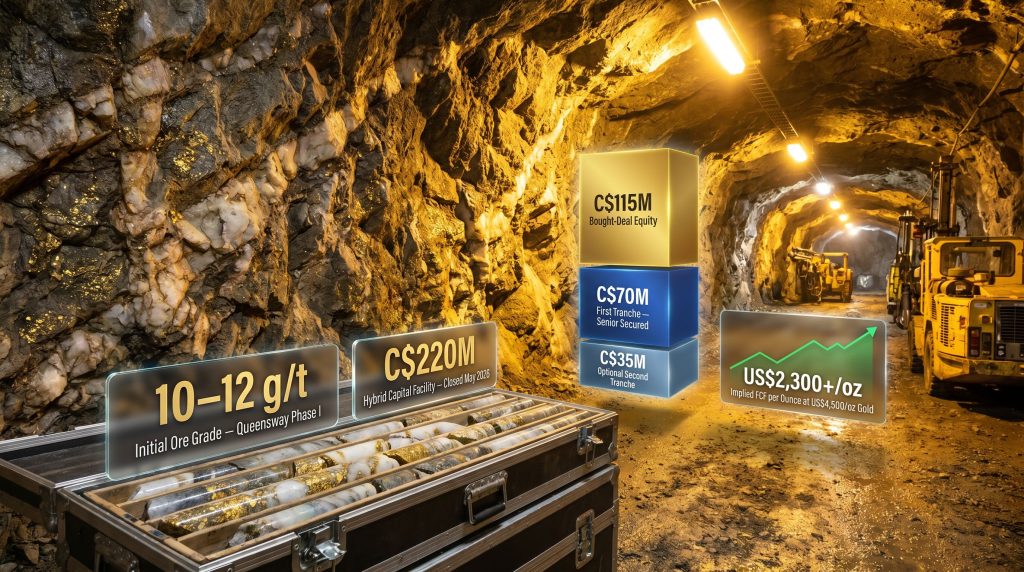
The New Found Gold Queensway financing closed at a combined C$220 million, but the mechanics beneath that number reveal a deliberate capital strategy rather than a straightforward debt transaction. What makes this package analytically interesting is not its size, but its architecture: a hybrid of senior secured credit and large-scale bought-deal equity, assembled through a process of iterative optimisation across several months.
The original path involved a non-binding term sheet for US$75 million in senior secured debt arranged by Nebari, signed in March 2026, split between a US$50 million initial draw and a US$25 million conditional component. That structure was abandoned entirely in April 2026, replaced by a substantially more ambitious package comprising a US$100 million bought-deal equity raise and a US$105 million senior secured credit facility with EdgePoint Investment Group as the lead lender. By the time the transaction closed in May 2026, currency dynamics and final adjustments produced the C$220 million headline figure.
| Milestone | Timing | Instrument | Quantum |
|---|---|---|---|
| Initial term sheet (Nebari) | March 2026 | Senior secured debt | US$75M |
| Superseding package announced | April 2026 | Equity + senior secured (EdgePoint) | US$205M |
| Final package closed | May 2026 | Hybrid facility + equity raise | C$220M |
The progression from a US$75 million single-instrument term sheet to a C$220 million hybrid close is not incidental. It reflects a deliberate decision to prioritise lender quality, covenant flexibility, and long-term capital alignment over the simplicity and speed of a conventional debt-only solution.
Dissecting the Two-Tranche Credit Facility
How the C$105 Million Facility Is Structured
The senior secured credit facility arranged by EdgePoint operates across two discrete tranches with meaningfully different purposes:
- First tranche (C$70 million): Drawn at close. Allocated to procurement of long-lead equipment, detailed engineering progression, and early construction mobilisation costs.
- Second tranche (C$35 million): Optional, available at the company's discretion within approximately one year of closing.
A critical detail that distinguishes this facility from conventional project finance is the confirmation that full funding to production does not require drawing the second tranche. The C$70 million first draw, combined with the C$115 million equity raise, already exceeds the C$155 million capital expenditure estimate outlined in the Queensway Phase I preliminary economic assessment (PEA). The optional tranche functions as a contingency buffer, not a base-case requirement.
Furthermore, definitive feasibility studies for comparable underground gold projects consistently demonstrate that covenant architecture at the pre-production stage materially influences construction outcomes, making the structure of this facility particularly noteworthy.
The Covenant Architecture: Why Minimal Restrictions Matter
Traditional project finance facilities impose layers of structural constraints: milestone-linked covenant packages, reserve-based lending restrictions, production-linked drawdown conditions, and lender consent requirements for major operational decisions. These mechanisms protect creditors but frequently constrain management's ability to optimise sequencing decisions during the pre-production phase, precisely when adaptive execution has the most value.
The Queensway facility is reported to carry minimal covenant restrictions across both tranches. This operational flexibility is particularly valuable during construction, when decisions around contractor engagement timing, equipment substitution, and permitting sequencing benefit from management discretion rather than compliance triggers anchored to pre-agreed milestones.
Key Structural Insight: In the junior-to-mid-tier gold development space, covenant architecture is frequently a more material risk variable than headline interest rates. A facility with minimal restrictions but slightly higher cost of capital can deliver substantially better project outcomes than cheap debt laden with restrictive operating covenants.
The C$115 Million Equity Raise and What Cornerstone Participation Signals
The equity component was executed as a bought-deal financing, a structure that provides price certainty for the issuer by having an underwriting syndicate purchase shares outright before reselling to investors. This mechanism eliminates the pricing risk inherent in marketed offerings. Eric Sprott participated as a cornerstone investor, a participation that carries meaningful signal value within the Canadian resource investment ecosystem.
Sprott has a well-documented track record of concentrating capital in high-grade Canadian gold assets at development and early-production stages. His involvement as an anchor investor in a bought-deal raise of this scale is relatively uncommon for pre-production developers. Institutional bought-deal anchoring at the C$115 million level implies that the Queensway asset cleared a high threshold of technical and economic due diligence from investors who understand what high-grade underground gold development actually requires to succeed.
Investor Psychology Perspective: In the junior mining sector, the identity of cornerstone investors communicates qualitative information that a prospectus cannot. When a cornerstone with a verifiable track record in a specific asset class anchors a raise at scale, it compresses the perceived risk premium for subsequent secondary market participants.
What Makes Queensway's Grade Profile Exceptional in a Global Context
Understanding Grams Per Tonne as a Value Driver
The concept of ore grade is straightforward in principle: it measures the concentration of recoverable metal within a given mass of rock. In practice, grade is the single most powerful determinant of operating economics in underground gold mining. Higher grades mean more gold is extracted per tonne of rock mined and processed, which directly reduces the cost per ounce of gold produced.
Queensway's initial mining zones are expected to yield ore averaging 10 to 12 grams per tonne (g/t). For context, the global gold mining industry average sits at approximately 1 to 2 g/t across producing operations, according to World Gold Council data. Queensway's projected initial grades are therefore five to ten times the global average, placing the project in the uppermost tier of high-grade gold development assets worldwide.
Moreover, understanding grade and permitting dynamics together is essential when evaluating whether a project of this calibre can convert its geological advantages into operational reality on schedule. This grade differential is not merely a technical metric. It reshapes the fundamental economics of the operation across multiple dimensions:
- Lower tonnes processed per ounce: Fewer trucks, less crushing, less grinding, less reagent consumption per unit of gold produced.
- Reduced energy intensity per ounce: A critical advantage in an environment where mining input cost inflation, particularly fuel and electricity, has pressured industry-wide all-in sustaining costs (AISC).
- Greater reconciliation buffer: When actual mined grades inevitably deviate from resource model estimates, higher initial modelled grades provide a larger safety margin before the project crosses into cash-flow-negative territory.
The Free Cash Flow Equation at Current Gold Prices
With gold prices sustaining above US$4,500 per ounce at the time the financing closed, Queensway's economics are exceptionally compelling. In addition, cut-off grade economics at these price levels mean that the viable resource envelope expands meaningfully, providing further upside to production planning assumptions.
| Metric | Queensway Projection |
|---|---|
| Initial ore grade | 10-12 g/t |
| Annual production target (initial years) | ~100,000 oz |
| All-in sustaining cost (AISC) | ~US$1,300/oz |
| Gold price environment | US$4,500+/oz |
| Implied free cash flow per ounce | US$2,300+ |
| Implied annual free cash flow | US$230M+ |
At these parameters, the theoretical payback period on the entire C$220 million financing package from a single year of steady-state Queensway production is less than twelve months. Even under a stress scenario where gold prices corrected sharply to approximately US$2,500 per ounce, the projected US$1,300 per ounce AISC would still sustain positive operating margins, though the free cash flow profile would compress significantly.
The World Gold Council estimates that global average AISC for gold producers typically ranges between US$1,200 and US$1,500 per ounce across the industry cycle. Queensway's projected US$1,300 per ounce places it within the lowest-cost quartile of global gold producers, providing structural downside resilience that average-grade operations simply cannot match.
The Phased Development Roadmap: From Capital Close to First Pour
Stage 1: Pre-Construction Execution (Q2 to Q3 2026)
Two permitting milestones define the critical path for the near-term schedule:
- Pine Cove mill expansion groundbreaking (targeted by end of Q2 2026): The existing mill, already operational at 700 tonnes per day (t/d) processing Hammerdown ore, is being expanded to 1,400 t/d, doubling throughput capacity. This expansion leverages already-permitted infrastructure, avoiding the environmental assessment timelines and capital intensity associated with greenfield processing facilities. In Canadian gold development contexts, greenfield mill permitting can add two to four years to a project schedule.
- Queensway early works permit (targeted by end of Q3 2026): This approval enables site preparation, access road construction, and initial earthworks ahead of full construction mobilisation.
A third infrastructure item operating on an external timeline deserves close investor attention: a provincial utility is undertaking an approximately 18-month transmission line relocation project to move a power line currently positioned above the Queensway deposit. This is a critical path dependency that sits outside the company's direct control, making it one of the key schedule risk variables for the 2027 production target.
Stage 2: Hammerdown as an Operational Proof Point (H2 2026)
The Hammerdown Gold mine is targeting commercial production in the second half of 2026, feeding the existing Pine Cove mill at its current 700 t/d capacity. This sequencing serves two strategic functions that are underappreciated in conventional coverage of the Queensway story:
- Operational validation: Hammerdown's production demonstrates that management can execute underground gold mining operations in the Newfoundland environment before committing to the significantly larger Queensway construction programme.
- Internal cash generation: Hammerdown's operational cash flows provide a supplementary funding source during the construction period, reducing the company's effective drawdown requirement on the financing package.
Stage 3: Queensway Construction and Production (H2 2026 to Late 2027)
Long-lead equipment procurement, funded from the initial C$70 million tranche, begins contemporaneously with financing close. The 18-month construction timeline from groundbreaking targets first gold production from Queensway in late 2027, with initial annual output of 100,000 ounces from the high-grade initial mining zones.
Scenario Analysis: Three Pathways Through 2027
Bull Case
- Gold prices sustain above US$4,000 per ounce through the construction period.
- Both Q2 and Q3 2026 permitting milestones achieved on schedule.
- Transmission line relocation completed within the 18-month utility timeline.
- Hammerdown delivers meaningful operating cash flow in H2 2026.
- Initial Queensway ore reconciles at or above 10 g/t modelled grades.
- Outcome: Annual free cash flow exceeds US$230 million from Year 1 of Queensway production, enabling full debt repayment within the first two years and creating optionality for resource expansion or dividend initiation.
Base Case
- Gold prices moderate to the US$3,000 to US$3,500 per ounce range.
- Minor permitting delays shift the early works permit to Q4 2026.
- Construction proceeds within a 5 to 10% cost contingency buffer, with the optional second tranche drawn.
- Grade reconciliation aligns broadly with PEA estimates.
- Outcome: Project generates US$1,700 to US$2,200 per ounce free cash flow margins; debt service comfortably covered; 2027 production timeline extends by one to two quarters.
Bear Case
- Gold prices correct sharply to US$2,000 to US$2,500 per ounce.
- Transmission line delays or permitting setbacks extend the construction timeline by six or more months.
- Initial Queensway grade reconciliation underperforms PEA estimates by a meaningful margin.
- Outcome: Project remains cash-positive above US$1,300 per ounce AISC, but free cash flow margins compress sharply; the 2027 production target is unlikely to be achieved; second tranche is required; timeline to full debt repayment extends to three or more years.
Disclaimer: Scenario projections involve assumptions about gold prices, operating costs, permitting timelines, and grade reconciliation outcomes that are inherently uncertain. Actual results may differ materially from any forward-looking projections. This article does not constitute financial advice.
The next major ASX story will hit our subscribers first
The Exploration Optionality Layer That Is Not in the Base Case
Why Resource Expansion Potential Matters Beyond the PEA
The current PEA and financing structure are built entirely around a defined initial resource envelope. The broader Queensway project contains significant potential for resource definition beyond the current study scope, a layer of optionality that is structurally absent from the base-case economic model.
In high-grade underground gold systems, resource expansion typically follows predictable geological patterns: extensions along strike, extensions at depth, and parallel veining within the same structural corridor. If Queensway's initial mining zones validate the geological model at expected grades, subsequent resource drilling programs could support:
- Extended mine life beyond the initial PEA scope.
- Potential throughput rate increases if the resource base justifies expanded mill capacity.
- Improved project economics in subsequent feasibility-level studies.
This exploration upside represents unpriced optionality within the current financing structure, meaning investors who participate at the current stage acquire exposure to resource growth potential without paying a premium for it in the deal economics.
Macro Tailwinds Amplifying the Strategic Value of High-Grade Development
Central Bank Demand and Structural Gold Price Support
Central bank gold demand has remained elevated across multiple consecutive years, providing a structural demand floor that has contributed to the sustained gold price environment exceeding US$4,500 per ounce in 2026. The World Gold Council has documented consecutive years of above-average central bank net purchases, with geopolitical uncertainty and monetary policy dynamics reinforcing gold's role as a reserve asset diversifier.
For high-grade development projects specifically, sustained elevated gold prices function as a non-linear value amplifier. Each additional US$100 per ounce increase in the gold price translates to approximately US$10 million in additional annual free cash flow at 100,000 ounces of annual production. At Queensway's 10 to 12 g/t grade profile, the volume efficiency relative to lower-grade peers means that a higher proportion of gold price upside flows directly to operating margins rather than being absorbed by proportionally higher mining costs.
Input Cost Inflation and the Grade Hedge
The mining industry has experienced material input cost inflation across fuel, labour, consumables, and equipment since 2021. This cost pressure has driven global average AISC significantly higher across the industry. High-grade operations provide a natural structural hedge against input cost inflation: because they process fewer tonnes per ounce of gold recovered, the per-ounce impact of fuel price increases, labour rate escalation, and reagent cost growth is substantially lower than at average-grade operations.
At 10 to 12 g/t versus the industry average of 1 to 2 g/t, Queensway will move a fraction of the rock per ounce that most comparable-scale gold operations require. This resource efficiency translates directly into a lower per-ounce cost exposure to input cost volatility, reinforcing the US$1,300 per ounce AISC projection even in an environment where industry-wide costs continue to rise.
Frequently Asked Questions
What replaced the original Nebari debt facility?
The non-binding term sheet for up to US$75 million from Nebari was superseded in April 2026 by a substantially larger and more complex structure: a US$105 million senior secured credit facility with EdgePoint Investment Group combined with a US$100 million bought-deal equity raise. The final closed package reached C$220 million after currency adjustments.
Does the company need to draw the full C$220 million to reach Queensway production?
No. The C$155 million PEA capital expenditure estimate is fully covered by the C$70 million first tranche combined with the C$115 million equity raise. The optional C$35 million second tranche is a discretionary contingency buffer that is not required for the base-case production scenario.
Why is the Pine Cove mill expansion strategically important?
Expanding an already-permitted and operational facility from 700 t/d to 1,400 t/d eliminates the permitting timeline and capital intensity of a greenfield processing facility. In Canadian jurisdictions, new mill permitting can add two to four years to a project schedule. The Pine Cove expansion compresses both dimensions simultaneously while leveraging proven infrastructure already processing Hammerdown ore.
What is the key external risk variable investors should track?
The provincial utility's transmission line relocation above the Queensway deposit operates on an approximately 18-month timeline and sits outside the company's direct control. Its alignment with the construction schedule is a critical path dependency that warrants monitoring as the primary external schedule risk for the late 2027 production target.
When does Hammerdown reach commercial production?
The Hammerdown Gold mine is targeting commercial production in the second half of 2026, providing operating cash flow and management execution validation ahead of Queensway's late 2027 first pour target.
Want to Catch the Next High-Grade Discovery Before the Market Does?
Discovery Alert's proprietary Discovery IQ model scans ASX announcements in real time, instantly identifying significant mineral discoveries — the kind of high-grade, capital-efficient assets that generate the most compelling returns — and delivering actionable alerts directly to subscribers. Explore historic discovery outcomes on Discovery Alert's discoveries page and begin a 14-day free trial to position ahead of the broader market.