May 21, 2026
Advanced robotic systems are revolutionising mining operations by addressing the fundamental challenge of worker safety in hazardous environments. The integration of autonomous explosives loading technology represents a critical shift toward eliminating human exposure during high-risk blast preparation activities. Newmont deploying Jevons' explosives robot demonstrates how mining innovation trends are reshaping traditional operational approaches. Modern mining operations face mounting pressure to implement comprehensive safety protocols while maintaining operational efficiency across diverse geological conditions.
Understanding the Technology Behind Robotic Blast Hole Loading
Battery-Electric Autonomous Systems for Mining Applications
The emergence of battery-electric autonomous platforms marks a significant technological advancement in mining equipment design. These systems operate independently of traditional fuel-based power sources, utilising advanced battery management systems capable of supporting continuous operation cycles. The integration of electric powertrains eliminates exhaust emissions in confined spaces whilst reducing mechanical complexity compared to diesel-powered alternatives.
Battery capacity specifications for mining robotics typically range from 200-400 kWh, supporting operational durations of 8-12 hours under standard loading conditions. Charging infrastructure requirements include high-voltage connections capable of delivering rapid recharge cycles between shifts, minimising equipment downtime during critical production windows.
Self-Levelling Chassis Technology for Unstable Terrain
Mining environments present unique challenges for vehicle stability, particularly during explosives loading operations near highwall faces. Self-levelling chassis systems incorporate hydraulic stabilisation technology enabling safe operation on slopes up to 15 degrees whilst maintaining precise positioning accuracy. This capability proves essential when accessing blast holes positioned on uneven surfaces or near geological discontinuities.
Advanced gyroscopic sensors continuously monitor vehicle attitude, triggering automatic adjustments to maintain horizontal platform orientation. The stabilisation system operates in real-time, compensating for ground settlement or equipment movement during payload deployment processes.
AI Navigation and Hole Detection Integration
Furthermore, AI in mining automation enables autonomous navigation through complex mining environments using LiDAR scanning technology combined with machine learning algorithms. Real-time environmental mapping allows robotic platforms to identify blast hole locations with sub-centimetre accuracy whilst avoiding obstacles and hazardous terrain features.
Computer vision systems recognise prepared blast holes through pattern recognition algorithms trained on thousands of site-specific images. This technology reduces positioning errors and ensures consistent loading patterns across multiple blast sequences.
Payload Module Configurations for Explosive Materials
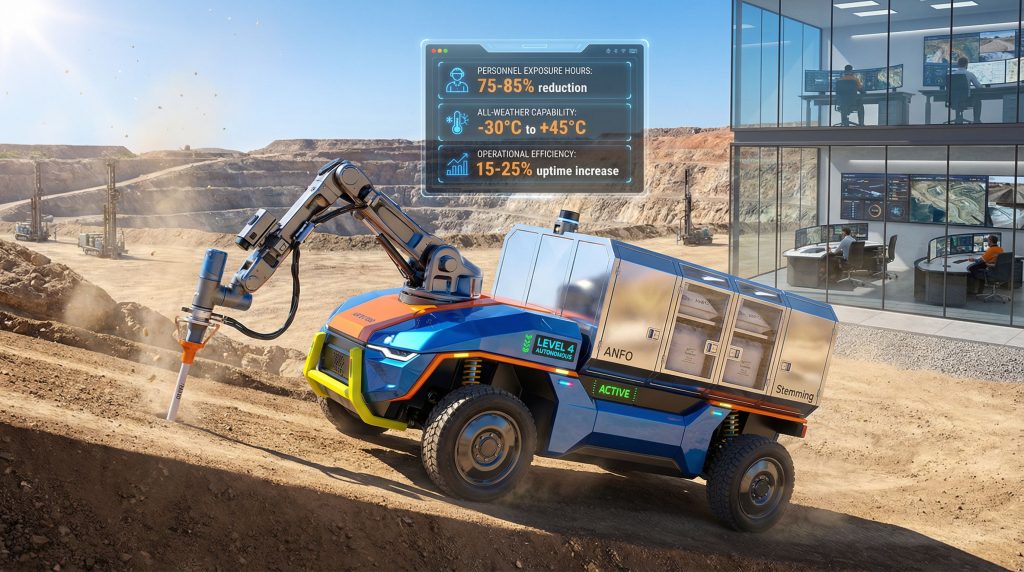
Interchangeable payload systems accommodate various explosive materials including ANFO (Ammonium Nitrate Fuel Oil) mixtures and specialised stemming materials. Modular design principles allow rapid reconfiguration between different payload types without extensive mechanical modifications.
Key payload specifications include:
- ANFO capacity: 2,000-5,000 kg per loading cycle
- Stemming material volume: 10-25 cubic metres
- Precision dispensing: ±5% accuracy for charge calculations
- Environmental sealing: IP67 rating for dust and moisture protection
When big ASX news breaks, our subscribers know first
Integration with Traditional Drill-and-Blast Workflows
Seamless Operational Integration Methodologies
Mining operations require sophisticated integration strategies to incorporate robotic systems within established drill-and-blast sequences. Workflow optimisation focuses on minimising disruption to existing production schedules whilst maximising safety benefits through reduced human exposure.
Integration methodologies typically involve:
- Pre-shift planning: Detailed blast hole mapping and sequence optimisation
- Equipment coordination: Synchronised scheduling with drilling and support equipment
- Quality assurance: Real-time monitoring of loading accuracy and charge placement
- Safety protocols: Automated exclusion zone management during robotic operations
Remote Control Versus Autonomous Operation Modes
Modern robotic platforms offer multiple operational modes ranging from direct remote control to fully autonomous execution. Remote control modes provide operators with direct oversight capability whilst maintaining safe distances from hazardous areas. Autonomous modes utilise pre-programmed blast patterns with minimal human intervention during execution phases.
Level 4 autonomous operation represents the highest degree of independence, requiring only supervisory oversight during normal operations. These systems execute complete loading sequences based on digital blast designs whilst continuously monitoring environmental conditions and safety parameters.
Central Command Room Monitoring Systems
Centralised monitoring facilities enable comprehensive oversight of multiple robotic units operating across extensive mining areas. High-resolution displays provide real-time telemetry data including equipment status, loading progress, and environmental conditions.
Communication systems utilise industrial-grade wireless networks supporting low-latency data transmission over distances exceeding 5 kilometres. Redundant communication pathways ensure continuous connectivity even in challenging radio frequency environments.
Why Mining Companies Prioritise Automated Explosives Handling
Analysis of Highwall-Related Mining Incidents
Historical mining safety data reveals significant risks associated with manual explosives loading operations, particularly near unstable highwall formations. Geotechnical hazards including rockfall, ground failure, and structural collapse pose ongoing threats to personnel working in proximity to blast holes.
Statistical analysis of mining incidents demonstrates elevated risk factors during explosives handling activities:
- Proximity hazards: 60% of explosives-related incidents occur within 50 metres of highwall faces
- Weather-related risks: Adverse conditions increase incident rates by 40-60%
- Equipment-related accidents: Manual handling contributes to 30% of workplace injuries
- Geological instability: Unstable ground conditions account for 25% of serious incidents
Regulatory Pressure on Safety Control Implementation
Mining regulatory frameworks increasingly emphasise "reasonably practicable" safety controls, requiring companies to implement available technologies that significantly reduce worker exposure risks. Automated explosives handling systems directly address regulatory expectations for hazard elimination rather than traditional risk mitigation strategies.
Australian mining safety regulations mandate comprehensive risk assessments for all explosives handling activities, with specific focus on eliminating human exposure where technically feasible. Regulatory compliance increasingly requires documented evidence of technology evaluation and implementation decisions.
Cost-Benefit Analysis of Human Exposure Reduction
In addition, economic analysis demonstrates substantial benefits from automated explosives loading through reduced personnel exposure hours and associated risk premiums. Traditional blast loading operations require 8-12 hours of direct personnel involvement per blast cycle, whilst robotic systems reduce exposure to 0-2 hours for supervisory activities only.
| Safety Metric | Traditional Method | Robotic System | Risk Reduction |
|---|---|---|---|
| Personnel Exposure | 8-12 hours/cycle | 0-2 hours/cycle | 75-85% reduction |
| Weather Dependency | High vulnerability | Minimal impact | Continuous operation |
| Precision Loading | Manual variance | Automated consistency | Improved outcomes |
| Equipment Utilisation | Limited to safe conditions | All-weather capability | 15-25% uptime increase |
Insurance and Liability Considerations
Insurance providers recognise automated explosives handling as a significant risk mitigation technology, offering premium reductions for operations implementing robotic safety systems. Liability exposure decreases substantially when human personnel are removed from high-risk activities through technological solutions.
Documented safety improvements support favourable insurance negotiations and demonstrate due diligence in implementing available safety technologies. Long-term insurance cost reductions often justify capital investment in robotic systems within 2-3 years of deployment.
High-Risk Mining Activities Benefiting from Automation
Pre-Split Loading Near Highwall Formations
Pre-split blasting techniques require precise explosive placement along predetermined fracture lines, typically positioned in close proximity to final highwall faces. Manual loading of these blast holes exposes personnel to significant geological hazards including rockfall and ground instability.
Robotic systems excel in pre-split applications through consistent charge placement accuracy and elimination of human exposure near unstable formations. Automated loading ensures uniform explosive distribution whilst maintaining safe distances from hazardous areas throughout the entire operation.
Unstable Ground Conditions and Geotechnical Hazards
Geological instability presents ongoing challenges in mining environments, particularly in areas affected by previous blasting activities or natural weathering processes. Automated systems operate safely in conditions deemed too hazardous for human personnel, expanding operational capability during adverse geological conditions.
Geotechnical monitoring integration allows robotic platforms to operate within predetermined safety parameters whilst continuously assessing ground stability indicators. Real-time hazard detection capabilities enable immediate withdrawal from developing dangerous conditions.
Extreme Weather Operations
Mining operations must continue across diverse climatic conditions, from extreme cold temperatures of -30°C to +45°C ambient conditions. Human personnel face significant physiological challenges during extended exposure to extreme temperatures, whilst robotic systems maintain consistent performance across this entire operational range.
Environmental resistance specifications include:
- Temperature tolerance: -30°C to +50°C operational range
- Moisture protection: IP67 sealing against dust and water ingress
- Wind resistance: Stable operation in winds up to 60 km/h
- Visibility conditions: Independent operation during fog, dust, or precipitation
Personnel Exposure Hour Reduction Strategies
However, systematic reduction of personnel exposure hours represents a fundamental safety strategy in modern mining operations. Robotic implementation enables dramatic decreases in human presence within designated hazard zones whilst maintaining production efficiency.
Exposure reduction methodologies include:
- Temporal separation: Robotic operations during periods of elevated risk
- Spatial isolation: Automated systems operating beyond safe human working distances
- Activity substitution: Robotic execution of highest-risk operational components
- Supervisory oversight: Remote monitoring replacing direct personnel involvement
Operational Implementation and Performance Metrics
Measuring Return on Investment from Robotic Systems
Mining operations evaluate robotic explosives systems through comprehensive financial modelling incorporating capital costs, operational savings, and risk reduction benefits. Primary cost drivers include equipment acquisition, training programmes, and infrastructure modifications required for autonomous operation.
Economic benefits encompass reduced labour costs for hazardous activities, decreased insurance premiums, and improved operational reliability during adverse conditions. Productivity gains from continuous operation capability often provide additional returns beyond primary safety objectives.
Key Performance Indicators for Autonomous Mining Robots
Performance measurement frameworks establish quantitative benchmarks for robotic system effectiveness across multiple operational dimensions:
Accuracy Metrics:
- Blast hole loading precision: ±2-5% variance from design specifications
- Charge placement consistency: 95-98% successful deployments
- Stemming material distribution: Uniform coverage across designated zones
Reliability Indicators:
- Equipment uptime: 90-95% availability during scheduled operations
- Mean time between failures: 200-300 operational hours
- Maintenance requirements: 15-20% reduction versus traditional equipment
Safety Performance:
- Personnel exposure reduction: 75-85% decrease in hazard zone presence
- Incident rate improvements: Near-elimination of explosives-related injuries
- Compliance achievement: 100% adherence to regulatory safety requirements
Industry Adoption Patterns and Market Dynamics
Major Mining Company Technology Integration Approaches
Leading mining corporations implement robotic explosives systems through structured pilot programmes designed to evaluate technology performance under specific operational conditions. Initial deployments typically focus on highest-risk applications where safety benefits provide maximum justification for capital investment.
Newmont deploying Jevons' explosives robot represents the second commercial implementation of Jevons Robotics technology, following successful trials and demonstrating growing industry confidence in autonomous explosives loading capabilities. This deployment specifically targets pre-split loading operations for highwall safety enhancement, as reported by Mining Monthly.
Technology partnership strategies emphasise long-term development relationships rather than simple equipment procurement. Mining companies seek suppliers capable of providing ongoing technical support, system updates, and adaptation to evolving operational requirements.
Pilot Programme Implementation Strategies
Successful robotic implementation requires comprehensive pilot testing addressing site-specific geological conditions, operational workflows, and integration challenges. Pilot programmes typically span 6-12 months, encompassing multiple blast cycles across varying environmental conditions.
Critical evaluation criteria include:
- Technical performance: Accuracy, reliability, and operational efficiency metrics
- Safety outcomes: Personnel exposure reduction and incident prevention
- Economic impact: Cost analysis including capital, operational, and risk reduction benefits
- Integration success: Compatibility with existing equipment and workflows
Scalability Considerations Across Multiple Sites
Mining companies evaluate robotic systems for potential deployment across multiple operational sites, requiring technology solutions adaptable to diverse geological and operational conditions. Scalability factors include equipment standardisation, training programme efficiency, and maintenance support infrastructure.
Fleet expansion strategies consider equipment utilisation optimisation, allowing robotic platforms to serve multiple operational areas through coordinated scheduling. Mobile deployment capabilities enable efficient resource allocation across varying production requirements.
The next major ASX story will hit our subscribers first
Technical Challenges and Engineering Solutions
Rugged Terrain Navigation and Stability Systems
Mining environments present extreme challenges for robotic navigation systems, requiring advanced sensor fusion technologies capable of real-time terrain assessment and path planning. LiDAR scanning systems create high-resolution environmental maps whilst identifying obstacles, hazards, and optimal routing options.
Stability control systems incorporate multiple redundant sensors monitoring vehicle attitude, ground conditions, and dynamic loading effects. Hydraulic stabilisation platforms compensate for uneven terrain whilst maintaining precise positioning accuracy during critical loading operations.
Navigation Technology Components:
- GPS positioning: Centimetre-level accuracy through RTK corrections
- Inertial navigation: Continuous position tracking during GPS signal interruption
- Obstacle detection: Real-time hazard identification and avoidance algorithms
- Path optimisation: Dynamic route calculation based on current conditions
Environmental Resistance and Durability Requirements
Mining robotics must withstand harsh environmental conditions including abrasive dust, corrosive chemicals, extreme temperatures, and mechanical vibration. Component selection emphasises industrial-grade durability with proven performance in severe operating conditions.
Environmental protection specifications:
- Dust resistance: IP67 sealing preventing particulate contamination
- Moisture protection: Waterproof enclosures for electronic components
- Temperature tolerance: Operation across -30°C to +50°C range
- Vibration resistance: Shock-mounted systems for rough terrain operation
Real-Time Communication in Remote Locations
Reliable communication systems enable continuous monitoring and control of robotic platforms operating in remote mining areas. Multi-band radio systems provide redundant connectivity through various frequency ranges, ensuring communication maintenance during challenging conditions.
Satellite communication backup systems support operations in areas beyond terrestrial network coverage. Low-latency data transmission enables real-time telemetry monitoring and emergency intervention capability when required.
Battery Life and Charging Infrastructure
Extended operational autonomy requires high-capacity battery systems supporting 8-12 hour duty cycles without recharging interruptions. Lithium-ion battery technology provides optimal energy density whilst supporting rapid charging during shift transitions.
Charging infrastructure includes high-voltage connections capable of delivering 100-200 kW charging rates for rapid battery replenishment. Solar charging systems offer supplementary power generation in remote locations with limited grid connectivity.
Interchangeable Payload Systems and Operational Versatility
Modular Design Benefits for Multi-Purpose Operations
Interchangeable payload systems expand robotic platform utility beyond explosives loading through rapid reconfiguration capabilities. Quick-change coupling mechanisms enable payload swapping within 15-30 minutes, maximising equipment utilisation across diverse operational requirements.
Modular design principles support various specialised payloads:
- De-watering systems: Pump modules for water removal operations
- Monitoring equipment: Environmental and geotechnical sensor platforms
- Material transport: Bulk material handling and distribution systems
- Maintenance tools: Equipment service and inspection capabilities
Equipment Utilisation Optimisation Strategies
Multi-purpose robotic platforms achieve higher utilisation rates through coordinated scheduling across various operational activities. Intelligent fleet management systems optimise payload allocation based on production priorities and equipment availability.
Utilisation optimisation includes:
- Dynamic scheduling: Real-time task allocation based on operational priorities
- Payload sharing: Efficient equipment distribution across multiple work areas
- Maintenance coordination: Synchronised service intervals minimising downtime
- Cross-training programmes: Personnel certification for multiple payload operations
Future Payload Development Possibilities
Emerging payload technologies expand robotic platform capabilities into specialised mining applications including precision drilling, rock sampling, and automated surveying. Advanced payload development focuses on integrating sophisticated sensors and analytical equipment for real-time data collection.
Future applications include autonomous core sampling systems, real-time grade analysis equipment, and precision placement tools for ground support installation. These developments transform robotic platforms into comprehensive mining automation solutions.
Economic Impact and Investment Considerations
Financial Models Supporting Mining Robotics Investment
Capital investment decisions for mining robotics require comprehensive financial modelling incorporating multiple benefit categories beyond traditional equipment analysis. Total cost of ownership calculations include acquisition costs, training expenses, infrastructure modifications, and ongoing operational support requirements.
Investment Analysis Framework:
- Capital expenditure: Equipment acquisition and installation costs
- Operational savings: Reduced personnel costs and improved efficiency
- Risk mitigation: Insurance premium reductions and liability limitation
- Productivity gains: Continuous operation capability and reduced weather delays
Payback periods typically range from 2-4 years depending on operational intensity and safety premium valuations. Higher-risk mining environments generally achieve faster investment recovery through substantial insurance and liability cost reductions.
Insurance Premium Reductions and Risk Assessment
Insurance providers increasingly recognise automated explosives handling as significant risk reduction technology, offering premium discounts for operations implementing robotic safety systems. Actuarial analysis demonstrates measurable decreases in incident probability when human personnel are removed from high-risk activities.
Risk assessment methodologies quantify exposure reduction benefits:
- Frequency reduction: Decreased incident probability through automation
- Severity limitation: Reduced consequences from elimination of personnel exposure
- Compliance enhancement: Improved adherence to safety regulations and standards
- Documentation quality: Enhanced record-keeping and operational transparency
Technology Depreciation and Upgrade Planning
Robotic system depreciation strategies account for rapid technological advancement and evolving operational requirements. Flexible financing arrangements support equipment upgrades and capability enhancements throughout operational lifecycles.
Upgrade planning considerations include software enhancement capabilities, hardware modularity for component replacement, and manufacturer support for technology refresh programmes. Lease arrangements often provide attractive alternatives to direct purchase for rapidly evolving technologies.
Mining Workforce Development and Automation Impact
Skill Transition from Manual to Supervisory Roles
Robotic implementation transforms workforce requirements from direct manual labour to technical supervision and system management. Personnel development programmes focus on technology operation, troubleshooting, and maintenance skills whilst preserving valuable mining experience and knowledge.
Transition strategies emphasise:
- Cross-training programmes: Developing technical skills for automation oversight
- Career progression: Advancement opportunities in technology-focused roles
- Experience retention: Leveraging mining expertise in supervisory capacities
- Skills certification: Formal recognition of automation operation competencies
Technical Training Requirements for Robot Operation
Comprehensive training programmes prepare personnel for robotic system operation through theoretical instruction combined with hands-on experience. Training curricula cover system operation, safety protocols, emergency procedures, and basic troubleshooting techniques.
Training Programme Components:
- System fundamentals: Technology overview and operational principles
- Safety protocols: Emergency procedures and hazard recognition
- Operational procedures: Standard operating procedures and best practices
- Maintenance basics: Routine inspection and preventive maintenance tasks
Certification programmes validate competency levels whilst ensuring consistent operational standards across multiple sites and personnel rotations.
Job Creation in Maintenance and Programming Sectors
Consequently, automation implementation creates new employment opportunities in specialised technical roles including robotics maintenance, software programming, and system integration. These positions often offer enhanced compensation reflecting advanced technical skill requirements.
Emerging job categories include:
- Robotics technicians: Equipment maintenance and repair specialists
- System programmers: Automation sequence development and optimisation
- Integration engineers: Technology implementation and workflow design
- Training specialists: Personnel development and certification programmes
Future Developments in Mining Automation Technology
Advanced AI and Machine Learning Integration
Next-generation mining robotics will incorporate sophisticated artificial intelligence systems capable of autonomous decision-making and adaptive learning from operational experience. Machine learning algorithms will optimise blast patterns, predict equipment maintenance requirements, and enhance safety through predictive hazard analysis.
AI development areas include:
- Predictive analytics: Anticipating equipment failures and maintenance needs
- Pattern optimisation: Improving blast design through historical performance analysis
- Adaptive control: Real-time adjustment to changing operational conditions
- Anomaly detection: Identifying unusual conditions requiring human intervention
5G Connectivity for Real-Time Data Transmission
Fifth-generation wireless networks enable unprecedented data transmission capabilities supporting real-time video streaming, telemetry monitoring, and remote control applications. Ultra-low latency communication systems facilitate near-instantaneous response times for critical safety interventions.
5G implementation benefits include:
- High bandwidth: Support for multiple simultaneous robotic operations
- Low latency: Real-time control and monitoring capabilities
- Network reliability: Redundant connectivity pathways for mission-critical applications
- Edge computing: Local data processing reducing transmission requirements
Predictive Maintenance and Diagnostic Systems
Advanced diagnostic systems will monitor equipment health through continuous sensor data analysis, predicting component failures before operational impacts occur. Furthermore, predictive maintenance strategies optimise equipment availability whilst minimising unexpected downtime and repair costs.
Diagnostic capabilities include:
- Vibration analysis: Early detection of mechanical wear and misalignment
- Thermal monitoring: Component temperature tracking for overheating prevention
- Fluid analysis: Hydraulic and lubricant condition assessment
- Performance trending: Long-term operational efficiency monitoring
Fleet Coordination and Swarm Robotics Applications
Multi-robot coordination systems enable synchronised operations across extensive mining areas through sophisticated fleet management algorithms. Swarm robotics principles support collaborative task execution and resource optimisation across multiple autonomous units.
Fleet coordination features:
- Task distribution: Intelligent workload allocation across available equipment
- Collision avoidance: Coordinated movement preventing equipment interference
- Resource sharing: Efficient utilisation of support equipment and infrastructure
- Performance optimisation: System-wide efficiency maximisation through coordinated operations
Commercial Deployment Success Factors and Lessons Learned
Site Selection Criteria for Successful Implementation
For instance, successful robotic deployment requires careful site selection based on geological conditions, operational requirements, and infrastructure availability. Optimal sites demonstrate clear safety benefits whilst providing sufficient operational volume to justify investment costs.
Selection Criteria Include:
- Geological suitability: Stable ground conditions supporting robotic operation
- Access infrastructure: Adequate roads and support facilities for equipment deployment
- Communication coverage: Reliable connectivity for remote monitoring and control
- Safety requirements: High-risk areas where automation provides significant benefits
Change Management Strategies for Operational Teams
Effective change management ensures smooth transition from manual to automated operations through comprehensive communication, training, and support programmes. Personnel engagement initiatives address concerns whilst highlighting career development opportunities in technology-focused roles.
Change management elements:
- Communication programmes: Regular updates on implementation progress and benefits
- Training initiatives: Comprehensive skills development for new operational requirements
- Support systems: Resources for personnel adaptation and career transition
- Feedback mechanisms: Continuous improvement based on operational experience
Performance Monitoring and Optimisation Approaches
Continuous performance monitoring enables ongoing optimisation of robotic system effectiveness through detailed analysis of operational data and outcomes. Key performance indicators track safety improvements, productivity gains, and cost reduction achievements.
Monitoring systems evaluate:
- Safety metrics: Incident rates and personnel exposure reduction achievements
- Operational efficiency: Productivity improvements and equipment utilisation rates
- Cost performance: Financial returns and total cost of ownership optimisation
- Technical reliability: Equipment performance and maintenance requirements
The ongoing evolution of mining automation technology continues transforming industry safety standards whilst improving operational efficiency across global mining operations. The AI-powered efficiency boost from robotic explosives loading systems represents a fundamental shift toward comprehensive automation solutions addressing the most hazardous aspects of mining production. Additionally, data-driven operations combined with 3D geological modelling provide the foundation for integrating Newmont deploying Jevons' explosives robot technology with modern mining intelligence systems. According to IM-Mining, this collaboration demonstrates how leading mining companies are embracing robotic solutions to enhance operational safety and efficiency.
Disclaimer: This analysis includes forward-looking statements regarding technology development and market trends. Actual outcomes may vary based on technological advancement rates, regulatory changes, and market conditions. Investment decisions should consider comprehensive risk assessment and professional financial advice.
Ready to Capitalise on Mining Innovation Breakthroughs?
Mining automation and technological advances create significant opportunities for ASX-listed companies developing cutting-edge solutions. Discovery Alert's proprietary Discovery IQ model identifies breakthrough announcements in mining technology and automation sectors, delivering real-time alerts on companies pioneering innovations like robotic systems and AI-driven mining solutions. Begin your 14-day free trial today and position yourself ahead of the market as the mining industry continues its technological transformation.