June 27, 2026
Canada Nickel confirms high-grade awaruite at Midlothian represents a significant breakthrough in the global nickel industry, where traditional processing methods face mounting environmental and economic pressures. Furthermore, this discovery highlights how innovative metallurgical approaches can revolutionise resource development through natural mineral properties that reduce processing complexity and environmental impact.
What Makes Awaruite a Game-Changing Nickel Mineral?
Understanding Awaruite's Unique Metallurgical Properties
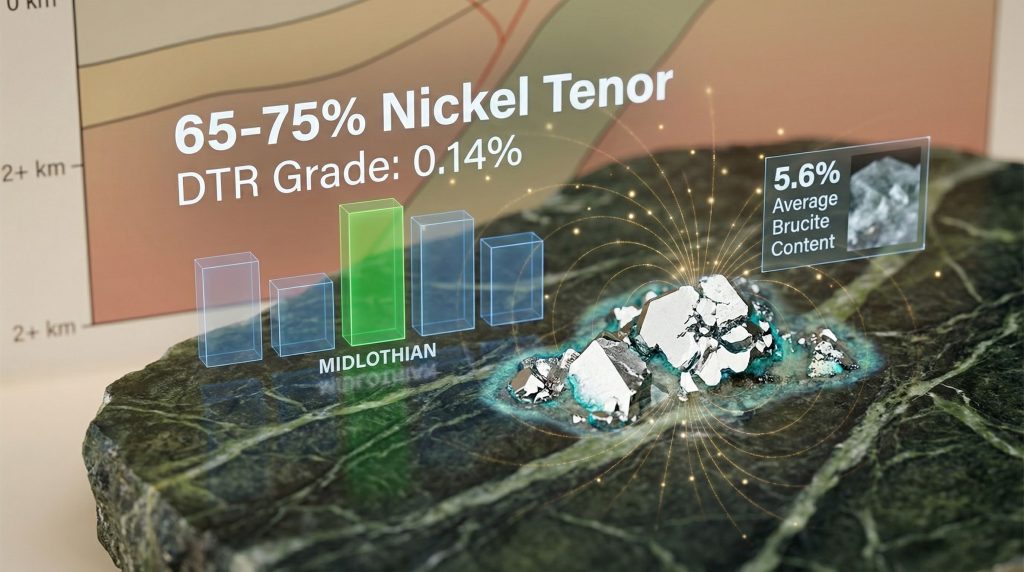
Awaruite represents a naturally occurring nickel-iron alloy that delivers exceptional processing advantages compared to conventional nickel sulfide and laterite deposits. This native metal typically contains between 65-75% nickel content, existing in a crystalline structure that enables direct magnetic separation without complex hydrometallurgical treatment.
The metallurgical characteristics of awaruite create several operational benefits that distinguish it from traditional ore types. Moreover, understanding nickel properties & uses becomes crucial when evaluating these unique processing advantages.
Key Processing Benefits:
• Direct magnetic recovery capability eliminates acid leaching requirements
• Lower energy consumption through simplified processing circuits
• Reduced environmental impact from eliminated chemical reagent usage
• Higher recovery efficiency through magnetic concentration methods
Recent testing at the Midlothian deposit has confirmed awaruite concentrations ranging from 0.25-0.36% across sample composites. Additionally, the project achieved an average 0.28% total nickel grade, placing Canada Nickel confirms high-grade awaruite at Midlothian among the highest-grade discoveries globally. Management reports nickel grades 30% higher than other leading awaruite deposits worldwide.
Davis Tube Recovery Testing Methodology
Davis Tube Recovery (DTR) testing serves as the industry standard for evaluating magnetic separation efficiency in nickel deposits containing ferromagnetic minerals. The DTR methodology measures the percentage of nickel recoverable through magnetic concentration, providing critical data for flowsheet design and economic assessment.
At Midlothian, initial DTR testing was conducted at coarser grind sizes than comparable operations. However, it still achieved 0.14% DTR nickel grades, suggesting substantial optimisation potential through finer grinding techniques.
Key Technical Parameters:
• Particle size distribution (P80 grind size optimisation)
• Magnetic field strength calibration for optimal separation
• Feed preparation protocols ensuring representative sampling
• Quality control measures maintaining consistent metallurgical results
The presence of minor heazlewoodite (Ni₃S₂) within the ore body adds complexity to processing considerations. Consequently, this secondary nickel sulfide may require flotation recovery or alternative treatment methods depending on liberation characteristics.
When big ASX news breaks, our subscribers know first
How Does Midlothian's Resource Profile Compare to Global Standards?
Resource Grade Analysis and Industry Context
Canada Nickel's confirmation of high-grade awaruite establishes Midlothian as a significant discovery within the global awaruite deposit database. The 590 million tonne inferred resource, containing 1.68 million tonnes of nickel, positions the project among larger-scale awaruite developments worldwide.
Comparative Analysis: Midlothian vs. Global Awaruite Deposits
| Metric | Midlothian | Industry Benchmark Range |
|---|---|---|
| Total Ni Grade | 0.28% | 0.18-0.25% |
| DTR Ni Grade | 0.14% | 0.10-0.15% |
| Resource Tonnage | 590 Mt | 200-800 Mt |
| Contained Nickel | 1.68 Mt | Variable |
| Grade Premium | +30% | Baseline comparison |
Statistical analysis reveals Midlothian's competitive positioning, with total nickel grades exceeding typical awaruite deposit ranges by significant margins. This grade advantage translates directly into processing economics, as higher head grades reduce per-unit production costs.
Geological Setting and Mineralisation Controls
Midlothian's geological framework consists of serpentinised ultramafic rocks, primarily dunite and peridotite formations characteristic of the Timmins nickel district. These host rocks provide the geochemical environment necessary for awaruite formation through hydrothermal alteration processes.
The deposit demonstrates exceptional continuity characteristics across multiple parameters. For instance, the drill results interpretation shows remarkable consistency throughout the system.
Deposit Characteristics:
• Strike length extent: Over 2 kilometres of identified mineralisation
• Depth potential: Open-ended mineralisation below current drilling
• Surface accessibility: Less than 5 metres overburden in many areas
• Structural consistency: Regular mineralisation distribution patterns
Drilling results from 22 holes totalling 9,268 metres have established the resource base through systematic sampling at approximately 1.5-metre intervals. QEMSCAN mineralogical analysis conducted on 5% of samples provides detailed characterisation of mineral phase associations.
What Are the Processing and Recovery Implications?
Metallurgical Testing Results Breakdown
Comprehensive metallurgical characterisation across three representative sample composites has confirmed consistent awaruite mineralisation throughout the deposit. The testing programme revealed awaruite content variability within a narrow range of 0.25-0.36%, indicating uniform ore characteristics suitable for standardised processing approaches.
Processing optimisation pathways emerge from the initial coarser grind size employed during DTR testing. Management has indicated that finer grinding may yield improved DTR nickel results, creating documented routes for metallurgical enhancement.
Brucite Co-Product Opportunities
Midlothian contains significant brucite [Mg(OH)₂] mineralisation averaging 5.6% throughout the deposit. Peak intervals reach 10.9% concentration, representing approximately 2.5 times higher brucite content than comparable awaruite projects.
Sustainable iron processing techniques demonstrate how mineral carbonation can achieve environmental benefits. Similarly, Midlothian's exceptional brucite concentrations enable large-scale CO₂ storage through permanent mineral carbonation processes.
"The exceptional brucite concentrations at Midlothian enable net-negative carbon footprint operations through industrial carbon capture applications."
Theoretical CO₂ Sequestration Calculation:
• Brucite molecular weight: 58.3 g/mol
• Stoichiometric CO₂ capacity: 1 mole Mg(OH)₂ + 1 mole CO₂ → MgCO₃ + H₂O
• Per-tonne sequestration potential: ~37 kg CO₂ per tonne of ore
• Annual CO₂ capacity: Substantial sequestration potential at commercial rates
This mineral carbonation capability addresses growing industry demands for carbon-neutral mining operations whilst potentially generating carbon credit revenues.
How Does the Drilling Programme Support Resource Expansion?
Exploration Campaign Overview
The systematic drilling programme executed between 2023-2025 has established Midlothian's resource foundation through comprehensive geological and geochemical characterisation. Statistical analysis of the 22-hole, 9,268-metre drilling database provides confidence in resource continuity and grade distribution patterns.
Drilling Programme Statistics:
• Sample density: One assay per 1.5-metre interval average
• Mineralogical testing: QEMSCAN analysis on 5% of samples
• Coverage area: 1.7 km² prospect identification
• Resource classification: Inferred category based on current drill spacing
Future drilling programmes will focus on DTR testing expansion across all existing and planned drill holes. This enables calculation of recoverable nickel resources alongside total nickel estimates, supporting progression toward Indicated resource classification.
Near-Surface Mineralisation Advantages
Shallow mineralisation characteristics create significant operational advantages for potential mining development. Overburden depths typically measuring less than 5 metres enable conventional open-pit mining methods with minimal waste rock removal requirements.
Understanding mining permitting insights becomes crucial for projects with such favourable surface characteristics.
Mining Development Implications:
• Reduced stripping ratios decrease pre-production capital requirements
• Conventional excavation methods utilise standard mining equipment
• Lower infrastructure costs through surface accessibility
• Shortened development timeline versus underground mining scenarios
Regional infrastructure advantages within the established Timmins mining district provide additional development benefits through existing transportation networks and skilled workforce availability.
What Are the Strategic Development Pathways?
Resource Estimation Methodology and Confidence
The current inferred resource classification reflects appropriate geological confidence levels based on drill hole spacing and sampling density. Statistical analysis supports resource continuity interpretations whilst maintaining conservative classification standards consistent with Canadian Institute of Mining requirements.
Technical Validation Framework:
• Geological modelling: Three-dimensional ore body interpretation
• Grade continuity analysis: Spatial correlation assessment
• Sample quality assurance: Standardised preparation and analytical protocols
• Resource categorisation: Appropriate confidence classification
Advancement toward Indicated resource status requires additional infill drilling to improve geological confidence. The identified 2+ kilometre strike length provides substantial expansion targets for future exploration programmes.
Operational Development Timeline Considerations
Project advancement pathways focus on metallurgical optimisation studies, environmental assessment preparation, and economic analysis development. The confirmed widespread awaruite mineralisation supports systematic DTR testing across the entire drill database.
Development Milestone Priorities:
- DTR testing completion on all existing drill holes
- Grind size optimisation studies for improved recovery
- Pilot-scale processing trials using bulk samples
- Environmental baseline assessment initiation
- Preliminary economic analysis development
How Does This Discovery Impact Regional Nickel Development?
Timmins District Nickel Potential
Midlothian's confirmation as a significant awaruite discovery reinforces the Timmins district's position as an emerging nickel province. The project benefits from established regional mining infrastructure, including transportation networks and experienced workforce availability.
Regional Development Advantages:
• Proven geological framework supporting additional discoveries
• Established mining culture and technical expertise
• Transportation infrastructure connecting to major markets
• Power grid accessibility for processing facility development
The district's ultramafic geological setting suggests potential for additional awaruite discoveries through systematic regional exploration programmes targeting similar geological environments.
Competitive Positioning Analysis
Canada Nickel's portfolio enhancement through Midlothian's addition creates strategic advantages within the global awaruite development landscape. The project represents the highest-grade asset in the company's holdings, providing premium ore characteristics for future production scenarios.
Strategic Portfolio Benefits:
• Grade premium positioning versus global awaruite benchmarks
• Resource diversification across multiple development projects
• Risk mitigation through geographic and geological diversity
• Market timing flexibility supporting optimal development sequencing
The next major ASX story will hit our subscribers first
What Are the Next Critical Milestones?
Technical Work Programme Priorities
Immediate technical priorities focus on expanding DTR testing coverage and optimising metallurgical parameters for improved recovery performance. The systematic testing approach will establish comprehensive recoverable resource estimates supporting economic assessment development.
Near-Term Technical Objectives:
• Complete DTR analysis on all 22 existing drill holes
• Conduct grind size optimisation studies for recovery improvement
• Initiate pilot-scale testing using representative bulk samples
• Develop processing flowsheet optimisation parameters
Advanced metallurgical studies will investigate fine-grinding impacts on DTR recovery rates. These studies may demonstrate significant improvement opportunities beyond current conservative estimates, as reported by the Canadian Mining Journal.
Economic Assessment Development
Preliminary economic analysis development requires integration of metallurgical test results, resource estimation updates, and processing cost modelling. The unique characteristics of awaruite processing create potential for favourable economics compared to conventional nickel operations.
Economic Analysis Components:
• Capital cost estimation for processing facility development
• Operating cost modelling incorporating magnetic separation advantages
• Brucite co-product evaluation and carbon credit potential
• Market analysis for awaruite concentrate sales
• Sensitivity analysis across commodity price scenarios
Furthermore, industry innovation trends suggest increasing demand for environmentally sustainable mining operations, which positions Canada Nickel confirms high-grade awaruite at Midlothian advantageously.
According to TipRanks analysis, the project's combination of high-grade awaruite mineralisation and carbon storage potential creates unique value propositions in today's environmentally conscious mining sector.
Investment Considerations and Disclaimers:
This analysis contains forward-looking statements and projections based on current geological and metallurgical information. Resource estimates remain in the Inferred category with associated geological uncertainty. Metallurgical test results represent preliminary data requiring additional validation through expanded testing programmes. Economic assessments require completion of comprehensive feasibility studies. Mineral resource estimates do not guarantee economic viability or successful project development. Investors should conduct independent due diligence and consider all risk factors before making investment decisions. Commodity price volatility, regulatory changes, and operational challenges may significantly impact project economics and development timelines.
Are You Looking to Capitalise on High-Grade Mineral Discoveries?
Discovery Alert's proprietary Discovery IQ model delivers real-time alerts on significant ASX mineral discoveries like high-grade nickel projects, instantly empowering subscribers to identify actionable opportunities ahead of the broader market. Understand why major mineral discoveries can lead to substantial returns by exploring historic examples, then begin your 14-day free trial today to position yourself ahead of the competition.