
June 26, 2026
Why Water Is the Hidden Enemy of Nickel Laterite Economics
Across the global nickel laterite development landscape, one of the least discussed but most consequential cost drivers is not reagent consumption, not mining equipment, and not labour. It is water. In remote regions like the arid interior of Western Australia, the logistics and infrastructure required to deliver industrial volumes of process water to a hydrometallurgical plant can consume hundreds of millions of dollars in capital before a single tonne of ore is processed. This is the fundamental challenge that the Alliance Nickel NiWest vat leach test-work program is designed to address, and why the outcomes of this metallurgical investigation carry implications well beyond a single project.
Understanding the significance of this program requires stepping back from the headline figures and examining the engineering and economic mechanics of nickel laterite processing, where small changes in processing route selection can shift project economics from marginal to compelling.
When big ASX news breaks, our subscribers know first
The NiWest Asset: Scale, Geology, and Why Grade Matters Here
Not all nickel resources are created equal. The distinction between nickel sulphide and nickel laterite deposits is one of the most important in the sector, and it is often underappreciated by generalist investors. Sulphide deposits can be processed through conventional flotation and smelting routes that are well understood and relatively capital-efficient. Laterite deposits, by contrast, require hydrometallurgical treatment, which is inherently more complex, more capital-intensive, and more sensitive to water availability and reagent supply. Understanding nickel properties and uses is therefore essential context for evaluating any laterite project.
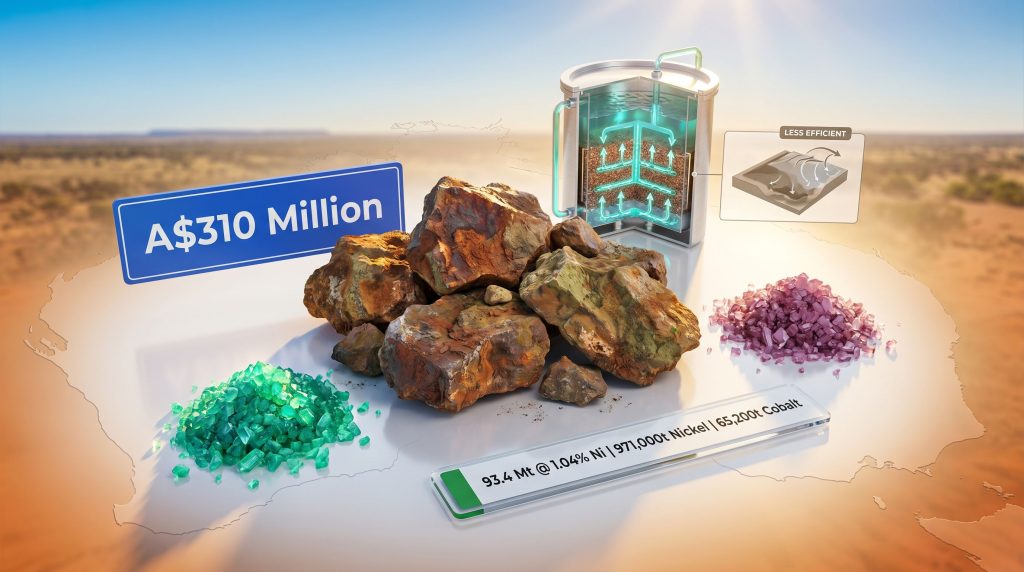
NiWest is a laterite deposit, and a substantial one. The project hosts a JORC 2012-compliant resource of 93.4 million tonnes grading 1.04% nickel and 0.07% cobalt, containing approximately 971,000 tonnes of nickel and 65,200 tonnes of cobalt in total. Crucially, more than 83% of this resource is classified as Measured or Indicated, which is a meaningful indicator of geological confidence. In the laterite space, where grade variability and mineralogical complexity can undermine metallurgical assumptions, having the majority of a resource in higher-confidence categories reduces technical risk for feasibility work.
A Grade That Stands Out in the Australian Laterite Pipeline
An average nickel grade of 1.04% is considered strong for a laterite deposit. Many Australian nickel laterite projects operate or are being evaluated at grades below 1.0%, where processing costs consume a greater share of revenue per tonne. NiWest's grade profile, combined with its resource size, positions it among the more substantial undeveloped nickel laterite inventories in the country.
The project is located in Western Australia's established nickel belt and sits directly adjacent to Glencore's Murrin Murrin nickel-cobalt operation, which has been processing nickel laterite ore using high-pressure acid leach (HPAL) technology since 1999. Murrin Murrin's multi-decade operating history in the same geological region provides meaningful context for NiWest's mineralogical behaviour and regional infrastructure, even though no formal arrangement between the two operations has been disclosed.
Heap Leach vs. Vat Leach: A Processing Decision With Nine-Figure Consequences
The 2024 Definitive Feasibility Study for NiWest specified a heap leach processing flowsheet targeting Class 1 nickel sulphate and cobalt sulphate as end products, aligned with battery supply chain requirements. Heap leaching is a well-established hydrometallurgical technique, but in remote laterite settings, it carries a specific and often underestimated infrastructure burden: water.
Under the DFS configuration, water infrastructure accounts for approximately A$310 million (around US$214 million) of total project capital expenditure. In an environment where development-stage projects are competing for finite capital and lender appetite is closely tied to upfront cost thresholds, a single infrastructure line item of this scale can materially affect bankability.
How the Two Approaches Compare
| Feature | Heap Leaching | Vat Leaching |
|---|---|---|
| Ore placement | Stacked on lined outdoor pads | Loaded into enclosed tanks or vats |
| Solution contact | Variable; permeability-dependent | More uniform and controlled |
| Leach kinetics | Slower under ambient conditions | Potentially faster with containment |
| Water sourcing | Large-scale external supply required | May allow localised sourcing |
| Capital footprint | Higher water infrastructure cost | Potentially lower overall capex |
| Environmental exposure | Larger surface area; evaporation risk | More contained; reduced losses |
| Suitability for clay-rich ores | Problematic channelling risk | Better containment of fine-grained material |
One of the lesser-known technical challenges with heap leaching clay-rich or fine-grained laterite ores is the channelling effect, where lixiviant solution follows preferential pathways through the ore bed rather than distributing uniformly. This results in zones of under-leached ore, reducing recovery rates and extending cycle times. Vat leaching's enclosed architecture reduces this risk by enabling more controlled solution delivery and better ore-to-lixiviant contact across the full ore mass.
The Mt Kilkenny Insight: Local Water as a Capital Unlock
The most strategically significant finding from Alliance Nickel's preliminary technical analysis is the potential to source sufficient process water from the Mt Kilkenny tenement, which sits within the NiWest project area. If the vat leach test-work confirms that the alternative processing route is viable, the external water supply infrastructure budgeted in the DFS could be substantially reduced or eliminated entirely.
This is not a marginal optimisation. The potential removal of a A$310 million capital line item would represent one of the most consequential single-step improvements available to the project without altering its fundamental resource base or production target.
This kind of local water sourcing opportunity is relatively rare in remote Western Australian laterite projects, where aquifer access, water rights, and pipeline distances frequently compound the capital challenge. The Mt Kilkenny tenement's position within the project boundary makes it both logistically and economically preferable as a supply source, subject to the technical confirmation that vat leaching can operate effectively within the water volume that local sourcing can support.
Structure and Objectives of the Vat Leach Test-Work Program
The program has been designed with a level of sample rigour that distinguishes it from preliminary screening studies. Rather than using small composite specimens, Alliance Nickel has extracted and shipped a 2-tonne bulk representative ore sample to an overseas metallurgical testing facility. This scale of sample is important because it generates data that more faithfully reflects how the ore body will behave across its full variability in a real processing environment.
What the Program Is Evaluating
The test-work is structured around five core performance parameters:
- Nickel and cobalt recovery rates under atmospheric vat leach conditions, benchmarked against DFS heap leach assumptions
- Solution distribution uniformity across the ore bed within the enclosed vat geometry
- Leach kinetics, specifically whether metal dissolution rates are meaningfully faster than observed in heap configurations for this ore type
- Leach cycle duration, assessing the total time required to achieve target metal recoveries
- Water consumption profiles, quantifying whether local Mt Kilkenny sourcing can meet the volume requirements of a vat leach operation at the project's planned throughput scale
The program is scheduled for completion in Q3 2026, after which results will be assessed against DFS benchmarks. Alliance Nickel has confirmed that this is a targeted optimisation exercise, not a project reset. All material assumptions underpinning the production target and financial model in the DFS remain in place pending test-work outcomes.
Three Metallurgical Advantages Worth Understanding in Depth
Improved Solution Distribution
In an open heap configuration, lixiviant is applied to the top of a stacked ore pad and relies on gravity and ore permeability to distribute through the material. When ore contains significant clay fractions, as is common in Western Australian laterites, permeability is inconsistent and solution short-circuits through high-permeability zones. The enclosed architecture of a vat leach system allows for more engineered solution delivery, reducing dead zones and improving contact across the ore mass. Higher and more predictable recovery per tonne is the direct operational consequence.
Faster Leach Kinetics for Laterite Ores
Nickel laterite ores are notoriously slow to leach under ambient atmospheric conditions. This is a geological characteristic tied to the mineralogy of the ore itself. The dominant nickel-bearing minerals in laterite deposits, particularly in the limonite and saprolite zones, include goethite, smectite, and serpentine-group minerals, which respond differently to acid leach conditions than sulphide minerals do to conventional processing. Enclosed vat systems can support more controlled temperature and solution chemistry conditions, which can accelerate the kinetics of nickel and cobalt dissolution relative to open heap configurations.
Shorter Leach Cycles and Working Capital Efficiency
Compressed leach cycle times have a compounding economic benefit. Less time in the leach circuit per tonne of ore means less ore is held in inventory at any given moment, which reduces the total vat capacity required and lowers capital expenditure on the processing circuit itself. It also accelerates the conversion of ore to metal in solution, improving working capital efficiency throughout the operation's life. For a project of NiWest's scale, even modest improvements in cycle time can have meaningful effects on long-term cash generation.
The next major ASX story will hit our subscribers first
What Favourable Results Would Mean for Project Economics
The financial implications of a positive test-work outcome extend across multiple dimensions of the project's investment case.
| Scenario | Test-Work Result | Likely Strategic Response |
|---|---|---|
| Favourable | Vat leach matches or exceeds heap leach recoveries with reduced water demand | DFS updated with vat leach flowsheet; capex revised materially downward |
| Partially Favourable | Kinetics improved but water savings below expectations | Hybrid flowsheet evaluation; targeted optimisation studies |
| Inconclusive | Insufficient statistical robustness in results | Extended program or additional sample testing |
| Unfavourable | Vat leach underperforms on key recovery metrics | Heap leach DFS configuration retained; alternative capex reduction strategies explored |
A fully favourable outcome would likely improve the project's net present value and internal rate of return by reducing the capital base against which returns are measured. It would also improve debt service coverage ratios, because a lower debt quantum is required when upfront capex falls. This matters enormously for project finance, where lender appetite for development-stage nickel assets in the current market is closely calibrated to coverage metrics.
Furthermore, from an offtake perspective, battery manufacturers and cathode precursor producers seeking long-term supply of Class 1 nickel sulphate and cobalt sulphate increasingly apply capital efficiency screens to the projects they consider partnering with. A NiWest with a substantially reduced capital requirement is a more attractive supply source for a procurement team weighing project delivery risk against supply security.
Battery Market Alignment and the Long-Term Demand Picture
NiWest's target products sit at a specific and strategically important point in the battery supply chain. Class 1 nickel sulphate, refined to battery-grade purity standards, is the primary nickel input into nickel-manganese-cobalt (NMC) cathode chemistries, which remain the dominant formulation in high-energy-density electric vehicle batteries. The broader battery raw materials market continues to evolve rapidly, with demand for battery-grade nickel projected to grow substantially through the late 2020s and into the 2030s as EV penetration accelerates across major automotive markets.
The cobalt sulphate co-product adds a further revenue dimension. Cobalt's role in cathode stabilisation, despite ongoing efforts by battery developers to reduce cobalt loading, remains material in higher-performance battery chemistries. A project delivering both products from a single processing circuit benefits from revenue diversification across two battery materials simultaneously. In addition, the battery storage expansion driving demand for these materials underscores how closely NiWest's product suite aligns with long-term market requirements.
The Indonesian nickel industry has dramatically increased global supply of lower-grade nickel products in recent years, however, projects producing high-purity Class 1 outputs retain a distinct market position. This dynamic, combined with the growing importance of critical minerals and energy security, means that projects capable of demonstrating not only resource quality but also capital efficiency and processing reliability are better positioned to attract the long-term offtake commitments and project financing structures that turn development-stage assets into operating mines.
Disclaimer: This article contains forward-looking statements and projections regarding commodity demand, project economics, and test-work outcomes. These involve inherent uncertainty and should not be construed as financial advice. Readers should conduct their own due diligence and seek independent professional advice before making any investment decisions.
Frequently Asked Questions: Alliance Nickel NiWest Vat Leach Test-Work
What is the Alliance Nickel NiWest vat leach test-work program?
Alliance Nickel has initiated a metallurgical evaluation program to test atmospheric vat leaching as a lower-capital alternative to the heap leach processing method established in the project's November 2024 Definitive Feasibility Study. A 2-tonne bulk ore sample has been shipped to an overseas facility, with the program targeting completion in Q3 2026.
Why is the A$310 million water infrastructure cost so significant?
In remote Western Australian laterite projects, delivering industrial-scale process water requires extensive pipeline, storage, and treatment systems. For NiWest's heap leach configuration, this infrastructure represents a material share of total project capex. Eliminating or substantially reducing this line item through local water sourcing enabled by vat leaching could significantly improve the project's financing profile and investment returns.
Does this investigation change the NiWest DFS or production target?
No. Alliance Nickel has confirmed that all material assumptions in the DFS, including the production target and financial forecasts, remain unchanged. A positive test-work result would inform an update to the existing feasibility study rather than triggering a complete restart of the technical evaluation process.
What is the difference between heap leaching and vat leaching for nickel laterite ores?
Heap leaching stacks ore on outdoor lined pads where solution is applied from above and relies on ore permeability for distribution. Vat leaching loads ore into enclosed tanks where solution contact is more controlled. For clay-rich laterite ores, vat leaching can reduce channelling effects and improve recovery consistency, while also enabling more contained water management and potentially shorter leach cycle times.
What is the resource size of the NiWest project?
NiWest hosts a JORC 2012-compliant nickel laterite resource of 93.4 million tonnes at 1.04% nickel and 0.07% cobalt, containing approximately 971,000 tonnes of nickel and 65,200 tonnes of cobalt. More than 83% of this inventory is classified as Measured or Indicated, reflecting a high degree of geological confidence relative to many development-stage laterite projects.
For ongoing coverage of nickel laterite processing developments and the broader Australian critical minerals sector, Mining.com.au provides regular reporting on project milestones and mineral processing advancements across the industry.
Want to Know When the Next Major Nickel Discovery Hits the ASX?
Discovery Alert's proprietary Discovery IQ model scans ASX announcements in real time, instantly identifying significant mineral discoveries across nickel, cobalt, and more than 30 other commodities — so subscribers can act before the broader market catches on. Explore historic discovery returns on Discovery Alert's dedicated discoveries page and begin a 14-day free trial to secure a genuine market-leading edge.