August 25, 2026
The Two Clocks Running Inside Every Nickel Price
Most commodity markets run on a single clock. Industrial demand rises, supply responds, prices normalize, and the cycle repeats. Nickel used to work that way. It no longer does.
Today, the nickel price cycle operates on two fundamentally different timescales simultaneously. The first is measured in quarters, tied to Chinese construction activity, stainless steel output, and manufacturing sentiment. The second is measured in decades, anchored to electric vehicle adoption curves, battery chemistry evolution, and the global energy transition. When these two clocks fall out of sync, the result is exactly the kind of violent, confusing price behaviour the market has delivered between 2025 and 2026.
Understanding which clock is driving the price at any given moment is arguably the most important analytical challenge facing nickel investors today.
When big ASX news breaks, our subscribers know first
Why the Nickel Price Cycle Behaves Differently from Other Metals
Industrial Metal by Day, Battery Metal by Tomorrow
Nickel's pricing complexity begins with its split identity. In the near term, the metal still responds to the same forces that governed it decades ago. Approximately two-thirds of global nickel consumption flows into stainless steel production, meaning that Chinese construction volumes, infrastructure investment cycles, and manufacturing output remain the dominant short-run price variables.
However, overlaid on top of this traditional demand architecture is a rapidly growing structural force: the electrification of transport. NCM (nickel-cobalt-manganese) battery cathodes require high-purity Class 1 nickel, and as global EV adoption accelerates, this demand layer is expanding in both scale and speed. According to the International Energy Agency, global EV sales could surpass 20 million units annually within this decade, a trajectory that would fundamentally alter nickel's demand composition.
The problem is that these two demand drivers do not move together. Industrial demand is cyclical and mean-reverting. Battery demand is structural and compounding. When cyclical forces dominate the short-term price, structural investors see value. When structural narratives dominate sentiment, cyclical analysts see risk. This perpetual tension makes nickel one of the most analytically demanding commodities in the critical minerals universe.
Why Are Nickel Cycles More Extreme Than Most Base Metals?
Three structural characteristics amplify the volatility of the nickel price cycle beyond what would be expected from demand dynamics alone:
- Geographic concentration of supply: A single country, Indonesia, accounts for more than 50% of global nickel mine output, creating extraordinary sensitivity to domestic policy decisions
- Extended development timelines: New nickel projects typically require 7 to 12 years from initial discovery to commercial production, meaning supply cannot respond quickly to price signals
- Product grade bifurcation: Class 1 high-purity nickel (battery-suitable) and Class 2 lower-purity nickel (stainless steel feedstock) serve distinct end markets with different pricing dynamics, creating internal fragmentation that distorts aggregate supply-demand signals
What is the nickel price cycle? The nickel price cycle describes the recurring pattern of expansion and contraction in nickel prices, driven by shifting supply conditions, industrial demand fluctuations, and evolving end-use markets including electric vehicle batteries. Cycle severity is amplified by Indonesia's dominant production share and the long capital lead times required to bring new nickel supply to market.
Where the Nickel Price Cycle Stands Right Now: 2025 to 2026
From Structural Oversupply to a Two-Year High
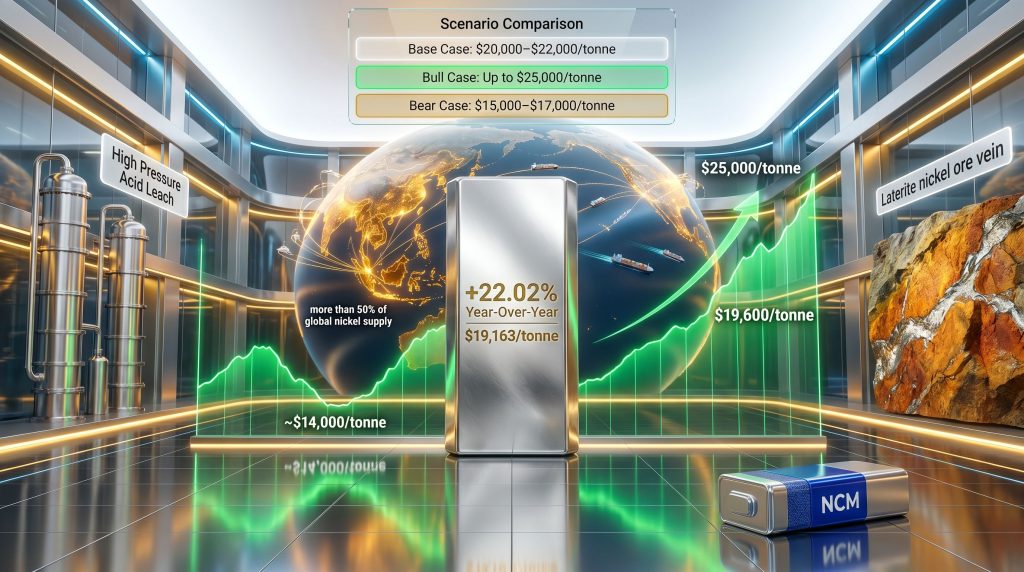
The 2025 price trough was driven almost entirely by a supply-side failure of discipline. A surge in Indonesian production flooded global markets, compressing prices to approximately $14,000 to $15,000 per tonne by late 2025, with Reuters reporting a low near $14,235 per tonne during the deepest phase of the downturn. Producer margins collapsed, capital allocation dried up, and market sentiment reached multi-year lows.
What followed was a reversal that caught many participants off guard. By early 2026, a combination of Indonesian supply policy changes and secondary processing bottlenecks triggered a sharp price recovery. Nickel reached a two-year high of approximately $19,600 per tonne before encountering profit-taking pressure that pulled prices back to the $19,000 to $19,163 per tonne range observed in May 2026.
| Metric | Value |
|---|---|
| Late 2025 Trough | ~$14,000 to $15,000/tonne |
| 2026 Cycle High | ~$19,600/tonne |
| Current Price (May 2026) | ~$19,004 to $19,163/tonne |
| Year-over-Year Change | +22.02% |
| Month-over-Month Change | +10.14% |
| All-Time Historical High | $54,050/tonne (May 2007) |
| Trading Economics Q2 2026 Consensus | ~$19,655/tonne |
| 12-Month Consensus Forecast | ~$20,953/tonne |
For those tracking live commodity data, the current pricing environment reflects a market in active transition between oversupply and cautious recovery.
Reading the Pullback: Consolidation or Reversal?
The retreat from the two-year high represents a technically normal pattern in commodity cycle recoveries. After a price moves approximately 35% above its recent trough within a compressed timeframe, speculative positioning becomes extended and profit-taking is a predictable response rather than a signal of fundamental deterioration.
The more important question is whether the structural imbalance that triggered the recovery has actually resolved. UBS analysis suggests the global nickel market could remain in surplus conditions through 2026, despite the upstream supply restrictions that catalysed the price rebound. This creates a nuanced picture: supply has tightened relative to 2025 conditions, but the market has not yet reached the deficit territory that would justify a sustained move toward $22,000 per tonne or beyond.
Key insight for investors: In commodity markets, the speed of a price recovery and the durability of that recovery are governed by different forces. A rapid rally driven by supply restriction can be interrupted by profit-taking without invalidating the structural case for higher prices over a longer horizon.
Disclaimer: Price forecasts and market projections referenced in this article represent analyst estimates and consensus views, not guaranteed outcomes. Commodity markets involve substantial uncertainty and actual prices may differ materially from any projection.
What Is Actually Driving Nickel's Recovery in 2026
Indonesia's Transition from Producer to Supply Manager
The single most important development reshaping the nickel price cycle is Indonesia's evolution from a volume-maximising producer into a deliberate supply manager. The parallel to OPEC's role in crude oil markets is analytically apt: when a single jurisdiction controls more than half of global output, its domestic policy decisions become the dominant price variable for all market participants worldwide.
In early 2026, Indonesian authorities implemented a combination of mining quota reductions and permit approval slowdowns. These measures constrained ore availability and delayed production ramp-ups across the country's nickel complex. The result was a rapid tightening of spot market conditions that translated directly into price recovery observed on the London Metal Exchange.
This shift carries long-term implications that extend beyond the immediate price cycle:
- Indonesian policy decisions now create a de facto price floor mechanism analogous to OPEC production discipline
- Investor risk assessments for nickel must incorporate political and regulatory risk from a single jurisdiction with outsized influence
- Supply forecasting models built on Indonesian production growth assumptions require reassessment if quota management becomes a permanent policy feature
The Sulfur Shortage: A Supply Chain Vulnerability Hidden in Plain Sight
One of the least understood dynamics in the current nickel price cycle involves a supply chain linkage between Middle East geopolitical disruption and battery-grade nickel production economics.
The mechanism works as follows: Mixed Hydroxide Precipitate (MHP) is the key intermediate product in converting Indonesian laterite ore into battery-grade Class 1 nickel. Furthermore, the production process for MHP relies on High Pressure Acid Leach (HPAL) technology, which requires substantial quantities of sulfuric acid. Sulfur, the feedstock for sulfuric acid production, is partly sourced through supply chains that transit the Strait of Hormuz. Geopolitical disruptions affecting this transit route constrain sulfur availability, raise acid input costs, and establish a higher cost floor for battery-grade nickel output.
This supply chain interdependency creates a situation where geopolitical risk in a region not associated with nickel mining directly influences battery-grade nickel production economics. It is a systemic vulnerability that mainstream commodity market commentary rarely addresses.
| Constraint Factor | Mechanism | Market Impact |
|---|---|---|
| Indonesian quota reductions | Reduced ore availability | Higher spot prices, tighter supply |
| Permit approval slowdowns | Delayed production ramp-ups | Structural output ceiling |
| Sulfur shortage via MHP pathway | Raised HPAL processing costs | Higher cost floor for Class 1 nickel |
| ESG compliance timelines | Slower Western project approvals | Limited ex-Indonesia supply growth |
| HPAL capital intensity | Difficult to scale quickly | Structural bottleneck on battery-grade output |
The Structural Supply Challenges That Define the Long-Term Nickel Cycle
HPAL Technology: The Bottleneck That Cannot Be Easily Removed
At the core of nickel's long-term supply challenge is a processing technology problem. Indonesia's laterite nickel ore is abundant, but it cannot be converted into battery-grade Class 1 nickel without HPAL facilities. These plants operate under extreme conditions, combining high-temperature, high-pressure processing with concentrated acid reagents to extract nickel and cobalt from low-grade laterite feedstock.
HPAL technology is:
- Capital-intensive: Individual facilities typically require multi-billion dollar capital commitments
- Technically complex: Commissioning periods are long and failure rates during startup are historically high
- Environmentally scrutinised: Acid tailings management and water use create regulatory flashpoints
- Difficult to scale: Unlike simpler processing pathways, HPAL capacity cannot be incrementally added and requires full-scale plant construction
The result is that even as Indonesia produces more than half of global nickel ore, converting that ore into the specific product quality required by battery manufacturers represents a separate and distinct infrastructure challenge. Consequently, the abundant raw material does not automatically translate into abundant battery-grade supply.
Why Western Nickel Projects Are Losing Ground
Outside Indonesia, the nickel project development landscape faces a compounding set of headwinds that are systematically reducing the probability of new supply additions from politically stable, high-cost jurisdictions:
- Environmental permitting timelines in jurisdictions like the United States, Canada, Australia, and Scandinavia routinely extend to 5 to 10 years from application to approval
- Input cost inflation has materially reduced project internal rates of return across the mining sector since 2022
- Commodity price volatility creates financing uncertainty, making long-term capital commitment from institutional sources difficult to justify
- Investor risk aversion following the 2023 to 2025 nickel price downturn has reduced equity market appetite for pre-production nickel assets
- ESG disclosure requirements impose additional due diligence burdens and potential reputational risk for investors in some deposit configurations
This environment has produced a widening gap between the volume of nickel projects announced in project databases and the volume actually advancing through development milestones. The pipeline looks full; the actual production additions are sparse.
The Five-Step Pathway to a Structural Deficit
A scenario in which nickel demand materially outpaces supply would require the following sequential conditions to hold:
- EV sales growth continues at trajectories consistent with IEA projections, sustaining compound growth in battery-grade nickel demand
- HPAL expansion stalls due to capital constraints, commissioning failures, or regulatory friction at Indonesian processing facilities
- Western project delays compound, with ESG permitting timelines and cost inflation preventing meaningful new supply additions
- Indonesian quota management tightens further, with the government maintaining or expanding supply restriction as a policy tool
- Demand growth absorbs existing surplus, transitioning the market from oversupply through balance to deficit
Each step in this sequence is independently plausible. The combination, if realised, would create price conditions that significantly exceed current consensus forecasts. Equally, failure at any step could see the bear case materialise, particularly if HPAL capacity scales faster than anticipated or EV adoption disappoints current projections.
Nickel Price Outlook: Three Scenarios Through 2030
Where Analysts See Prices Heading
Current consensus forecasts from Trading Economics project nickel reaching approximately $19,655 per tonne by end of Q2 2026 and approximately $20,953 per tonne over a 12-month horizon. The Oregon Group has projected prices could reach $25,000 per tonne if supply tightening accelerates beyond current assumptions. The base case view from multiple market analysts clusters in the $20,000 to $22,000 per tonne range over the medium term.
| Scenario | Key Assumption | Indicative Price Range | Central Driver |
|---|---|---|---|
| Base Case | Moderate EV growth, partial HPAL scale-up, surplus persists into late 2026 | $20,000 to $22,000/tonne | Supply gradually tightens, demand growth steady |
| Bull Case | HPAL expansion stalls, Indonesian quotas tighten, deficit emerges | Up to $25,000/tonne | Supply constraint intensifies faster than forecast |
| Bear Case | Surplus persists beyond 2026, EV demand disappoints, Indonesia expands output | $15,000 to $17,000/tonne | Indonesian policy reversal, demand shortfall |
The 2030 Demand Equation
If global EV sales exceed 20 million units annually as IEA projections suggest, the downstream demand implications for battery-grade nickel are substantial. Nickel demand has been estimated to potentially double by 2030 relative to current levels, contingent on the pace of NCM chemistry adoption relative to competing battery architectures such as lithium iron phosphate (LFP), which uses no nickel at all.
This battery chemistry competition is a frequently underappreciated variable in nickel demand modelling. LFP batteries have gained significant market share in lower-cost EV segments, particularly in China, creating a scenario where EV volume growth does not translate proportionally into nickel demand growth. Conversely, premium-range and high-energy-density vehicles continue to favour NCM and NCA cathodes with substantial nickel content.
Structural transition in progress: Nickel is shifting from a metal whose price cycle is determined primarily by construction and manufacturing activity to one increasingly governed by energy transition policy, EV adoption rates, and battery chemistry decisions made by automakers and cell manufacturers. This shift requires a fundamentally different analytical framework.
The next major ASX story will hit our subscribers first
How Sophisticated Investors Are Positioning Within the Nickel Price Cycle
The Optionality Framework: Buying Future Price Exposure at Trough Valuations
In deeply depressed commodity markets, exploration and development stage assets function as financial options on future price recovery. The investment thesis operates through a simple sequence:
- Asset valuations compress during the price trough as sentiment turns negative and institutional capital withdraws
- Projects with genuine resource scale, jurisdictional quality, and improving economics maintain option value even when current prices make development uneconomic
- As the price cycle turns, these assets re-rate significantly because their value is leveraged to the commodity price improvement
- The entry point at trough valuations provides asymmetric return potential relative to the risk absorbed
This contrarian positioning approach has historically generated the strongest returns in commodity cycles precisely because the entry point occurs when the narrative is most negative. However, the challenge is distinguishing between assets that genuinely retain option value and those where depressed valuations reflect permanent impairment rather than cyclical distress.
What Defines a High-Quality Nickel Asset in the Current Cycle
Not all nickel assets offer equivalent leverage to price recovery. The characteristics that differentiate compelling opportunities from value traps include:
- Resource scale: Large deposit sizes provide operating leverage to price improvement and attract institutional capital
- Jurisdictional stability: Politically secure, mining-friendly regulatory environments reduce sovereign risk premiums
- Infrastructure access: Proximity to transportation networks, port facilities, and reliable power sources materially improves project economics and reduces development capital requirements
- Byproduct revenue streams: Co-production of copper, cobalt, and platinum group elements (PGEs) reduces the effective nickel cost of production and provides economic resilience across price scenarios
- Processing pathway suitability: Ore characteristics that support cost-competitive metallurgy reduce processing capital intensity and improve project returns
| Investment Approach | Risk Profile | Return Potential | Optimal Time Horizon |
|---|---|---|---|
| Physical nickel or futures contracts | High volatility, mark-to-market exposure | Moderate, cycle-dependent | Short to medium term |
| Producing miners (major diversified) | Moderate, portfolio diversification | Moderate, dividend supported | Medium term |
| Single-asset development projects | High, binary development risk | High, leverage to price cycle | Long term |
| Exploration optionality assets | Very high, pre-resource uncertainty | Very high if cycle thesis proves correct | Long-term cycle positioning |
Project Economics: How Price Assumptions Change the Development Calculus
Why the Assumed Long-Term Price Is the Most Important Variable in Any Feasibility Study
Nickel project economics are extraordinarily sensitive to the long-term price assumption embedded in financial models. The same physical asset can move from deeply uneconomic to highly attractive across a price range that the market traversed in less than twelve months during the 2025 to 2026 cycle:
- At the 2025 trough of $14,000 to $15,000 per tonne, the overwhelming majority of development projects outside Indonesia failed basic economic hurdles, capital dried up, and development activity stalled
- At the current recovery level of $18,000 to $20,000 per tonne, marginal projects begin demonstrating viability in preliminary economic assessments, and studies recommence
- At $22,000 to $25,000 per tonne (consistent with the bull scenario), large-scale, multi-decade nickel projects with substantial byproduct credits generate compelling returns that justify the capital commitments required for development
Byproduct revenue from copper, cobalt, and PGEs plays a mathematically significant role in this sensitivity analysis. A project that generates meaningful cobalt and copper credits alongside its primary nickel output can reduce its effective nickel breakeven price by several thousand dollars per tonne, making it economically viable at price levels that would make a pure nickel producer uneconomic.
The Key Metrics That Determine Project Quality
Beyond the headline nickel price assumption, the variables that most directly influence project economic quality include:
- Strip ratio: The ratio of waste rock to ore determines the mining cost per tonne of material processed. Lower strip ratios indicate more efficient mining and lower unit costs
- Resource tonnage and grade: Larger, higher-grade deposits support longer mine lives, better capital efficiency, and greater economies of scale
- Processing pathway: The metallurgical route from ore to saleable product determines both capital intensity (the upfront cost of plant construction) and operating cost structure (the ongoing cost per tonne processed)
- Infrastructure proximity: Existing roads, rail, port facilities, and power connections can reduce development capital by hundreds of millions of dollars
- Permitting jurisdiction: The regulatory framework, permitting timeline, and political stability of the host jurisdiction affect both the timeline to production and the risk premium investors attach to the asset
Nickel's Strategic Role Beyond the Price Cycle
Critical Mineral Classification and Its Market Implications
Governments across the United States, European Union, Australia, and Canada have progressively reclassified nickel as a critical mineral, elevating its strategic standing beyond its traditional commodity status. This reclassification reflects growing recognition that battery supply chains represent national security infrastructure rather than purely commercial markets.
The policy implications of critical mineral classification are real, though their translation into project-specific support is highly variable and should not be assumed without specific confirmation. The broader effect has been increased governmental interest in understanding domestic and allied supply chains, which indirectly elevates the perceived strategic value of nickel assets located in politically aligned jurisdictions.
The Geographic Diversification Imperative
Western governments and major automotive manufacturers are actively working to reduce supply chain concentration risk associated with Indonesian and Chinese-controlled nickel processing infrastructure. This creates a structural incentive for nickel development in jurisdictions outside Southeast Asia, particularly in North America, Australia, and Scandinavia.
Projects offering large-scale, battery-grade-capable nickel resources in these jurisdictions attract attention beyond pure commodity economics. In addition, the strategic value of supply chain diversification adds a layer of interest that can support project advancement even in periods when pure commodity price economics are marginal.
Frequently Asked Questions About the Nickel Price Cycle
What caused nickel prices to crash in late 2025?
The 2025 price downturn was driven primarily by structural oversupply, with Indonesian production growth significantly exceeding consumption growth. Prices fell to approximately $14,000 to $15,000 per tonne as the market absorbed excess material. Weak industrial demand from China's construction sector amplified the downward pressure.
Why did nickel prices recover strongly in early 2026?
The recovery was triggered by Indonesian supply restrictions, including mining quota reductions and a slowdown in permit approvals, combined with a sulfur shortage that raised MHP processing costs. These supply-side developments created a higher cost floor and renewed investor interest, lifting prices toward the two-year high of approximately $19,600 per tonne.
What is the difference between Class 1 and Class 2 nickel?
Class 1 nickel is high-purity material, typically produced through HPAL or other refining processes, and is suitable for EV battery cathode manufacturing. Class 2 nickel is lower-purity material primarily consumed by the stainless steel industry. These two grades serve distinct end markets, trade at different price points, and respond to different demand drivers.
Could nickel reach $25,000 per tonne?
Oregon Group analysis suggests nickel could reach $25,000 per tonne if supply constraints intensify and EV demand continues on current growth trajectories. The base case consensus from sources including Trading Economics clusters in the $20,000 to $22,000 per tonne range. The bear case, in which surplus conditions persist, puts prices closer to $15,000 to $17,000 per tonne. All projections involve material uncertainty and should not be treated as reliable forecasts.
How does Indonesia influence the global nickel price cycle?
Indonesia produces more than half of global nickel supply, giving its regulatory and mining policy decisions direct influence over global market conditions. Changes in mining quotas, permit approvals, export restrictions, and downstream processing investment all affect the quantity and quality of nickel reaching international markets. This concentration means Indonesia now functions as a swing producer capable of meaningfully shifting price trajectories through domestic policy changes.
What is HPAL and why is it important for battery-grade nickel?
High Pressure Acid Leach is the primary processing technology used to convert nickel laterite ore into battery-grade Class 1 material. The process uses sulfuric acid under high temperature and pressure conditions to extract nickel from low-grade ore. HPAL is capital-intensive, technically complex, and difficult to scale rapidly, creating a structural bottleneck in the battery-grade nickel supply chain that limits how quickly Indonesian ore abundance can be converted into battery-ready material.
What the Nickel Price Cycle Tells Us About Timing
The 2025 to 2026 nickel price cycle contains a lesson that experienced commodity investors recognise across multiple asset classes and multiple cycles: the gap between current price signals and underlying structural reality is where asymmetric investment opportunities are created.
The nickel market compressed to trough levels not because the long-term demand thesis broke down, but because short-cycle oversupply overwhelmed structural demand signals. The subsequent recovery was not driven by demand acceleration but by supply restriction, confirming that the fundamental imbalance had not resolved.
Looking toward 2030, the confluence of constrained HPAL capacity, Indonesian supply management, Western project delays, and accelerating EV demand creates a plausible scenario in which the market transitions from its current partially-oversupplied state into genuine deficit territory. Whether that scenario materialises on the timeline implied by current forecasts remains genuinely uncertain.
What is less uncertain is that nickel's price cycle is now structurally more complex than at any previous point in its history. Investors, analysts, and corporate decision-makers who continue to apply single-lens industrial commodity frameworks to a metal that is simultaneously transitioning into a strategic battery material will systematically misprice both the risks and the opportunities that the nickel price cycle presents.
Final strategic perspective: In commodity markets shaped by structural transitions, today's price reflects yesterday's supply-demand balance. Tomorrow's price will reflect a market architecture that is still being built. The distance between those two realities is where patient, conviction-driven investors have historically found their strongest returns.
This article is for informational purposes only and does not constitute financial or investment advice. Commodity markets involve substantial risk, and past price performance is not indicative of future results. Readers should conduct their own due diligence before making any investment decision.
Want to Be First When the Next Major Nickel Discovery Hits the ASX?
Discovery Alert's proprietary Discovery IQ model delivers real-time alerts the moment significant mineral discoveries — including nickel and other battery-critical commodities — are announced on the ASX, translating complex geological data into clear, actionable investment insights for traders and long-term investors alike. Explore how historic discoveries have generated exceptional returns on Discovery Alert's dedicated discoveries page and begin your 14-day free trial today to position yourself ahead of the market.