July 18, 2026
Nigeria's industrial landscape faces a transformative moment as the Nigeria Ajaokuta Steel Plant Revival emerges as a critical catalyst for economic diversification. The convergence of massive untapped production capacity, urgent market demand, and innovative financing mechanisms creates unique transformation opportunities across the continent's manufacturing sector.
Nigeria's industrial aspirations have long centered on achieving steel production self-sufficiency, yet this ambition has remained unrealised despite substantial historical investments in foundational infrastructure. Furthermore, the gap between existing production capabilities and market requirements has created compelling investment scenarios for international partners willing to navigate complex operational challenges.
What Makes the Nigeria Ajaokuta Steel Plant Revival Nigeria's Most Critical Industrial Gamble?
The Ajaokuta Steel Company represents one of Africa's most significant dormant industrial assets, established in 1984 in Kogi State within Nigeria's north-central region. This metallurgical complex has remained largely inactive for over four decades, despite substantial foundational infrastructure remaining structurally viable.
Strategic Asset Valuation Framework
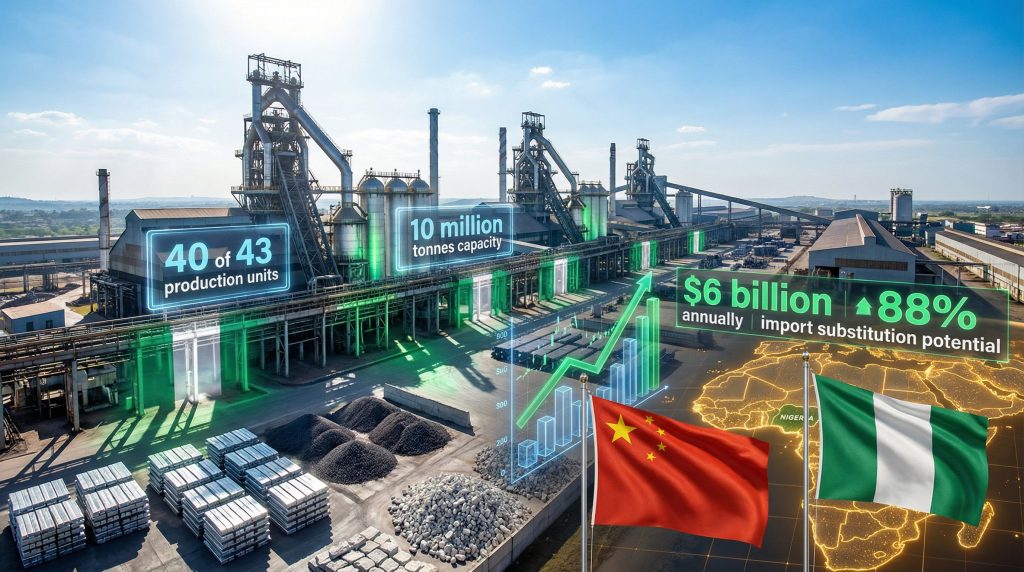
Recent engineering assessments reveal that the facility maintains core operational infrastructure capable of supporting steel production, though equipment modernisation remains essential. The plant's rolling mill capacity of 1.3 million tonnes annually provides an immediate restart pathway, while the broader facility infrastructure supports expansion to 10 million tonnes of annual production capacity.
Current market dynamics demonstrate Nigeria's acute steel supply shortage, with domestic production at approximately 1.2 million tonnes annually against estimated demand of 10 million tonnes. This 8.8 million tonne deficit represents an 88% import dependency rate, indicating substantial market absorption capacity for increased domestic production.
Market Gap Analysis and Production Scenarios
The nation's steel requirements are primarily fulfilled through scrap metal recycling rather than integrated ore-to-steel manufacturing processes. However, Nigeria possesses substantial iron ore deposits across Kogi and Niger states, yet these resources remain underutilised due to infrastructure integration challenges and operational inconsistencies.
| Production Stage | Current Capacity | Target Capacity | Market Impact |
|---|---|---|---|
| Phase 1 Rolling Mill | 1.3 million tonnes | Immediate restart | 8% domestic demand |
| Full Integration | Limited | 10 million tonnes | 100% domestic supply |
| Regional Export | None | 2-5 million tonnes | ECOWAS market penetration |
The production-sharing investment model eliminates direct federal funding requirements while enabling rapid capacity activation. Chinese engineering teams deployed for technical assessments concluded that rolling mill operations could commence within six months following investment agreement finalisation.
When big ASX news breaks, our subscribers know first
How Do Chinese Investment Models Transform African Industrial Assets?
Contemporary Chinese industrial investment approaches in Africa emphasise self-financed capital deployment combined with production-sharing revenue recovery mechanisms. In addition, this model contrasts sharply with traditional development finance structures that typically require sovereign guarantees or multilateral institution backing.
Production-Sharing Agreement Architecture
The proposed $2 billion investment operates through China's National Development and Reform Commission (NDRC) approval framework, ensuring strategic alignment with broader Belt and Road Initiative objectives. Twenty Chinese engineers conducted comprehensive technical assessments at the investor's expense, demonstrating commitment to thorough due diligence processes.
Joseph Tegbe, representing Nigeria-China Strategic Partnership coordination, emphasised that the investment structure requires no direct federal government funding. Chinese partners would independently raise capital subject to NDRC approval, then recover investments through production-sharing arrangements with the Nigerian government.
Engineering assessments determined that while most existing equipment requires replacement due to technological obsolescence, the core infrastructure remains structurally sound and operationally viable. This evaluation supports the six-month rolling mill activation timeline following investment agreement completion.
Technical Rehabilitation and Modernisation Strategy
The phased implementation approach prioritises immediate production capacity activation before comprehensive facility modernisation. Rolling mill restart provides revenue generation and operational validation, supporting subsequent expansion phases toward full 10 million tonne annual capacity.
Chinese investment models typically integrate:
- Self-financed capital deployment
- Technology transfer provisions
- Local workforce development programs
- Supply chain integration strategies
- Performance-based recovery mechanisms
This framework enables rapid project implementation while minimising host country financial exposure and political risk factors that have historically impeded large-scale industrial development projects across sub-Saharan Africa.
What Are the Geopolitical Implications of Nigeria's Steel Independence Strategy?
Nigeria's pursuit of steel production self-sufficiency reflects broader economic diversification objectives beyond petroleum revenue dependency. Consequently, the Nigeria Ajaokuta Steel Plant Revival represents a strategic industrial policy initiative with significant implications for West African regional manufacturing development.
Regional Manufacturing Hub Development
The Economic Community of West African States (ECOWAS) region, comprising over 380 million people, demonstrates substantial steel consumption growth potential driven by infrastructure development, urbanisation, and manufacturing expansion. Nigeria's 10 million tonne production capacity could serve regional markets while reducing collective import dependency.
Steel production independence supports downstream manufacturing sectors including automotive assembly, construction materials, and machinery production. These industries require reliable, cost-competitive steel supplies that import dependency cannot consistently provide due to currency volatility and supply chain disruptions.
Strategic Partnership Competition Dynamics
Nigeria's simultaneous engagement with Chinese and Russian industrial partners reflects strategic hedging approaches designed to maximise competitive investment terms while diversifying geopolitical risk exposure. Both nations possess extensive steel industry expertise and financial capabilities for large-scale infrastructure projects.
The original Ajaokuta facility was constructed through Soviet-era technical cooperation, creating familiarity with Russian metallurgical engineering approaches. However, contemporary Chinese manufacturing capabilities and Belt and Road Initiative financing mechanisms offer modernised alternatives to traditional state-to-state development models.
Competitive partnership negotiations enable Nigeria to:
- Compare investment terms and recovery mechanisms
- Access diverse technological approaches and expertise
- Reduce dependency on single-source financing
- Strengthen bargaining positions in final negotiations
- Integrate multiple partnership benefits simultaneously
How Does the Ajaokuta Free Trade Zone Model Accelerate Industrial Revival?
Free trade zone development represents a complementary strategy for maximising the steel plant's economic impact through integrated industrial ecosystem creation. The 4,000-hectare development area designation supports comprehensive value chain clustering from mining through finished manufacturing.
Economic City Integration Framework
Industrial free trade zones provide regulatory environments optimised for manufacturing operations, including streamlined customs procedures, tax incentives, and simplified labour regulations. These frameworks attract downstream manufacturers requiring reliable steel supplies while creating employment and technology transfer opportunities.
The integrated approach encompasses:
- Upstream Integration: Iron ore mining from regional deposits
- Primary Processing: Steel production and intermediate product manufacturing
- Downstream Manufacturing: Automotive components, construction materials, machinery parts
- Logistics Infrastructure: Transportation, warehousing, and distribution facilities
- Support Services: Technical assistance, financing, and administrative functions
Comparative African Industrial Zone Performance
Successful African free trade zones demonstrate significant economic transformation potential when properly implemented and managed. Morocco's Tangier zone has attracted substantial automotive manufacturing investment, while Ethiopia's industrial parks target textile and leather production for export markets.
These zones succeed by creating integrated ecosystems where manufacturers benefit from reduced operational costs, streamlined regulations, and concentrated supply chains that improve productivity and competitiveness compared to dispersed industrial development approaches.
Ghana's manufacturing zones near Tema Port illustrate how transportation infrastructure integration enhances export competitiveness and attracts foreign direct investment. Similarly, integration at Ajaokuta could position Nigerian steel production for both domestic supply and regional export opportunities.
What Financial Engineering Makes This $2 Billion Investment Viable?
The production-sharing agreement model represents innovative financial engineering that aligns investor and government incentives while minimising public sector financial exposure. This structure enables large-scale industrial investment without traditional debt financing or sovereign guarantee requirements.
Risk Mitigation Through Phased Implementation
The staged investment approach reduces financial risk through operational validation at each phase. Rolling mill activation provides immediate cash flow generation and market testing before full-scale facility modernisation and expansion investments.
| Investment Phase | Capital Requirement | Production Capacity | Revenue Potential |
|---|---|---|---|
| Rolling Mill Restart | $200-400 million | 1.3 million tonnes | $780 million annually |
| Partial Integration | $800-1,200 million | 5 million tonnes | $3 billion annually |
| Full Modernisation | $2 billion total | 10 million tonnes | $6 billion annually |
Note: Revenue projections assume steel prices of $600 per tonne and may vary significantly based on global commodity market conditions and local pricing dynamics.
Market demand validation through the 8.8 million tonne annual supply deficit provides strong offtake certainty for expanded production. Nigeria's structural steel shortage ensures domestic market absorption while regional export opportunities offer additional revenue diversification.
International Development Finance Integration
Production-sharing agreements can integrate with international development finance institution support for additional risk mitigation and technical assistance. Multilateral development banks increasingly support private sector-led infrastructure projects that demonstrate clear economic transformation benefits.
Political risk insurance, commodity price hedging, and currency fluctuation protection mechanisms further enhance investment viability while protecting both Chinese investors and Nigerian government interests from external market volatility. Furthermore, these tariffs economic implications continue to influence global steel trade patterns.
Why Have Previous Revival Attempts Failed and How Is 2026 Different?
Historical analysis of the Ajaokuta facility reveals consistent challenges including policy inconsistency, legal disputes, and infrastructure dependencies that prevented sustained operations. The plant never achieved full production capacity despite substantial construction completion and operational readiness.
Historical Failure Pattern Analysis
Legal disputes over iron ore concessions created operational uncertainty that deterred consistent production planning and investment. Mining rights complications prevented reliable raw material supplies essential for integrated steel production operations.
Policy inconsistency across multiple government administrations resulted in changing priorities and resource allocation decisions that undermined long-term operational planning. Industrial development strategies frequently shifted with political transitions, preventing sustained focus on steel sector development.
Infrastructure integration challenges, particularly railway connectivity between iron ore deposits and the steel plant, created logistical constraints that increased operational costs and reduced competitiveness compared to imported steel alternatives.
Contemporary Success Factor Differentiation
Current revival prospects benefit from several structural changes that address historical failure factors:
Financing Model Innovation: Production-sharing agreements eliminate government funding requirements while aligning investor incentives with operational success rather than construction completion.
Technical Assessment Validation: Independent Chinese engineering evaluation confirms infrastructure viability and provides realistic operational timelines based on contemporary technical standards.
Market Demand Validation: The 8.8 million tonne supply deficit provides guaranteed offtake certainty that did not exist during previous periods when domestic steel demand remained limited.
Regional Integration Opportunities: ECOWAS market development creates export potential that enhances project economics beyond domestic supply substitution alone.
The next major ASX story will hit our subscribers first
How Does the Nigeria Ajaokuta Steel Plant Revival Impact Nigeria's Economic Transformation Agenda?
Steel production capacity represents a foundational element of industrial development that enables multiple downstream manufacturing sectors while reducing foreign exchange pressures from import dependency. The Nigeria Ajaokuta Steel Plant Revival aligns with broader economic diversification objectives beyond petroleum revenue reliance.
Manufacturing Sector Catalyst Development
Reliable domestic steel supply enables automotive assembly, construction materials production, and machinery manufacturing sectors that require consistent, cost-competitive raw material access. These industries generate substantial employment while building technical capabilities and supply chain integration.
Direct employment at the steel facility could exceed 50,000 positions across production, maintenance, administration, and support functions. Indirect employment through downstream manufacturing and service providers multiplies total job creation impacts significantly.
Technology transfer through Chinese partnership creates opportunities for Nigerian technical workforce development in advanced metallurgical processes, equipment maintenance, and quality control systems. These capabilities support broader industrial sector development beyond steel production alone.
Foreign Exchange and Trade Balance Optimisation
Current steel imports represent approximately $3.5 billion annually in foreign exchange expenditure that domestic production could eliminate while generating export revenue through regional supply contracts. This trade balance improvement supports currency stability and reduces balance of payments pressures.
Export potential to ECOWAS markets could generate additional foreign exchange earnings while positioning Nigeria as a regional industrial hub. Steel exports support broader manufactured goods export development as domestic production costs become competitive with international suppliers.
The multiplier effects of reduced steel imports extend throughout the economy as construction costs decrease, infrastructure development accelerates, and manufacturing competitiveness improves through reduced input costs. Additionally, the iron ore trends demonstrate growing regional demand for steel products.
What Are the Environmental and Social Transformation Scenarios?
Contemporary steel production requires comprehensive environmental management systems to address air quality, water usage, waste generation, and energy consumption impacts. Modern facilities integrate pollution control technologies and resource efficiency measures that minimise environmental footprints.
Sustainable Industrial Development Integration
Environmental impact assessments and sustainability frameworks are essential components of modern industrial development that ensure long-term operational viability while meeting international environmental standards. These assessments guide technology selection and operational procedures.
Community development integration through local employment, skills training, infrastructure investment, and social programs creates positive relationships between industrial operations and surrounding populations. These programs support sustainable development that benefits both facility operations and community welfare.
Circular economy principles including waste reduction, energy efficiency optimisation, and resource recycling minimise operational costs while reducing environmental impacts. Advanced steel production facilities increasingly integrate these approaches as operational best practices.
Regional Development Multiplier Effects
Industrial development in Kogi State creates urbanisation pressures and opportunities that require comprehensive planning for housing, transportation, education, and healthcare infrastructure. These developments transform regional economic structures and population demographics.
The North-Central Nigeria region benefits from industrial clustering effects as steel production attracts related manufacturing, mining, and service industries. This clustering creates specialised labour markets and supply chains that enhance overall regional competitiveness.
National industrial policy validation through successful large-scale manufacturing demonstrates Nigeria's capability to support complex industrial operations. Consequently, the metals industry analysis suggests this could potentially attract additional foreign direct investment in manufacturing sectors requiring similar infrastructure and technical capabilities.
The global steel market continues to be influenced by factors including the US–China trade war impact, which creates opportunities for alternative supply sources like Nigeria's revived production capacity. Furthermore, recent developments indicate that Nigeria is in talks with Chinese firms over the $2 billion Ajaokuta steel plant revival, while the 42-year-old Ajaokuta plant is set for reboot with $2bn Chinese-backed plan.
This analysis is based on publicly available information and strategic assessment frameworks. Investment decisions should incorporate comprehensive due diligence, market analysis, and risk assessment procedures. Steel industry investments involve significant commodity price volatility and operational complexity that require specialised expertise and careful risk management.
Want to Find the Next Major Industrial Transformation?
Discovery Alert's proprietary Discovery IQ model delivers real-time notifications on significant ASX mineral discoveries, empowering investors to identify actionable opportunities in mining and resource sectors ahead of the broader market. Explore how historic discoveries can generate exceptional returns and begin your 14-day free trial today to position yourself at the forefront of Australia's next major industrial transformation.