May 18, 2026
When One Refinery Changes a Nation's Credit Story
Sovereign credit ratings are rarely moved by a single industrial facility. The mechanics of rating agency methodology span dozens of variables: fiscal balances, institutional quality, external liquidity, debt composition, and political risk. Yet in May 2026, something analytically unusual occurred in African credit markets. The Nigeria credit rating upgrade, executed by S&P Global Ratings lifting the long-term sovereign from B- to B, placed a privately owned refinery complex on the Lekki Peninsula at the centre of its rationale. Understanding why that happened requires examining the structural forces building beneath the surface of Africa's largest economy for several years.
When big ASX news breaks, our subscribers know first
Nigeria's First Sovereign Upgrade in 14 Years: The Multi-Agency Signal
The S&P upgrade on May 15, 2026 was not an isolated event. It was the third major rating upgrade Nigeria received within a 13-month window, creating an unusual degree of multi-agency alignment that investors and analysts rarely see concentrated so tightly.
Understanding Sovereign Credit Ratings: Agency Comparison
| Rating Agency | Previous Rating | Current Rating | Date of Action |
|---|---|---|---|
| S&P Global Ratings | B- | B | May 15, 2026 |
| Fitch Ratings | B- | B | April 2025 |
| Moody's Investors Service | Caa1 | B3 | May 2025 |
| Dagong Global Credit Rating | N/A | BB+ | Prior to 2026 |
When three globally recognised agencies converge on an upward trajectory within roughly 13 months, it typically signals that structural, rather than purely cyclical, improvements are being recognised. The divergence between Western agency ratings sitting at B and Chinese agency Dagong's BB+ rating is analytically instructive. It reflects different methodological weightings: Western agencies apply significant discounts for institutional governance, data quality, and political risk, while commodity export capacity and industrial scale receive heavier weighting in some emerging-market frameworks.
Key Insight: A sovereign credit upgrade is not merely symbolic. It directly affects the interest rate a government pays on international bonds, the appetite of foreign institutional investors, and the risk premium embedded in local-currency assets. Moving from B- to B within S&P's scale may appear incremental, but at the margin it can meaningfully lower Nigeria's cost of capital.
The Four Structural Pillars Behind the S&P Decision
Pillar 1: Oil Output Expansion and Revenue Capture
Higher crude oil production volumes contributed to improved fiscal receipts in the period leading to the upgrade. Equally important was the tightening of institutional mechanisms for capturing petroleum revenues, which had historically suffered from significant leakage. However, S&P did flag that approximately 200,000 barrels per day of Nigerian crude production remain pledged under NNPC financing arrangements, constraining the government's effective control over its primary revenue source. These oil price risks remain a persistent consideration in the overall rating narrative.
Pillar 2: The 2023 Naira Liberalisation
The decision by President Bola Tinubu's administration to float the naira in 2023 removed a long-standing foreign exchange distortion that had suppressed official reserves and incentivised parallel market activity. The consequences for Nigeria's external balance were substantial:
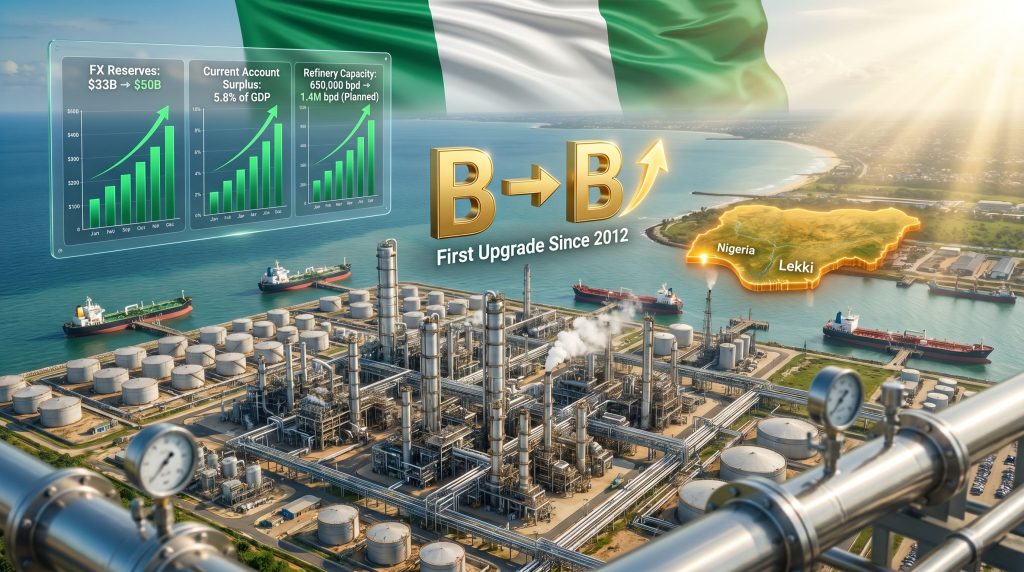
- Gross foreign exchange reserves climbed from approximately $33 billion in 2023 to $50 billion by early March 2026, a gain of $17 billion in under three years
- The current account surplus is projected at 5.8% of GDP in 2026, representing a meaningful improvement from prior deficit positions
- The removal of the fixed exchange rate eliminated a structural overhang that had discouraged legitimate capital inflows
Pillar 3: The Dangote Refinery as an External Balance Stabiliser
This is the pillar that has attracted the most analytical attention, and for good reason. Nigeria historically spent close to $10 billion annually importing refined petroleum products, representing one of the most persistent structural drains on its foreign exchange position. No matter how much crude oil Nigeria pumped, a substantial share of its export earnings was recycled back into refined fuel imports, creating a self-defeating loop that undermined every positive oil price cycle.
The Dangote Industries Ltd. refining and petrochemical complex at Lekki, operating at close to its 650,000 barrel-per-day nameplate capacity, has materially changed this dynamic:
- Approximately two-thirds of the complex's crude feedstock was sourced from domestic Nigerian fields in 2025
- The facility has transitioned Nigeria from a net refined-product importer to an emerging regional exporter, selling petrol and diesel into West African and broader Atlantic Basin markets
- S&P cited Dangote's feasibility study for an expansion to 1.4 million barrels per day as evidence that the refinery's relevance to Nigeria's external balance is structural, not temporary
Pillar 4: Geopolitical Insulation Through Domestic Supply
S&P's rating report explicitly highlighted the refinery's role in buffering Nigeria against supply disruptions. Furthermore, the domestic availability of refined fuel, gas, and fertiliser reduces Nigeria's exposure to geopolitical oil shocks that would otherwise flow directly into its import bill and consumer price levels.
How the Dangote Refinery Became a Sovereign Credit Variable
The formal elevation of a single privately owned industrial facility to the status of a macroeconomic stabiliser in sovereign credit analysis is genuinely unprecedented at the continental level. The Dangote Industries complex, representing a $20 billion investment, now sits inside Nigeria's sovereign credit framework in a way that creates a concentration dynamic with few parallels anywhere in Africa.
This has important implications that extend beyond the headline rating:
- The operational performance of a single plant in one industrial zone now carries partial responsibility for the creditworthiness of a 220-million-person nation
- Any disruption to the refinery, whether from operational, regulatory, feedstock, or geopolitical factors, carries potential spillover effects into Nigeria's sovereign credit assessment
- Pension fund regulatory reform has already begun to reflect this new reality, with a waiver allowing Nigerian pension funds to participate in a potential Dangote refinery IPO, signalling that domestic capital markets are pricing in long-term strategic value
Scenario Watch: If the planned expansion to 1.4 million barrels per day reaches financial close and begins construction, Nigeria's refined product export capacity would rival that of several established OPEC member states. That single development could fundamentally alter the country's external account arithmetic and potentially support a further rating upgrade toward BB- territory.
The Consumer Welfare Disconnect: Where the Macro Story Ends
The Nigeria credit rating upgrade and the Dangote refinery's operational success tell a compelling macroeconomic story. What they do not tell is the story experienced by most Nigerian households.
S&P explicitly warned in its rating report that the refinery is unlikely to ease retail fuel prices. Nigerian pump prices are now benchmarked to global market prices following the removal of fuel subsidies, meaning the refinery operates within a market-pricing framework rather than a subsidised domestic supply model. The facility also continues to import blending crudes as part of its feedstock mix, maintaining a partial linkage to global commodity costs. Petrol and diesel prices at Nigerian filling stations have risen multiple times since the Middle East conflict intensified in early 2026.
The social data are stark:
| Indicator | Value | Period |
|---|---|---|
| Poverty rate (national poverty line) | 63% (~140 million people) | 2025 |
| Poverty rate (national poverty line) | 56% | 2023 |
| Headline inflation | 34.8% | December 2024 |
| Headline inflation | 15.15% | December 2025 |
The World Bank's April 2026 Nigeria Development Update noted that household incomes had not expanded at a pace sufficient to offset persistent inflation pressures, and that poverty reduction had not yet begun. The disinflation from 34.8% to 15.15% over 2025 is a meaningful improvement in macroeconomic terms, yet the transmission to real purchasing power for low-income households has been minimal. Nigeria is simultaneously becoming a refining powerhouse and failing to protect its own consumers from the costs of that transformation.
The Hidden Liabilities Behind the Upgraded Rating
S&P's upgrade is not without significant caveats embedded within the rating report itself. Several disclosures deserve attention from investors and analysts:
- Nigeria's debt stock calculation includes a $5 billion swap facility signed with First Abu Dhabi Bank PJSC, collateralised at 133% with local-currency bonds, an off-balance-sheet exposure that most headline debt figures omit
- Approximately 200,000 barrels per day of Nigerian crude production are pledged under separate NNPC financing arrangements, constraining effective government control over primary revenues
- S&P flagged that Nigeria's fiscal and external data remain prone to errors, omissions, and large frequent revisions, an unusually candid warning to accompany a positive rating action
This data quality issue is particularly significant. An upgrade built partly on a statistical foundation that the rating agency itself considers unreliable introduces a layer of analytical uncertainty that is difficult to quantify. Consequently, the true picture of Nigeria's fiscal and external position could be either better or worse than reported figures suggest. Indeed, commodity market volatility adds a further layer of complexity to interpreting these data gaps.
The next major ASX story will hit our subscribers first
The IMF Divergence: A Competing Analytical Framework
S&P's optimism is not universally shared among multilateral institutions. The IMF reduced its 2026 growth forecast for Nigeria to 4.1% from 4.4% at its Spring Meetings in Washington, citing the adverse effects of war-related increases in fuel, fertiliser, and shipping costs on non-oil economic activity. This divergence creates an interesting analytical tension:
| Indicator | S&P Framework | IMF Projection |
|---|---|---|
| 2026 GDP Growth | Positive upgrade scenario | 4.1% (revised down from 4.4%) |
| Brent Crude Price Assumption | $100/barrel (2026 remainder) | More conservative baseline |
| External Balance | 5.8% of GDP current account surplus | Caution on non-oil erosion |
| Structural Risk | Refinery as stabiliser | War-related cost pressures |
S&P's upgrade arithmetic depends materially on a Brent crude price assumption of $100 per barrel for the remainder of 2026. If oil prices moderate below that level, the fiscal arithmetic supporting the upgrade weakens meaningfully. This is perhaps the most important single variable for investors monitoring Nigeria's credit trajectory.
The Political Tripwire: Election Spending and the Subsidy Risk
Nigeria's fiscal trajectory faces a well-defined pressure point before the upgrade can be considered durable. The general government deficit is projected to widen from 3.0% of GDP in 2025 to 4.2% in 2026 and 4.1% in 2027, driven by capital expenditure acceleration ahead of the January 2027 general election. The 2026 budget allocates 32.2 trillion naira (approximately $23 billion) to capital expenditure, equivalent to 7.3% of GDP.
S&P identified one scenario above all others as a direct reversal trigger:
Scenario Risk: If fuel subsidies are reintroduced in any form before or during the 2027 election campaign, S&P has effectively pre-signalled that a rating reversal would follow. With a poverty rate of 63% and an election approaching, the political calculus on fuel pricing represents a measurable policy tripwire that investors should monitor closely.
The Tinubu administration has explicitly ruled out subsidy reinstatement in its current policy framework. However, the combination of rising pump prices, a 63% poverty rate, and a national election creates precisely the political conditions under which energy subsidy commitments have historically been reversed across emerging markets. This dynamic reflects the broader geopolitical risk landscape that shapes sovereign credit outcomes across commodity-dependent economies.
Three Forward-Looking Scenarios for Nigeria's Credit Trajectory
Scenario 1: The Upgrade Holds and Deepens
- Brent crude stabilises at or above $90/barrel through 2027
- The Dangote expansion to 1.4 million bpd reaches financial close
- The 2027 election passes without subsidy reinstatement
- Fiscal deficit narrows toward 3.5% of GDP by 2028
- Likely outcome: Stable B rating with potential positive outlook revision toward BB- by 2028-2029
Scenario 2: The Rating Stagnates (Most Probable Near-Term Path)
- Oil prices moderate below $85/barrel, reducing fiscal headroom
- Election spending keeps the deficit above 4% of GDP through 2027
- Refinery expansion remains at feasibility stage without capital commitment
- Poverty and inflation data continue to diverge from macro headline improvements
- Likely outcome: Rating maintained at B with stable outlook, no further upgrade action before 2028
Scenario 3: Reversal Risk (Low Probability, High Impact)
- Fuel subsidies reintroduced under electoral pressure
- Oil production disruptions from Niger Delta security deterioration
- Naira depreciation resurfaces, eroding reserve gains
- NNPC crude pledge obligations constrain revenue flexibility
- Likely outcome: Negative outlook placed on B rating, potential return toward B- within 12-18 months
In addition, Nigeria's position within the broader multi-polar world economy introduces further variables that may not be fully captured by any single rating agency's scenario modelling.
Key Data Points: Nigeria's Credit Upgrade at a Glance
| Metric | Value | Significance |
|---|---|---|
| S&P Rating Change | B- to B (May 2026) | First upgrade since 2012 |
| Foreign Reserve Growth | $33B (2023) to $50B (March 2026) | +$17B in under 3 years |
| Current Account Surplus | 5.8% of GDP (2026 projection) | Structural external improvement |
| Poverty Rate | 63% in 2025 (~140 million people) | Macro gains not reaching households |
| Headline Inflation Change | 34.8% (Dec 2024) to 15.15% (Dec 2025) | Disinflation without real income recovery |
| 2026 Capital Budget | 32.2 trillion naira (~$23B) | 7.3% of GDP, election-cycle risk |
| Dangote Current Capacity | ~650,000 bpd | Near nameplate utilisation |
| Dangote Planned Expansion | 1.4 million bpd | Structural external balance anchor |
Frequently Asked Questions
What does the Nigeria credit rating upgrade from B- to B actually mean for investors?
A move from B- to B signals that S&P views Nigeria's capacity to meet its financial obligations as marginally improved. In practical terms, it can lower the interest rate Nigeria pays on international bonds, attract a broader pool of institutional investors constrained by minimum rating thresholds, and reduce the risk premium embedded in naira-denominated assets. However, a B rating remains firmly within speculative-grade territory, meaning significant risks are still present.
Why does the Dangote refinery appear in a sovereign credit rating decision?
Rating agencies assess a country's external balance, specifically the relationship between export earnings and import spending. Because Nigeria previously imported close to $10 billion worth of refined petroleum products annually, the Dangote refinery's ability to substitute domestic production for those imports directly strengthens Nigeria's current account position. When a single facility materially shifts a country's trade balance at this scale, it becomes analytically relevant to sovereign credit assessment, regardless of whether it is privately or publicly owned.
What would it take for Nigeria to reach BB- status?
Reaching the next rating milestone would require a sustained combination of factors:
- Fiscal deficit reduction below 3% of GDP on a durable basis
- Demonstrated naira exchange rate stability without central bank distortions
- Dangote expansion to materially above 650,000 barrels per day
- Poverty rate stabilisation supported by real wage growth
- Transparent and consistent fiscal data reporting that eliminates the errors and omissions flag
How does the IMF's more cautious view affect the upgrade's credibility?
The IMF's downward revision of Nigeria's 2026 growth forecast to 4.1%, combined with concerns about war-related cost pressures on non-oil activity, creates a competing analytical narrative to S&P's upgrade rationale. The key divergence point is S&P's $100/barrel Brent crude assumption for the remainder of 2026. If oil prices track closer to IMF baseline projections, the fiscal arithmetic supporting the upgrade becomes less comfortable.
Disclaimer: This article is intended for informational and analytical purposes only and does not constitute financial advice. Sovereign credit ratings, economic forecasts, and scenario projections involve significant uncertainty and are subject to change. Readers should conduct their own research and consult qualified financial advisers before making investment decisions.
Want to Stay Ahead of Major Resource and Commodity Discoveries Shaping Sovereign Markets?
As Nigeria's credit story demonstrates, single industrial assets can reshape entire economies — and Discovery Alert's proprietary Discovery IQ model delivers real-time ASX mineral discovery alerts, turning complex commodity data into actionable investment insights the moment significant announcements hit the market. Explore historic discoveries and their extraordinary returns or start your 14-day free trial today to position yourself ahead of the next transformative find.