August 12, 2026
West Africa's industrial transformation hinges on a critical challenge that extends far beyond resource availability. While Nigeria sits atop some of the continent's most substantial natural gas reserves, the true strategic imperative lies in converting these underground assets into reliable supply chains capable of anchoring large-scale manufacturing operations. This conversion process represents one of Africa's most significant untapped industrial catalysts, with implications extending across multiple economic sectors and investment strategy components.
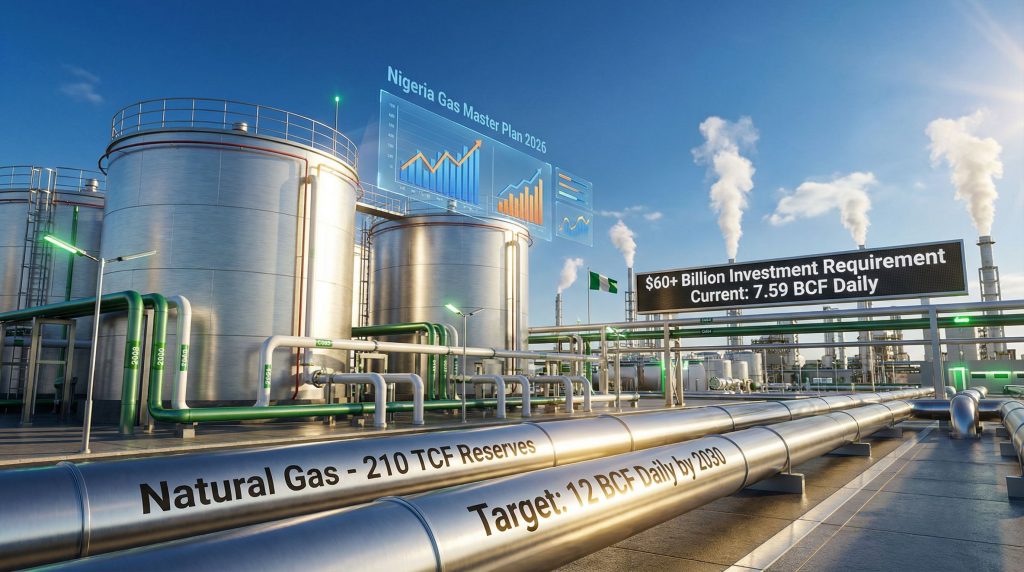
Nigeria's proven gas reserves exceed 210 trillion cubic feet, with potential resources reaching 600 trillion cubic feet, according to NNPC statements reported by Ecofin Agency in February 2026. Yet current daily production stands at only 7.59 billion cubic feet as of the first half of 2025, as documented by the Nigerian Upstream Petroleum Regulatory Commission. This production gap illustrates the fundamental challenge facing industrial expansion: transforming theoretical resource abundance into practical supply reliability.
The strategic complexity becomes apparent when examining Nigeria's ambitious production targets. Furthermore, the country aims to achieve 10 billion cubic feet daily by 2027 and 12 billion cubic feet daily by 2030, representing a 31.6% and 58% increase respectively from current levels. These targets require more than $60 billion in investment across the oil and gas value chain by 2030, as outlined in the NNPC Gas Master Plan 2026.
Key Reserve-to-Production Metrics:
- Current daily production: 7.59 billion cubic feet (H1 2025)
- 2027 production target: 10 billion cubic feet daily
- 2030 production target: 12 billion cubic feet daily
- Total investment requirement: $60+ billion across value chain
- Proven reserves: 210 trillion cubic feet
- Potential resources: Up to 600 trillion cubic feet
The gas-to-industry value chain encompasses five critical components that determine supply reliability. Upstream production involves both associated gas from oil fields and non-associated gas reserves, requiring different extraction and processing approaches. Transportation infrastructure connecting production zones to consumption centres represents the most capital-intensive element, with pipeline networks requiring substantial coordination across multiple states and regulatory jurisdictions.
Processing and treatment facilities must separate liquids, remove impurities, and standardise BTU content for industrial applications. In addition, storage and distribution systems provide essential flexibility during demand variations, while end-use integration requires industrial facility adaptation for efficient gas consumption. Each component presents distinct technical and financial challenges that influence overall supply chain reliability.
NNPC leadership, as communicated through Ecofin Agency reporting, characterises the fundamental challenge as converting resources into reliable supply and economic value rather than addressing resource scarcity. The strategic emphasis focuses on infrastructure expansion, supply reliability, and greater flexibility between domestic and export markets, positioning industrial partnerships as central to achieving production targets.
What Makes Industrial Gas Procurement Strategic for Manufacturing Giants?
Large-scale industrial operations require fundamentally different gas supply approaches compared to power generation or residential applications. Manufacturing conglomerates face unique procurement challenges that directly influence their expansion strategies and competitive positioning within regional and international markets.
Volume Security and Scalability Requirements
Industrial gas contracts must accommodate rapid capacity expansion without creating supply bottlenecks that could constrain production growth. Manufacturing operations typically require baseload reliability with consistent daily volumes regardless of seasonal demand fluctuations. This reliability extends beyond simple volume commitments to include scalability provisions with built-in expansion clauses for production capacity increases.
Quality specifications represent another critical differentiator for industrial gas procurement. Consequently, industrial-grade gas requires specific BTU content and minimal impurities that differ significantly from power generation standards. Delivery infrastructure considerations include dedicated pipeline capacity or priority access during peak periods, ensuring manufacturing operations maintain continuity during high-demand scenarios.
Economic Competitiveness Factors
Gas pricing structures significantly impact manufacturing cost competitiveness, particularly for energy-intensive industries. The cost impact varies dramatically across industrial sectors:
Table: Industrial Gas Cost Impact by Sector
| Industry Sector | Gas Share of Production Costs | Price Sensitivity Level | Strategic Importance |
|---|---|---|---|
| Fertiliser Manufacturing | 70-80% | Extremely High | Critical for food security |
| Cement Production | 30-40% | High | Infrastructure development |
| Petrochemical Refining | 15-25% | Moderate-High | Value-added processing |
| Power Generation | 60-70% | High | Grid stability support |
For fertiliser manufacturing, gas represents 70-80% of production costs, making price volatility an existential threat to operational viability. Cement production, with gas comprising 30-40% of costs, faces significant competitive pressure when gas prices fluctuate relative to alternative fuels. Petrochemical refining operations, while less gas-dependent at 15-25% of costs, require consistent supply for complex processing chains that cannot tolerate interruptions.
Recent gas supply deals for Dangote industrial expansion illustrate these procurement complexities in practice. Dangote Refinery, Dangote Cement, and Dangote Fertiliser signed revised Gas Sale and Purchase Agreements on February 1, 2026, with two NNPC subsidiaries: Nigerian Gas Marketing Company and NNPC Gas Infrastructure Company. These agreements were structured to accommodate rising energy demand linked to the Dangote Group's industrial expansion projects and form part of the conglomerate's Vision 2030 strategy.
David Bird, Managing Director of Dangote's refining unit, stated through Ecofin Agency reporting that the agreements represent an important step in the refinery's expansion strategy. The contracts are designed to help secure gas volumes needed to support expected increases in production capacity and were characterised as a proactive move to guarantee energy supply required for future industrial operations.
Gas Sale and Purchase Agreement Structure Innovation
Modern industrial gas agreements incorporate several strategic elements that extend beyond simple supply contracts. Take-or-pay provisions establish minimum volume commitments that provide suppliers with revenue certainty while obligating industrial consumers to purchase specified quantities or pay for unutilised volumes.
Swing capacity clauses enable additional volumes during peak production periods, providing flexibility above baseload commitments. However, price indexation mechanisms link gas costs to international commodity prices or inflation indices, managing long-term cost exposure for both suppliers and consumers. Force majeure protections address supply guarantees during infrastructure disruptions, ensuring contract resilience during maintenance or emergency events.
The Dangote agreements demonstrate multi-facility integration across three separate industrial entities signed simultaneously, indicating coordinated supply planning across multiple production facilities. This approach enables consolidated purchasing power and standardised contract negotiation across the conglomerate while supporting Vision 2030 strategy implementation.
When big ASX news breaks, our subscribers know first
How Do Long-Term Supply Agreements Shape Industrial Strategy?
Multi-year gas supply agreements function as strategic infrastructure investments that enable manufacturing conglomerates to plan major capital expenditures and market expansion initiatives with greater confidence. These agreements create a foundation for industrial development that extends far beyond simple fuel procurement.
Contract Duration and Strategic Planning
The Dangote Group's gas procurement history illustrates the strategic importance of long-term supply security. In 2025, NNPC and Dangote signed a 10-year partnership extension involving delivery of 100 million cubic feet per day to Dangote Refinery alone. The revised agreements signed in February 2026 build upon this foundation while expanding coverage to include Dangote Cement and Dangote Fertiliser operations.
This 100 million cubic feet daily figure represents approximately 1.3% of Nigeria's current total daily production, indicating that single-conglomerate supply agreements consume meaningful percentages of national output. Such commitments require careful coordination between industrial expansion plans and national gas production capacity development.
Infrastructure Development Linkage
NNPC's characterisation of the Gas Master Plan 2026 positions long-term industrial gas agreements as infrastructure investment signals that justify government and private sector capital deployment. These agreements provide contractual certainty that supports pipeline expansion and distribution network development decisions.
The bifurcated structure of the Dangote agreements illustrates this infrastructure coordination approach. Nigerian Gas Marketing Company handles commercial gas sales and customer management, while NNPC Gas Infrastructure Company manages gas transportation and distribution infrastructure. This separation enables specialised focus on commercial operations versus infrastructure control.
Regional Supply Chain Integration Benefits
Strategic gas partnerships enable vertical integration across manufacturing operations, particularly for conglomerates operating multiple industrial facilities. Furthermore, the Dangote Group's simultaneous agreements across three business units demonstrate several integration advantages:
- Cross-facility gas sharing during maintenance periods
- Consolidated purchasing power for improved pricing negotiations
- Standardised quality specifications across all operations
- Shared infrastructure development costs
- Coordinated expansion planning across business units
Investment Planning Certainty
Long-term gas agreements remove critical uncertainty from industrial expansion planning, typically triggering accelerated capital deployment. Secured gas supply enables capacity expansion projects, technology modernisation investments, workforce development programmes, and supply chain development initiatives.
NNPC stated through Ecofin Agency reporting that agreements with Dangote position the group as a central industrial player in Nigeria's gas strategy. These contracts provide a contractual basis for additional gas infrastructure development and reflect the country's ambition to turn reserves into a catalyst for industrial growth.
What Role Does Government Policy Play in Industrial Gas Allocation?
Nigeria's gas sector operates within a comprehensive regulatory framework that prioritises domestic utilisation over export revenues, creating unique opportunities for local industrial development while managing competing economic pressures.
Domestic Gas Obligation Framework
The Nigerian government requires gas producers to allocate minimum 40% of production for domestic use before export eligibility, creating a protected supply pool for local industries. This domestic gas obligation framework prioritises power generation and large industrials for preferential access, supporting industrial policy objectives over short-term export revenue maximisation.
Infrastructure development receives government co-investment support through pipeline networks connecting production to consumption centres. Fiscal incentives provide tax advantages for domestic gas utilisation projects, making local supply agreements more economically attractive compared to export alternatives.
NNPC Gas Master Plan 2026 Implementation
The Gas Master Plan 2026 represents a comprehensive approach to maximising domestic gas value creation through coordinated policy and investment strategies. NNPC CEO Bashir Ojulari described the plan as an execution-focused roadmap emphasising commercial viability of projects and stronger coordination across the gas sector.
Strategic Implementation Pillars:
- Production optimisation: Reducing flaring and increasing associated gas capture
- Infrastructure expansion: New pipeline networks connecting production to consumption centres
- Market development: Creating demand through industrial policy incentives
- Investment attraction: Public-private partnerships for major gas projects
The plan targets national production of 10 billion cubic feet per day by 2027 and 12 billion cubic feet per day by 2030, requiring more than $60 billion in investment across the oil and gas value chain. Particular focus emphasises strengthening supply for power generation, compressed natural gas development, cooking gas distribution, mini-LNG projects, and large industrial consumers.
Balancing Export Revenue and Domestic Development
Gas producers must navigate complex trade-offs between higher export revenues and domestic industrial development objectives. International gas price volatility creates ongoing tension between short-term revenue maximisation and long-term economic diversification goals, particularly in the context of market volatility hedging strategies.
Economic Scenario Analysis:
| Global Gas Price Level | Export Revenue Premium | Domestic Development Impact | Strategic Recommendation |
|---|---|---|---|
| High ($15+ per MMBtu) | 200-300% above domestic | Reduced local supply | Balanced allocation with quotas |
| Moderate ($8-15 per MMBtu) | 100-150% above domestic | Moderate local availability | Domestic priority with export flexibility |
| Low (Below $8 per MMBtu) | 50-100% above domestic | Strong local supply | Maximise domestic utilisation |
NNPC's more collaborative and investor-oriented approach to plan implementation reflects recognition that sustainable gas sector development requires balancing export opportunities with domestic industrial foundation building. The agreements with Dangote provide a contractual model for additional gas infrastructure development while demonstrating commitment to domestic value creation.
How Do Industrial Gas Deals Impact Nigeria's Energy Transition?
Large-scale industrial gas consumption creates a strategic bridge between fossil fuel dependence and renewable energy adoption, particularly through cleaner-burning applications and efficiency improvements that support broader energy transition challenges.
Compressed Natural Gas Industrial Applications
Industrial gas agreements increasingly incorporate provisions for CNG development, supporting Nigeria's transportation fuel diversification beyond traditional thermal energy applications. For instance, Dangote Cement's revised gas agreements include specific provisions for compressed natural gas solutions for industrial transport, representing secondary applications beyond primary thermal energy use.
CNG Market Development Scenarios:
- Industrial fleet conversion enabling manufacturing companies to transition truck fleets from diesel to CNG
- Regional distribution networks where gas suppliers develop CNG refuelling infrastructure
- Export potential positioning CNG as a cleaner alternative to diesel in West African markets
- Integration with existing gas supply infrastructure reducing deployment costs
This CNG integration demonstrates value-chain optimisation where reliable gas supply enables broader operational transformation beyond core manufacturing processes. Industrial transportation represents a significant cost component for manufacturing operations, particularly for companies like Dangote Cement that require extensive logistics networks for raw material sourcing and finished product distribution.
Manufacturing Process Optimisation
Access to reliable gas supply enables industrial efficiency improvements that reduce overall energy consumption while maintaining or increasing production output. Combined heat and power applications allow industrial facilities to generate electricity alongside production operations, improving overall energy efficiency.
Process integration utilises waste heat from gas combustion for secondary operations, maximising energy value extraction from each unit of gas consumed. Furthermore, natural gas substitution for coal and heavy fuel oil provides immediate emission reduction benefits while maintaining industrial competitiveness.
Energy Transition Strategy Alignment
The Dangote Group's Vision 2030 strategy emphasises increasing production while shifting toward cleaner energy sources, positioning gas supply security as enabling both commercial growth and environmental objectives. This dual approach reflects broader Nigerian energy policy that seeks to leverage natural gas as a transition fuel while building foundations for renewable energy adoption.
Industrial gas agreements support this transition by providing operational stability that enables manufacturers to invest in efficiency improvements and cleaner technologies. Reliable energy supply removes uncertainty that often prevents capital deployment for environmental upgrades.
What Are the Investment Implications of Strategic Gas Partnerships?
Industrial gas supply agreements signal major capital deployment intentions and serve as leading indicators for broader economic development patterns across Nigeria's manufacturing sector.
Capital Expenditure Acceleration
Secured gas supply removes critical uncertainty from industrial expansion planning, typically triggering coordinated investment across multiple operational areas. Capacity expansion projects become feasible when energy supply reliability is contractually guaranteed, enabling manufacturers to commit capital for new production lines and facility upgrades.
Technology modernisation investments follow gas supply security as manufacturers can justify advanced equipment purchases with confidence in long-term operational viability. Workforce development programmes and skills training initiatives receive increased funding when expansion plans have secured energy foundations.
Supply chain development accelerates as secure gas supply enables manufacturers to commit to long-term relationships with local suppliers, creating multiplier effects throughout regional economies. Consequently, local supplier capacity building becomes economically viable when anchor industrial customers have guaranteed operational continuity.
Market Confidence Effects
Long-term gas agreements demonstrate government and private sector commitment to industrial development, creating signals that attract additional investment beyond direct participants. Foreign direct investment in complementary industries increases when energy infrastructure reliability is established through major supply contracts, particularly in regions facing energy exports challenges.
Investment Multiplier Effects:
- Foreign direct investment attraction in complementary industries
- Local supplier network expansion supporting industrial clusters
- Infrastructure development acceleration beyond gas-specific projects
- Skills development and technology transfer initiatives
- Regional economic integration strengthening
The February 2026 Dangote agreements illustrate these multiplier effects through their integration with Vision 2030 strategy objectives. The simultaneous signing across three business units signals coordinated expansion planning that extends beyond individual facility requirements to encompass broader industrial ecosystem development.
Financial Market Implications
Strategic gas partnerships influence debt and equity market perceptions of industrial expansion viability. Secured long-term energy supply improves credit profiles for expansion financing while reducing operational risk premiums that lenders typically apply to energy-dependent manufacturing operations.
Equity valuations benefit from reduced operational uncertainty and demonstrated government support for industrial development. International investors view long-term gas supply agreements as evidence of regulatory stability and policy commitment to manufacturing sector growth.
How Do Global Energy Markets Influence Nigerian Gas Strategy?
International energy price volatility and supply chain disruptions create complex opportunities and challenges for Nigeria's domestic gas utilisation strategy, requiring careful balance between export revenue generation and local industrial development.
Export vs. Domestic Use Trade-offs
Nigeria's gas sector must navigate competing pressures between international market opportunities and domestic economic development objectives. Global gas price fluctuations significantly impact the relative economics of export versus domestic allocation decisions, particularly when considering the US natural gas forecast and its implications for international pricing.
High international gas prices exceeding $15 per MMBtu create export revenue premiums of 200-300% above domestic pricing, generating substantial foreign exchange earnings but potentially constraining local supply availability. Moderate pricing between $8-15 per MMBtu provides balanced incentives that support domestic priority policies while maintaining export flexibility.
Low international pricing below $8 per MMBtu reduces export premiums to 50-100% above domestic rates, creating optimal conditions for maximising domestic utilisation and industrial development acceleration. These price scenarios directly influence government allocation policies and private sector investment decisions.
Regional Competition Dynamics
Nigeria competes with other African gas producers for both export markets and industrial development opportunities, requiring strategic positioning that leverages unique advantages while addressing competitive challenges.
African Gas Producer Competitive Landscape:
- Algeria: Established European pipeline connections providing market access advantages
- Mozambique: Large LNG export projects under development targeting Asian markets
- Egypt: Strategic Mediterranean location enabling European supply diversification
- Ghana: Emerging domestic gas utilisation programmes creating regional development competition
Nigeria's domestic market size and industrial development potential provide unique advantages for gas monetisation strategies that prioritise local value creation over pure export revenue optimisation. The scale of domestic demand from companies like Dangote Group creates anchor consumption that supports infrastructure development and production expansion.
Infrastructure Investment Coordination
Global energy market dynamics influence infrastructure investment timing and capacity decisions for Nigerian gas development. International price volatility affects project finance availability and investment return calculations for major pipeline and processing facility development.
The $60 billion investment requirement outlined in the Gas Master Plan 2026 must account for international market conditions that influence both revenue projections and capital cost assumptions. Strategic gas partnerships like the Dangote agreements provide revenue certainty that supports infrastructure investment decisions during periods of global price volatility.
The next major ASX story will hit our subscribers first
What Success Metrics Define Effective Industrial Gas Strategy?
Measuring the impact of strategic gas partnerships requires comprehensive tracking of both immediate operational benefits and longer-term economic development outcomes that extend beyond individual contract performance.
Operational Performance Indicators
Supply reliability metrics track the percentage of contracted volumes delivered on schedule, providing fundamental assessment of contract performance. Cost competitiveness measures compare gas pricing relative to alternative fuel sources, quantifying economic advantages achieved through strategic partnerships.
Infrastructure utilisation rates monitor pipeline capacity factors and distribution efficiency, indicating whether supply chain investments are achieving anticipated returns. Quality consistency tracking measures gas specification compliance rates, ensuring industrial requirements are met consistently across contract duration.
Economic Development Metrics
Manufacturing output growth following gas supply security provides evidence of contract effectiveness in enabling industrial expansion. Employment creation metrics track both direct job creation within gas-dependent industries and indirect employment effects throughout regional economies.
Export competitiveness improvements measure manufacturing cost reductions that enable entry into international markets, demonstrating strategic value beyond domestic market benefits. Technology transfer assessment evaluates advanced manufacturing processes enabled by reliable energy supply, indicating capability development achievements.
Strategic Partnership Assessment Framework
The Dangote Group agreements provide specific examples for evaluating strategic partnership effectiveness. Previous 10-year partnership extensions and current revised agreements create baseline measurements for assessing contract evolution and strategic adaptation.
Key Performance Indicators:
- Contract renewal frequency and volume expansion rates
- Industrial capacity utilisation improvements following supply security
- Regional supply chain development acceleration
- Government policy objective achievement through private sector partnerships
- Infrastructure investment leverage through contractual certainty
Vision 2030 strategy alignment provides additional assessment criteria for measuring strategic partnership success beyond immediate commercial metrics. Environmental transition progress through cleaner energy adoption offers supplementary success indicators.
Future Outlook: Nigeria's Gas-Industrial Integration Trajectory
The convergence of abundant gas reserves, growing industrial demand, and supportive government policy creates unprecedented opportunity for Nigeria to establish itself as West Africa's dominant manufacturing hub through strategic energy partnerships.
Scenario Planning for 2030
Three distinct development scenarios emerge from current trajectory analysis, each with specific implications for industrial gas strategy and economic transformation outcomes.
Optimistic Scenario:
- 12 billion cubic feet daily production achieved through accelerated infrastructure development
- 60% domestic utilisation rate supporting comprehensive industrial cluster development
- Major industrial clusters established around gas infrastructure hubs
- Nigeria transitions to net exporter of manufactured goods across multiple sectors
- Regional manufacturing leadership position established throughout West Africa
Base Case Scenario:
- 10 billion cubic feet daily production meeting revised Gas Master Plan targets
- 45% domestic utilisation rate supporting steady industrial growth
- Consistent manufacturing expansion with primary regional market focus
- Balanced energy export revenue and domestic development achievement
- Sustained economic diversification progress with manufacturing sector growth
Challenging Scenario:
- 8 billion cubic feet daily production due to infrastructure development delays
- 35% domestic utilisation maintaining current export-focused orientation
- Limited industrial expansion constrained by supply chain uncertainty
- Continued heavy dependence on commodity export revenues
- Regional competitive position maintenance without significant advancement
Critical Success Factors
The success of gas supply deals for Dangote industrial expansion will ultimately determine which scenario materialises, making current supply agreement negotiations critical for Nigeria's long-term economic transformation trajectory.
Infrastructure development coordination between government policy and private sector investment represents the primary determinant of scenario outcomes. The $60 billion investment requirement demands unprecedented public-private partnership effectiveness to achieve optimistic scenario results.
International market integration strategies must balance export revenue optimisation with domestic industrial foundation building. However, global energy transition trends create both opportunities and challenges for gas-based industrial development strategies.
Strategic Implications for Stakeholders
Manufacturing conglomerates like Dangote Group must coordinate expansion planning with national gas production capacity development to ensure supply reliability during growth phases. Government policy makers face complex allocation decisions between export revenue generation and domestic industrial development support.
International investors seeking African manufacturing opportunities should monitor gas supply agreement developments as leading indicators of industrial expansion viability and regional competitive positioning. Energy sector investors must assess domestic utilisation trends alongside export market opportunities for optimal portfolio development.
The transformation of Nigeria's gas resources into industrial competitive advantage depends fundamentally on the success of current strategic partnership negotiations and their implementation over the remainder of this decade. These agreements will determine whether Nigeria achieves its potential as West Africa's manufacturing hub or continues its historical dependence on commodity exports.
Disclaimer: This analysis involves forward-looking statements and projections based on current information and trends. Actual outcomes may differ materially from scenarios presented due to various factors including global market conditions, regulatory changes, infrastructure development progress, and other unforeseen circumstances. Readers should conduct independent research and analysis before making investment or business decisions based on this information.
Ready to Capitalise on the Next Major Discovery?
Discovery Alert's proprietary Discovery IQ model delivers real-time alerts on significant ASX mineral discoveries, instantly empowering subscribers to identify actionable opportunities ahead of the broader market. Begin your 14-day free trial today and secure your market-leading advantage whilst exploring how major mineral discoveries can generate substantial returns.