July 10, 2026
The Geological Lottery Africa Has Been Sitting On
For decades, the dominant narrative around African resource wealth has centred on a familiar paradox: a continent holding an extraordinary share of the world's critical minerals, yet capturing a disproportionately small fraction of the economic value those minerals generate. Nowhere is this tension more visible than in Nigeria, where a Nigeria lithium reserve discovery is forcing an economy historically anchored to crude oil revenues to confront the scale of what lies beneath its non-petroleum geology.
The global energy transition has fundamentally reordered the strategic value of specific minerals. The critical minerals demand for lithium, nickel, platinum group metals (PGMs), and rare earth elements has moved these resources from industrial footnotes to the centrepiece of geopolitical supply chain strategy across the United States, European Union, and China. Against this backdrop, two significant mineral discoveries announced at the African Natural Resources and Energy Investment Summit 2026 in Abuja have placed Nigeria at the centre of a conversation it has long been absent from.
When big ASX news breaks, our subscribers know first
Two Discoveries, One Strategic Signal
The Kaduna Polymetallic Province: Breadth Over Single-Commodity Exposure
The first announcement involved the identification of a world-class polymetallic mineral province in Kaduna State, verified by the Nigerian Geological Survey Agency (NGSA). The deposit was identified by Steron Mining and Company Limited in collaboration with the NGSA, which subsequently confirmed the geological findings.
What makes polymetallic provinces commercially distinct is their multi-revenue architecture. Rather than depending on a single commodity price cycle, operators can generate simultaneous cash flows across several mineral streams. The Kaduna deposit contains high-grade concentrations of:
- Platinum group metals (PGMs)
- Gold
- Nickel
- Copper
- Lithium
- Rare earth elements (REEs)
Nigeria's Minister of Solid Minerals Development, Dr. Dele Alake, characterised the Kaduna find as a landmark breakthrough with the potential to elevate Nigeria's standing in the global market for strategic minerals used in clean energy technologies and advanced manufacturing. The high-grade nature of the deposits was specifically highlighted as a differentiating quality factor.
Investor Insight: Polymetallic deposits provide a natural hedge against single-commodity price downturns. If lithium prices soften, for instance, gold or PGM revenues can support project economics. This structural diversity makes the Kaduna province considerably more resilient than a pure-play lithium discovery.
The Abuja Lithium Reserve: 3.3 Million Metric Tonnes Confirmed
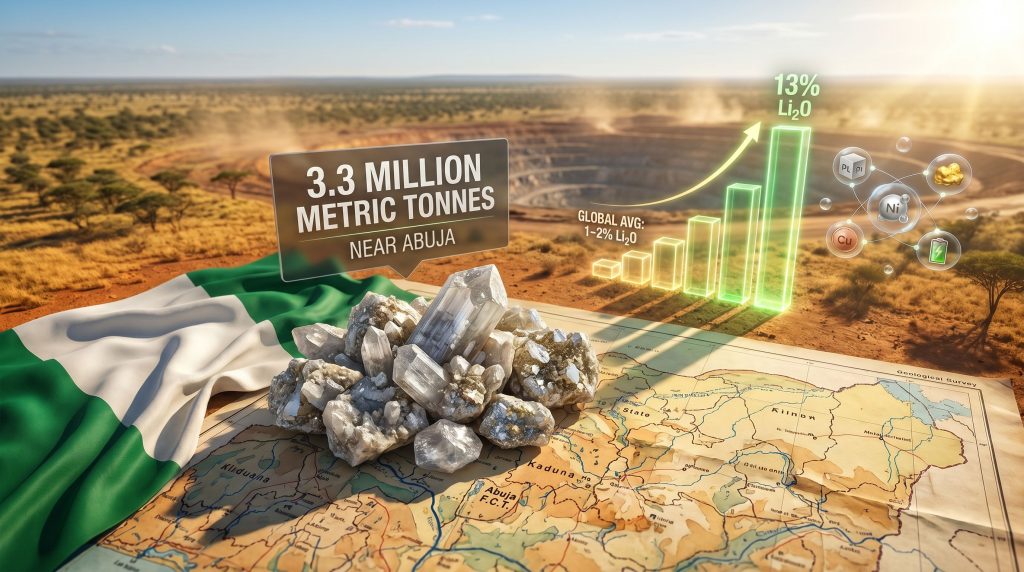
Separately, Steron Mining and Company Limited disclosed an estimated 3.3 million metric tonnes of lithium reserves at its mining site near Abuja. This constitutes one of the most significant standalone Nigeria lithium reserve discovery announcements in the country's recorded mining history and was unveiled at the same 2026 summit.
The dual-announcement format is itself strategically significant. By revealing a polymetallic province in Kaduna alongside a discrete lithium reserve near the capital, Nigeria's mining sector is signalling breadth of geological opportunity rather than a concentrated single-site story. This matters to institutional investors who assess country-level mineral prospectivity rather than individual project economics alone.
How Nigerian Lithium Grades Stack Up Against Global Benchmarks
Understanding Li₂O Concentration as a Commercial Threshold
One of the least understood aspects of lithium investment outside specialist circles is the critical role of ore grade in determining project viability. Understanding how lithium mining works reveals that lithium oxide concentration, expressed as a percentage of Li₂O, is the primary commercial benchmark for hard-rock spodumene deposits.
The following thresholds are widely used across the industry:
| Li₂O Grade Range | Commercial Classification |
|---|---|
| Below 1.0% | Sub-economic; generally not viable |
| 1.0% to 2.0% | Minimum viable threshold for most projects |
| 2.0% to 4.0% | Good commercial grade |
| 4.0% to 6.0% | High quality; strong project economics |
| Above 10.0% | Exceptionally rare; premium-tier deposit |
Against these benchmarks, Nigerian lithium geology stands out sharply. ASX-listed Chariot Resources Limited, which secured six mining licences across Nasarawa, Kogi, Kwara, Ekiti, and Cross River states, independently verified spodumene extraction grades ranging from 2.66% to 5.96% Li₂O across its licensed sites. Certain Nigerian deposits have recorded concentrations approaching 13% Li₂O — a figure that would place them among the highest-grade hard-rock lithium sources identified anywhere on earth.
Technical Note: High-grade deposits do more than improve headline economics. They reduce the volume of ore that must be processed to yield a tonne of lithium carbonate equivalent (LCE), directly lowering energy consumption, processing costs, and environmental footprint per unit of output. For frontier jurisdictions where energy infrastructure is constrained, this grade advantage is operationally meaningful.
Nigeria's Lithium Landscape: A Comparative Overview
| Site or Programme | Location | Reserve / Grade | Verified By |
|---|---|---|---|
| Steron Mining Lithium Reserve | Near Abuja | ~3.3 million metric tonnes | NGSA |
| Kaduna Polymetallic Province | Kaduna State | PGMs, gold, nickel, copper, Li, REEs | NGSA + Steron Mining |
| Chariot Resources Licensed Sites | Nasarawa, Kogi, Kwara, Ekiti, Cross River | 2.66% to 5.96% Li₂O spodumene | Independent verification |
| National Lithium Belt Estimate | 10+ states | $34B to $700B estimated value | NGSA mapping |
Nigeria's lithium-bearing geology spans at least ten states, tracing a belt mapped by the NGSA that extends from the northwest toward the southeast, approaching the Cameroon border. Total estimated reserve value across this belt ranges from $34 billion to $700 billion depending on methodology, commodity pricing assumptions, and deposit scope — a variance that itself illustrates how early-stage much of this geology remains. Furthermore, recent research published in geochemical literature reinforces the geological significance of Nigeria's lithium-bearing pegmatite formations across these states.
Who Is Deploying Capital Into Nigeria's Lithium Sector
Chinese Investment Leads the Committed Capital Wave
Jiuling Lithium Mining Company and Canmax Technologies have collectively committed investments exceeding $1.3 billion to establish lithium processing infrastructure in Nasarawa and Kaduna states. This level of financial commitment from Chinese industrial capital is not incidental. It mirrors a well-established strategic playbook: secure upstream supply access while simultaneously building downstream processing capacity inside the producing country.
What is less commonly discussed is the value-capture implication of this model. When foreign processors build in-country facilities, host nations gain jobs and tax revenues — but the highest-margin stages of the lithium value chain, including battery precursor chemicals and cathode active materials, typically remain in the investor's home jurisdiction. Moreover, Chinese companies are actively grabbing stakes in Nigeria's lithium and EV future, making Nigeria's ambition to capture more than raw export value all the more dependent on deliberate policy architecture around domestic processing mandates.
Australian Junior Mining Enters the Picture
The involvement of ASX-listed Chariot Resources Limited carries a different signal than Chinese industrial investment. Australian junior mining companies operate on exploration risk capital, meaning their entry is driven by geological conviction rather than downstream supply security. Their independently verified grades of 2.66% to 5.96% Li₂O across multiple licensed states represent a technically credible exploration outcome that adds weight to the broader thesis about Nigerian lithium prospectivity.
Saudi Capital Being Actively Courted
Nigeria has separately pitched $600 million in lithium and gold projects to Saudi investors, reflecting a deliberate strategy to build an investor base diversified beyond Chinese capital. This matters geopolitically: dependence on a single foreign investor class in a critical mineral sector creates leverage vulnerabilities that sovereign resource strategies should seek to mitigate.
The Structural Barriers That Could Limit Nigeria's Potential
Infrastructure: The Invisible Cost Multiplier
High ore grades and large reserve tonnages are necessary but not sufficient conditions for a successful mining operation. Nigeria's mining sector faces a set of infrastructure constraints that add cost at every stage of the value chain:
- Transport corridors: The absence of dedicated rail links between mineral-bearing states and export ports adds significant cost-per-tonne relative to more developed mining jurisdictions.
- Power reliability: Mineral processing is energy-intensive. Grid instability in Nigeria raises operating costs and complicates the business case for in-country processing ambitions.
- Port capacity: Export scalability depends on adequate port infrastructure to handle bulk mineral shipments competitively.
These are not insurmountable problems, but they require capital investment that typically must precede, or run in parallel with, mining development rather than following it.
Artisanal Mining: A Hidden Depletion and Governance Risk
Unregulated artisanal and small-scale mining (ASM) activity across Nigeria's lithium-bearing states creates a compound problem that is often underappreciated by outside investors:
- Resource depletion: Surface and near-surface high-grade material — often the most economically significant portion of a deposit — can be extracted ahead of formal development, reducing the resource base available for bankable feasibility studies.
- Environmental liability: ASM activity can create ground disturbance and contamination that complicates future environmental permitting for formal operators.
- Revenue leakage: Minerals extracted through informal channels bypass royalty and tax collection systems, reducing the fiscal benefit to the state and undermining the revenue diversification argument.
Formalising ASM activity is a stated government priority under the Ministry of Solid Minerals Development's reform programme. However, the operational complexity of transitioning thousands of informal operators into a regulated framework should not be underestimated.
Regulatory Maturity and the Timeline to Bankable Feasibility
Risk Callout: In frontier mining jurisdictions, the gap between a verified resource discovery and a definitive feasibility study — the document required before project financing can be secured — routinely spans five to ten years. Regulatory clarity, transparent royalty frameworks, and enforceable environmental compliance mechanisms are not optional features of an attractive investment environment; they are prerequisites.
Nigeria's mining regulatory infrastructure has historically been less developed than its petroleum sector equivalent. The Nigerian Minerals and Mining Act and its associated regulations provide a framework, but investor confidence requires consistent application of that framework over time, not just its existence on paper.
Nigeria Within Africa's Broader Critical Minerals Competition
How Africa's Major Critical Mineral Producers Compare
| Country | Primary Critical Mineral | Notable Development Status |
|---|---|---|
| Nigeria | Lithium, PGMs, REEs, Nickel, Gold | 3.3Mt lithium reserve near Abuja; Kaduna polymetallic province verified |
| Zimbabwe | Lithium | Africa's largest lithium producer; mineral-for-infrastructure arrangements with China |
| DRC | Cobalt, Copper | Approximately 70% of global cobalt supply; persistent governance challenges |
| Zambia | Copper | $372M UK investment commitment in copper assets |
| Kenya | Rare Earth Elements | Preliminary US agreement on $62.4B estimated untapped REE deposits |
| Namibia | Uranium, Lithium | Growing junior miner interest; emerging exploration profile |
Nigeria's Competitive Differentiators Within This Landscape
Several factors distinguish Nigeria's positioning relative to peer African mineral producers:
- Commodity diversity: The combination of lithium, PGMs, gold, nickel, copper, and REEs across multiple provinces creates a broader investment proposition than single-commodity producers.
- Economic scale: As Africa's largest economy by GDP, Nigeria brings capital market depth, existing trade infrastructure, and domestic industrial demand that smaller mineral-rich nations cannot replicate.
- Coastal access: Unlike several landlocked competitors in the critical minerals space, Nigeria's port access provides a latent logistical advantage provided internal connectivity is improved.
- Geological belt continuity: The NGSA-mapped lithium belt traversing more than ten states suggests a systemic geological endowment rather than isolated deposits — a distinction that matters for long-term sector scale.
The next major ASX story will hit our subscribers first
From Oil Dependency to Mineral Diversification: The Economic Reframing
Why the Solid Minerals Sector Carries Structural Importance Beyond Revenue
Nigeria's petroleum revenues have historically accounted for the dominant share of government foreign exchange earnings, creating a structural vulnerability to oil price cycles that has periodically destabilised public finances. The solid minerals sector's contribution to GDP has remained marginal despite the geological evidence of significant endowment — a gap the current administration is explicitly seeking to close.
A successfully developed critical minerals sector would deliver economic benefits across several dimensions:
- A countercyclical revenue stream decoupled from crude oil price movements
- Foreign direct investment inflows spanning exploration, processing, logistics, and services
- Technical workforce development in geology, mining engineering, and environmental management
- Downstream industrial development potential in battery component manufacturing over the long term
The Value-Addition Question: Who Captures the Margin?
The most strategically important question facing Nigeria's minerals sector is not whether lithium can be extracted, but at what point in the value chain Nigerian entities capture economic benefit. The progression from raw ore to refined lithium carbonate to battery-grade lithium hydroxide to cathode active material represents a series of value-addition steps, each carrying progressively higher margins.
Nigeria's stated objective of building in-country processing capacity aligns with this logic. However, investment structures that place processing infrastructure under foreign ownership — even when physically located in Nigeria — can still result in the majority of value-added margin flowing offshore. Structuring investment agreements to ensure progressive local content requirements and domestic value retention will be as important as attracting the initial capital. Consequently, trends in African mining finance suggest that host nations are increasingly seeking equity participation rather than royalty-only arrangements to better retain in-country value.
Frequently Asked Questions: Nigeria Lithium Reserve Discovery
How large is Nigeria's newly confirmed lithium reserve near Abuja?
Steron Mining and Company Limited has identified an estimated 3.3 million metric tonnes of lithium reserves at its mining site near Abuja, disclosed at the African Natural Resources and Energy Investment Summit 2026.
What minerals were confirmed in the Kaduna polymetallic province?
The Kaduna deposit contains verified high-grade concentrations of platinum group metals, gold, nickel, copper, lithium, and rare earth elements, confirmed by the Nigerian Geological Survey Agency in collaboration with Steron Mining.
How does Nigerian lithium grade compare to global averages?
Nigerian deposits are notably high-grade relative to global norms. Verified spodumene grades from licensed sites range between 2.66% and 5.96% Li₂O, while certain deposits have recorded concentrations approaching 13% Li₂O against a global commercial average of 1% to 2%.
What is the estimated total value of Nigeria's lithium reserves nationally?
Estimates vary significantly based on methodology and commodity pricing. Nigeria's total lithium reserve value across more than ten lithium-bearing states has been cited at figures ranging from $34 billion to $700 billion.
Which companies are currently active in Nigeria's lithium sector?
Key operators include Steron Mining and Company Limited (Abuja reserve and Kaduna polymetallic province), Chariot Resources Limited (ASX-listed, six licensed sites), Jiuling Lithium Mining Company, and Canmax Technologies, the latter two having committed a combined total exceeding $1.3 billion in processing infrastructure.
What are the primary risks facing Nigeria's lithium development timeline?
The main constraints include inadequate transport and energy infrastructure, widespread artisanal mining activity creating resource depletion and permitting complications, regulatory framework maturity relative to more established mining jurisdictions, and the extended timeline typically required to convert exploration discoveries into producing mines.
Key Takeaways
- Nigeria has confirmed two major mineral discoveries: a polymetallic province in Kaduna State and a 3.3 million metric tonne lithium reserve near Abuja, both verified by the NGSA
- Nigerian lithium is commercially differentiated by exceptionally high ore grades, with verified deposits reaching up to 13% Li₂O against a global commercial average of 1% to 2%
- Total national lithium reserve value estimates span $34 billion to $700 billion across more than ten states
- Chinese companies alone have committed over $1.3 billion in processing infrastructure, with Saudi and Australian capital also entering the sector
- Structural barriers including infrastructure deficits, artisanal mining activity, and regulatory development gaps must be systematically addressed to convert geological potential into sustained export revenue
- The value-addition question — determining how much of the lithium value chain margin is retained within Nigeria rather than captured offshore — will ultimately define whether this Nigeria lithium reserve discovery reshapes the country's economic structure or simply replicates the extractive model that characterised its oil era
This article contains forward-looking assessments based on publicly available geological data, investment announcements, and industry benchmarks. Reserve estimates, valuation ranges, and development timelines are subject to material change as exploration and feasibility work progresses. Nothing in this article constitutes financial or investment advice.
Want To Be First When the Next Major Mineral Discovery Hits the ASX?
Discovery Alert's proprietary Discovery IQ model delivers real-time alerts on significant ASX mineral discoveries — transforming complex geological data into actionable investment insights for both short-term traders and long-term investors. Explore historic examples of exceptional discovery returns and begin your 14-day free trial today to position yourself ahead of the broader market.