
August 22, 2026
The Hidden Mechanics Behind Africa's Most Significant Oil Comeback
For decades, the economics of oil-dependent nations have followed a familiar pattern: production peaks attract capital, disruption drives capital away, and recovery depends on whether underlying structural conditions genuinely change or merely stabilise temporarily. Nigeria has lived through each phase of this cycle more dramatically than almost any other major producer. What makes the current moment analytically distinct is not simply that output numbers have improved, but that the mechanisms driving the improvement span security, infrastructure, governance, and gas commercialisation simultaneously. That convergence is rare, and understanding it matters far beyond the barrel count.
When big ASX news breaks, our subscribers know first
Nigeria Oil Output Hits 5-Year High: Understanding the Full Scale of the Turnaround
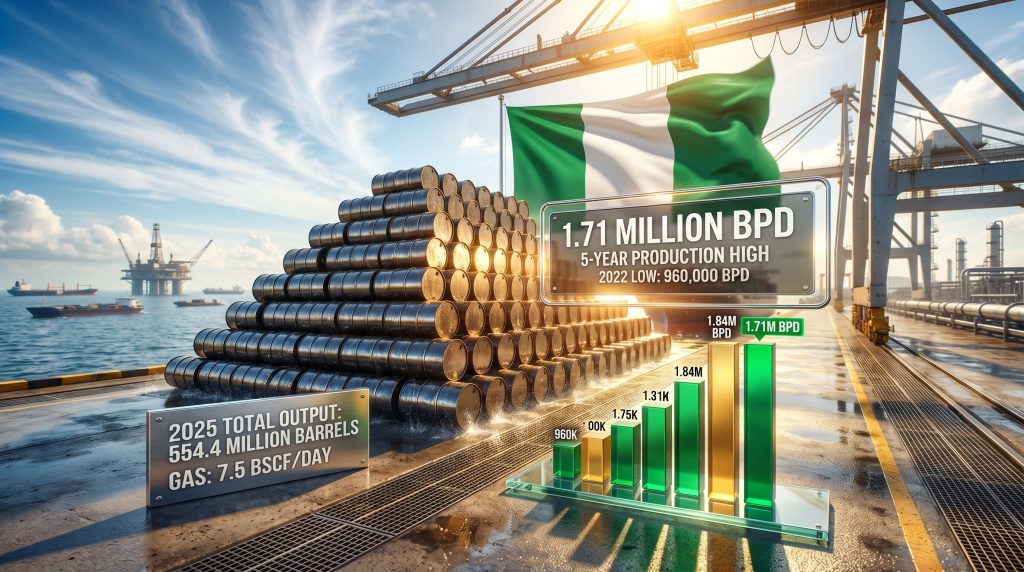
Nigeria's crude oil production has reached 1.71 million barrels per day (bpd) across the April 2025 to April 2026 measurement window, representing the highest sustained output the country has recorded in five years, according to figures disclosed by NNPC Group Chief Executive Officer Bayo Ojulari in the company's One-Year Mandate Report Summary. The announcement confirms that Nigeria oil output hits 5-year high after a prolonged period of operational deterioration that saw production collapse to approximately 960,000 bpd in 2022, roughly half of what the country was capable of extracting at peak capacity.
The following table captures the core production metrics reported across the period:
| Indicator | Figure |
|---|---|
| Sustained Production High (April 2025–April 2026) | 1.71 million bpd |
| 2025 Episodic Peak Output | 1.84 million bpd |
| 2025 Annual Daily Average | 1.63 million bpd |
| 2022 Production Low | ~960,000 bpd |
| 2025 Total Annual Output | 554.4 million barrels |
| NEPL Peak (December 2025) | 565,000 bpd |
| Natural Gas Output Rate | 7.5 billion scf/day |
| Year-on-Year Production Increase | ~5% |
The gap between the 1.84 million bpd episodic peak and the 1.71 million bpd sustained level is itself analytically instructive. It reflects the operational reality that Nigerian production remains subject to intermittent disruptions, even as the underlying trajectory has shifted decisively upward. Episodic peaks tend to coincide with periods of extended security stabilisation or successful infrastructure commissioning, while pullbacks reflect the fragility that persists in certain parts of the Niger Delta operating environment.
How Far Has Nigeria Actually Come? Contextualising the Recovery
To appreciate the significance of the current milestone, it helps to position 1.71 million bpd against Nigeria's longer production history. During the mid-2000s through the early 2010s, Nigeria operated closer to a production ceiling of 2.0 to 2.2 million bpd, making it Africa's largest crude oil producer by volume. The subsequent collapse driven by militant activity, pipeline vandalism, and chronic crude theft reduced the country's effective output to levels not seen since the early phases of offshore development.
The recovery from 960,000 bpd to 1.71 million bpd represents a restoration of approximately 78 to 85% of the lost productive capacity relative to those earlier benchmarks. Framed differently, Nigeria has recovered the equivalent of roughly 750,000 bpd of previously lost output. That figure exceeds the total current production of several smaller African oil-producing nations.
The recovery is substantial by any measure, but it remains partial. Nigeria's historical peak capacity has not yet been reclaimed, meaning meaningful upside potential still exists if structural improvements are sustained and deepened.
This distinction between partial recovery and full restoration matters for investors and policymakers alike. It signals that the current milestone is not the ceiling of the improvement story, but potentially an intermediate point in a longer trajectory, contingent on continued execution across the enabling factors examined below.
What Is Actually Driving the Production Rebound?
Security Stabilisation in the Niger Delta
The single most consequential factor in Nigeria's production collapse was the wave of militant activity and coordinated crude oil theft that took hold across the Niger Delta from roughly 2016 onward. Pipeline infrastructure became a primary target, not merely through direct sabotage but through sophisticated theft operations involving covert pipeline tapping and the diversion of crude oil into illicit supply chains. The consequence was a dual loss: physical extraction from the production system and volumetric leakage before crude could reach export terminals.
The improvement in Niger Delta security conditions has created two reinforcing production benefits:
- Well and flow station reactivation: Facilities that were shut in due to unacceptable security risk have progressively returned to operation, expanding the active production base without requiring new exploration or development drilling.
- Reduced volumetric losses: Restored pipeline integrity means a higher proportion of extracted crude reaches export terminals, improving the relationship between wellhead production and reported export volumes.
It is worth noting that security conditions in the Niger Delta remain structurally complex. Community relations and revenue-sharing arrangements continue to present unresolved tensions in certain producing areas, and any resurgence in organised activity could rapidly erode current gains. The stability achieved so far is best understood as a meaningful improvement over the recent nadir rather than a definitive resolution of the region's underlying dynamics.
Infrastructure Delivery and the AKK Pipeline
NNPC identified infrastructure delivery as a central pillar of the production recovery, with Ojulari specifically citing the completion of the Ajaokuta-Kaduna-Kano (AKK) pipeline river crossing as a key milestone. The AKK pipeline is designed to transport natural gas from Nigeria's southern producing regions northward, strengthening supply reliability for industrial and power generation consumers across the country's northern corridor.
The river crossing component represents a technically demanding section of the broader pipeline project, requiring specialised engineering to maintain structural integrity across a major waterway. Its completion removes a critical bottleneck that would otherwise constrain the pipeline's ability to reach full operational throughput.
Several gas processing facilities were also commissioned during the reporting period. While specific facility names and location details were not disclosed in the publicly available summary, the commissioning of additional processing capacity serves multiple production objectives:
- It reduces flaring of associated gas, capturing volumes that would otherwise be wasted.
- It increases throughput capacity for gas produced alongside crude oil, improving overall field economics.
- It supports the expanded domestic gas supply agreements discussed later in this article.
NEPL's Emerging Role as a State-Sector Production Contributor
One of the less widely discussed dimensions of Nigeria's production recovery is the performance of NNPC Exploration and Production Limited (NEPL), the company's dedicated upstream subsidiary. NEPL achieved a standalone peak output of 565,000 bpd in December 2025, a figure that represents a substantial share of national production and signals a meaningful shift in the productive contribution of state-controlled upstream operations.
Historically, international oil company joint ventures dominated Nigeria's upstream production profile, with state-sector operations frequently characterised by underinvestment, operational inefficiency, and governance challenges. The NEPL output figure suggests that this dynamic is evolving, with the state-sector upstream arm becoming a credible volume contributor rather than a passive participant in national production statistics.
Nigeria's Gas Sector: The Underappreciated Dimension
Sustained Output at 7.5 Billion Standard Cubic Feet Per Day
While crude oil production figures typically dominate coverage of Nigeria's energy sector, the maintenance of 7.5 billion standard cubic feet per day (bscf/d) of natural gas production represents an equally significant operational achievement. Gas production requires consistent management of upstream wells, processing infrastructure, and downstream delivery systems, and maintaining this output level alongside a major crude recovery signals operational discipline across both hydrocarbon streams.
Nigeria holds some of the largest natural gas reserves on the African continent, yet has historically monetised only a fraction of this resource base efficiently. A significant portion of gas co-produced with crude oil has been flared, representing both an environmental cost and a substantial missed economic opportunity. The maintenance of 7.5 bscf/d of productive gas output, combined with reduced flaring through new processing capacity, represents movement toward more complete resource utilisation.
Industrial Gas Supply Agreements and Domestic Deepening
NNPC has formalised expanded gas supply agreements with major domestic industrial consumers, with Dangote Cement and the Dangote Refinery identified as anchor off-takers. These arrangements reflect a deliberate strategic orientation toward domestic gas deepening rather than pure export maximisation.
The logic behind this approach is worth unpacking:
- Bankable demand signals: Long-term supply agreements with creditworthy industrial anchor customers create predictable demand that justifies upstream gas investment and reduces the commercial uncertainty that has historically deterred gas development.
- Industrial value creation: Supplying reliable gas feedstock to energy-intensive industries retains more economic value within Nigeria's domestic economy compared to exporting raw or processed gas internationally.
- Import substitution support: Stable energy supply to the Dangote Refinery, in particular, supports the facility's ramp-up toward full capacity, which has direct implications for Nigeria's refined product import bill.
This approach mirrors resource utilisation strategies pursued by other commodity-rich nations seeking to move up the value chain, using primary resource extraction as the foundation for broader industrial development rather than as an end in itself.
The Dangote Refinery: Nigeria's Structural Import Dependency Problem
NNPC's Consolidated 7.25% Equity Stake
NNPC's formalisation of its 7.25% equity stake in the Dangote Refinery positions the national oil company as a direct financial participant in what is Africa's largest single-train petroleum refinery, with a nameplate capacity of 650,000 bpd. This equity relationship aligns NNPC's commercial interests with the refinery's operational success in a way that purely contractual supply relationships would not.
The introduction of an incorporated joint venture (IJV) model for refinery operations adds an important governance dimension to this arrangement. Under an IJV structure, the refinery operates with greater commercial independence from government budget cycles and administrative processes. This reduces the risk of politically driven operational interference, a concern that has historically undermined the performance of state-linked energy assets in Nigeria and across the African continent more broadly.
Nigeria has long faced a structural paradox: the country produces significant volumes of crude oil yet imports the majority of its refined petroleum products, paying out substantial foreign exchange in the process. The Dangote Refinery's operational ramp-up, if sustained, directly addresses this inefficiency by producing refined products domestically from Nigerian crude.
The economic significance of resolving this paradox cannot be overstated. The difference between exporting crude and importing refined products versus processing crude domestically and selling finished products locally represents a substantial annual foreign exchange saving, with compounding benefits for the naira's stability and Nigeria's current account position.
Governance Reforms: The Foundation That Makes Production Gains Durable
From Opacity to Institutional Accountability
Production milestones attract attention, but governance reforms determine whether those milestones translate into sustained investment and durable economic benefit. On this front, NNPC has made substantive changes that represent a meaningful departure from the institutional opacity that historically characterised Nigeria's national oil company.
Key governance developments across the reporting period include:
- Monthly performance reporting: The introduction of a regular public reporting cadence allows investors, analysts, and the Nigerian public to track operational progress in near-real time, reducing the information asymmetry that previously inflated the risk premium attached to Nigerian oil assets.
- First-ever earnings call (November 2025): NNPC's inaugural earnings call marked a significant institutional milestone, bringing the company's communication practices closer to those of commercially oriented national oil companies elsewhere in the world.
- Federation account remittances (since July 2025): Consistent fiscal transfers to Nigeria's federation account demonstrate that production growth is translating into tangible government revenue, addressing a longstanding concern about whether NNPC's operational improvements produce actual budgetary benefit.
Why Governance Reform Matters for Long-Term Capital Attraction
The strategic importance of these reforms extends beyond their immediate operational significance. Institutional unpredictability has historically been one of the most significant deterrents to long-term foreign direct investment in Nigeria's upstream sector, arguably more so than production risk itself. International oil companies allocate capital across competing global opportunities, and Nigerian assets have frequently been discounted relative to their resource endowment because of governance-related uncertainty.
Transparent reporting frameworks and commercially disciplined operating practices reduce this uncertainty premium. Over time, if governance reforms are maintained and deepened, Nigerian upstream assets should attract capital at a lower cost, improving the economics of development projects and enabling exploration activity that the current risk premium has made marginal.
The next major ASX story will hit our subscribers first
Macroeconomic Implications and the OPEC Dimension
Foreign Exchange Revenue and Naira Stability
Oil export revenues remain the dominant source of Nigeria's foreign exchange earnings, making the production recovery directly relevant to monetary policy and currency stability. The arithmetic is straightforward: at prevailing global oil prices, the gap between 960,000 bpd (the 2022 low) and 1.71 million bpd (the current sustained level) represents a difference of approximately 750,000 bpd of additional oil available for export. Across a full year, that differential translates to hundreds of millions of additional barrels of dollar-denominated export receipts, providing the Central Bank of Nigeria with greater capacity to manage naira volatility.
Nigeria's OPEC+ Positioning
The production recovery also has implications for Nigeria's position within the OPEC+ supply management framework. OPEC production decisions and quota allocations will become increasingly relevant as Nigeria demonstrates sustained output capacity. Furthermore, OPEC's global influence on price dynamics means that Nigeria's improved production profile intersects with broader market forces that directly affect the country's export revenue calculations.
Countries that consistently produce at or above their allocated quotas complicate the bloc's collective output management, while those with demonstrated production capacity have stronger grounds for seeking larger formal quotas in future allocation negotiations. The recent exit of the UAE from OPEC introduces additional complexity into African producer dynamics within the organisation.
The UAE's decision, driven in part by frustration with production constraints relative to its expanded capacity, creates a precedent that other high-capacity producers may reference in future negotiations. For Nigeria, which has sometimes struggled to consistently meet even its existing OPEC quota due to operational challenges, reaching and sustaining 1.71 million bpd strengthens its credibility as a reliable producer within the organisation's framework.
How Do Global Price Pressures Affect Nigeria's Recovery?
It is also worth considering how external price dynamics intersect with Nigeria's domestic production story. The oil price rally seen in recent periods has provided a supportive revenue backdrop for Nigeria's recovery efforts, though this tailwind is not guaranteed to persist. In addition, the trade war impact on oil markets has introduced demand-side uncertainty that Nigerian planners must factor into their fiscal modelling.
However, the situation is further complicated by Venezuela oil policy changes under shifting US sanctions frameworks, which have the potential to alter global supply balances and, consequently, the price environment in which Nigeria sells its crude. These external variables reinforce why Nigeria's governance reforms and production diversification strategy matter so much beyond the headline barrel count.
African Producer Comparison
Situating Nigeria's recovery within the broader African oil production landscape provides useful context for understanding its regional significance:
| Country | Approximate 2025 Output | Primary Challenge |
|---|---|---|
| Nigeria | 1.63–1.71 million bpd | Infrastructure & theft (historically) |
| Angola | ~1.1 million bpd | Mature field natural decline |
| Libya | ~1.2 million bpd | Ongoing political instability |
| Algeria | ~0.9 million bpd | Ageing reservoir base |
| Congo (Brazzaville) | ~0.25 million bpd | Limited upstream investment |
Nigeria's recovery, if sustained, reinforces its position as Africa's leading crude oil producer by volume, a status that has strategic implications for the continent's energy diplomacy and resource nationalism conversations.
Key Risks That Could Undermine the Recovery
Niger Delta Structural Vulnerability
Despite measurable security improvement, the Niger Delta remains a structurally complex operating environment. The community relations and revenue-sharing dynamics that underpin social stability in producing areas have not been fully resolved across all regions, representing a latent source of disruption that could be triggered by political changes, economic grievances, or shifts in local power dynamics. Investors and analysts tracking Nigerian production should monitor Niger Delta security conditions as a leading indicator of output trajectory.
Oil Price Sensitivity and Fiscal Breakeven
Nigeria's fiscal breakeven oil price is estimated at approximately $90 to $100 per barrel, a level that requires sustained global oil prices to maintain the government revenue necessary for continued infrastructure and security investment. A prolonged period of sub-breakeven prices would compress the financial headroom available to sustain the very programmes that are currently enabling the production recovery, creating a circular vulnerability in the reform strategy.
Infrastructure Execution Risk
Nigeria's historical record on large-scale energy infrastructure delivery has been uneven, with projects frequently experiencing cost overruns, timeline extensions, and technical complications. The AKK pipeline and associated gas infrastructure carry inherent execution risk, and the production upside embedded in current projections assumes continued successful delivery of infrastructure commitments. Cautious optimism, grounded in the genuine progress achieved so far but tempered by awareness of historical patterns, remains the appropriate analytical posture.
Frequently Asked Questions: Nigeria Oil Output Recovery
What is Nigeria's current oil production level?
Nigeria's crude output has reached 1.71 million barrels per day over the April 2025 to April 2026 measurement period, its highest sustained level in five years, confirming that Nigeria oil output hits 5-year high as disclosed in NNPC's One-Year Mandate Report Summary by Group CEO Bayo Ojulari. (Source: Business Insider Africa, Segun Adeyemi, April 28, 2026.)
Why did Nigeria's oil production decline so severely before this recovery?
The primary causes of Nigeria's production collapse between 2016 and 2022 included organised militant activity targeting production infrastructure in the Niger Delta, systematic pipeline vandalism, widespread crude oil theft operations that diverted volumes from the legitimate supply chain, and reduced capital commitment from international oil companies responding to the resulting security and governance risks.
Has Nigeria fully recovered its historical production capacity?
Not yet. Nigeria's pre-disruption production ceiling approached 2.0 to 2.2 million bpd, meaning the current 1.71 million bpd sustained level represents a significant recovery but still falls approximately 15 to 20% below historical peak capacity. The recovery is substantial but incomplete.
What is the AKK pipeline and why does it matter for Nigeria's energy sector?
The Ajaokuta-Kaduna-Kano pipeline is a major gas transmission infrastructure project designed to transport natural gas from Nigeria's southern production areas northward, improving energy supply reliability for industrial users and power generators across the country's northern regions. The completion of its river crossing section removed a significant bottleneck in its progression toward full operation.
What governance reforms has NNPC introduced?
NNPC has introduced monthly performance reporting, conducted its first public earnings call in November 2025, and resumed consistent remittances to Nigeria's federation account since July 2025. These changes represent a meaningful shift toward commercial transparency and institutional accountability by a state oil company that has historically operated with limited public disclosure.
What is NNPC's involvement in the Dangote Refinery?
NNPC holds a 7.25% equity stake in the Dangote Refinery and has adopted an incorporated joint venture model for its participation in refinery operations. This structure is designed to improve operational efficiency and insulate the refinery's commercial decision-making from government budget cycles.
Disclaimer: This article contains forward-looking statements, production forecasts, and macroeconomic projections that are subject to material uncertainty. Oil production levels, commodity prices, security conditions, and infrastructure timelines can change rapidly and unpredictably. This content is provided for informational purposes only and does not constitute financial or investment advice. Readers should conduct independent research and consult qualified advisers before making any investment decisions.
Want To Capitalise on the Next Major Resource Discovery Before the Broader Market?
While Nigeria's oil recovery highlights how transformative resource developments can generate substantial returns, Discovery Alert's proprietary Discovery IQ model delivers real-time alerts on significant ASX mineral discoveries — instantly turning complex data into actionable opportunities for investors at every level. Explore historic discovery returns that demonstrate just how lucrative early positioning can be, and begin your 14-day free trial today to secure your market-leading advantage.