
June 13, 2026
The Aluminium Supply Chain's Most Vulnerable Chokepoint
Few commodities illustrate the concept of structural irreplaceability quite like West African bauxite. Aluminium smelters across the Gulf and Asia do not purchase Guinean ore as a preference — they purchase it as a necessity. Guinea's deposits combine high gibbsite content, favourable stripping ratios, and direct coastal shipping access through Port of Kamsar in ways that competing sources in Australia, Indonesia, and Brazil cannot fully replicate at scale. When a single nation accounts for the majority of global bauxite production growth, any structural change in how that nation manages its resources sends ripple effects across the entire aluminium supply chain.
That structural reality is now colliding with a deliberate sovereign strategy. Guinea is no longer content to export raw ore while others capture the processing margin. The establishment of Nimba Mining Company as a fully state-owned operator marks a calculated inflection point — one that raises fundamental questions about pricing power, industrial policy, and the future of aluminium supply security for producers from Abu Dhabi to Zhengzhou.
When big ASX news breaks, our subscribers know first
What Is Nimba Mining Company and Why Do Guinea Bauxite Exports Depend on It?
The Sovereign Logic Behind Guinea's First State-Owned Mining Operator
Nimba Mining Company was established by presidential decree on August 5, 2025, as a 100% state-owned entity built around the Tinguilinta bauxite mine in eastern Guinea. The founding rationale was not simply to fill an operational vacuum left by a departed private operator. It represented a deliberate repositioning of the Guinean state as a direct participant in the sector rather than merely a licensor of it.
The geological foundation underpinning NMC's mandate is substantial. The Tinguilinta deposit holds an estimated 400 million tonnes of bauxite reserves, providing a multi-decade extraction horizon that supports long-term industrial planning rather than short-cycle commodity trading. Combined with established port access through Kamsar, the asset provides NMC with the infrastructure backbone required for rapid operational scaling.
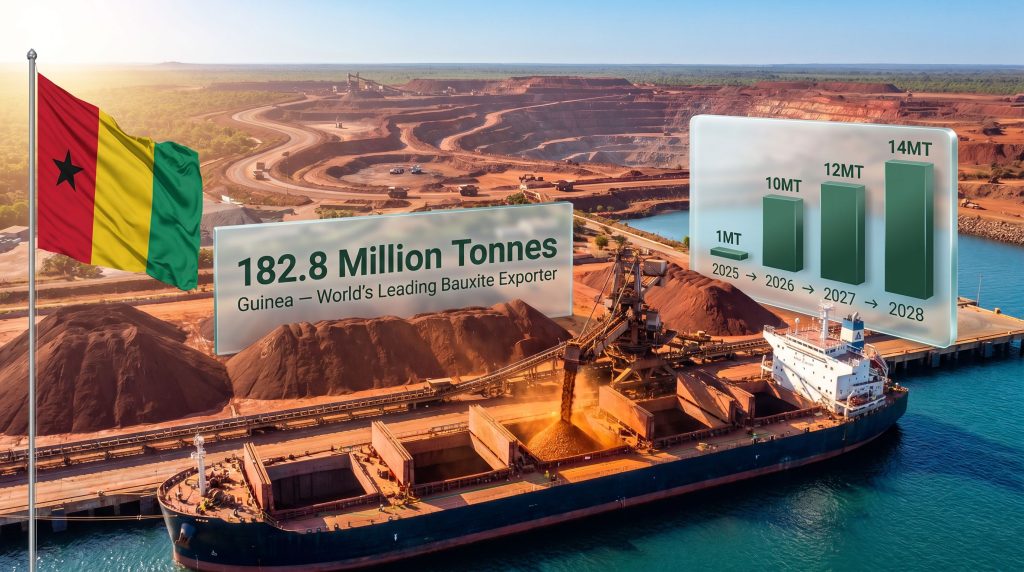
This matters enormously within the context of Guinea's broader economic architecture. The bauxite sector contributes approximately 15% of national GDP, making it the central engine of Guinea's fiscal base. With 182 million tonnes of bauxite exported in 2025 compared to 125 million tonnes in 2023, Guinea has extended its position as the world's leading bauxite exporting nation by a substantial margin, according to NMC's CEO Patrice L'Huillier speaking to Ecofin Agency in May 2026.
Guinea's Structural Position in the Global Aluminium Value Chain
The dependency dynamic between Guinea and its primary customers runs deeper than simple export volumes suggest. Gulf-based aluminium producers, particularly those operating large-scale refineries in the UAE, require consistent supply of high-quality bauxite to maintain refinery throughput economics. Chinese alumina refineries along the coast of Shandong and Guangxi have similarly built procurement models around Guinean ore grades that competing bauxite sources cannot easily substitute.
Furthermore, among the leading bauxite mines globally, Guinea's Tinguilinta operation stands out for its combination of reserve scale and logistical efficiency. This asymmetric dependency gives Guinea negotiating leverage that has historically gone underutilised due to fragmented private ownership and limited price transparency. NMC's creation consolidates that leverage under a single state-aligned entity with an explicit mandate to convert geological advantage into fiscal and industrial outcomes.
How NMC Achieved One of the Fastest Mining Restarts in Recent Industry History
Infrastructure Condition and the 87-Day Mobilisation Window
When Patrice L'Huillier assumed the role of NMC's CEO in September 2025, the Tinguilinta mine and Port of Kamsar facilities had been largely idle for nearly twelve months following the withdrawal of the previous concession holder. The condition assessment that followed proved decisive for the entire restart timeline.
L'Huillier confirmed to Ecofin Agency that the facilities were found to be in generally good condition with no major deterioration — a finding that made an aggressive restart schedule immediately viable rather than aspirational. From that assessment, NMC developed a structured action plan aligned with the Ministry of Mines' target of resuming operations before October 31, 2025.
The restart met its deadline precisely. The first barge was loaded on October 31, 2025, followed by a formal first vessel loading ceremony on November 4 attended by government representatives. Nimba Mining Company's first shipment of approximately 200,000 tonnes from Port of Kamsar was described by L'Huillier as ranking among the fastest operational restarts ever accomplished in the international mining industry — a characterisation that gains credibility when one considers the typical 12 to 24-month timelines associated with greenfield mine startups or heavily damaged asset rehabilitations.
The Three Pillars That Made Rapid Restart Possible
Several interlocking factors explain how NMC compressed what would typically be a multi-year reactivation process into under three months:
-
Infrastructure preservation — No major structural deterioration meant capital expenditure was directed toward operational mobilisation rather than asset rehabilitation, dramatically reducing both cost and timeline.
-
Retained institutional knowledge — Guinean technical teams who had maintained familiarity with the site despite twelve months of inactivity provided an irreplaceable advantage. Their knowledge of equipment quirks, geological conditions, and port logistics eliminated the learning curve that plagues completely reconstituted workforces.
-
Phased prioritisation — Rather than attempting full simultaneous activation, NMC organised the restart progressively, channelling initial resources into maintenance, production, and safety roles before expanding into secondary functions.
The subcontracting architecture added further operational depth during the ramp-up phase. Chinese firm CHICO was engaged under the first mining subcontracting agreement in January 2026, followed in February 2026 by a second agreement with Guinean company IBS, which specialises in blasting and crushing operations. This sequencing reflects a deliberate strategy of layering contractor capacity rather than deploying all resources simultaneously.
| Milestone | Date | Outcome |
|---|---|---|
| NMC Established by Presidential Decree | August 5, 2025 | 100% state-owned entity created |
| First Barge Loaded | October 31, 2025 | Ministry restart deadline met |
| First Vessel Loading Ceremony | November 4, 2025 | Government milestone witnessed |
| First Export Shipment | November 2025 | ~200,000 tonnes from Port of Kamsar |
| Full Mining Operations Resume | December 2025 | Transition from stockpile to active extraction |
| CHICO Subcontract Signed | January 2026 | Chinese mining contractor engaged |
| IBS Subcontract Signed | February 2026 | Guinean blasting and crushing specialist engaged |
NMC's Production Ramp-Up: Targets Through to 2028
A Scaled Growth Trajectory Anchored to Market Reality
NMC's production strategy is structured as a deliberate step-up rather than an immediate capacity push — a distinction that reflects both market absorption considerations and operational prudence during the contractor integration phase.
The monthly production target for April 2026 stands at 700,000 tonnes, with NMC targeting the threshold of one million tonnes per month from June 2026 onward. Annualised, this trajectory supports the following export volume schedule confirmed by L'Huillier to Ecofin Agency:
| Year | Target Export Volume | Notes |
|---|---|---|
| 2025 | 1 million tonnes | Achieved, primarily from available stockpiles |
| 2026 | 10 million tonnes | Current execution year, ramp-up ongoing |
| 2027 | 12 million tonnes | Forward forecast |
| 2028 | 14 million tonnes | Full Tinguilinta operational capacity |
The 2025 figure of one million tonnes was met through drawdown of existing stockpiles accumulated under the prior operator, with full mining operations only resuming in December 2025. The ramp from one million tonnes in 2025 to ten million in 2026 therefore represents genuine extraction-driven volume growth rather than a continuation of prior-year production levels.
What Could Derail the Ramp?
Several constraint categories warrant monitoring as NMC progresses through its scale-up trajectory:
-
Human capital scarcity in specialised disciplines — L'Huillier explicitly identified mine planning engineers and automation technicians as high-demand skill sets where Guinean talent exists but faces intense international competition. Attracting and retaining these professionals in a country undergoing rapid industrial expansion requires compensation structures and career pathways that state-owned enterprises have historically struggled to deliver competitively.
-
Port of Kamsar throughput ceiling — The infrastructure dependency between mine production capacity and port export capacity represents a potential bottleneck as volumes approach the 14 million tonne annual target. No publicly available data currently quantifies Port of Kamsar's design throughput relative to NMC's ambition.
-
Export quota policy uncertainty — The Guinean Ministry of Mines is exploring a volume regulation framework for bauxite exports, a mechanism presented at the International Bauxite Conference in Miami. L'Huillier confirmed NMC views this development as unlikely to disrupt its growth trajectory, suggesting an expectation that state-owned operators would receive preferential quota treatment under any implemented framework.
Speculative consideration: If Guinea implements sector-wide export volume caps to support bauxite pricing, NMC's status as the sovereign operator may effectively insulate its growth targets while creating competitive constraints for private sector participants sharing the same export corridor.
Guinea Bauxite Pricing Reform: The Guinea Bauxite Index
Why Price Opacity Has Cost Guinea Hundreds of Millions in Fiscal Revenue
One of the least-discussed structural weaknesses in Guinea's bauxite sector is the historical absence of a transparent national pricing reference. Bauxite transactions have long been priced against Chinese spot market dynamics, with limited visibility for Guinean authorities into the actual commercial terms being agreed between operators and offtakers.
This opacity has meaningful fiscal consequences. Without a robust reference index, Guinea's mining royalty and export tax calculations depend on declared transaction values that authorities cannot independently verify against market benchmarks. The resulting information asymmetry has historically favoured international buyers rather than the resource-holding state.
NMC is actively contributing to the development of the Guinea Bauxite Index (GBX), a national pricing reference mechanism under construction by the Ministry of Mines. The mechanism draws on a structural advantage embedded in Guinea's regulatory framework: every bauxite transaction requires government approval before execution. This creates granular, real-time visibility into pricing trends across both Chinese and Indian markets, as well as freight cost movements.
L'Huillier confirmed to Ecofin Agency that NMC contributes to the GBX development by sharing current operational and commercial data with the Ministry, enabling authorities to build a genuine understanding of market dynamics rather than relying on aggregated trade statistics with significant reporting lags.
A credible national pricing benchmark would serve multiple strategic objectives simultaneously: strengthening Guinea's fiscal revenues, providing a negotiating reference for long-term offtake agreements, and potentially positioning the GBX as a regional pricing standard for West African bauxite transactions more broadly.
NMC's Alumina Refinery Ambition: From Ore Exporter to Industrial Processor
The Economics of Moving Up the Value Chain
Raw bauxite commands a fraction of the per-tonne value of processed alumina, which in turn commands a fraction of aluminium metal pricing. Every tonne of bauxite that leaves Guinea unprocessed represents a transfer of the processing margin to the importing country's industrial base. At Guinea's export volumes, this cumulative value leakage is significant.
Guinea has declared an ambition to build between five and six alumina refineries by 2030. NMC's specific contribution to this national agenda centres on a refinery project near the Tinguilinta site, targeting a processing capacity of approximately one million tonnes of alumina per year. In addition, broader alumina refinery investment activity across the sector signals growing institutional confidence in processing-focused industrial models.
What distinguishes this initiative from previous attempts is the combination of institutional continuity and state mandate that NMC brings. Preliminary studies were originally conducted in the early 2010s and a site has already been identified, meaning the project is not starting from zero. L'Huillier confirmed to Ecofin Agency that engineering study contracting is imminent, with the studies themselves expected to take approximately 18 months, followed by a two to three year construction phase, producing a realistic operational timeline of around 2030.
Execution Risks That Have Derailed Similar Projects Across Africa
The alumina refinery ambition is analytically compelling but historically difficult to execute across the African continent. Key risk factors include:
-
Financing structure complexity — Alumina refineries are capital-intensive assets requiring multi-billion dollar commitments. Attracting project finance at acceptable terms requires credible offtake agreements, typically with established aluminium producers, which introduces a chicken-and-egg dynamic between securing financing and securing customers.
-
Energy and water infrastructure requirements — Alumina refining through the Bayer process is highly energy and water intensive. Guinea's hydropower potential is substantial, but grid infrastructure connecting generation capacity to industrial processing sites requires parallel investment.
-
Engineering and procurement lead times — Refinery-grade processing equipment faces long lead times in current global supply chains, meaning delays in study completion directly compress the construction schedule.
The alumina refinery ambition is not without historical precedent for delay. What differentiates the 2026 context is the presence of a state-aligned operator with direct policy mandate. Whether that institutional alignment translates into execution discipline or becomes a vehicle for politicised decision-making is the central execution risk.
The next major ASX story will hit our subscribers first
Gold Diversification: The Resolute Mining Partnership
Building a Multi-Commodity National Mining Champion
NMC's mandate explicitly extends beyond bauxite. The Guinean strategy, as articulated by L'Huillier, positions NMC as an integrated and diversified national mining company spanning extraction, processing, and multi-commodity development across gold and base metals including copper.
The partnership with Resolute Mining, an Australian gold producer, represents NMC's first concrete step toward commodity diversification. The two entities are collaborating on gold exploration programmes in eastern Guinea, with a combined investment commitment of approximately $10 million per year beginning in 2026.
NMC contributes terrain knowledge, institutional relationships, and operational infrastructure to the partnership. Critically, L'Huillier highlighted a human capital dimension that is rarely discussed in coverage of Guinea's mining sector: a significant cohort of Guinean engineers has accumulated gold sector experience through employment in neighbouring countries including Senegal, Côte d'Ivoire, and Mali. This cross-border experience base represents a deployable technical workforce that can support gold exploration activity without requiring the multi-year training investment typical of greenfield capability building.
Regional Rebalancing: Why Guinea Is Attracting Capital Fleeing Mali
The regional investment landscape provides a meaningful tailwind for NMC's diversification ambitions. Mali has historically been one of West Africa's major gold producers, but deteriorating security conditions and regulatory instability have prompted a significant repositioning of mining capital and technical talent toward more stable jurisdictions.
Guinea's relative political and security stability in 2026 positions it as a credible beneficiary of this rebalancing dynamic. L'Huillier confirmed that some companies are actively choosing to leave Mali and reposition operations in Guinea or Côte d'Ivoire, and that experienced mining professionals are following investment flows in the same direction. Consequently, major aluminium mining companies are reassessing their regional exposure strategies in light of these shifting conditions.
| Factor | Guinea | Mali | Côte d'Ivoire |
|---|---|---|---|
| Political/Security Environment (2026) | Relatively stable | Elevated risk | Stable |
| Bauxite Reserves | World-leading | Minimal | Limited |
| Gold Potential | Significant | Major producer | Significant |
| Regulatory Trajectory | Improving | Deteriorating | Strong |
| Active State Mining Entity | Yes (NMC) | No | No |
The EGA Dispute: What Resolution Would Mean for Guinea's Partnership Model
Mutual Dependency and the Pragmatism Imperative
Emirates Global Aluminium lost its Guinean bauxite concession in July 2025 following a protracted dispute centred on obligations to construct an alumina refinery within Guinea. The withdrawal created both the operational vacuum that NMC was established to fill and an ongoing geopolitical tension that carries implications well beyond a single bilateral relationship.
The dependency dynamic between EGA and Guinea is genuinely bilateral. EGA's Abu Dhabi refinery requires Guinean bauxite supply to maintain throughput economics, while Guinea has strong structural incentives to maintain durable relationships with capable international operators who bring capital, technical expertise, and long-term offtake commitments.
L'Huillier confirmed to Ecofin Agency that NMC is not a direct party to the Guinea-EGA negotiations, but characterised the mutual interests as aligned and expressed confidence that an agreement would be reached with pragmatism and realism driving both sides toward resolution.
If Guinea and EGA reach a structured settlement that includes revised bauxite supply terms, NMC could emerge as the primary domestic supply counterparty under a new offtake framework, converting a geopolitical dispute into a long-term commercial arrangement that serves both Guinea's export revenue objectives and EGA's refinery supply security simultaneously.
An amicable resolution would send a significant signal to the broader international mining investment community. Guinea's treatment of the EGA situation is being closely observed by every international operator with a Guinean concession. A negotiated outcome that respects commercial principles while enforcing developmental obligations would reinforce Guinea's positioning as a pragmatic rather than punitive resource governance jurisdiction.
Key Risks and Forward Scenarios for 2026 to 2030
What Investors and Industry Participants Should Monitor
Guinea's trajectory under NMC leadership involves genuine structural advantages but carries execution risks that require clear-eyed assessment:
-
Bauxite price trajectory — Continued softness in spot bauxite pricing compresses NMC's revenue base before alumina processing capacity comes online, potentially creating fiscal pressure that influences production volume decisions.
-
Talent competition — The global mining industry is experiencing sustained competition for specialised technical skills. Guinea's ability to repatriate Guinean engineers working internationally will partly determine the quality and pace of NMC's operational development.
-
Alumina refinery financing — Securing credible project finance partners for a one million tonne per year alumina refinery before 2030 requires parallel progress on offtake agreements, energy infrastructure, and engineering studies within a compressed timeframe.
-
Quota policy design — The structure of any export volume regulation framework will have asymmetric effects across operators. The design detail matters as much as the policy intention.
Three forward scenarios frame the range of plausible outcomes through 2030:
Optimistic scenario: NMC reaches 14 million tonnes by 2028, alumina refinery breaks ground by 2027, the EGA dispute is resolved through a structured supply agreement, and the GBX is adopted as a regional pricing benchmark that meaningfully strengthens Guinea's fiscal position.
Base scenario: Production ramp-up proceeds largely on schedule with minor delays, the alumina refinery timeline extends to 2031 to 2032, a quota system is implemented with carve-outs protecting state-owned operators, and the EGA settlement reaches a workable middle ground.
Downside scenario: A sustained bauxite price decline compresses NMC revenues before refinery income diversifies the revenue base, refinery financing stalls, and talent shortages create production volatility during the critical 2026 to 2028 ramp phase.
Frequently Asked Questions
What is Nimba Mining Company?
Nimba Mining Company is a 100% state-owned Guinean mining entity established by presidential decree on August 5, 2025. It operates the Tinguilinta bauxite mine in eastern Guinea and the associated export infrastructure at Port of Kamsar, with a mandate that extends beyond bauxite into gold, copper, and alumina processing development.
How large are the Tinguilinta bauxite reserves?
The Tinguilinta deposit holds approximately 400 million tonnes of bauxite reserves, providing NMC with a multi-decade extraction foundation that supports both near-term export scaling and the long-term alumina refinery business case.
What are NMC's export targets through 2028?
NMC is targeting 10 million tonnes in 2026, scaling to 12 million tonnes in 2027 and 14 million tonnes by 2028, representing full Tinguilinta operational capacity utilisation.
What is the Guinea Bauxite Index?
The GBX is a national bauxite pricing reference mechanism under development by Guinea's Ministry of Mines. It draws on transaction-level approval data to provide real-time market visibility across Chinese and Indian buying markets, with the objective of reducing pricing opacity and strengthening Guinea's fiscal and commercial negotiating position.
When might NMC's alumina refinery become operational?
Based on the 18-month engineering study timeline and two to three year construction phase confirmed by NMC's CEO, a realistic operational start date for the approximately one million tonne per year refinery sits at around 2030.
How does Guinea's bauxite sector compare globally?
Guinea is the world's leading bauxite exporting nation, with 182 million tonnes exported in 2025 compared to 125 million tonnes in 2023, representing exceptional volume growth driven by expanding operational capacity across multiple operators within the country. However, Nimba Mining Company Guinea bauxite exports remain a focal point for analysts monitoring whether state-led consolidation will ultimately accelerate or constrain this growth trajectory.
Disclaimer: This article contains forward-looking statements, production targets, and scenario analyses that are subject to significant uncertainty. NMC's production and development timelines represent management targets rather than guaranteed outcomes. Investors and analysts should conduct independent due diligence before drawing investment conclusions from the information presented here. Commodity price forecasts and market scenario analyses are speculative in nature and should not be relied upon as predictions of future performance.
Want to Track the Next Major Mineral Discovery Before the Market Does?
Discovery Alert's proprietary Discovery IQ model delivers real-time alerts on significant ASX mineral discoveries — cutting through complex commodity data to surface actionable opportunities the moment they are announced. Explore Discovery Alert's dedicated discoveries page to see how historic finds have generated substantial returns, and begin your 14-day free trial today to position yourself ahead of the broader market.