July 10, 2026
When Commercial Insurance Meets Geopolitical Reality
The global energy insurance market was built on a foundational assumption: that commercial policies could reliably distinguish between accidents and acts of war. For decades, that distinction was manageable. Pipelines failed due to corrosion, equipment faults, or third-party interference. Insurers paid claims. The system functioned.
That assumption has now been stress-tested by the most consequential infrastructure insurance ruling in recent memory. A UK High Court decision involving the Nord Stream 1 pipeline has recalibrated how war exclusion clauses apply to critical energy infrastructure, and the implications extend far beyond one disputed claim.
The Nord Stream insurance case war exclusion ruling does not merely resolve a legal dispute. It fundamentally reshapes the risk calculus for every operator, financier, and underwriter with exposure to energy infrastructure in geopolitically volatile regions — particularly given the evolving geopolitical risk landscape affecting critical assets worldwide.
When big ASX news breaks, our subscribers know first
Why the Nord Stream 1 Claim Was Unlike Any Other
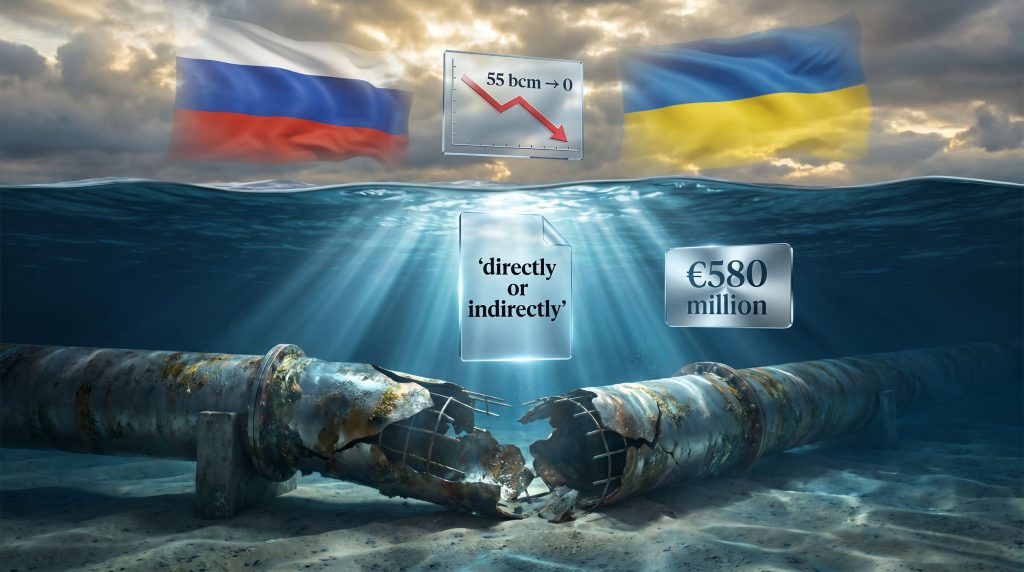
To appreciate the scale of what was decided, consider the asset at the centre of this case. Nord Stream 1 was not a minor regional pipeline. At peak operation, it transported up to 55 billion cubic metres (bcm) of natural gas annually from Russia to Germany, making it one of the most strategically consequential energy arteries in European history. Its operator, Nord Stream 1 AG, is 51% owned by Russia's state-backed Gazprom, adding sovereign complexity to an already intricate legal dispute.
The insurance claim totalled approximately €580 million (roughly $663 million USD), making it one of the largest infrastructure insurance disputes ever brought before a UK court. The defendants included specialist underwriters at Lloyd's of London and Arch Insurance.
In September 2022, explosive detonations ruptured multiple sections of the Nord Stream 1 and Nord Stream 2 pipelines beneath the Baltic Sea. What followed was not just a geopolitical mystery but a legal reckoning that would take years to resolve.
The Asset Class That Makes This Case Different
Subsea pipelines occupy a uniquely complex space in the insurance market. They sit at the intersection of marine engineering, energy security, and sovereign infrastructure, requiring bespoke coverage from specialist syndicates rather than standard commercial policies. The policies governing Nord Stream 1 were marine energy contracts containing war exclusion clauses, a standard feature across this asset class.
What makes subsea infrastructure particularly difficult to insure against hybrid threats is its physical inaccessibility. Unlike an onshore facility where damage can be immediately inspected and attributed, subsea damage assessments require remotely operated vehicles, specialist divers, and extended investigation timelines. This opacity compounds the attribution problem that sits at the heart of the war exclusion debate.
The Legal Architecture of War Exclusion Clauses
How These Clauses Are Constructed
War exclusion clauses are deliberately broad instruments. In marine and energy policies, they typically remove insurer liability for any loss arising, directly or indirectly, from:
- Armed conflict or warlike operations between states
- Military actions or hostile acts carried out by government-affiliated entities
- The deployment of explosives in a conflict context
- Any damage occurring under the order of any government
The breadth is intentional. Insurers drafting these clauses understood that the causal pathways between geopolitical conflict and physical damage are rarely linear. The phrase "directly or indirectly" is the operative mechanism, and its importance cannot be overstated.
Structural insight: The "directly or indirectly" formulation means that insurers do not need to prove a direct causal chain between a specific military order and a specific act of damage. They need only demonstrate that a conflict was a meaningful contributing factor within the broader causal landscape.
Why Causation Standards Matter More Than Attribution
One of the most significant aspects of the Nord Stream ruling, presided over by Judge Dame Clare Moulder, was its treatment of the attribution question. Conventional assumptions in insurance litigation often presumed that insurers would need to identify a specific perpetrator before a war exclusion could be successfully invoked. The UK High Court ruling dismantled that assumption entirely.
The court applied a "significant cause" standard, asking not who carried out the sabotage, but whether the Russia-Ukraine war served as a meaningful causal context for the attack. The evidentiary threshold was probability rather than certainty: was state involvement more probable than not?
Under that framework, the court evaluated three distinct scenarios:
- Russian state responsibility: The attack would constitute an act of war directly connected to the ongoing armed conflict with Ukraine
- Ukrainian state responsibility: The attack would represent a wartime operation against Russian-controlled infrastructure, again situating it within the conflict
- Third-party state responsibility: Even under this scenario, the court found the Russia-Ukraine war provided the material context that enabled and motivated the attack
Under all three scenarios, the war exclusion applied. The result was a complete denial of the €580 million claim.
The Full Scope of What the Court Decided
The following table summarises the core judicial findings:
| Legal Question | Court's Determination |
|---|---|
| Did the war exclusion clause apply? | Yes, ruled applicable in full |
| Was a specific perpetrator identified? | No, identification was not legally required |
| Causal standard applied | War must be a "significant" cause; state involvement more probable than not |
| Were Lloyd's and Arch liable? | No, relieved of all liability |
| Was the anchor-damage argument accepted? | No, rejected by the court |
| Total claim value denied | Approximately €580 million (~$663 million USD) |
The Failed Anchor Argument and Why It Matters
Nord Stream AG attempted to carve out a partial recovery by arguing that damage to one specific pipeline section resulted from a ship's anchor strike rather than explosive sabotage. This would have placed that particular damage outside the war exclusion entirely, potentially recovering a portion of the overall claim.
The court rejected this argument, finding insufficient evidentiary basis to treat that section's damage as separable from the broader sabotage event. This rejection carries important implications for future litigation: asset owners cannot assume that mechanical or physical damage arguments will succeed in isolating losses from a larger sabotage context. Furthermore, the Nord Stream loses $580m claim decision reinforces how courts may treat ostensibly separate damage events as part of a unified geopolitical act.
What This Ruling Means for Energy Infrastructure Insurance Markets
The Four Dimensions of Systemic Change
The Nord Stream insurance case war exclusion ruling reshapes the market across four interconnected dimensions:
1. Geographic scope of exclusions
The pipeline was located in the Baltic Sea, hundreds of kilometres from active combat operations in Ukraine. The ruling confirms that physical distance from a conflict zone does not insulate an asset from war exclusion application. Geopolitical conflict context, not geographic proximity, is the operative factor.
2. Attribution ambiguity as an insurer advantage
Historically, ambiguous attribution was seen as a potential advantage for claimants: if no one could prove who did it, how could insurers invoke a war exclusion? The ruling inverts this logic. Attribution ambiguity, when set against a backdrop of active interstate conflict, can itself support the probabilistic case for state involvement.
3. The "significant cause" threshold's low evidentiary bar
The court did not require war to be the sole cause or even the primary cause of the damage. It needed only to be a significant cause. This represents a meaningful lowering of the bar for insurers seeking to invoke exclusions in conflict-adjacent scenarios.
4. Policy drafting incentives for underwriters
Having prevailed on broad exclusion language, underwriters are now likely to tighten existing exclusion clauses further and apply more granular geopolitical risk screening to energy infrastructure portfolios.
The Coverage Gap Problem Facing Asset Operators
The ruling exposes a structural vulnerability that many energy infrastructure operators may not have fully appreciated before this case:
| Risk Category | Pre-Ruling Assumption | Post-Ruling Reality |
|---|---|---|
| Subsea pipeline sabotage | Potentially recoverable under all-risks policy | May be excluded if geopolitical conflict is a significant contextual cause |
| Attribution requirement | Perpetrator identification often assumed necessary | Courts may not require specific attribution for exclusion to apply |
| Geographic proximity to conflict | Physical proximity to war zone seen as threshold | Conflict need not be geographically proximate to trigger exclusion |
| Mechanical damage defence | Viable partial recovery pathway | Rejected unless clearly separable from broader sabotage event |
Navigating the Grey Zone of Hybrid Conflict
Modern geopolitical confrontation increasingly operates through deniable actors, proxy operations, and ambiguous attribution — precisely the environment where standard marine energy policies are most exposed. This creates what the industry is beginning to recognise as a hybrid conflict coverage gap. Consequently, the resulting global supply chain disruption stemming from such geopolitical incidents further amplifies these coverage vulnerabilities.
Operators and project finance teams should be evaluating:
- Whether existing all-risks policies contain broad "directly or indirectly" war exclusion language
- The degree to which active or latent interstate conflicts in a region could provide a significant causal context for future sabotage events
- Whether standalone war risk policies adequately cover state-sponsored or state-adjacent sabotage, noting that many war risk policies carry their own carve-outs for state actors
- Whether political risk insurance provides a meaningful complementary layer for hybrid warfare scenarios
Industry caution: Standalone war risk coverage is substantially more expensive than standard all-risks marine energy policies, and may carry exclusions that render coverage illusory for the precise scenarios operators most need to address.
The End of Nord Stream and Europe's Structural Energy Transition
Why Reconstruction Is Now Financially Impossible
Before the 2022 sabotage, Nord Stream 1 represented decades of investment in European energy infrastructure. At full throughput capacity of 55 bcm per year, it was a cornerstone of German and broader European gas supply. With insurance recovery now foreclosed by the court ruling, the financial case for any restoration effort collapses entirely.
Reconstruction of deepwater pipeline infrastructure of this scale and complexity would require billions in capital investment. Without insurance proceeds, and against a backdrop of radically altered European energy policy, no credible commercial rationale for rebuilding exists.
Europe's Post-2022 Energy Architecture
The ruling places a definitive legal and financial marker on the Nord Stream era, reinforcing structural shifts already embedded in European energy infrastructure. In addition, European supply chain security considerations have accelerated the diversification of energy sources across the continent, particularly in relation to energy transition minerals that underpin renewable infrastructure build-out.
- European LNG import capacity has expanded substantially since 2022, with floating storage and regasification units (FSRUs) deployed across multiple member states including Germany, Finland, the Netherlands, and Italy
- Russian pipeline gas dependency across EU member states has declined dramatically from approximately 40% of EU gas imports pre-2022 to a fraction of that figure
- Long-term LNG supply contracts signed by European buyers since 2022 have locked in supply chains that structurally bypass Russian pipeline infrastructure
Furthermore, the critical raw materials transition driving Europe's energy pivot has accelerated demand for secure, non-Russian supply chains across the continent. The Nord Stream insurance case war exclusion ruling removes any residual ambiguity about whether the pipeline system could ever re-enter service under changed geopolitical conditions. The answer, legally and financially, is no.
The next major ASX story will hit our subscribers first
Strategic Warnings for Infrastructure Investors
For investors and project finance teams: The Nord Stream ruling signals that commercial insurance frameworks built on pre-hybrid-warfare assumptions may not provide the financial safety net embedded in project finance models for critical infrastructure in geopolitically sensitive corridors.
The implications extend beyond pipelines. Subsea cables, offshore energy platforms, cross-border electricity interconnectors, and liquefaction terminals all face versions of the same coverage gap. Any critical infrastructure asset that could plausibly become a target in the context of interstate tensions now carries unquantified insurance risk that standard policy language may not adequately address.
Prudent investors should be pressing for:
- Explicit policy language reviews addressing hybrid and state-adjacent sabotage scenarios
- Independent geopolitical risk assessments integrated into insurance placement strategies
- Scenario modelling that accounts for war exclusion invocation as a base-case risk, not a tail risk
- Diversified coverage structures that layer political risk insurance alongside marine energy policies
FAQ: Nord Stream Insurance Case and War Exclusion Clauses
What was the total value of the insurance claim rejected?
The UK High Court rejected a claim of approximately €580 million (roughly $663 million USD) filed by Nord Stream 1 AG against insurers including Lloyd's of London and Arch Insurance.
Did the court need to identify who sabotaged Nord Stream?
No. The court determined that perpetrator identification was not a legal requirement. The ruling turned on whether state involvement was more probable than not, and whether the Russia-Ukraine war was a significant cause of the event.
What is a war exclusion clause?
A war exclusion clause removes insurer liability for losses arising directly or indirectly from armed conflict, military operations, government-ordered actions, or the use of explosives in a conflict context. These clauses are standard features of marine and energy insurance policies.
Does this ruling mean all pipeline sabotage is uninsurable?
Not necessarily. Sabotage events with no plausible connection to active interstate conflict would not automatically trigger a war exclusion. However, the ruling establishes that even geographically distant attacks can fall under exclusion if conflict serves as a significant contextual cause.
What was Nord Stream 1's capacity before the sabotage?
Nord Stream 1 had an annual throughput capacity of up to 55 billion cubic metres of natural gas, making it one of the most strategically significant energy pipelines in European history.
Disclaimer: This article is for informational purposes only and does not constitute legal, financial, or investment advice. The legal analysis presented reflects publicly reported court findings and should not be relied upon as a substitute for independent legal or professional counsel. Forecasts and assessments of market impact involve inherent uncertainty and may not reflect actual outcomes.
Want to Stay Ahead of Major Resource Discoveries Shaping Global Energy and Materials Markets?
As geopolitical risk reshapes critical infrastructure and accelerates the global energy transition, identifying the next significant mineral discovery has never been more important — Discovery Alert's proprietary Discovery IQ model delivers real-time ASX mineral discovery alerts, turning complex resource data into actionable investment insights, with historic discoveries demonstrating the scale of returns available to investors who act swiftly. Begin your 14-day free trial at Discovery Alert today and position yourself ahead of the broader market.