May 18, 2026
The growing complexities surrounding Nornickel delivery delays due to Iran conflict highlight unprecedented vulnerabilities in global metal supply chains. Regional tensions have fundamentally altered maritime logistics networks, forcing producers to abandon traditional shipping corridors and implement costly alternative routing strategies. The intersection of geopolitical instability and industrial commodity trade reveals critical weaknesses in how base metals reach international markets, with implications extending far beyond immediate shipping costs.
What Makes Base Metals Vulnerable to Geopolitical Shipping Disruptions?
Critical Maritime Chokepoints in Global Metal Trade
The world's shipping infrastructure depends heavily on several narrow passages that control massive volumes of global trade. The Strait of Hormuz processes approximately 21% of petroleum liquids globally, according to U.S. Energy Information Administration data, making it one of the most strategically significant waterways for energy and industrial commodity flows. Furthermore, many vessels carrying base metals utilise the same corridors as part of integrated shipping networks.
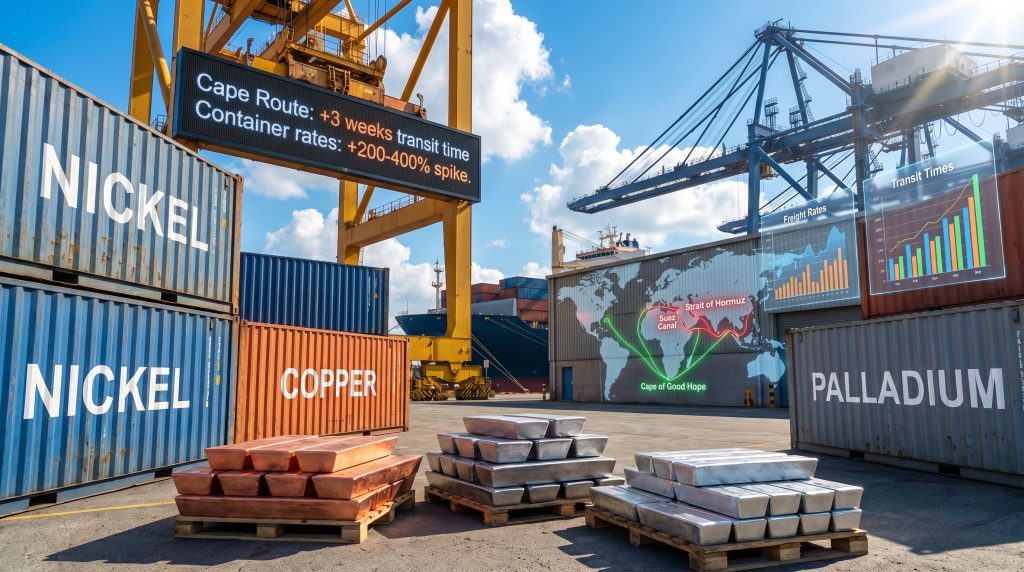
The Suez Canal serves as the primary Europe-Asia corridor for industrial metals, handling roughly 12% of global trade by volume. Recent disruptions from Middle Eastern conflicts have forced producers like Nornickel to abandon this route entirely, with the company's sales chief noting that base metals shipments now go exclusively around Africa rather than through the canal.
When forced to use alternative routing via the Cape of Good Hope, vessels must travel an additional 3,500-4,000 nautical miles compared to Suez passage. This geographic reality extends voyage times by 10-14 days under normal conditions, though recent disruptions have created even longer delays of approximately three weeks for some producers, further complicating the tariffs impact on markets.
Base Metals Most Exposed to Route Disruptions
Palladium represents the highest concentration risk amongst major industrial metals. Nornickel, as the world's largest palladium producer, ships significant volumes from Arctic facilities in Murmansk through these vulnerable corridors. Consequently, the automotive industry's dependence on palladium for catalytic converters creates particular supply chain sensitivity when shipping disruptions occur.
Nickel faces substantial exposure due to Russia's significant global production share and the metal's critical role in battery manufacturing. With approximately 50% of Nornickel's sales flowing to China and growing electric vehicle demand, any shipping delays directly impact manufacturing timelines across multiple industries, similar to challenges seen in US–China trade war effects.
Copper presents a different risk profile despite more geographically distributed global production. The metal's infrastructure applications and Asian demand concentration mean that delivery delays create cascading effects throughout construction and manufacturing sectors.
When big ASX news breaks, our subscribers know first
How Do Shipping Route Changes Impact Metal Delivery Economics?
Cost Structure Analysis of Alternative Routing
| Route Comparison | Transit Time | Additional Distance | Economic Impact |
|---|---|---|---|
| Suez Canal | 14-16 days | Baseline route | Standard freight rates |
| Cape of Good Hope | 35-40 days | +3,500-4,000 nautical miles | Significant cost escalation |
| Time Extension | +21-26 days | Extended working capital | Inventory carrying costs |
The economic implications of extended routing create multiple cost pressures. Fuel consumption increases substantially with longer voyages, as modern bulk carriers consume approximately 80-100 tonnes of fuel daily. For instance, additional transit time of 10-14 days can add $400,000-500,000 in fuel costs per voyage at current marine fuel prices.
Working capital requirements escalate when delivery times extend by three weeks. Companies must finance inventory for additional periods while vessels remain at sea, creating interest expenses and opportunity costs. Moreover, port fees and vessel charter rates extend proportionally with voyage duration, compounding the financial impact.
Freight Rate Volatility During Crisis Periods
Historical disruptions provide context for current cost escalations. The 2021 Ever Given blockage in the Suez Canal caused temporary shipping rate increases of 50-300% on affected routes, demonstrating how quickly freight markets respond to supply constraints.
Container shipping rates experience the most dramatic volatility during acute disruptions:
• Asia-Europe routes: 100-300% spikes during peak disruption periods
• Fuel surcharges: Additional 15-25% for rerouted shipments
• Emergency routing premiums: 50-200% above baseline rates
Bulk carrier premiums affect metals shipments differently than containerised goods. Capesize and Panamax vessels carrying base metals typically see more moderate but sustained rate increases of 25-75% during extended disruptions, as these ships have fewer alternative employment options than container vessels.
War risk insurance adds another cost layer, typically ranging from 0.05-0.5% of cargo value depending on route classification and current threat assessments. Lloyd's market data shows these rates can double during active conflict periods in key shipping zones.
Which Metal Producers Face the Greatest Strategic Exposure?
Russian Base Metal Export Dependencies
Nornickel exemplifies the challenges facing geographically concentrated producers. The company ships base metals from Arctic facilities in Murmansk to international markets, historically utilising both Suez Canal and Cape of Good Hope routes depending on political conditions. However, current Middle Eastern tensions have eliminated the Suez option entirely, exacerbating Nornickel delivery delays due to Iran conflict.
The producer's sales distribution reveals both diversification and concentration risks:
• China: 50% of total sales volume
• Russia: 15% domestic market
• United States: 5% of shipments
• Other markets: 30% to Europe, North Africa, Middle East, and additional Asian destinations
This geographic spread provides some insulation from regional demand shocks, though the heavy China concentration creates delivery timing sensitivities when shipping disruptions occur. These dynamics mirror broader trends discussed in the mining industry evolution as companies adapt to changing global conditions.
European port infrastructure dependencies present additional vulnerabilities. Traditional reliance on Rotterdam and Hamburg as distribution hubs creates logistical bottlenecks when geopolitical tensions affect European relationships. Nornickel's strategic pivot toward Tangier as an alternative hub reflects this concern.
Supply Chain Resilience Strategies
Forward-thinking producers are implementing several adaptation mechanisms:
Port Infrastructure Diversification: Nornickel is considering investments in Middle East, Turkish, and Moroccan port facilities to reduce European dependency. This geographic rebalancing mirrors broader supply chain localisation trends across multiple industries.
Alternative Transportation Networks: While maritime transport remains dominant for bulk metals, some producers are exploring rail corridors and multimodal logistics solutions. Furthermore, the Trans-Siberian Railway and emerging China-Europe rail connections offer potential alternatives for specific route pairs.
Strategic Inventory Positioning: Companies are establishing regional stockpiles closer to key consumption markets. This approach reduces just-in-time delivery pressures whilst creating buffer capacity during shipping disruptions.
How Are Metal Markets Adapting to Persistent Geopolitical Risks?
Price Discovery Mechanisms During Disruptions
Market pricing mechanisms are evolving to incorporate shipping risk premiums more systematically. Regional price differentials now reflect delivery certainty rather than just transportation costs, with guaranteed delivery commands earning 5-15% premiums over spot availability during disruption periods.
Forward contract adjustments represent another adaptation mechanism. Longer-term supply agreements increasingly include force majeure clauses specifically addressing shipping route closures. In addition, delivery windows are expanding from traditional 30-day periods to 60-90 day ranges to accommodate routing flexibility.
Freight cost pass-through capabilities vary significantly by producer size and market position. According to Reuters analysis, Nornickel management noted that higher metal prices offset increased shipping costs during recent disruptions, suggesting successful cost absorption in rising commodity markets. Smaller producers may lack this pricing flexibility.
Long-term Infrastructure Investment Responses
Middle East and North African port capacity is expanding rapidly as producers seek shipping alternatives. Dubai, Tangier, and emerging Turkish facilities are attracting infrastructure investment as companies diversify away from traditional European gateways.
Alternative overland transport corridors are receiving increased attention despite cost disadvantages. Rail connections between Asian production centres and European consumption markets offer routing security even when maritime options face disruption.
Digital supply chain integration accelerates during disruption periods. Real-time cargo tracking, predictive route optimisation, and blockchain-based supply chain verification systems help companies manage extended delivery timelines and communicate transparently with customers, particularly relevant for events discussed at the global mining innovation expo.
What Regional Market Dynamics Emerge from Shipping Disruptions?
Asian Market Concentration Trends
China's position as the destination for approximately 50% of Nornickel's base metal sales illustrates broader Asian market dynamics. The region's manufacturing concentration creates natural shipping corridor dependencies, with most Europe-to-Asia metals trade historically flowing through Suez Canal routing.
Southeast Asian processing capacity expansion reflects supply chain localisation trends. Countries including Indonesia, Malaysia, and Vietnam are developing metals processing capabilities to serve regional demand whilst reducing shipping distance dependencies.
Regional supply chain localisation initiatives gain momentum as companies recognise the costs of extended global supply networks. Battery manufacturers are co-locating with nickel processing facilities, whilst automotive producers are sourcing palladium through regional distribution centres rather than direct European shipments.
European Supply Security Considerations
Strategic metals stockpiling programmes are expanding across European Union countries as supply security concerns intensify. These government-backed initiatives create buffer inventory for critical materials whilst reducing immediate shipping disruption impacts, particularly important given developments at the European raw materials facility.
Domestic processing capacity investments reflect long-term supply chain thinking. European companies are evaluating the economics of processing imported concentrates locally rather than importing finished metals from distant production centres.
Alternative supplier qualification processes accelerate during disruption periods. European manufacturers traditionally dependent on Russian metals are expanding approved supplier networks to include Australian, South American, and African producers despite higher baseline costs.
How Do Extended Delivery Times Affect Industrial Metal Users?
Manufacturing Sector Adaptation Strategies
Inventory buffer expansion represents the most immediate adaptation mechanism. Manufacturing companies are extending their typical 15-30 day raw material inventories to 45-90 day ranges to accommodate shipping uncertainties. This working capital increase carries financing costs but provides operational continuity during Nornickel delivery delays due to Iran conflict and similar disruptions.
Supply contract renegotiation for delivery flexibility allows manufacturers to maintain production schedules despite shipping variability. Contracts increasingly specify acceptable delivery windows rather than fixed dates, with pricing adjustments reflecting this flexibility.
Alternative material specification considerations emerge when preferred metals face supply constraints. Some manufacturers are qualifying substitute materials or alloys to reduce dependency on specific supply chains, though this approach requires extensive testing and certification processes.
Automotive Industry Specific Impacts
Palladium supply chain criticality creates particular challenges for automotive manufacturers. Catalytic converter production requires precise palladium specifications, and extended delivery times can halt vehicle assembly lines. The industry's just-in-time manufacturing philosophy conflicts directly with shipping unpredictability.
Electric vehicle battery metal security concerns extend beyond immediate production needs. Battery manufacturers require consistent nickel and copper supplies for scaling production, and shipping delays affect capacity planning and customer delivery commitments.
Regional production localisation acceleration reflects automotive industry responses to supply chain fragility. Consequently, companies are prioritising suppliers with regional production capabilities over lowest-cost global alternatives when shipping reliability becomes uncertain.
The next major ASX story will hit our subscribers first
What Long-term Structural Changes Are Emerging in Metal Trade?
Hub-and-Spoke Distribution Model Evolution
Tangier as alternative European gateway exemplifies emerging logistics patterns. Nornickel's strategic focus on this Moroccan port reflects its advantages: proximity to European markets without direct European Union political complications, plus access to both Atlantic and Mediterranean shipping routes.
Dubai and Singapore as Asian distribution centres offer similar strategic positioning for Asian markets. These established trade hubs provide warehousing, financing, and distribution capabilities whilst maintaining political neutrality during regional conflicts.
Panama and Houston for Americas market access complete the global distribution network transformation. These locations offer storage capacity and onward distribution capabilities whilst reducing dependency on traditional European trans-shipment points.
Technology Integration for Supply Chain Visibility
Real-time cargo tracking and route optimisation systems become essential during disruption periods. Satellite-based vessel monitoring allows companies to adjust delivery schedules dynamically and communicate realistic timelines to customers.
Predictive analytics for disruption management help companies anticipate potential shipping delays before they impact operations. Machine learning systems analyse geopolitical developments, weather patterns, and port congestion data to recommend proactive inventory adjustments.
Blockchain-based supply chain verification addresses authenticity concerns when supply chains become more complex. Extended routing through multiple ports and handling facilities increases documentation requirements and chain-of-custody verification needs.
How Should Investors Evaluate Geopolitical Risk in Metal Investments?
Risk Assessment Framework for Metal Producers
Geographic concentration of production assets represents the primary risk factor. Companies like Nornickel with Arctic facilities face higher exposure than producers with globally distributed operations. Investors should evaluate what percentage of production capacity exists in geopolitically sensitive regions.
Shipping route dependency analysis requires understanding traditional export pathways and available alternatives. Producers shipping through multiple potential corridors demonstrate greater operational flexibility than those dependent on single routes.
Market diversification metrics indicate customer base resilience. Nornickel's sales spread across China (50%), Russia (15%), US (5%), and other markets (30%) provides better risk distribution than companies serving single regions.
Infrastructure investment capacity determines adaptation speed during disruptions. However, companies with sufficient capital to invest in alternative port facilities, storage capacity, and transportation networks can better navigate geopolitical challenges.
Valuation Impact Considerations
Working capital requirements increase during extended shipping periods. Investors should model the financial impact of carrying inventory for additional 2-4 weeks during disruption scenarios, including interest expenses and storage costs.
Freight cost absorption vs. pass-through capabilities depend on market position and commodity price trends. Premium producers with differentiated products typically demonstrate better cost pass-through ability than commodity-grade suppliers.
Market share implications of delivery reliability create competitive advantages for companies with robust logistics networks. Customers increasingly value supply security over lowest-cost procurement, potentially supporting pricing premiums for reliable suppliers.
Frequently Asked Questions About Metal Supply Chain Disruptions
How long do typical shipping disruptions last?
Acute crisis periods typically persist 2-6 weeks based on historical precedents. The 2021 Ever Given Suez Canal blockage lasted six days but created cascading delays for several weeks afterward. Current Middle Eastern tensions affecting Nornickel operations began in late February 2026 and continue to impact routing decisions, as detailed in Marine Link's coverage.
Extended geopolitical tensions can influence shipping patterns for 6-18 months or longer. The ongoing situation demonstrates how sustained conflicts create permanent routing changes rather than temporary adjustments.
Permanent route changes require 2-5 years for full supply chain adaptation. Companies must invest in alternative infrastructure, renegotiate contracts, and establish new logistics partnerships during these extended transitions.
Which metals are most critical for supply security?
Palladium represents the highest concentration risk due to Russian production dominance and automotive industry dependency. Nornickel's position as the world's largest producer creates single-source vulnerabilities for many customers, particularly evident during current Nornickel delivery delays due to Iran conflict.
Rare earth elements for technology applications face similar concentration challenges, though these materials typically travel different shipping routes than bulk base metals.
Lithium and cobalt for energy transition applications present emerging supply security concerns as electric vehicle adoption accelerates globally.
Platinum group metals for industrial catalysts combine production concentration with specialised applications, creating limited substitution options during supply disruptions.
How do companies hedge against shipping disruption risks?
Geographic supply source diversification represents the most effective long-term strategy. Companies qualifying suppliers from multiple continents reduce single-region dependency, though this approach may increase baseline costs.
Strategic inventory positioning in key consumption markets provides buffer capacity during shipping delays. Nornickel's consideration of Middle East and North African infrastructure investments reflects this approach.
Force majeure insurance coverage specifically addressing shipping disruptions helps companies manage financial impacts. Standard marine insurance typically excludes war risk, requiring separate coverage for conflict-related delays.
Alternative transportation mode development includes rail corridors, air freight for emergency shipments, and multimodal logistics solutions. While economically disadvantageous under normal conditions, these alternatives provide essential backup capacity during maritime disruptions.
Investment Disclaimer: The analysis presented in this article is for educational purposes only and should not be construed as investment advice. Commodity markets involve substantial risk, and geopolitical developments can create rapid price movements. Investors should conduct their own due diligence and consult qualified financial advisors before making investment decisions. Past performance does not guarantee future results, and shipping disruptions may have varying impacts on different producers and markets.
Looking for Investment Opportunities in Geopolitically Resilient Metal Producers?
Discovery Alert's proprietary Discovery IQ model delivers real-time alerts on significant mineral discoveries across the ASX, helping investors identify companies with diversified supply chains and strategic positioning ahead of market disruptions. Explore Discovery Alert's discoveries page to understand how major mineral finds have generated substantial returns, then begin your 14-day free trial to gain the market-leading advantage needed in today's complex geopolitical environment.