August 6, 2026
The Hidden Architecture Behind Global Oil Transit Risk
Energy markets have always priced geopolitical risk, but the physical infrastructure underpinning that risk rarely receives the analytical attention it deserves. Most market participants focus on crude benchmarks, OPEC's market influence, or demand forecasts from major Asian economies. Far fewer examine the underlying transit architecture that determines whether a barrel of oil can actually reach its destination at all. That distinction has never mattered more than it does today, particularly as the UAE oil pipeline to bypass Hormuz accelerates into the global spotlight.
The Strait of Hormuz sits at the intersection of the Persian Gulf and the Gulf of Oman, functioning as the sole maritime exit point for the majority of Gulf-produced crude oil. Its strategic significance is almost impossible to overstate. Under normal operating conditions, approximately one-fifth of the world's total oil supply transits this corridor, flowing primarily toward energy-hungry Asian economies including China, India, Japan, and South Korea.
At its narrowest navigable point, the strait spans just a few dozen kilometres, making it one of the most consequential single points of failure in the entire global economic system.
What makes Hormuz particularly vulnerable is not simply its physical narrowness but the structural dependency it creates. Nations including Kuwait, Iraq, Qatar, and Bahrain have no viable overland pipeline networks or alternative maritime export corridors. Their entire crude export architecture runs through this single waterway. That structural dependency is not a new concern, but it has historically been treated as a manageable theoretical risk rather than an operational reality requiring immediate capital investment.
That calculation changed on February 28, 2026, when a US-Israeli air and naval campaign prompted an Iranian response that effectively closed the Strait of Hormuz to commercial oil traffic. The closure severed roughly 20% of globally traded crude oil flows, triggering immediate supply shocks, accelerating energy price inflation, and prompting governments across multiple import-dependent economies to implement emergency fuel rationing measures. The spectre of a broader demand-destruction cycle and economic contraction moved from academic discussion into live policy crisis management.
The disruption also functioned as something rarely seen in energy infrastructure planning: a live audit. Within weeks, it became vividly clear which Gulf producers possessed the physical infrastructure to maintain export volumes and which were effectively paralysed.
When big ASX news breaks, our subscribers know first
How the UAE Built Its First Line of Defence Against Hormuz Disruption
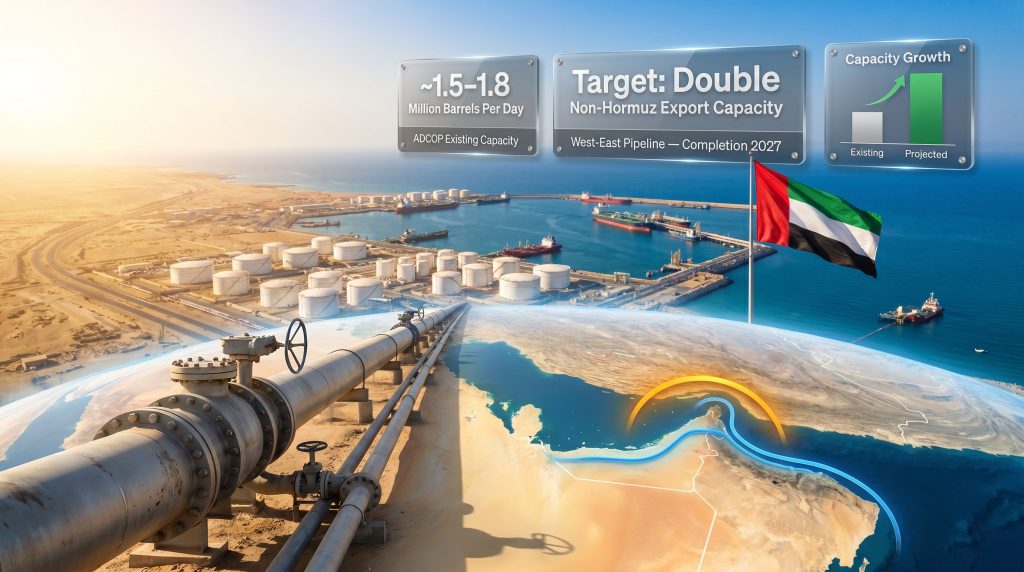
The UAE's existing bypass capability centres on the Abu Dhabi Crude Oil Pipeline, widely referred to as ADCOP or the Habshan-Fujairah pipeline. Stretching approximately 380 kilometres from Abu Dhabi's inland production fields to the Port of Fujairah on the Gulf of Oman coastline, this pipeline was conceived precisely to address the Hormuz vulnerability. It carries up to 1.8 million barrels per day (bpd) and routes that oil entirely outside the strait's jurisdiction.
Fujairah's geography is the critical enabler here. Its position on the Gulf of Oman places it entirely beyond the Hormuz transit zone, meaning that crude loaded at Fujairah never passes through the waterway at all. Over recent years, the emirate has developed into a sophisticated oil storage and bunkering hub, with significant tank farm capacity supporting both crude exports and refined product distribution to global markets.
ADCOP has proven its strategic value during the current disruption, allowing the UAE to continue monetising a meaningful portion of its crude production while Hormuz-dependent neighbours face near-total export paralysis. However, the pipeline's capacity ceiling of approximately 1.8 million bpd represents a constraint that falls well short of the UAE's full production potential, leaving a significant share of output either stranded or dependent on alternative, riskier routing.
The West-East Pipeline: Doubling Down on Bypass Capacity
What Is the West-East Pipeline and Why Does It Matter?
Abu Dhabi's response to the February 2026 disruption came swiftly. Abu Dhabi Crown Prince Sheikh Khaled bin Mohamed bin Zayed directed ADNOC to accelerate construction of the West-East Pipeline during an executive committee meeting, with the Abu Dhabi Media Office confirming the project's fast-tracked timeline. According to Reuters, the pipeline is currently under construction and is expected to become operational by 2027.
The strategic objective is straightforward: when the West-East Pipeline is combined with the existing ADCOP system, the UAE's total oil export capacity routable outside the Strait of Hormuz is designed to approximately double. Both pipelines terminate at the Port of Fujairah, reinforcing its role as the UAE's primary Hormuz-independent export gateway.
The comparison between the existing and incoming infrastructure highlights the scale of this transformation:
| Feature | ADCOP (Existing) | West-East Pipeline (Incoming) |
|---|---|---|
| Operational Status | Active | Under construction |
| Target Completion | Operational | 2027 |
| Capacity Role | Primary bypass | Redundancy and capacity expansion |
| Export Terminal | Fujairah, Gulf of Oman | Fujairah, Gulf of Oman |
| Operator | ADNOC | ADNOC |
| Strategic Outcome | ~1.8 million bpd bypass | Approximately doubles total bypass capacity |
A lesser-known dimension of this infrastructure build is what it implies about Abu Dhabi's long-term production ambitions. ADNOC has been pursuing an aggressive upstream expansion strategy targeting 5 million bpd of production capacity by 2030. Building bypass pipeline infrastructure that can accommodate significantly expanded volumes is not simply a crisis response; it is a forward integration of export logistics into a broader production growth strategy. The Hormuz disruption has consequently accelerated a timeline that was already moving.
Gulf Export Architecture: A Two-Tier System Emerges
Which Gulf Producers Can Actually Bypass Hormuz?
The February 2026 closure has crystallised what energy analysts and infrastructure specialists have long understood but rarely articulated publicly: the Gulf oil export system is structurally bifurcated between producers with bypass capability and those without.
Currently, only the UAE and Saudi Arabia operate crude oil export pipelines that route outside the Strait of Hormuz. Saudi Arabia's East-West Crude Oil Pipeline, commonly known as Petroline, connects Eastern Province fields to the Red Sea terminal at Yanbu, providing a fully independent export corridor that bypasses the Gulf entirely. Oman benefits from natural geographic insulation through its extensive Gulf of Oman coastline, though it lacks a dedicated bypass pipeline system of comparable scale.
By contrast, Kuwait, Iraq, Qatar, and Bahrain remain almost entirely dependent on Hormuz transit for crude exports. This structural exposure is not easily or quickly remedied. Building major pipeline infrastructure across complex terrain, negotiating transit agreements, securing financing, and completing construction typically requires years of lead time and capital commitments measured in billions of dollars.
The divergence between bypass-capable and Hormuz-dependent Gulf producers is not merely a logistical distinction. During a sustained closure, it translates directly into the ability to generate sovereign revenue, maintain fiscal stability, and retain market share with long-term import customers.
The competitive implications are significant. In a scenario where Hormuz access remains constrained for an extended period, Gulf producers with bypass infrastructure can continue supplying Asian customers while Hormuz-dependent producers cannot. Furthermore, import-dependent economies in Asia, which have spent years diversifying their crude supplier bases, may begin favouring Fujairah-routed UAE barrels not just for price reasons but for supply security assurance — a factor that carries growing weight in long-term supply contract negotiations.
The Macro-Economic Ripple Effects of a Doubled Bypass Corridor
Understanding what the UAE oil pipeline to bypass Hormuz actually means for global markets requires thinking beyond the bilateral UAE-Asia trade relationship. The implications cascade across multiple economic systems simultaneously.
Energy price inflation triggered by the Hormuz closure has moved well beyond oil markets. Elevated fuel costs flow through transportation networks into consumer goods pricing, agricultural input costs, and industrial production expenses. Governments across multiple economies have responded with fuel subsidies, rationing schemes, and emergency central bank interventions — all of which carry their own fiscal and monetary costs. In addition, economists have flagged the risk of entrenched inflation if supply constraints persist beyond the short term.
These oil market disruptions are compounding existing energy security pressures already reshaping how governments plan for future supply reliability. The addition of even 1 to 2 million bpd of alternative routing capacity to global supply availability carries measurable price-dampening potential.
Markets price not just current supply but expected future supply availability. The announcement and acceleration of the West-East Pipeline therefore carries a forward-guidance dimension: it signals to energy markets that additional bypass volumes will come online within an 18-month window, which itself influences near-term price expectations.
The economies most directly affected by the Hormuz closure, and therefore most directly benefiting from expanded UAE bypass capacity, include:
- China, the world's largest crude oil importer, heavily reliant on Gulf supply
- India, whose refining sector depends significantly on Middle Eastern crude grades
- Japan and South Korea, which import the vast majority of their oil requirements and have limited domestic production to fall back on
- Southeast Asian economies, many of which lack strategic petroleum reserve buffers of sufficient scale to absorb extended supply disruptions
Strategic Drivers: Why Speed Matters More Than Cost
The decision to accelerate the West-East Pipeline reflects a convergence of strategic pressures that make the 2027 completion target more than an engineering milestone.
Revenue continuity sits at the core of the calculation. The UAE's fiscal architecture remains substantially tied to hydrocarbon export revenues, and ADNOC's ability to monetise production directly supports government budget stability. Every day of constrained bypass capacity during an active Hormuz closure represents foregone revenue that cannot be recovered. Accelerating the pipeline compresses the exposure window.
Long-term market positioning adds a second strategic layer. Asian energy importers are not passive recipients of whatever crude is available. They actively diversify supplier relationships and infrastructure linkages to reduce their own geopolitical exposure. A UAE that can guarantee reliable non-Hormuz delivery becomes a structurally preferred supplier, particularly for buyers building out long-term energy security frameworks.
Recurring risk pricing provides a third driver. The global oil price shock triggered by the February 2026 Hormuz closure was not the first time the strait's vulnerability has been demonstrated, and regional tensions involving Iran have a documented history of cyclical escalation. Infrastructure built in response to the current crisis will remain valuable across future disruption scenarios, providing permanent rather than crisis-specific strategic value.
The next major ASX story will hit our subscribers first
Scenario Analysis: How 2027 Plays Out Across Different Geopolitical Pathways
The value of the West-East Pipeline varies considerably depending on how the current geopolitical situation evolves. Three broad scenarios are worth examining:
If Hormuz reopens before 2027: The pipeline still delivers substantial permanent strategic value as redundancy infrastructure. Fujairah's expanded capacity reinforces its position as a global oil hub independent of geopolitical conditions, and the UAE enters any future disruption scenario with significantly greater routing flexibility than it possesses today.
If Hormuz remains contested through 2027 and beyond: The pipeline becomes immediately critical to both UAE revenue generation and global supply stabilisation upon completion. The UAE and Saudi Arabia would together represent the only two Gulf producers capable of maintaining near-full export volumes, conferring significant geopolitical and commercial leverage. Asian import markets would likely consolidate purchasing relationships with Fujairah-routed suppliers as a structural supply security response.
If escalation threatens the construction timeline itself: Construction delays would extend the UAE's export capacity constraints and sustain upward pressure on global energy prices. This scenario underscores the importance of infrastructure security as a distinct category of risk in active conflict environments.
What Investors and Energy Analysts Should Watch
For those monitoring crude oil price trends and energy infrastructure developments, several indicators will signal how the West-East Pipeline's development is progressing and what its market impact trajectory looks like:
- Construction progress updates from ADNOC, particularly any announcements regarding engineering milestones, contractor appointments, or procurement timelines
- Fujairah export volume data, which will reflect the degree to which existing ADCOP capacity is being fully utilised during the current disruption
- Asian crude import pattern shifts, particularly any movement toward increased UAE crude purchasing at the expense of Hormuz-dependent suppliers
- Hormuz diplomatic developments, including the status of the UK-France naval mission and any US-Iran diplomatic channel activity that could affect the strait's operational status before 2027
- ADNOC production capacity announcements, which will indicate whether the pipeline's throughput design is being calibrated to match an accelerated upstream expansion timeline
The Guardian's analysis of the West-East Pipeline project highlights that the 2027 completion target is being treated as a firm strategic deadline rather than an aspirational estimate, underscoring the seriousness with which Abu Dhabi is approaching this infrastructure challenge.
Disclaimer: This article contains forward-looking scenario analysis based on publicly available information as of May 2026. Energy market conditions, geopolitical developments, and infrastructure timelines are subject to rapid and material change. Nothing in this article constitutes investment advice or a recommendation to buy or sell any financial instrument.
The Longer Strategic Signal: Infrastructure as Geopolitical Currency
Perhaps the most underappreciated dimension of the UAE oil pipeline to bypass Hormuz story is what it reveals about the emerging role of physical infrastructure in Gulf energy geopolitics. For decades, the strategic conversation focused almost exclusively on production volumes, pricing agreements, and spare capacity. The February 2026 Hormuz disruption has, however, forced a fundamental reorientation toward transit architecture as the primary determinant of real-world export capability.
The UAE's accelerated pipeline investment signals a broader doctrine taking shape across Gulf energy policy: the recognition that the ability to produce oil and the ability to export it are two entirely different strategic capabilities, and that long-term competitive positioning requires mastery of both.
As Fujairah's capacity expands and its role as the Gulf's premier non-Hormuz export hub deepens, the port's strategic importance to the global energy system will grow in ways that extend well beyond any single geopolitical episode. The West-East Pipeline is not merely a response to the February 2026 crisis. It is the foundation of a post-Hormuz-dependency export architecture that will shape Gulf energy geopolitics for decades to come.
Want to Stay Ahead of the Resource Discoveries Reshaping Global Energy Markets?
While the UAE's pipeline infrastructure signals a structural shift in how energy security is valued, the ripple effects are already influencing commodity demand and exploration activity across the ASX. Discovery Alert's proprietary Discovery IQ model delivers real-time alerts on significant ASX mineral discoveries — from critical energy commodities to the resources underpinning the global energy transition — ensuring subscribers can act on actionable opportunities the moment they emerge. Explore Discovery Alert's discoveries page to understand how historic ASX mineral finds have generated exceptional returns, and begin your 14-day free trial today to position yourself ahead of the broader market.