
June 6, 2026
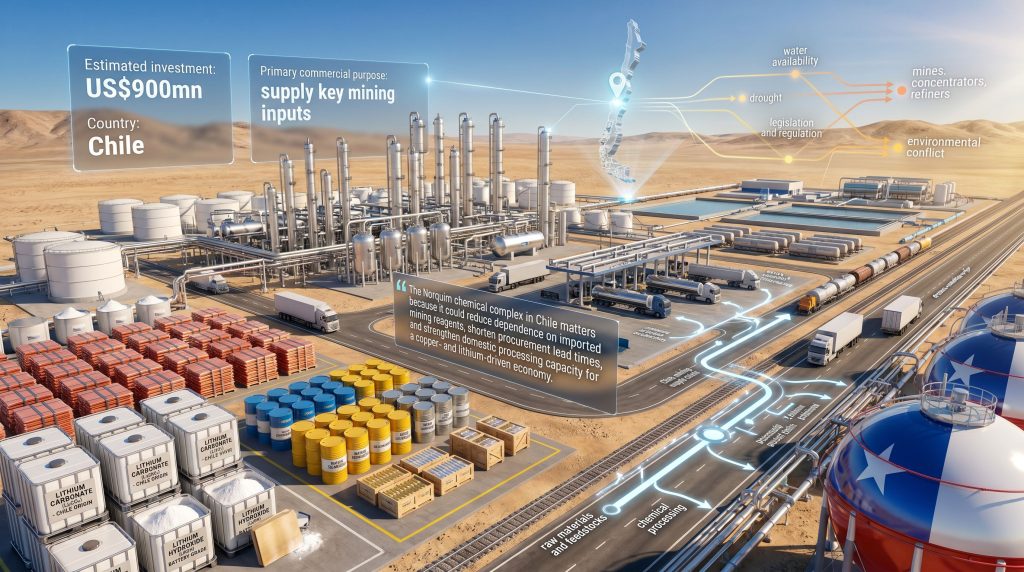
Why the Norquim chemical complex in Chile matters
Mining countries are often judged by the size of their ore bodies and export volumes, yet the resilience of a mining system can hinge on something less visible: the steady flow of chemical inputs that keep concentrators, leach pads, water circuits, and refining steps running on schedule. In that sense, the Norquim chemical complex in Chile is not just another industrial project. It is better understood as a test of whether a major mineral producer can strengthen the supply chains behind copper, lithium, gold, and silver output.
The Norquim chemical complex in Chile matters because it could reduce dependence on imported mining reagents, shorten procurement lead times, and strengthen domestic processing capacity for a copper- and lithium-driven economy. Based on limited public information, the project is described as a proposed US$900 million chemical complex in Chile intended to supply key mining inputs.
That framing makes it strategically relevant to supply security, import substitution, logistics efficiency, and broader industrial resilience. In addition, Chile’s role in battery minerals gives this industrial logic added weight, especially when viewed alongside the country’s evolving Chile lithium strategy.
This matters in Chile because mining is not only large in export value, but also chemically intensive. Ore extraction and processing rely on a continuous stream of reagents, water chemicals, and industrial materials. If these inputs arrive late, cost too much, or face global supply disruption, operating performance can suffer even when metal prices are strong.
“A mining complex may have ore, power, and labour in place, yet still face operational strain if crucial chemicals are delayed, rationed, or repriced unexpectedly.”
Industry research brief lens
Viewed as a market intelligence case rather than a simple project announcement, the Norquim chemical complex in Chile sits at the intersection of five core themes:
- National industrial policy and whether Chile can build more value-added capacity around mining
- Mining consumables demand from copper, lithium, precious metals, and related processing circuits
- Environmental permitting risk tied to emissions, water use, hazardous materials, and waste handling
- Logistics competitiveness for mines seeking shorter delivery cycles and more reliable inventory planning
- Regional value-chain development in which industrial inputs are produced closer to end use
How large Chile’s mining chemicals opportunity could be
Chile’s position as a major producer of copper and a significant participant in lithium makes demand for chemical inputs structurally relevant. Even without verified public data on this project’s exact product slate, the industrial logic is clear: a country with large mineral processing activity needs chemicals for flotation, leaching, impurity control, water treatment, and downstream conversion.
In practical terms, mining-linked demand in Chile can include:
- Flotation reagents for concentrators processing sulphide ores
- Leaching inputs for hydrometallurgical operations
- Water chemicals for treatment, recycling, and plant water management
- Industrial raw materials and feedstocks used in chemical manufacturing and mineral processing
- Lithium-related intermediates where relevant to lithium carbonate and lithium hydroxide value chains
- Refining and finishing chemicals associated with products such as copper cathodes
An underappreciated point is that mining chemicals are not just a procurement line item. They can become a bottleneck. Shortages or delays may affect throughput, metal recovery, maintenance planning, and export timing. Consequently, Chile’s mining supply chain is partly a chemistry problem, not just a geology or logistics problem.
Key demand drivers in Chile
| Demand Driver | Why It Matters | Likely Chemical/Input Need | Confidence Level |
|---|---|---|---|
| Copper processing | Core pillar of Chilean mining activity | Reagents, acids, water chemicals | High industry relevance |
| Lithium conversion | Important for battery-material processing pathways | Processing chemicals, intermediates | Moderate, depends on product mix |
| Water stress and reuse | Drought shapes industrial water design | Water treatment chemicals | High |
| Productivity upgrades | Mines seek recovery and efficiency gains | Specialty process chemicals | High |
| Refining and finishing | Downstream processing adds chemical intensity | Purification and treatment inputs | Moderate |
Chemicals as a hidden mining constraint
Mining headlines tend to focus on ore grades, production guidance, or commodity prices. However, plants do not run on metal prices alone. They run on secure access to inputs. A disruption in mining reagent supply can create knock-on effects such as:
- Lower processing continuity
- Reduced recovery rates if substitute reagents are less effective
- More cautious inventory management and higher working capital needs
- Shipping delays for final products if processing schedules slip
That matters particularly in a market already shaped by the Chile copper supply gap and broader copper supply pressures.
What products and downstream functions a complex like this could support
Publicly available material confirms the broad purpose of supplying key mining inputs, but it does not establish a full verified list of products, capacities, or end-market allocations. That distinction matters.
Confirmed versus inferred
| What is publicly confirmed | What can be reasonably inferred from industry context |
|---|---|
| Proposed chemical complex in Chile | It may target mining and industrial consumables linked to Chilean demand patterns |
| Estimated investment of US$900 million | Product focus could include base industrial chemicals, mining reagents, or water chemicals |
| Intended to supply key mining inputs | Logistics, storage, and feedstock handling would likely be central to plant economics |
A complex of this type could plausibly support several downstream functions, including:
- Base industrial chemicals used across mining and processing operations
- Mining reagents for extraction and concentration circuits
- Water treatment chemicals for reuse, desalination-linked systems, and discharge compliance
- Lithium-related intermediates if the final plant design includes relevant chemical conversion steps
- Feedstock handling and storage systems needed for safe and efficient distribution
According to a BNamericas project report, the plan is framed around supplying critical mining inputs, which reinforces the project’s role as industrial infrastructure rather than a niche side venture.
Step-by-step process-chain explainer
- Raw materials or feedstocks are sourced through domestic or imported channels
- Chemical processing converts them into usable industrial inputs that meet customer specifications
- Finished inputs are stored and distributed through industrial logistics already serving large-scale mining
- Mines, concentrators, refiners, or lithium processors apply them in extraction, water treatment, impurity removal, or materials conversion
How the project could reshape supply-chain economics
If the project proceeds as envisioned, its main economic effect may be less about headline volume and more about procurement resilience. For mine operators, local or near-market chemical inputs can change how plants plan inventories, negotiate contracts, and respond to disruptions.
Potential benefits include:
- Reduced shipping distance compared with overseas sourcing
- Improved inventory planning for high-frequency consumables
- Lower exposure to external disruptions such as port congestion or freight volatility
- Faster replenishment for critical plant chemicals
That said, lower cost should not be assumed. Whether domestic production improves competitiveness depends on several variables:
- Feedstock costs
- Energy prices
- Water availability
- Transport links
- Operating scale
- Contract structures with mining customers
“A local plant can improve supply security without automatically becoming the cheapest source. Reliability and total landed cost often matter as much as headline unit price.”
These economics become even more relevant against the backdrop of a global copper supply crunch and Chile’s strategic focus on processing industries linked to both copper and Chile’s lithium reserves.
Scenario framework
| Scenario | Operating Outcome | Likely Impact on Chilean Mines |
|---|---|---|
| Base case | Partial local supply complements imports | Better procurement resilience |
| Upside case | Local production displaces meaningful imported volumes | Lower dependency on overseas suppliers |
| Downside case | Permitting, feedstock, or infrastructure constraints limit utilisation | Limited short-term supply relief |
Environmental and regulatory hurdles in Chile
For any large chemical facility in Chile, environmental evaluation is central rather than incidental. Projects in this category typically face scrutiny around:
- Emissions and air-quality impacts
- Water demand in a drought-sensitive environment
- Hazardous materials handling and storage safety
- Waste streams and by-product management
- Land use compatibility with surrounding activities
- Community impact and legal objections where applicable
The source material itself flags themes such as environment, environmental evaluation, environmental conflict, drought, legislation and regulation, and legal issues. Therefore, any serious assessment must place permitting and compliance near the centre of the investment case.
Key questions to watch
- What stage has the environmental review reached?
- What inputs, outputs, and by-products are identified in official filings?
- How much water and power would the site require?
- What transport infrastructure is needed to receive feedstocks and ship finished chemicals?
- Are there community consultation challenges or legal appeals?
- What mitigation measures are proposed for waste, emissions, and water use?
Water as a decisive variable
In Chile, water often becomes the timeline driver for industrial projects. Chemical production and mining ecosystems are increasingly judged on:
- Freshwater intensity
- Recycling rates
- Desalinated water integration
- Wastewater treatment performance
“In practice, a project can look commercially persuasive on paper while its real schedule is dictated by water, permitting, and social acceptance constraints.”
Important disclaimer: public source material reviewed here does not provide enough verified detail to state the project’s exact water consumption, current approval stage, or likely timeline. Any estimate beyond that would be speculative.
How the project fits into Chile’s broader industrial strategy
The larger question behind the project is whether the country can move beyond being primarily an ore and materials producer and deepen adjacent manufacturing capability. This reflects a structural economic debate: should a leading mining nation also produce more of the inputs its mining sector consumes?
A project like this can be viewed through four possible economic roles:
- Ore producer serving export markets
- Refined materials supplier including products such as copper cathodes
- Industrial inputs manufacturer serving domestic mining operations
- Regional export platform if scale and economics eventually allow broader market reach
This is especially relevant because the same industrial base may support both mature copper operations and parts of the newer lithium ecosystem. Furthermore, that overlap in logistics, feedstocks, and processing know-how is commercially significant.
Possible macro implications include:
- Lower import dependence for selected inputs
- More local industrial employment intensity than pure extraction alone
- Greater resilience in strategic sectors tied to mining output
- Improved attractiveness for future downstream investment
- Potential clustering effects around industrial zones, ports, and logistics corridors
Main risks facing execution and commercial performance
A US$900 million capex tag signals a major industrial undertaking, not a small auxiliary project. Large chemical builds commonly face execution risks that investors and suppliers should not downplay.
Risk matrix
| Risk Category | What Could Go Wrong | Why It Matters |
|---|---|---|
| Permitting | Delays or added mitigation requirements | Timeline slippage |
| Feedstock sourcing | Input price spikes or supply shortages | Margin pressure |
| Utilities | Power or water constraints | Lower utilisation |
| Market demand | Weaker offtake than expected | Revenue uncertainty |
| Logistics | Port, road, or storage bottlenecks | Delivery disruptions |
| Social or legal | Community opposition or litigation | Redesign or delay |
| Construction | Contractor shortages, equipment inflation, commissioning issues | Capex overruns |
Another key issue is customer concentration. If plant economics depend on a narrow group of large mining buyers, then offtake visibility becomes critical. Long-term contracts can support financing confidence, but overreliance on a few customers can also amplify renegotiation risk.
For investors, projects like this can trigger two opposite reactions:
- Strategic enthusiasm, where the market rewards local supply-chain resilience
- Execution scepticism, where investors discount the concept until permits, contracts, and engineering milestones become tangible
A recent company profile overview also suggests that market interpretation will depend heavily on whether strategic ambition is matched by practical execution.
What investors, suppliers, and policymakers should watch next
The most useful signals of real progress are not headlines alone, but milestone evidence. Stakeholders should watch for:
- Environmental filing updates
- Permitting decisions
- Engineering and design advancement
- Feedstock agreements
- Utility access arrangements
- Logistics contracts
- Customer offtake announcements
- Financing structure details
- Construction start and commissioning targets
Supplier opportunities, if the project advances, could extend to:
- EPC and industrial engineering
- Storage and tank systems
- Water treatment solutions
- Emissions control technology
- Hazardous materials handling systems
- Plant automation
- Logistics and warehousing services
Bottom-line outlook
The Norquim chemical complex in Chile is strategically compelling if it can strengthen domestic supply for mining inputs, commercially meaningful if it secures reliable demand and workable feedstock economics, and operationally uncertain until environmental, water, legal, and execution issues become clearer.
The most balanced interpretation is this: the project is not simply a large industrial build, but a practical test of whether Chile can translate mineral leadership into a stronger local chemicals ecosystem that supports productivity, logistics resilience, and value-added industry around mining.
Could The Next Major Discovery Be Spotted Early?
For investors tracking the supply chains and strategic shifts shaping mining, Discovery Alert delivers real-time ASX mineral discovery alerts powered by its proprietary Discovery IQ model, helping identify actionable opportunities before the broader market reacts. To see how major discoveries have historically driven exceptional returns, explore Discovery Alert’s discoveries page and start a 14-day free trial today.